A collector's guide to Middleville, USA: its geology, mining history and notable minerals, illustrated with the 46 specimens documented from this locality on EarthWonders.
Key facts
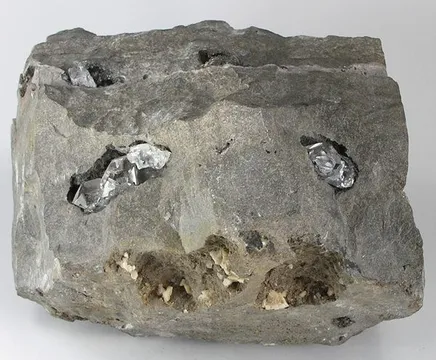
Middleville is one of the names at the heart of the Herkimer diamond story: a small Mohawk Valley village whose ledges of Little Falls Dolostone have yielded some of North America’s most recognizable quartz specimens. The deposit is not a diamond pipe, a pegmatite, or an alpine cleft. It is a carbonate-hosted cavity deposit, where quartz crystals grew in vugs and pockets within Cambrian dolostone and dolomitic sandstone, commonly in intimate association with dolomite, calcite, clay, and black hydrocarbon material traditionally called anthraxolite, bitumen, or pyrobitumen.
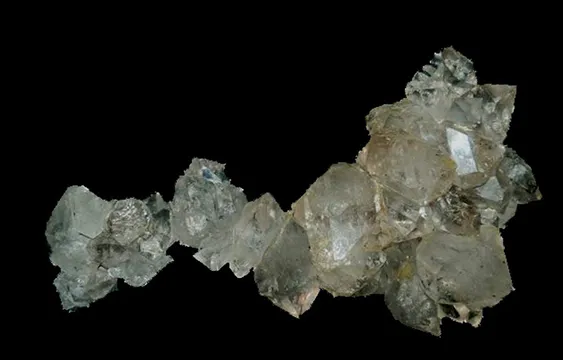
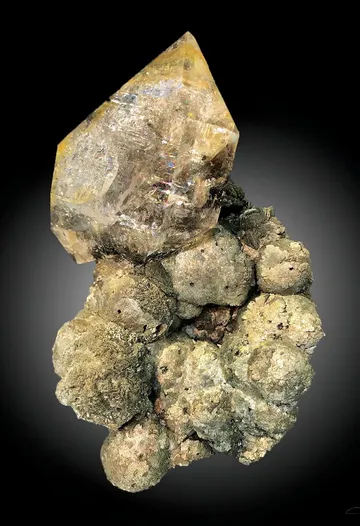
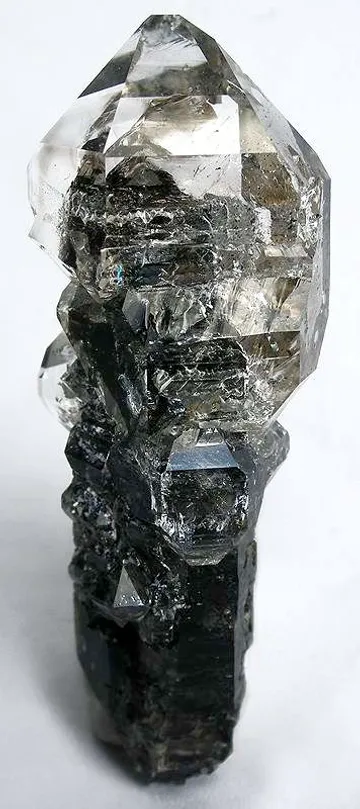
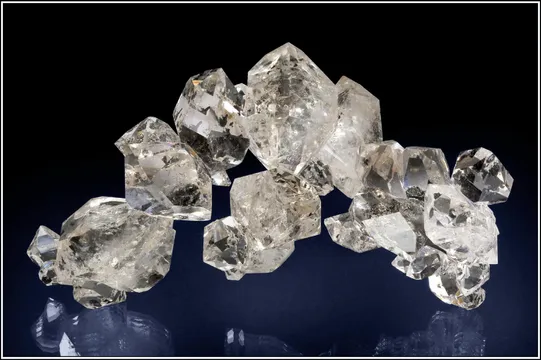
Collectors value Middleville for a very particular look: bright, glassy, usually colorless to faint smoky quartz in short, stout, doubly terminated crystals, often complete all around and apparently “cut” by nature. The best pieces have sharp rhombohedral terminations, brilliant luster, high transparency, and just enough internal character—black carbon flecks, tiny veils, liquid inclusions, phantoms, or clay wisps—to make them unmistakably from the Herkimer district. Matrix pieces are especially desirable because the host dolostone is hard and extraction is unforgiving; most crystals break free before a pocket can be preserved as a display specimen.
Regional View
Country View
Historically, Middleville stands beside Little Falls as one of the classic early localities behind the old names “Middleville diamond” and “Little Falls diamond.” The more familiar trade name “Herkimer diamond” came to dominate, but the Middleville mines remain among the most important collecting grounds. Ace of Diamonds, the Herkimer Diamond Mine, the Middleville quarry, and newer private or restricted Middleville-area workings have all contributed to the district’s specimen record.
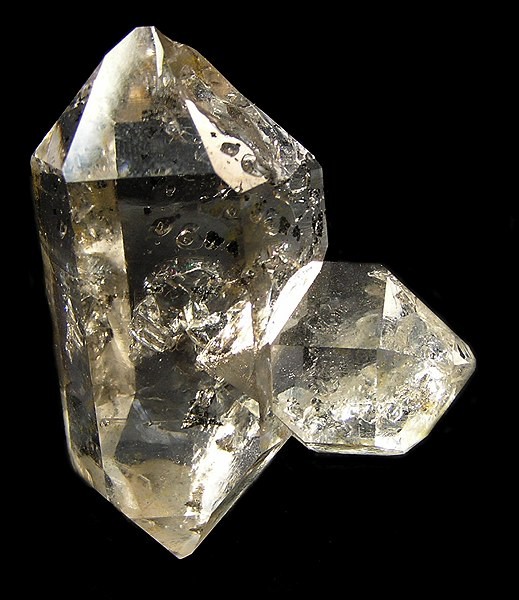
Photo: Wikimedia Commons
The geological signature is as compelling as the aesthetics. Productive cavities may be lined with secondary dolomite or drusy quartz, floored with mud, smeared with black hydrocarbon films, or partly packed with loose crystals. Some pockets yield only a few battered points; others have produced hundreds, and classic field-trip literature records muddy pockets up to a meter across and reports of as many as 1,000 crystals from a single pocket. This is why Middleville retains its aura: the deposit is familiar enough for beginners to visit, but the finest specimens still come from real pocket work, patience, and a collector’s eye.
Search for specimens: View all specimens from Middleville, USA
Middleville lies in Herkimer County, New York, in the Mohawk Valley collecting district, with the main specimen localities west of West Canada Creek in the town of Newport. The productive rock is the Little Falls Dolostone, a Cambrian carbonate unit dominated by dolostone but locally including sandstone and mixed dolostone-sandstone beds. Regional studies describe the unit as vuggy, variably colored, and locally stromatolitic, with quartz, dolomite, calcite, anthraxolite or related hydrocarbons, and minor sulfides and iron oxides occupying cavities, coatings, inclusions, and later fracture or pore spaces.
The “ore bodies” here are not ore bodies in the metal-mining sense. Middleville’s economic product is mineral specimens, and the pay zones are vuggy ledges and pocket-bearing horizons in the dolostone. Productive cavities range from tiny holes to multi-foot pockets. Smaller vugs commonly yield millimeter to one-inch crystals, drusy linings, and loose chips; larger pockets may contain mud, dolomite crystals, hydrocarbon films, and free-growing doubly terminated quartz. The best crystal pockets are often associated with open space, clayey residue, and carbonaceous staining, but not every blackened vug is productive, and not every pocket preserves undamaged crystals.
The accepted broad paragenesis for the district is complex and still discussed. The carbonate host records shallow-marine deposition and later dolomitization. Subsequent fluids dissolved portions of the rock and created cavities; secondary dolomite, hydrocarbons, calcite, and quartz entered or formed during later stages. Classic fluid-inclusion work records low formation temperatures for the quartz, with saline inclusions and CO2 or vapor bubbles, while later discussions have emphasized organic complexes, hydrocarbons, and the role of stromatolitic or algal material in the cavity system. For collectors, the important field expression is simple: hard gray dolostone, vugs, pocket clay, dolomite-lined cavities, black carbonaceous material, and quartz crystals that could grow freely enough to finish at both ends.
Middleville’s collecting history runs from early loose finds in fields and stream sediments to nineteenth-century quarry and road-cut discoveries and, eventually, commercial fee mining. Early New York mineralogical literature recognized the abundance and beauty of clear quartz from the Herkimer County area, and the Middleville name became attached to the crystals before the broader “Herkimer diamond” nickname became standard. By the twentieth century, Middleville’s public mines had become a rite of passage for American rockhounds.
The two best-known Middleville-area commercial names are the Herkimer Diamond Mine and Ace of Diamonds. The Herkimer Diamond Mine, associated with the Herkimer Diamond Development operation and today with the Herkimer Diamond Mines resort complex, remains an active public collecting locality with above-ground surface mines, seasonal admission, and keep-what-you-find rules. Its 2026 public season is listed as April 12 through October 31, 9 AM to 5 PM, seven days a week, weather permitting. Ace of Diamonds is equally important historically and mineralogically, but its current public mine, campground, and physical gift shop are listed by its operators as closed until further notice. Collectors should verify access directly before planning a trip; productive ground around Middleville is private property, and permission or paid access is essential.
Production has never been a continuous industrial tonnage story. Middleville specimens are produced pocket by pocket: by breaking ledge, splitting boulders, tracing fractures, prying blocks, screening rubble, and carefully extracting crystals before hammers and wedges destroy them. Public visitors may find small crystals by searching loose material after rain, but serious specimens usually require sustained work into hard dolostone. The notable finds are the pockets—muddy, carbon-stained openings that may contain a few fine floaters, hundreds of small bright crystals, smoky druse on matrix, crystal clusters, enhydro examples, or hydrocarbon-included pieces. Large, intact matrix plates and complete floaters over several centimeters are far less common than loose small crystals and are the real prize from Middleville.
Quartz from Middleville is the classic Herkimer habit: short, equant to stout prismatic SiO2 crystals with rhombohedral terminations at both ends, usually colorless and water-clear but locally smoky, veiled, clay-included, or speckled with black hydrocarbon material. Published district descriptions record larger pocket crystals up to about 4 inches, smaller vug crystals up to about 1 inch, and drusy linings in cavities; market specimens range from tiny loose points to thumbnails, miniatures, clusters, and rare matrix pieces. Associations at Middleville include dolostone, dolomite, calcite, pyrobitumen or related hydrocarbons, and locally sphalerite or sulfide inclusions. Fine pieces are separated from ordinary ones by complete terminations, glassy undamaged faces, strong transparency, aesthetic intergrowth, and natural placement on matrix; black flecks or fluid inclusions can add desirability when they are sharp and well positioned rather than muddy or obscuring.
The “Diamond” associated with Middleville is the historic and commercial Herkimer diamond name, not native carbon diamond. Middleville diamonds are naturally faceted, doubly terminated quartz crystals from dolostone vugs, prized because their brightness, symmetry, and water-clear transparency can resemble cut stones at first glance. The finest Middleville examples are complete floaters with sharp points, bright rhombohedral faces, minimal bruising, and lively internal features such as tiny black pyrobitumen specks, negative crystals, rainbows, or fluid inclusions; less selective pieces are cloudy, chipped, flattened by contact, or merely broken fragments from rubble. Labels should make the identity explicit—Quartz var. Herkimer diamond, Middleville, Herkimer County, New York—so the locality nickname is preserved without implying the mineral species diamond.
Other documented Middleville minerals are few but important to the identity of the deposit. Calcite occurs in the pocket system, typically yellow to brown in broader Little Falls Dolostone descriptions. Dolomite is the essential companion, commonly cream, gray, or light pink, forming curved-faced crystals and vug linings. Pyrobitumen, petroleum-like material, and older “anthraxolite” terminology record the black hydrocarbon phase that coats cavities and occurs as inclusions in the quartz. “Glauconite,” ozocerite, enhydro quartz, and a questioned sphalerite record appear in locality databases or collector documentation, but they are best treated cautiously unless attached to a reliable label, analysis, or published record. Middleville is not celebrated for type-locality mineral species; its rarities are specimen-form rarities—enhydros, hydrocarbon-included floaters, smoky druse plates, clusters, matrix vugs, and unusually clean complete crystals.
The first collecting issue is nomenclature. “Herkimer diamond” is a locality and trade name for quartz, not a mineralogical identification as diamond. Good labels should say quartz, ideally with “var. Herkimer diamond” or “Herkimer-style quartz,” followed by the precise locality. A specimen labeled simply “Diamond, Middleville” is misleading unless the seller makes the quartz identity unmistakable.
The second issue is locality substitution. Doubly terminated quartz occurs in many parts of the world, and some Afghan, Pakistani, Chinese, Ukrainian, Norwegian, and American quartz can resemble Herkimer material to a casual buyer. True Herkimer diamonds should come from the Herkimer County/Mohawk Valley district; “Herkimer-style” is the appropriate wording for similar quartz from elsewhere. Provenance matters most for better pieces: a mine name such as Herkimer Diamond Mine, Ace of Diamonds, Middleville quarry, or a documented old collection label adds confidence.
Condition is often the value decider. Middleville dolostone is extremely tough, and crystals are commonly chipped during extraction. Examine both terminations under magnification for bruises, frosted percussion marks, tiny conchoidal chips, and repaired breaks. Matrix specimens deserve extra scrutiny: fine natural matrix Herkimers are scarce, so look for unnatural glue lines, suspiciously clean contact points, or crystals reset into cavities after extraction.
Treatments are less central than misrepresentation, but cleaning can change appearance. Many Herkimers are washed, mechanically cleaned, or acid-cleaned to remove clay, carbonate, or iron staining. That is normal when disclosed and when it has not etched the luster or created artificial-looking surfaces. Polished or tumbled quartz sold as a natural Herkimer crystal is a serious problem; the classic value rests on natural faces and natural terminations.
Hydrocarbon inclusions should not be mistaken for dirt or damage. Black specks, veils, films, and phantoms are part of Middleville’s character, and a well-placed inclusion in a water-clear crystal can be highly desirable. Heavy carbon that turns the specimen muddy or opaque is a matter of taste, but crystal form and luster still rule. Enhydros should be handled carefully and protected from thermal shock; sudden heating, freezing, or ultrasonic cleaning can endanger fluid inclusions or existing fractures.
Market availability is tiered. Small loose Middleville Herkimers are common and affordable. Clean thumbnails and modest miniatures are readily obtainable. Fine matrix pieces, large complete floaters, clusters with all points intact, sharp smoky druse plates, documented enhydros, and specimens from named pockets or older collections are much scarcer. The best Middleville pieces are no longer mere tourist souvenirs; they compete in the serious quartz market on completeness, brightness, size, provenance, and visual drama.
The sound of Middleville collecting is steel on dolostone. The public pits along Route 28 have long been animated by the same rhythm: crack hammers, chisels, pry bars, children scanning rubble for sparkle, and seasoned diggers watching fractures instead of blindly smashing rock. The romantic version says Herkimers simply pop out of gray stone, and sometimes a first-time visitor really does find a bright point in the dirt after rain. The serious version is slower. Productive pockets are hidden in hard rock, and the collector who wants intact crystals must open the rock along natural weaknesses before the vug collapses into fragments.
One of the most vivid published field accounts from Middleville describes the neighboring Herkimer Diamond Mines and Ace of Diamonds as rival attractions separated by only a small thickness of dolostone. The scene is part geology lesson, part open-air theater. At the family-oriented mine, casual visitors rent a hammer, put on goggles, and test their patience against an expanse of gray rock. At Ace of Diamonds, the culture has historically leaned harder toward the “claim” mentality: people bring sledges and pry bars, work a wall for days, and hope for a vug several feet wide. The shout that keeps everyone going is simple: “I found one!”
Ace of Diamonds also accumulated characters in the way only a famous collecting locality can. Roadside America recorded owner Ted Smith’s dry amusement at the metaphysical side of the trade; after years of watching crystal seekers pass through, he said, “you’ll meet every type who ever stepped off a starship.” The same account noticed W.G. Hagglund from Canada working under a shade tarp, deep into a multi-week effort. He had spent 16 straight days pounding rock and had moved several tons of dolostone, calling it a vacation from his regular job as a school bus driver. Before that, he had built replicas of the Starship Enterprise bridge for corporate events—a detail so odd and perfect that it belongs in the folklore of American fee mining.
The pocket itself is the recurring drama. Field-trip literature records muddy vugs up to a meter in diameter and cites reports of as many as 1,000 crystals from a single pocket. That number explains the obsession. A dull opening in dolostone may be empty, lined only with druse, smeared with black hydrocarbon, or packed with clay. But if the cavity formed cleanly and stayed open long enough, the mud can hold loose, doubly terminated quartz crystals that never had to attach to a wall. The best moments in Middleville collecting are tactile: prying out a block, seeing a dark cavity, easing clay aside with fingers instead of steel, and finding a complete glassy point where a hammer blow would have ruined it.
Middleville’s modern history also includes loss and rebuilding. In October 2017, a fire destroyed the historic barn at the Herkimer Diamond Mines that housed the registration center, gem store, activity center, and museum. Campers across the road woke to sirens and orange light; one described first thinking it was a “good morning sunrise.” No one was hurt, but the loss was personal as well as commercial. The Middleville fire chief recalled a cross-shaped cluster said to have been found on September 11, 2001, around the time the second tower fell. The mine reopened its collecting operation, and in 2018 began building Miners’ Village, turning a local disaster into a new chapter for the same ledges that made the place famous.