






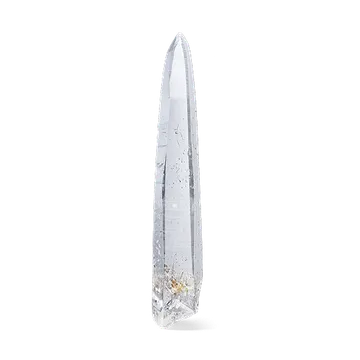
Herkimer Quartz, Herkimer County, New York - iconic doubly terminated crystals, glassy and water-clear, prized for locality variety and collector appeal.
Key facts
Quartz from Herkimer County, New York, is one of the classic mineral collectibles of North America: bright, glassy, doubly terminated rock-crystal quartz known in the trade as “Herkimer diamonds.” The name is a compliment to their brilliance, not a mineralogical identity. They are quartz, SiO2, but the best crystals have the snap, luster, transparency, and naturally sharp geometry that made early collectors compare them with faceted gemstones.
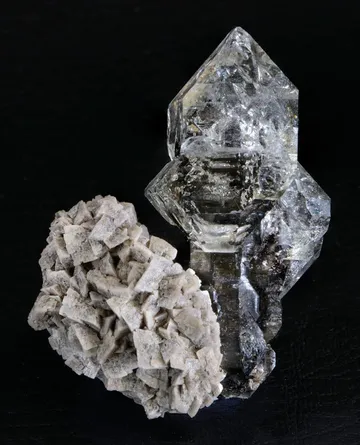
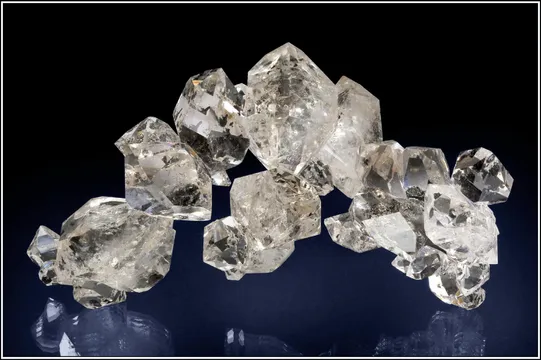
Their most recognizable habit is a short, stout, doubly terminated crystal, commonly with prism faces about as prominent as the pyramidal terminations. Fine specimens look as if they have already been cut and polished, yet their faces are natural. The best Herkimers are water-clear, highly lustrous, sharply edged, and complete all around, often freed from the host rock with no obvious attachment point. That “floater” quality is central to their appeal: these crystals grew in open cavities, vugs, and muddy pockets in dolostone, where they could develop terminations at both ends rather than growing as ordinary quartz points from a wall.
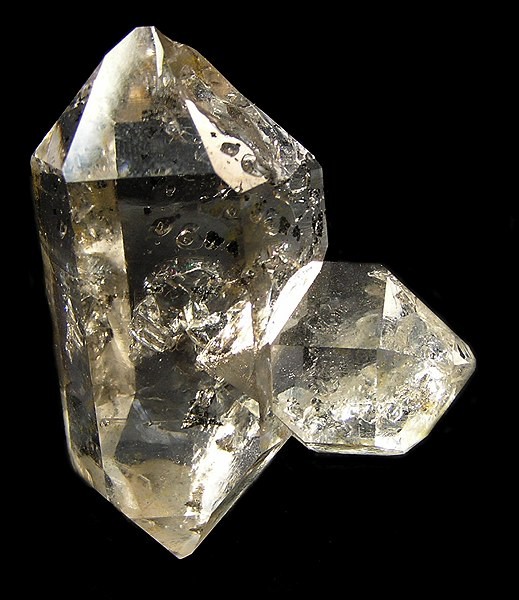
Photo: Wikimedia Commons
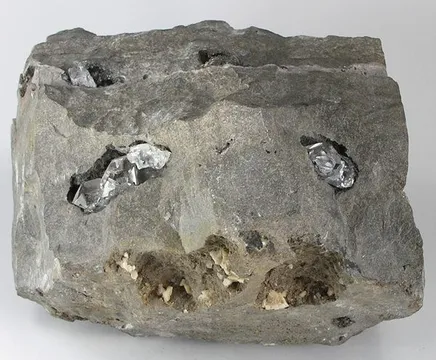
The host is the Little Falls Dolostone, a hard Cambrian carbonate unit exposed around Herkimer County and the Mohawk Valley. The same rock that frustrates diggers with its toughness also preserves the pockets that make the locality famous. Vugs may be lined with dolomite, drusy quartz, calcite, and black hydrocarbon material traditionally called anthraxolite, bitumen, or pyrobitumen. The association with hydrocarbons is not incidental scenery; it is one of the defining signatures of the district. Dark films, black specks, phantoms, coatings, and pocket fillings give many Herkimer specimens their unmistakable look and have long shaped discussions about how the crystals formed.
Collectors prize the locality for a rare combination: beauty, accessibility, history, and variety. Herkimer crystals have been known for more than two centuries, were described in early New York mineralogical literature, and remain available because active fee-dig and commercial operations continue to expose productive dolostone. Yet the finest specimens still require real mining judgment. A casual visitor may find bright chips and small crystals in rubble; a serious collector learns beds, joints, pocket sounds, clay seams, hydrocarbon stains, and the unpleasant truth that a promising vug is often empty.

Photo: Wikimedia Commons
Search for specimens: View all quartz specimens from Herkimer County, USA
The collecting district lies in central New York’s Mohawk Valley, especially around Middleville, Little Falls, Newport, and nearby Herkimer County localities where the Little Falls Dolostone is exposed. The productive rock is a vuggy dolostone and dolomitic sandstone sequence, locally with stromatolitic layers, quartz grains, chert, dolomite, calcite, sulfides, and black hydrocarbon material. The crystals occur in cavities rather than in igneous pegmatites or alpine fissures, so the deposit is best thought of as low-temperature, carbonate-hosted quartz mineralization in a sedimentary rock.
The host rock is old; the crystals are not necessarily the same age as the host. The Little Falls Dolostone records a Cambrian shallow-marine carbonate setting, but the quartz, secondary dolomite, calcite, and hydrocarbon events are interpreted as later cavity and fracture mineralization. Published field-trip and fluid-inclusion discussions have treated Herkimer quartz as a low-temperature product formed during later fluid movement through porous and fractured dolostone, with estimates around 51 °C in classic accounts and later discussion emphasizing the role of hydrocarbons and organic complexes in stabilizing clear quartz growth. For the collector, the practical outcome is visible in the rock: cavities, joints, bituminous films, pocket clay, and dolomite-lined vugs are the ground truth.
The commercial collecting history is unusually strong. Herkimer-style quartz was known to Indigenous people and early settlers long before the modern tourist mines. Early accounts used names such as “Little Falls diamonds” and “Middleville diamonds,” reflecting the first noted localities before “Herkimer diamond” became the standard trade name. By the nineteenth century the crystals had entered mineralogical literature, and by the twentieth century the Middleville-area fee mines had become a rite of passage for American collectors.
Modern access is mainly through private fee-dig and commercial operations. The Herkimer Diamond Mines at Middleville operates above-ground collecting areas and public mining during its season; Diamond Mountain Mining at Little Falls offers reservation-based collecting on a large Herkimer-bearing property. Ace of Diamonds Mine at Middleville is a historically important commercial Herkimer locality and remains one of the key names attached to the district, but collectors should verify its current access before traveling. New York land ownership and collecting rules matter: productive ground is private or controlled, and responsible collecting requires permission or paid access.
Production has never been a simple industrial story of ore tonnage. Herkimer quartz is produced by opening pockets, breaking ledge, screening rubble, and carefully extracting crystals from cavities. Some pockets yield only druse and broken quartz; others contain loose, mud-packed, doubly terminated crystals. Field-trip accounts record muddy vugs up to about a meter across and note that as many as 1,000 crystals have been found in a single pocket. Geology.com’s field account describes cavities ranging from smaller than a pea to several feet across, with finds varying from millimeter crystals to specimens over twenty centimeters.
Notable locality names within Herkimer County include the Herkimer Diamond Mine and Ace of Diamonds Mine at Middleville, the Middleville quarry area, Treasure Mountain Diamond Mine near Little Falls, Diamond Mountain Mining at Little Falls, and other named or private Herkimer County occurrences recorded in mineral databases and collector literature. Serious specimens are still being recovered, but most require time, skill, and heavy manual work in very tough dolostone.
The classic Herkimer crystal is short, equant, colorless, transparent, doubly terminated, and highly lustrous. The best examples have crisp rhombohedral terminations, bright prism faces, sharp edges, and no obvious point of attachment. Many are “floaters,” meaning they are crystallized all around. This is the habit that made the locality famous.
The normal size range is broad. Tiny crystals and “micros” occur abundantly in rubble, pocket clay, and small vugs. Attractive thumbnail to miniature crystals are common enough to keep the locality active for public collecting. Fine single crystals in the 2–5 cm range are much more selective, especially if complete, lustrous, and water-clear. The New York State Geological Association field guide records quartz in the Little Falls Dolostone as large crystals up to 4 inches in pockets, smaller crystals up to 1 inch in vugs, and linings of pockets and vugs. Larger cabinet specimens, clusters, skeletal forms, and exceptional matrix pieces are scarcer and are the material that serious collectors compete for.
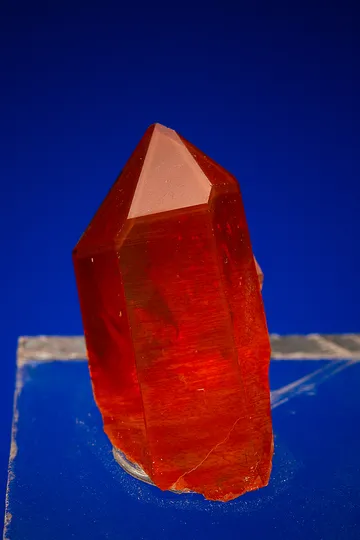
Color is usually colorless to very pale smoky. Some crystals show true smoky tones, gray-brown body color, or black appearances caused by internal or external hydrocarbon material. Black specks, smears, veils, included carbonaceous fragments, and phantoms are highly characteristic. A fine hydrocarbon inclusion can add locality flavor without hurting value, especially if it is aesthetically placed and the quartz remains bright. Heavy black inclusions can either make a specimen dramatic or reduce transparency, depending on composition and overall visual balance.
Associated minerals are part of the Herkimer identity. Dolomite is the most common companion and may appear as cream, gray, pinkish, or saddle-shaped crystals in cavities. Calcite occurs as yellow to brown crystals and as later cavity filling. Pyrite, marcasite, sphalerite, galena, chalcopyrite, hematite, limonite, and clay minerals are reported from the Little Falls Dolostone system, but most collector pieces are judged around quartz with dolomite, calcite, druse, and hydrocarbon. Mindat photo records for Herkimer County quartz especially emphasize associations with pyrobitumen, dolomite, calcite, marcasite, petroleum, and dolostone.
Several non-classic habits matter to advanced collectors. Scepters, skeletal crystals, hopper-like forms, “barbells,” “black diamonds,” phantomed crystals, drusy plates, complex clusters, and elongated prismatic forms all occur in the broader Herkimer district. Some are rare enough that mine names and pocket provenance become important. Diamond Mountain, for example, is noted by its operators for black stem scepters, barbells, skeletal crystals, hydrocarbon-included “black diamond” quartz, and complex Herkimer forms. HerkimerHistory’s collector documentation also records earlier long-prismatic quartz phases, phantoms, parallel overgrowths, and scepters from several district localities, showing that “Herkimer diamond” is best understood as a locality-centered habit and trade term rather than a single rigid crystal form.
Quality is judged by completeness first. A truly fine Herkimer should be complete at both ends, without a bruised termination, sawed base, or obvious missing attachment. Luster comes next: the faces should be bright and glassy, not etched dull or abraded. Transparency matters greatly, but “flawless” is not the only aesthetic; lively internal veils, rainbows, negative crystals, black carbon specks, and phantoms can make a specimen more interesting if they do not destroy the form. For matrix specimens, the best pieces show one or more sharp quartz crystals naturally placed in vuggy dolostone, ideally with attractive dolomite or druse rather than a clumsy gray block.
The first authenticity issue is nomenclature. A Herkimer diamond is not diamond; it is quartz. Sellers should identify it as quartz or rock crystal quartz from Herkimer County, New York. The word “diamond” is a historic and commercial nickname, but it can mislead non-specialists. Serious labels should read something like “Quartz var. Herkimer diamond, Middleville, Herkimer County, New York, USA,” not simply “diamond.”
The second issue is locality substitution. Doubly terminated quartz crystals occur in many places, including Afghanistan, Pakistan, China, Norway, Ukraine, Arizona, and other regions. Some of those crystals are beautiful, and some look superficially similar, but they are not Herkimer County quartz. Petroleum-bearing double-terminated quartz from Afghanistan and Pakistan is especially likely to be confused with or marketed as “Herkimer.” In the collector market, “Herkimer-style” is acceptable for similar habit from elsewhere; “Herkimer diamond” should be reserved for material from the Herkimer County/Mohawk Valley source area.
Treatments are not the central problem with Herkimers; misrepresentation is. Most collector crystals are sold natural, perhaps mechanically cleaned, washed, or acid-cleaned to remove carbonate, iron staining, or clay. The more common concerns are broken and repaired crystals, glued-in-matrix specimens, misleading “in matrix” pieces, tumbled or polished quartz sold as natural, and ordinary double-terminated quartz from other localities sold under the Herkimer name. On fine specimens, provenance from a known mine, an old collection label, or a reputable dealer matters.
Condition is often the deciding factor. The dolostone is tough, and extraction is violent: hammers, wedges, pry bars, and ledge work all threaten terminations. Many crystals have tiny chips at points, bruised faces, internal percussion fractures, or edge nicks. Pocket clay may protect crystals, but crystals freed by smashing vuggy blocks can be damaged before they are even seen. Check both terminations under magnification. Look for fresh conchoidal chips, frosted bruises, repaired breaks, and unnatural glue lines, especially where a crystal meets matrix.
Hydrocarbon inclusions should be evaluated thoughtfully. Black specks and films are normal for the locality; they are not automatically damage. A sharp, water-clear crystal with a discrete black inclusion can be more desirable than an empty-looking crystal of lesser form. However, heavy carbon that obscures the crystal, smeared pocket coatings, or black crusts on damaged surfaces can reduce appeal. “Smoky” color should not be confused with black carbon coatings; the two effects can look different and have different value implications.
Rarity is tiered. Small loose crystals are widely available. Clean thumbnails and modest miniatures remain accessible. Complete, water-clear, lustrous crystals over several centimeters, fine matrix pieces, large floaters, bright clusters, scepters, skeletal crystals, black hydrocarbon-rich forms, and documented pocket pieces are much more selective. Exceptional Herkimer County quartz is still obtainable, but the best examples are no longer casual tourist souvenirs; they are serious mineral specimens with prices driven by size, perfection, form, provenance, and visual drama.
The sound of Herkimer collecting is not quiet. At Middleville the day begins with steel on dolostone: ringing hammers, wedges driven into cracks, the scrape of pry bars, the sudden pause when a block shifts, and the small crowd behavior familiar to every pay dig. One shout of “I found one!” is enough to keep ten other people hammering at gray rock that looked hopeless five minutes earlier.
The romantic version says the crystals simply glitter out of the rubble, and sometimes they do. Children and first-time visitors really do find loose crystals by scanning broken stone for a flash in the sun. But the serious method is slower and more deliberate. Geology.com’s field account follows Bill McIlquham of Peterborough, Ontario, mining at Ace of Diamonds with his wife Anne, their friend Laurie Mullett, and Duffy the Rockhound. The important detail is not merely that they had tools; it is that they used them like miners rather than tourists. Instead of smashing dolostone to gravel, Bill worked fractures with wedges, opening the rock along weaknesses already present. That patience is how large cavities survive extraction.
The reward, when it comes, is theatrical. A cavity may be mud-packed, hydrocarbon-stained, lined with druse, or disappointingly empty. But the right pocket opens into what collectors call paydirt: loose, brilliant quartz crystals sitting where the rock hid them for geological time. Published accounts describe cavities carrying anything from a few crystals to a few thousand, with crystals from millimeters to more than twenty centimeters. The New York State Geological Association field-trip guide records muddy pockets up to a meter across and cites reports of as many as 1,000 crystals in a single pocket. For a digger, that number is not an abstraction; it is the difference between an afternoon of bruised knuckles and a story retold for the rest of one’s collecting life.
Roadside America captured the other side of the Middleville scene: not the museum-label view, but the open-pit theater of summer collecting. The two old rival attractions, Herkimer Diamond Mines and Ace of Diamonds, sat close along Route 28, separated by only a small thickness of dolostone but by different personalities. The article describes a giant silvery Herkimer-shaped sign hanging from a crane at Ace, tourists renting hammers, and “power prospectors” working claims like gamblers convinced the next blow will open the pocket. At Ace they met W.G. Hagglund from Canada, shaded by a tarp, surrounded by tools, and already on day sixteen of pounding rock. He had quarried several tons of dolostone and called it a vacation from driving a school bus. It is a perfect Herkimer detail: the mine offers instant gratification to some visitors, but the people who really learn the rock often become wonderfully obsessive.
There is an older field trick that belongs in any Herkimer lore: probing joints with a metal rod. HerkimerHistory records that in the 1960s some collectors followed joint systems and listened for a certain sound when a probe struck a crystal in a pocket. That small acoustic clue says a great deal about the deposit. These are not vein pockets in soft earth; they are hidden cavities in a blocky, fractured dolostone where joints guide fluids, pockets, tools, and human hope.
The black carbon material adds another layer to the story. Old miners speak of “chasing the carbon,” because hydrocarbon-rich zones often accompany productive pockets. The phrase is practical, not poetic. A vug with black hydrocarbon films, clay, and dolomite may be a better target than clean-looking barren rock. HerkimerHistory describes pockets packed with hydrocarbon and clear crystals as “Jewery Boxes,” preserving the local spelling and the local excitement. The best version of a Herkimer pocket is exactly that: gray dolostone outside, black carbon and mud inside, and bright double-terminated quartz waiting like cut glass in a safe.

_(Herkimer_District,_New_York_State,_USA)_1.jpg)