






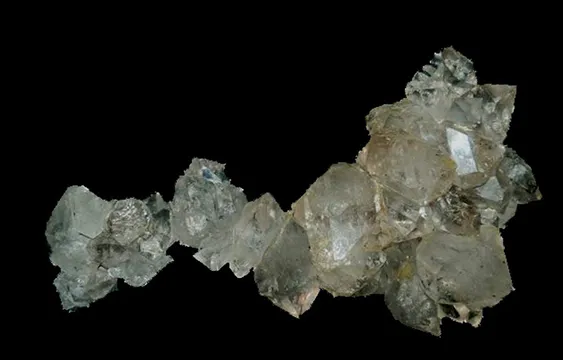
Herkimer County, USA - famed for Herkimer diamonds, doubly terminated quartz from Little Falls Dolostone; prized for exceptional clarity, vug pockets, and Amer…
Key facts
Herkimer County, in central New York’s Mohawk Valley, is one of the few mineral localities whose name has escaped specialist circles and entered ordinary language. Its “Herkimer diamonds” are not diamond at all, but exceptionally bright, doubly terminated quartz crystals from vugs in the Little Falls Dolostone and closely associated dolostone outcrops around Middleville, Little Falls, Newport, and neighboring Mohawk Valley localities. The deposit is a carbonate-hosted, low-temperature quartz occurrence: crystals grew in solution cavities, mud-filled pockets, and drusy-lined vugs rather than in pegmatites or alpine clefts, which is why the best pieces can look like loose, naturally cut gemstones rather than wall-grown quartz points.
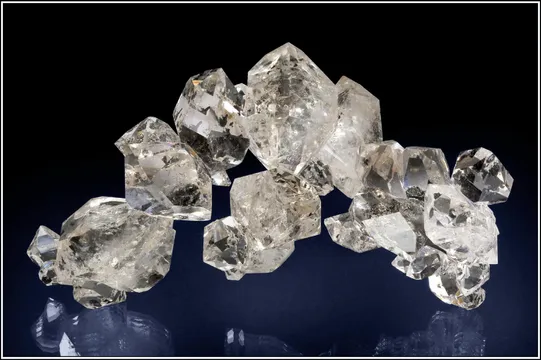
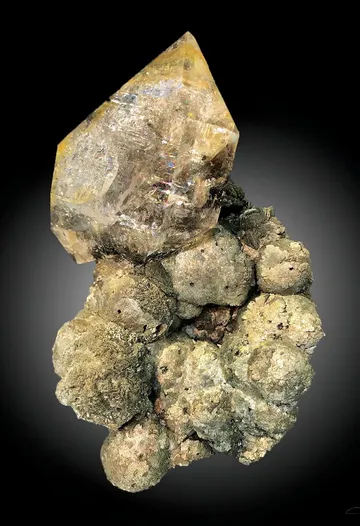
The classic assemblage is deceptively simple but remarkably distinctive: quartz with dolomite, calcite, black anthraxolite or pyrobitumen, local pyrite and marcasite, and occasional petroleum or fluid inclusions. Fine crystals are short, stout, glassy, and brilliant, commonly with six prism faces and two sharp rhombohedral terminations; the best are water-clear, complete all around, and sharply edged, with just enough internal veils, black hydrocarbon specks, moving bubbles, or phantoms to tell the story without destroying the transparency. Matrix specimens are especially prized because the Little Falls Dolostone is hard and unforgiving, and many crystals separate from the pocket walls during extraction.
Collectors value Herkimer County not simply because the crystals are beautiful, but because they are an American classic with nearly two centuries of literature behind them. Early New York mineralogists described the clear quartz from Middleville, Little Falls, Salisbury, Newport, and the West Canada Creek area long before modern fee mining made the locality famous. Later field guides, museum collections, and collector articles refined the story: the crystals occur in vuggy beds of the Cambrian Little Falls Formation, many pockets contain carbonaceous residue, and some pockets have yielded extraordinary numbers of crystals. The locality’s identity is now so strong that “Herkimer diamond” has become a locality term as much as a habit term.
Regional View
Country View
The geological setting is part of the appeal. The Little Falls Formation records shallow-marine carbonate deposition along the southern margin of the Adirondack region, followed by dolomitization, cavity formation, hydrocarbon migration, and later silica-bearing fluids. In the most specimen-rich beds, the rock may show drusy quartz linings, black hydrocarbon films, dolomite or calcite, and scattered larger crystals that apparently grew with little attachment to the host. That open-space growth accounts for the famous doubly terminated habit.

Photo: Wikimedia Commons

Photo: Wikimedia Commons
Search for specimens: View all specimens from Herkimer County, USA
The productive Herkimer County occurrences lie in the Mohawk Valley district of central New York, with the best-known collecting localities clustered around Middleville in the Town of Newport and around Little Falls. The host is the Cambrian Little Falls Formation, historically called the Little Falls Dolostone, a thick sequence of sandy, vuggy dolostone and dolomitic sandstone. At Little Falls, the formation has been described as roughly 400 feet thick in its type area, with gray, medium- to thick-bedded dolostone, sandstone and mixed dolostone-sandstone beds, chert, glauconite, silicified ooids, and vuggy intervals. The Middleville area exposes the same broad kind of rock: hard tan to buff weathering dolostone, sandy beds, chert stringers, stromatolitic layers, and solution cavities.
The “ore bodies,” in specimen-mining terms, are not veins of quartz ore but pocket-bearing horizons. Local collectors distinguish major pocket zones, vug zones, and druse zones. A productive pocket zone may be bounded by hard cap rock and table rock, with cavities ranging from small openings to pockets several feet across. Smaller vug zones are packed with holes only inches wide, not all of them mineralized, but many containing drusy quartz, black carbonaceous material, mud, dolomite, and occasional Herkimer crystals. Druse zones tend to carry small pyramidal quartz coatings and veinlets, with the occasional larger crystal or cluster perched on the druse. The best pockets are the ones that preserve open space, clean mud, and crystal growth with minimal attachment: those conditions produce sharp floaters, clusters with undamaged contacts, and rare matrix pieces.
The mineralization is a sequence of cavity and fracture fillings. Dolomite and calcite occur as early and late generations; quartz occurs as drusy linings, prismatic phases, tiny “baby floater” druse, and the larger doubly terminated crystals sought by collectors. The black material traditionally called anthraxolite is a carbonaceous hydrocarbon residue, also described in modern collector and mineralogical literature as pyrobitumen or bitumen-like material depending on occurrence. It can coat pocket walls, fill cavities, sit as specks inside quartz, or form smoky phantoms. Fluid-inclusion work and field-trip literature have long pointed to low-temperature conditions, with a classic homogenization estimate near 51 °C and formation at significant burial depth. Later discussions emphasize that hydrocarbon-bearing fluids and organic compounds may have played an important role in moving silica and controlling quartz growth.
Historically, the crystals were known from stream gravels, plowed fields, road cuts, and natural outcrops before organized tourist mining existed. Early nineteenth-century writers described clear quartz from Middleville and the West Canada Creek/Little Falls district, noting the abundance of crystals, the black carbonaceous inclusions, and cavities containing liquid. By the twentieth century, the locality had become a staple of eastern U.S. rockhounding. Commercial public collecting expanded after mid-century, with fee mines and campsites making the district accessible to families and serious collectors alike.
The principal modern names collectors encounter include the Herkimer Diamond Mines near Middleville, Ace of Diamonds Mine at Middleville, Crystal Grove Diamond Mine and Campground near St. Johnsville in the broader Mohawk Valley collecting belt, Treasure Mountain Diamond Mine near Little Falls, Diamond Mountain Mining at Little Falls, and a number of private or reservation-based operations. The Herkimer Diamond Mines property is tied to the Scialdo family’s ownership since 1979 and today operates as a mining, resort, retail, and educational destination. Its 2026 public mining season is posted as April 12 through October 31, with above-ground surface mines, hand-tool collecting, and visitor instruction. Crystal Grove posts a 2026 season through October 12 and emphasizes mining for matrix and drusy specimens. Diamond Mountain Mining lists collecting by reservation only at its Ritter Road property near Little Falls. Ace of Diamonds has historically been one of the most important Middleville public mines; its own current web pages include both litigation-related notices and mining information, so collectors should confirm access directly before planning a trip.
Collecting access is almost entirely permission-based. New York collecting law and land ownership make “just stopping at an outcrop” a poor practice; serious collectors should use public fee mines, guided digs, or documented private permission. Most public operations restrict equipment to hand tools, commonly banning powered, electric, hydraulic, or oversized tools. Closed-toe footwear, eye protection, gloves, and patience are more important than romance. The rock is hard dolostone, and the productive work is often slow: splitting blocks, listening for hollow pockets, prying along seams, working mud carefully, and screening pocket debris for small floaters.
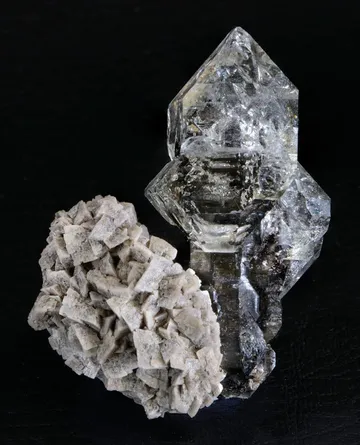
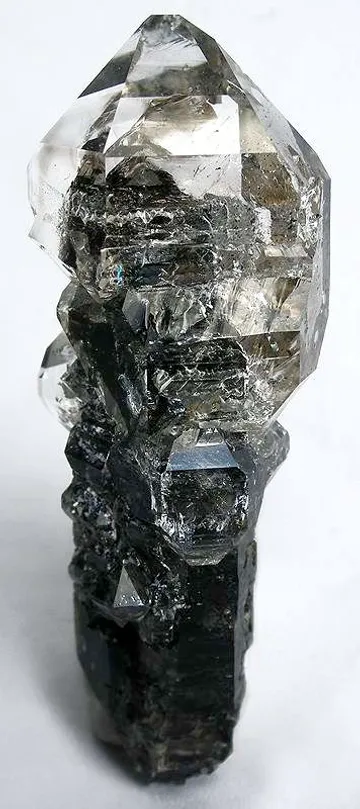
Notable finds range from thumbnail floaters to cabinet-size matrix groups, large single crystals, smoky included crystals, enhydros with moving bubbles, and scepters. Field-trip literature records muddy pockets up to about a meter across and reports that as many as 1000 crystals have been recovered from a single pocket. Collector records from Treasure Mountain are especially important for black-stemmed scepter quartz: earlier, hydrocarbon-rich quartz stems are overgrown by clearer caps, producing sharp visual contrast. The best modern Herkimer County specimens are not necessarily the largest. A perfectly complete 2 cm floater with water clarity, sharp terminations, and no bruised edges may outrank a much larger cloudy crystal; a natural cluster that survives extraction intact can outrank a repaired showier piece; and a matrix Herkimer with the crystal still seated in its original carbon-lined vug is always a locality prize.
Quartz from Herkimer County is the locality’s defining mineral: bright, vitreous SiO2 in short, stout, doubly terminated crystals, typically colorless to faint smoky, with prism faces often as visually important as the terminations. Crystals range from microscopic druse and pea-size floaters to hand-size crystals, with classic field-trip accounts noting water-clear crystals to about 10 cm and older descriptions mentioning occasional crystals several inches long; the larger examples are often more included, internally fractured, or smoky. The best-known associations are dolostone matrix, dolomite, calcite, anthraxolite or pyrobitumen, clay pocket mud, pyrite and marcasite, and liquid or hydrocarbon inclusions. Middleville and Little Falls material supplies the standard “Herkimer diamond” look, while Treasure Mountain is especially noted for scepter quartz with black, hydrocarbon-included stems and clearer caps. Fine pieces here are judged by complete doubly terminated form, glassy luster, transparency, sharp edges, intact contacts or original matrix, and interesting but not overwhelming inclusions; ordinary pieces are bruised, cloudy, heavily contacted, or separated from context without compelling form.
“Diamond” from Herkimer County is a historic and commercial name, not a mineralogical one: the famous Herkimer diamond is quartz, not native carbon diamond. Serious labels should identify these specimens as quartz, variety Herkimer diamond, or Herkimer-style quartz from a precise Herkimer County locality such as Middleville, Ace of Diamonds Mine, Herkimer Diamond Mine, Treasure Mountain Diamond Mine, or Diamond Mountain Mining. The diamond comparison comes from the best crystals’ water-clear transparency, high vitreous luster, sharp natural faces, and doubly terminated “already cut” appearance. Specimens catalogued under “Diamond” from this locality should therefore be understood as locality-named quartz: usually colorless to smoky, thumbnail to miniature in most commercial examples, associated with dolostone, dolomite, calcite, and black hydrocarbon inclusions. The most desirable examples are complete, undamaged Herkimer quartz crystals or clusters with exceptional brilliance and reliable Herkimer County provenance, not actual diamonds.
Beyond quartz, Herkimer County’s documented mineral list includes calcite, dolomite, pyrite, marcasite, galena, sphalerite, chalcopyrite, goethite, baryte, celestine, perovskite, glauconite-group material, and hydrocarbon substances recorded as petroleum, ozocerite, anthraxolite, or pyrobitumen depending on source and usage. Treasure Mountain records calcite, dolomite, goethite, marcasite, pyrite, pyrobitumen, quartz, and scepter quartz; county-level records also place baryte in the Town of Fairfield, celestine at Starkville, galena and chalcopyrite around Salisbury Corners, and perovskite plus melilite-group material in the Town of Manheim. The most collectible “rarities” for Herkimer specialists are not exotic species but paragenetic features: black-stemmed scepter quartz, moving-bubble enhydros, petroleum-bearing inclusions, hydrocarbon phantoms, crystals perched on druse, and matrix pieces with the pocket architecture preserved.
The first rule is nomenclature. A Herkimer diamond is quartz. It is not diamond, not a diamond simulant in the gemological sense, and not a faceted stone unless someone has cut it. The term is legitimate as a historic locality variety name, but a good collector label should still say “Quartz var. Herkimer diamond” and give the locality as tightly as possible. “Middleville, Herkimer County, New York” is useful; “Ace of Diamonds Mine, Middleville, Town of Newport, Herkimer County, New York” is better when true.
The commonest authenticity problem is locality substitution. Doubly terminated, glassy quartz from Pakistan, Afghanistan, China, Tibet, Arizona, Norway, Ukraine, and other localities is often sold using Herkimer language. Some of those crystals are attractive and collectible in their own right, but they are not Herkimer County specimens. “Herkimer-style quartz” is acceptable for similar habit from elsewhere; “Herkimer diamond” should be reserved for Herkimer County and the historically associated Mohawk Valley district when provenance is secure. Be especially cautious with jewelry parcels and low-cost online lots that use only the word “Herkimer” with no mine, county, dealer history, or collection provenance.
Condition is the heart of value. Herkimers are hard, but sharp quartz edges chip readily, and the dolostone host is punishing during extraction. Many single crystals have bruised terminations, crushed side faces, sawed or broken contacts, or internal fractures from hammer shock. Clusters and matrix pieces deserve close inspection under strong light because repairs are common, and some dealer descriptions frankly treat repaired clusters as normal for the style. Repair is not automatically disqualifying if disclosed and well done, but unrepaired complete clusters and crystals naturally attached to matrix command a premium.
Large crystals are not automatically fine crystals. The most ordinary large Herkimers are cloudy, heavily veiled, or included with too much carbonaceous matter; the best large examples combine size with complete geometry, transparency, high luster, and minimal damage. Conversely, a small floater with razor terminations and no bruising is a serious specimen. Collectors should rotate the crystal under a pinpoint light: truly fine Herkimers flash from face to face, reveal crisp edges, and show no dull abrasion on the terminations.
Inclusions can add value when they are aesthetic and diagnostic. Black anthraxolite or pyrobitumen specks, smoky phantoms, negative crystals, fluid inclusions, and moving bubbles can be excellent features. They also invite overstatement. Not every internal veil is an enhydro; not every yellowish inclusion is petroleum; and not every smoky crystal is a clean phantom. Enhydros should show a visible bubble in a liquid-filled cavity that moves when the specimen is gently tilted. Handle these specimens carefully and avoid heat, ultrasonic cleaning, and aggressive chemicals, especially if the specimen contains hydrocarbons, calcite, marcasite, or repaired areas.
Cleaning should be conservative. Fresh pocket mud can be rinsed away, and quartz tolerates careful washing, but associated carbon films, iron sulfides, calcite, dolomite, and pocket coatings may be part of the specimen’s character. Overzealous acid cleaning can remove calcite context, loosen matrix, expose repairs, or strip the specimen of the very associations that prove locality. Marcasite and pyrite inclusions or coatings may weather to rusty stains; in some Herkimer specimens a little iron oxide is simply part of the post-mining life of the piece.
Market availability remains high at the entry level and selective at the top. Loose small crystals, tourist-grade finds, and simple thumbnails are abundant. Good miniatures, clean floaters, and aesthetic clusters are steady but more selective. Fine matrix pieces, large sharp crystals, and Treasure Mountain scepters are legitimately scarce, especially with collection history and no restoration. The best buying strategy is to ignore the word “diamond” and judge the specimen as quartz: form, brilliance, condition, locality precision, aesthetics, and provenance.
Long before fee mines, gift shops, and buckets of pocket mud, these crystals had a local life. Mohawk people and early settlers knew the clear stones from streams, fields, and outcrops. They were bright enough to be kept, traded, and treated as special objects before European glass beads changed the local economy of sparkle. That early human history matters because the Herkimer diamond was never merely a geological curiosity; it was always a found object, a little piece of natural geometry appearing in soil, creek gravel, and broken dolostone.
The nineteenth-century accounts read like the birth certificate of a classic locality. Lewis Caleb Beck’s 1842 mineralogy of New York described uncommon transparent crystals in Herkimer County, especially around Middleville, Fairfield, Little Falls, Salisbury, and Newport. Beck preserved Vanuxem’s memorable praise that there was “probably no locality in the world” producing more perfect or beautiful quartz crystals than Middleville, adding that with equal refractive power they would rival diamond. The comparison stuck. Even then, observers noticed the black substance accompanying the crystals and the liquid-filled cavities that sometimes looked yellow and resinous after freezing damage. What modern collectors call hydrocarbon inclusions, anthraxolite, pyrobitumen, phantoms, and enhydros were already catching attention.
James Dwight Dana’s 1837 description has the unmistakable sound of field collecting. At “Middlefield,” on the banks of the West Canada Creek, he described crystals in calciferous sandstone, loose in large cavities with earth; “several hundred crystals” could be obtained from a single cavity by prying open fissured rock. His size range ran from the head of a pin to four or six inches long. He noted smoky crystals, anthracite-like inclusions, rare fluid cavities, and drusy quartz from the same locality. It is difficult to read that passage without recognizing the same collecting experience still repeated today: find the cavity, work the seam, open the mud, and suddenly the hard gray rock yields glass.
A 1997 New York State Geological Association field trip guide gives the pocket story a modern numerical edge. It describes muddy vugs up to a meter in diameter in the Late Cambrian Little Falls Formation near Middleville, Little Falls, and Herkimer, and repeats the collector-famous report that as many as 1000 crystals have been found in a single pocket. That number explains why the locality inspires both patience and obsession. A day at the mines can be hot, dusty, and unrewarding, but one pocket can rewrite the day, the season, or a collection.
The work is not delicate at the beginning. Field accounts describe the two modes every Herkimer digger learns: searching through loose rock and tailings for flashes, or attacking the ledge with hammers, wedges, chisels, and pry bars. The first method rewards patience; the second rewards knowledge of the rock and a tolerance for bruised knuckles. Experienced collectors listen for hollow-sounding rock, follow seams, look for black carbon, and treat pocket mud as specimen ground rather than waste. The romance begins only after the hard dolostone gives way.
The locality’s modern story also includes loss and reinvention. In October 2017, a devastating fire destroyed the historic barn at the Herkimer Diamond Mines that housed the registration center, gem store, activity center, and museum. The mine continued into a new chapter, launching Miners’ Village in 2018 and rebuilding the visitor experience around education, collecting, retail, and the resort. For many collectors, that episode marks the transition from an old-style roadside mineral attraction to the polished public destination that now introduces thousands of people to field collecting.
Treasure Mountain adds a more specialist chapter. Its scepter quartz is not simply “another Herkimer.” The best pieces preserve a black, hydrocarbon-rich earlier crystal as the stem, overgrown by a clearer later cap. In a good example the inner termination can be seen through the transparent overgrowth, giving the specimen a geological before-and-after quality: carbon-darkened first growth sealed inside water-clear quartz. That is Herkimer collecting at its most mineralogical, where beauty depends on understanding sequence.

_(Middleville,_New_York_State,_USA)_2_(41214935814).jpg)