Ace of Diamonds Mine, New York - classic Herkimer district locality known for water-clear quartz crystals; accessible pockets and gem-quality specimens.
Key facts
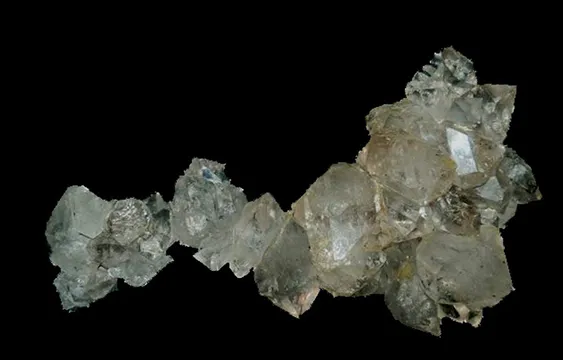
Ace of Diamonds Mine is one of the classic collecting localities of the Herkimer district: a commercial, above-ground “Herkimer diamond” quarry near Middleville in the Town of Newport, Herkimer County, New York. Its fame rests not on the carbon mineral diamond, but on extraordinarily bright, water-clear, doubly terminated quartz crystals weathered and mined from cavities in the Late Cambrian Little Falls Dolostone. In the best Ace pieces, the quartz has the hard, wet luster and sharply rhombohedral terminations that made the district’s crystals a world standard for naturally faceted quartz.
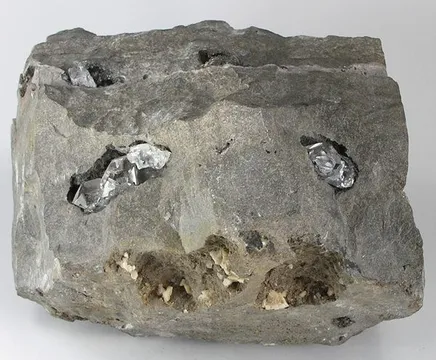
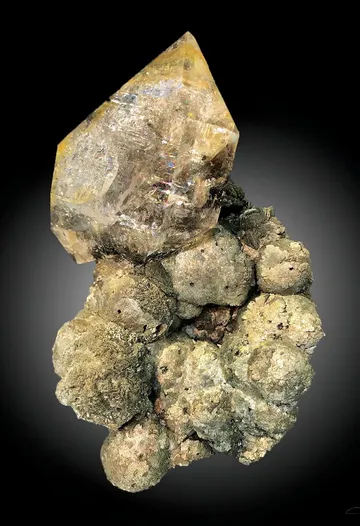
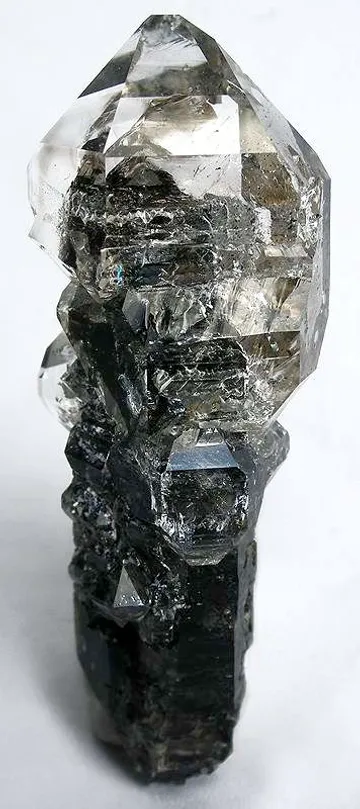
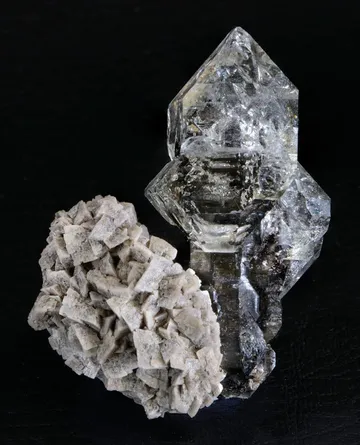
The deposit is a vug-and-pocket occurrence in tough, silicified dolostone. The cavities may be lined with drusy quartz, dolomite, calcite, or black hydrocarbon residue, and they range from tiny openings that yield only a few loose points to large mud-filled pockets capable of producing dozens or hundreds of crystals. The strongest Ace specimens are not merely loose singles; they are bright floaters, skeletal clusters, and rare matrix pieces with gem quartz perched on calcite or dolomite, sometimes carrying black pyrobitumen or anthraxolite inclusions, smoky phantoms, or moving fluid inclusions.
Regional View
Country View
Historically, Ace of Diamonds matters because it was one of the most accessible places where serious collectors could work real Herkimer ground with hammers, wedges, pry bars, and patience rather than simply buy a souvenir. It sat in the same celebrated Middleville belt as the better-known Herkimer Diamond Mines, but developed its own reputation among hard-rock diggers for productive claims, pocket work, smoky or included quartz, and occasional show-quality clusters.

Photo: Wikimedia Commons / Rob Lavinsky

Photo: Wikimedia Commons / Rob Lavinsky
Search for specimens: View all specimens from Ace of Diamonds Mine, USA
Ace of Diamonds Mine is a surface collecting locality in the Herkimer diamond district of the Mohawk Valley, near Middleville, Herkimer County, New York. The working exposes the Little Falls Dolostone, a Late Cambrian dolostone unit noted throughout east-central New York for vuggy beds, algal stromatolite structures, secondary dolomite and calcite, anthraxolite or pyrobitumen, and the doubly terminated quartz crystals traditionally called Herkimer diamonds. At Middleville the Little Falls is a very hard, commonly silicified dolostone; collectors quickly learn that the deposit is less a “dig in dirt” locality than a quarrying locality where the right block, seam, or cavity must be read and opened without shattering the crystals.
There is no ore body in the usual mining sense. The economic product is specimen quartz from cavities. The mineralization is diagenetic and vug-hosted: dolostone beds contain irregular pockets, some mud-filled, some lined with drusy quartz or small rhombs of dolomite, and some stained or coated with black hydrocarbon residue. Within those openings, quartz grew freely enough to develop terminations at both ends. Many crystals are short, stout, hexagonal prisms with rhombohedral faces; some are squat, skeletal, tabular, or distorted by contact growth and pocket collapse. Loose singles are common in productive material, but true matrix specimens are scarcer because crystals detach easily from the pocket walls and because extracting intact matrix from dense dolostone is punishing work.
The common mine sequence seen by collectors is topsoil and glacial material over broken dolostone and then the pocket-bearing ledge. Productive pockets are not evenly distributed. A collector may split dozens of promising blocks and find only empty vugs, then break into a cavity that carries a spread of gemmy singles, tiny druse, and one or two larger crystals. The best finds are often associated with dark, greasy-looking hydrocarbon films or black anthraxolite-rich seams, but not every black seam is productive. Dolomite and calcite may form attractive pale matrix, and the rarest aesthetic combinations from Ace show colorless quartz perched on, embedded in, or surrounded by calcite or dolomite rather than simply loose from gray host rock.
The modern Ace of Diamonds business was closely associated with the Smith family. The mine and campground were advertised as family owned and operated for more than 50 years. Theodore P. “Ted” Smith was involved with the property from an early age and, beginning in 1996, operated the business with his wife Anita and daughter Anna. In the fee-dig era, Ace attracted everyone from first-time families searching loose rubble to committed collectors who rented or worked claims, opened ledge pockets, and spent days or weeks moving heavy dolostone by hand. The locality’s collectible production is therefore a mixture of tourist finds, self-collected advanced material, miner-produced commercial specimens, and older pieces dispersed through dealer inventories and auction records.
Collecting access must be treated as closed unless the operator announces otherwise. The official Ace of Diamonds Mine & Campground site states that the mine, campground, and physical gift shop are closed until further notice because of litigation among landowners, while online sales remain available. That closure matters to collectors: fresh Ace material is no longer entering the market at the pace it did when the quarry and claims were active, and locality documentation is increasingly important. Older labels may say “Ace of Diamonds,” “Middleville,” “Herkimer,” or simply “Herkimer diamond”; the strongest labels name Ace specifically and, ideally, note the collector, pocket, date, or association.
Quartz from Ace of Diamonds is the entire reason the mine is famous: brilliant, commonly water-clear to lightly smoky, doubly terminated “Herkimer-style” crystals from vugs in the Little Falls Dolostone. Most loose crystals range from small thumbnail points to a few centimeters, but documented Herkimer pockets in the district can yield crystals from millimeters to more than 20 cm, and Ace is represented by very large cabinet clusters as well as bright small singles. Good Ace quartz is judged by glassy luster, completeness of both terminations, transparency, balance of form, and whether the piece retains matrix or association; ordinary pieces are loose, bruised, partly etched, or chipped, while elite examples may show sharp floater growth, skeletal architecture, black hydrocarbon or pyrobitumen inclusions, smoky phantoms, fluid bubbles, or rare calcite and dolomite matrix contrast.
At Ace of Diamonds, “Diamond” is a historic and commercial name rather than a valid species occurrence: the mine has not produced natural carbon diamonds, and the celebrated “Herkimer diamonds” are SiO2 quartz. The diamond comparison comes from the look of the best crystals—bright, transparent, naturally faceted, and doubly terminated—so a label that says “Diamond, Ace of Diamonds Mine” should be read cautiously and reconciled with the specimen itself, which should test and appear as quartz. The best “diamond” specimens from this locality are therefore the finest Herkimer-style quartz pieces: clean floaters, brilliant gem points, included smoky crystals, and uncommon matrix groups rather than any kimberlite- or lamproite-derived diamond material.
Other documented minerals and materials from Ace of Diamonds include calcite, dolomite, enhydro quartz, and pyrobitumen, with anthraxolite commonly used by collectors for the black solid hydrocarbon residue in pockets and inclusions. Broader Little Falls Dolostone mineral lists for the district also include pyrite, marcasite, sphalerite, galena, chalcopyrite, hematite, limonite, and glauconite-like material, but the mindat record specific to Ace is modest and specimen-oriented. No type-locality mineral is documented from Ace of Diamonds; the locality’s rarity lies instead in exceptional combinations—quartz on calcite, quartz with dolomite, smoky or hydrocarbon-rich quartz, enhydro crystals with moving bubbles, and large aesthetic clusters that survived extraction from very tough host rock.
The central authenticity issue is the word “diamond.” Ace of Diamonds is a Herkimer diamond locality, not a natural diamond mine. Serious labels should identify the species as quartz, often with the variety or trade name “Herkimer diamond” or “Herkimer-style quartz.” A specimen sold simply as “diamond” from Ace should be regarded as mislabeled unless the seller makes clear that the word is the traditional Herkimer trade name. Quartz has Mohs hardness 7, no cleavage, and a specific gravity near 2.65; it will not behave like diamond optically, physically, or gemologically.
Geographic mislabeling is also common in the broader market. Doubly terminated quartz from Pakistan, Afghanistan, Tibet, China, Arizona, Mexico, and other localities is often offered under Herkimer-style names. Some of that material is attractive in its own right, but it is not an Ace of Diamonds specimen unless supported by reliable provenance. For Ace pieces, favor older mine labels, self-collected documentation, dealer labels that predate the closure, photographs of the specimen at time of collection, or association with known Ace diggers. Matrix can help but is not proof: Herkimer district dolostone is distinctive, yet loose quartz from many sources can look deceptively similar in isolation.
Condition is the collector’s battlefield. The dolostone is extremely hard, and crystals are frequently bruised during extraction. Check both terminations, prism edges, and contact points under strong light. Tiny chips can be masked by the brilliance of the quartz. Repaired clusters are not automatically bad—indeed, large Herkimer clusters commonly separate in the pocket or during recovery and are reassembled along natural contacts—but repair should be disclosed. The best repairs are tight, natural-contact joins with no invented composition; excessive glue, shifted alignment, or added crystals lowers both scientific and aesthetic value.
Loose singles are abundant enough that only especially sharp, glassy, included, smoky, unusually large, or perfectly complete examples stand out. Matrix pieces from Ace are much scarcer and command stronger interest when the quartz sits naturally on calcite, dolomite, drusy quartz, or gray dolostone without awkward trimming or obvious reconstruction. Enhydro pieces should be handled gently and stored away from heat and strong direct sunlight; moving bubbles are most visible with a loupe and careful backlighting, but thermal shock and careless jewelry mounting can ruin the feature. Hydrocarbon-included crystals may show black specks, films, or smoky internal veils; these are desirable when natural and well placed, but heavy inclusions can also obscure the gem quality that collectors prize.
With the mine closed to public digging, fresh locality-specific material is less predictable. Ace specimens still appear regularly from older collections, dealer backstock, and private collections assembled during the active fee-dig years, but top-tier pieces—large clean floaters, aesthetic clusters, and quartz-on-calcite or quartz-on-dolomite combinations—are not casually replaceable. A modest, well-documented Ace miniature with good form may be a better purchase than a larger unlabeled “Herkimer” with uncertain origin.
The classic Ace of Diamonds scene was not quiet collecting; it was steel on dolostone. Visitors remember the sound before the sparkle: hammer blows, wedges ringing, blocks shifting, and people crouched over gray rock looking for black seams and vuggy faces. The quarry drew families, metaphysical buyers, weekend rockhounds, and the long-haul diggers who treated a Herkimer pocket like a campaign rather than a picnic.
One of the best recorded pocket stories centers on Bill McIlquham of Peterborough, Ontario. On a visit to Ace of Diamonds, Bill was working with his wife Anne, their friend Laurie Mullett, and Duffy the Rockhound, a dog whose presence in the photographs made the whole operation feel like a family expedition with a geological objective. They had located a large cavity and were not simply smashing rock at random. Bill used a sledgehammer, wedges, and pry bars to exploit natural fractures, tapping one wedge into a crack, then another, letting the pressure do what brute force would ruin. The method mattered: big Herkimer pockets can reward patience with clusters and loose crystals, but the same pocket can be destroyed by one impatient blow.
The moment of entry into a pocket is the Herkimer collector’s recurring dream. The rock gives, a lid of dolostone lifts, and the dark interior flashes back. In the McIlquham pocket, the reward was more than one hundred quartz crystals, from tiny points to crystals several centimeters long. The photographs of that dig include the caption “Paydirt! First look into a new cavity!”—a phrase every pocket miner understands. The cavity produced singles and clusters, the kind of day’s work that justifies the weight of the tools and the bruised hands.
Ace also attracted characters. In one roadside account, the mine was described as the tougher, more adult-oriented counterpoint to the family attraction next door. Ted Smith, the longtime Ace operator, was portrayed with a mixture of amusement and tolerance toward the full spectrum of visitors who came for crystals. His reported line about meeting “every type who ever stepped off a starship” captured the mine’s peculiar social geology: hard-rock diggers next to crystal healers, tourists next to claim workers, dowsers next to people with twenty-pound sledges.
Another digger in that same account was W.G. Hagglund from Canada, working under a shade tarp with an arsenal of tools. He had reportedly been pounding rock for 16 straight days and had moved several tons of dolostone. His normal job was school-bus driver, but he had also built replicas of the Starship Enterprise bridge for corporate events. “CEOs love to sit in the captain’s chair,” he explained. That is pure Ace of Diamonds: a man on vacation from one unusual life by doing something even harder, chasing quartz in a hillside one fracture at a time.
The Smith family story gives the locality a more recent and more serious emotional edge. Ted Smith died on March 7, 2022, after a life tied closely to the mine, heavy equipment, flying, and the Herkimer business. The official mine notice that followed the later legal closure reads less like a tourist update than a family appeal. Anna Jane Smith wrote of trying to save the business built by Ted and Anita Smith and by Don and Helen Smith before them. For collectors, that closure is not just a change in access; it marks the interruption of one of the district’s recognizable collecting cultures.