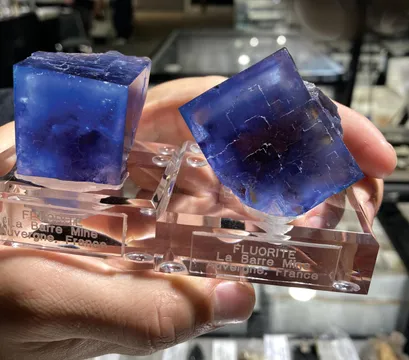
Le Burg Mine, France — famed modern fluorite locality producing sky-blue to deep blue cubic fluorite on quartz, with brassy gangue and copper-mining history.
Key facts
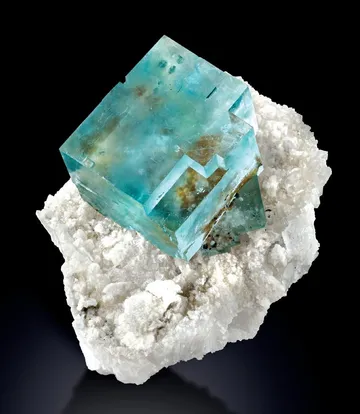
Le Burg, more often rendered on French labels as Le Burc or Mine du Burg, is one of the great modern fluorite localities of France: an underground fluorspar mine in the Albigeois district of the Tarn, south-western Massif Central, where a steep hydrothermal vein cuts Paleozoic schists near Alban and Paulinet. Its collector fame rests on a very specific look—transparent to translucent cubic fluorite, most memorably sky-blue to deep blue, commonly sitting on sparkling white quartz and enlivened by brassy chalcopyrite or iron-carbonate gangue. The best specimens are unmistakably French: lustrous blue cubes with darker blue edge-zoning or internal phantoms, sometimes with pale yellow zones, perched on fine quartz druses rather than simply broken from massive ore.
Regional View
Country View
The mine matters historically because it bridges two eras. The vein system belongs to an old copper-mining landscape, known in the Tarn since antiquity and worked for copper long before fluorite became the principal commodity. In the twentieth century, SOGEREM, associated with the Pechiney and later Alcan industrial line, turned Le Burg into one of France’s last active underground fluorspar operations. By the early 2000s it was still producing industrial spath fluor while also yielding cabinet specimens that now stand among the classic European fluorites. When the Tarn fluorite operations closed in 2006, Le Burg became not merely an old locality but a finished chapter: no new underground production pockets are being opened, and good pieces now circulate chiefly from miners’ holdings, old French collections, and international collections assembled while the mine was active.

Photo: Wikimedia Commons
That museum-scale piece, 40 x 27 x 14 cm in the Muséum de Toulouse collection, shows why Le Burg is more than a “blue cube” locality. The fluorite grows as a broad, architectural mass with quartz matrix, not as isolated trimmed crystals, and the blue-green translucency has the slightly smoky, watery quality collectors associate with the Tarn. Most market specimens are far smaller, but the same signature—blue cubic fluorite over glittering quartz—is what separates a true Le Burg from the many other French fluorite districts.

Photo: Wikimedia Commons
Although blue is the classic colour, Le Burg also produced much scarcer yellow to amber fluorite. Good yellow pieces are easily mistaken in spirit for Valzergues or other Aveyron material, but documented examples from old Le Burg finds show that the Tarn mine was capable of vivid golden cubes as well as the better-known blue.
Search for specimens: View all specimens from Le Burg Mine, France
Le Burg lies in the commune of Paulinet, in the Alban–Le Fraysse area of the Tarn, roughly east of Albi and southwest of Alban. Geologically it is part of the fluorite-bearing Albigeois crystalline district on the southwestern margin of the Massif Central, where fractured Paleozoic basement rocks host a suite of fluorite, quartz, baryte, siderite, chalcopyrite, pyrite, sphalerite and subordinate copper minerals. The country rock at Le Burg is chiefly epimetamorphic Paleozoic schist with sandstone and volcanic levels; the regional structural grain includes brittle fractures trending approximately N80 to N120 E, many of which are fluorite-bearing in the Albi region.
The Le Burg deposit is a steep vein or lens system controlled by a main fracture around N110 E, dipping north. Published descriptions differ slightly in dip and recognized dimensions as underground development evolved, but the picture is consistent: the mineralization extends for about a kilometre to 1.2 km along strike and for roughly 235 to 250 m vertically in the better-documented mine area, forming a succession of lenticular ore bodies rather than a single uniform slab. The vein could pinch out or swell dramatically, with reported widths ranging from nothing to about 10 m. In the richest zones the ore was massive, exceptionally pure fluorite; figures cited for Le Burg include CaF2 contents as high as about 95%, with quartz, siderite and chalcopyrite as the principal accessory minerals.
For collectors, the important geological point is that Le Burg was not just a massive fluorspar body. Open space in the vein and breccia zones allowed multiple episodes of crystallization: early silicification and comb quartz, fluorite generations, later quartz, siderite, chalcopyrite and pyrite, followed in places by additional fluorite and quartz. That repeated opening and sealing accounts for the zoned cubes, fluorite-over-quartz combinations, quartz-coated chalcopyrite, and specimens in which pale yellow and several blue zones alternate inside a single cube. The most desirable pieces are those that escaped the crusher as intact plates or three-dimensional clusters rather than ore fragments.
Modern fluorspar exploitation began in the early 1950s under SOGEREM, a Pechiney subsidiary later associated with Alcan. Le Burg was the underground member of a Tarn fluorspar group that also included the nearby Montroc and Moulinal open-pit operations. In 2004, local reporting still described Le Burg as an active mine producing about 50,000 tonnes of spath fluor per year, with sixteen underground miners working down to roughly the -220 m level. Ore was raised from underground, crushed, concentrated by dense-media separation and further processed in the Tarn system, with Montroc playing an important role in later treatment. By 2006, however, the Tarn fluorite mines had closed: Montroc and Moulinal as open pits, and Le Burg as the underground operation.
Collecting access today should be regarded as closed. Underground workings are no longer accessible for collecting, and recent local accounts describe the galleries as sealed and flooded. Surface buildings and the former mine yard have had post-mining uses, and official post-closure management has included treatment of mine waters and sludge. Old dumps in the wider area have been discussed by French field collectors, but the mine itself is not a casual collecting locality, and any visit would require current permission from the relevant landholder or operator.
Several specimen-producing settings are well documented in the trade and collecting record. Blue fluorite on fine white quartz is the classic association, including pieces from deeper levels such as the -200 m level. Fine examples show cubes to several centimetres on edge: published specimen records include blue fluorite crystals to about 3.3 cm, 3.4 cm and 4.3 cm, and old large matrix specimens far beyond normal cabinet scale. Yellow Le Burg fluorite is much rarer; one documented old-find small cabinet specimen from the late 1970s carried amber-yellow cubes, the central crystal about 3.2 cm on edge, on a sloping matrix. A Dutch field account from the late 1980s described an approximately 80 x 50 cm group of centimetre-scale dark-blue fluorite cubes displayed in the mine office, a tantalizing reminder that exceptional material existed underground even if comparatively little reached the collector market intact.
Fluorite is the defining species at Le Burg, where it occurs mainly as cubic crystals in sky-blue, grey-blue, deep blue, blue-green, pale yellow and scarcer amber-yellow tones, commonly on white quartz and locally with chalcopyrite, siderite, pyrite or baryte. The classic specimens are blue cubes with glassy lustre and visible zoning: darker blue rims, colourless edge flashes, pale yellow internal ghosts, or alternating blue and yellow bands seen best with transmitted light. Market and museum pieces show a wide size range, from miniature druses of sub-centimetre cubes to cabinet plates with individual cubes around 2–4 cm and rare large display specimens; the best pieces preserve a natural quartz matrix, strong transparency, sharp undamaged edges, and a balanced distribution of cubes rather than a sawn or cleaved mass of ore. Yellow Le Burg fluorite is much less common than blue and is valued when the locality is well proven, especially because such specimens can be confused stylistically with other French yellow-fluorite districts.
Quartz at Le Burg is usually important as the matrix and textural partner to fluorite rather than as the principal show mineral, but that understates its collector value: fine Le Burg fluorites often owe their aesthetics to carpets of small, brilliant, white to colourless quartz crystals that set off the blue cubes. Quartz occurs as drusy crusts, comb-textured vein quartz, small prismatic crystals in geodes, and later coatings on fluorite or chalcopyrite; some specimens show fluorite that was first overgrown by quartz and then by a later generation of small yellow fluorite cubes and chalcopyrite. Excellent quartz-bearing pieces are those in which the matrix is complete, sparkling and sculptural, with fluorite placed clearly above it rather than half-swallowed by massive vein material. Stand-alone quartz specimens from Le Burg are less celebrated than the fluorite combinations, but quartz is essential to the locality’s most recognizable cabinet pieces.
Beyond fluorite and quartz, Le Burg has a compact but interesting mineral list typical of a fluorite-copper vein system: baryte, chalcopyrite, siderite, pyrite, sphalerite, dolomite, goethite, malachite, cuprite, native copper, bismuthinite, stromeyerite and members of the tetrahedrite subgroup are all recorded. Chalcopyrite is the most visible accessory on specimens, sometimes as small brassy crystals and, in noted examples, as octahedral forms coated with quartz. Native copper reflects the older copper story of the district, and bismuthinite and stromeyerite give the locality micromineralogical interest beyond its display fluorite. Le Burg is not primarily a type-locality name in the way some classic European mines are; its reputation rests instead on the quality and recognizability of its blue fluorite and fluorite-quartz specimens.
The first authenticity issue with Le Burg is nomenclature. Labels may read Le Burg, Le Burc, Mine du Burg, Mine du Burc, Alban, Le Fraysse, Paulinet, or simply Tarn. These are not necessarily competing localities; they often refer to the same mine or the same collecting area. Confusion arises because several French fluorite districts produced blue or yellow cubic crystals. Le Beix can resemble Le Burg in blue zoned fluorite, while Valzergues and other Aveyron localities can resemble the rarer amber-yellow Le Burg material. Provenance matters greatly for unusual colours, especially yellow specimens, and old miner, dealer, or collection labels are worth preserving.
There is no well-known, locality-specific epidemic of manufactured Le Burg fakes or routinely treated specimens, but fluorite is a mineral in which enhancement and misrepresentation should always be considered. Be cautious of improbable colour uniformity, suspiciously perfect repaired cubes, glued-on crystal groups, or pieces whose matrix does not match the typical quartz-schist-siderite setting. Strong blue colour alone is not proof of Le Burg. Conversely, not every genuine Le Burg fluorite is electric blue; some are grey-blue, blue-green, pale, or only strongly coloured at the rims.
Condition is a major value driver. Fluorite cleaves easily, and Le Burg cubes commonly show small edge rubs, cleaved corners, bruised tips, or contacts where a crystal was attached to vein material. Larger matrix pieces are especially prone to edge wear and old repairs because they were rescued from an industrial mine environment, not collected gently from an alpine fissure. For blue pieces, look for undamaged front-facing cubes, clean internal zoning, bright quartz, and minimal bruising along the most visible cube edges. A single discreet cleaved rear or lower contact is acceptable on many otherwise fine specimens; a broad, dull, abraded face across the display side is much less acceptable.
Fluorescence is present on at least some Le Burg fluorites, with documented yellow material fluorescing purple. It should be treated as a bonus rather than a universal diagnostic test. For handling and display, avoid strong heat, aggressive cleaning, and long-term intense sunlight until the specimen has been observed; fluorite colour centres can be variable, and there is little to gain by exposing a valuable classic specimen to bright light unnecessarily. Quartz crusts trap dust, so gentle air, a soft brush, and minimal water are safer than acids or ultrasonic cleaning, especially where chalcopyrite, malachite, siderite, or repaired edges are present.
Availability is finite. The mine is closed, underground access is not available, and fresh production is not entering the market. Small to miniature blue fluorites still appear with some regularity from old European collections and dealer stock, but top matrix pieces with transparent blue cubes over quartz are markedly harder to replace. Recent public sales show the market’s preference clearly: good small cabinet to cabinet specimens with bright blue cubic fluorite, quartz matrix and chalcopyrite accents have reached four-figure prices, while modest, paler, damaged, or less aesthetic examples remain more accessible. The rare yellow pieces occupy a separate niche: they need solid provenance, but when right, they broaden a Le Burg suite beyond the expected blue.
In March 2004, when many French mines had already gone silent, a reporter followed the Burg miners underground and found a working world that now feels almost improbable. At 220 metres below the surface, a low, powerful machine called a “scoop” roared through the gallery—not a news scoop, as the reporter joked, but the mine’s loader, its engine hammering inside the rock tunnel. The mine had been created in 1953 and was still drawing about 50,000 tonnes of spath fluor a year. Thierry Gasser, the 35-year-old chief miner, described Le Burg and the Salins du Midi mine at Varangéville as among the last true underground mines in France not already promised to closure. Within two years, even that would change.
The crew was small and local: sixteen underground miners, aged 24 to 50, all from the surrounding area. Robert Roucayrol, 48, was about to bring a truckload of ore back up through the internal winding roadway, the descenderie or remonte—a half-hour drive through the mine’s own underground road system. The machines were punishing. Ear protection was compulsory, the scoop’s engine noise reverberated through the tunnel, and the driver sat sideways to see both forward and backward while the vehicle shook over rough ground. Gérard Roques, the elder of the group, summed up the work in one earthy line: after eight hours, “une sieste fait du bien”—a nap does you good.
There were moments underground that read like a mineral collector’s dream, except they belonged to production miners rather than weekend crystal hunters. Gasser measured a 2.70 m vein at the face. The bluish colour gave away the spath fluor. In headlamp light, pieces of copper flashed like gold—remnants of the metal that had attracted miners to Paulinet since Gallo-Roman times. Red stalactites formed where iron-rich water dripped from the roof. In the wall, bouquets of quartz crystals were visible enough for the reporter to note that they would delight mineralogists. Roucayrol simply called them “des choses qu’on n’a pas l’habitude de voir”—things one is not used to seeing.
The mine was wet, controlled and constantly watched. Signs warned of albraques, water holes where mine water was pumped, settled and discharged. Ventilators at the tops of three ventilation shafts kept air moving through the workings. The temperature stayed around 15°C in summer and winter. Working galleries were progressively backfilled with sterile waste as extraction advanced, a practice that helped explain why yesterday’s pocket could vanish behind tomorrow’s fill.
The hoistman’s job had its own theatre. “Ce n’est pas un ascenseur Otis!” one miner said—this was no Otis elevator. A metal cage carried men down and up in a two-minute ride, the cable passing over a headframe pulley and winding onto a drum near the hoistman’s desk, smelling of black grease. André Fabre, 46, controlled it that morning. He watched depths on both a digital display and an old graduated bar, stayed in contact with men below by telephone, and monitored a screen where a red square appeared if a link was lost. Every miner who descended hung a token on a board. Fabre could almost watch his own farm from the mine site; the workings lay beneath land farmed by his wife. “Il faut les deux,” he said. You need both.
Another miner, Denis Clarenc, 35, made the mine sound less like an occupation than a family inheritance. “Pour nous, la mine, c’est une affaire de famille!” he said. His brothers Jean-Luc and Didier already had 18 and 20 years at SOGEREM. Denis had once been a bodywork repairman and came to the Burg “pour voir”—to see. He learned drilling, loading, mucking and blasting, including the permit needed to charge drill holes with explosives. The shifts were precise: 5 a.m. to 1 p.m. with a 20-minute snack break, or 1 p.m. to 7 p.m. with no break, alternating 40-hour and 30-hour weeks to average 35. At first, the underground work followed him home. He admitted he slept badly; once he woke in the night searching everywhere for his lamp.
A year earlier, in October 2003, the mine’s geologist Philippe Bains had explained the deposit with the enthusiasm of someone who hunted the vein for a living. He singled out the blue iridescent Burg spath fluor as world-renowned, then described the rock as a story of folds, fractures and trapped mineralization. Ore was being taken from around -170 m to -220 m. Special underground machines with a central driving position and a front bucket carried about two tonnes at a time. The ore went to a crusher and then by belt to dense-media baths that separated fluorite from earth and rock, giving roughly 90% purity before further upgrading at the sister plant at Montroc. About 80 tonnes per day left by truck for the Albi freight station.
After closure, the story did not end; it changed from extraction to memory, water and land use. In 2013 a proposal to place a sewage-sludge composting platform on the old mine site stirred local concern. The plan described 19,500 tonnes of sludge per year from towns including Gaillac, Lavaur, Saint-Affrique, Rodez, Carmaux, Aussillon, Castres and Albi, mixed with 17,000 tonnes of green waste and wood to make 9,000 tonnes of compost. Opponents focused on what lay below: about 350,000 m3 of water filling the old galleries, overflowing through local streams toward the Dadou and the Rasisse reservoir, a water supply for nearly 40,000 people. The old mine had become a hidden hydrological body.
In June 2026, the site briefly returned to public attention during national geology days. About fifty participants arrived by three buses for a guided visit to the former fluorspar mines of the canton. Philippe Bains again led the explanation, this time helped by former miners Yvan Palmyre and J. Paul Lattes, who held a large plan of the underground Burg mine showing galleries, veins and ventilation shafts. The account described oak timbering later replaced by steel beams, galleries backfilled as they advanced, a descenderie enlarged over time to accommodate larger trucks, and pumps capable of moving up to 100 m3 of water per hour. If a pump failed, it had to be repaired fast; after closure, the water finally won, and the underground mine flooded.
Mindat locality page: Le Burg Mine (Le Burc Mine), Paulinet, Albi, Tarn, Occitanie, France — The most useful concise mineral list for the locality, including fluorite, quartz, baryte, bismuthinite, chalcopyrite, cuprite, dolomite, goethite, malachite, native copper, pyrite, siderite, sphalerite, stromeyerite and tetrahedrite-subgroup minerals.
Mindat fluorite occurrence page: Fluorite from Le Burg Mine — Documents the fluorite habit as cubic, the typical sky-blue colour, and photo-data associations dominated by quartz with chalcopyrite, baryte, pyrite and siderite.
Wikimedia Commons: Fluorine MHNT.MIN.2010.16.1.jpg — A major Muséum de Toulouse fluorite-quartz specimen from Le Burg, 40 x 27 x 14 cm, photographed by Didier Descouens.
Wikimedia Commons category: Le Burg Mine — A compact image set of Le Burg fluorite and fluorite-quartz specimens, including the Muséum de Toulouse specimen and older dealer images.
Pierrot, R.; Picot, P.; Fortuné, J.-P.; Tollon, F. (1976), Inventaire minéralogique de la France: Tarn, BRGM — The departmental mineral inventory repeatedly cited for Tarn mineral occurrences, including minerals recorded from Le Burg.
Soulié, M. (1971), Observations minéralogiques et métallogéniques sur le district à fluorine du Tarn. Étude de la mine du Burg, thèse de doctorat de 3e cycle, Université Paul Sabatier, Toulouse, 165 p., 11 plates — A key mine-specific academic work, cited in later district literature.
Couturier, P. (1980), Contribution à l’étude géologique et gîtologique du district à fluorine de l’Albigeois cristallin, région de Mont-Roc, Le Burc (Tarn), thèse, Université Paul-Sabatier Toulouse 1 — A regional geological and metallogenic study explicitly covering Mont-Roc and Le Burc.
Deloule, E. (1981), Contribution à l’étude génétique des concentrations de fluorine. Application aux gisements filoniens de Montroc et du Burc (Tarn), thèse, Université Paris 7 — A genetic study of fluorite concentrations in the Montroc–Burc vein system.
Féraud, J. (1999), Mémento des roches et minéraux industriels: la fluorine ou spath fluor, Rapport BRGM R 40825 — Industrial and economic context for French fluorspar, including Le Burg as an active underground mine at the time of publication.
Couturier, P.; Fortuné, J.-P.; Vassal, M., “Le filon de fluorine de Mont-Roc (Tarn)” — Although focused on Mont-Roc, this district paper summarizes the Albigeois fluorite setting, paragenesis, structures and references to Le Burg-specific work.
MO001 Fluorite, Le Burg Mine, France — Crystal Classics — A short specimen video hosted on Vimeo showing a Crystal Classics Le Burg fluorite.
Blue Fluorite and Quartz, Burc mine, Le Burg, Tarn — Les Minéraux specimen video — Rotating video of a blue fluorite and quartz specimen from the -200 level, with alternating yellow and blue ghosts.
Mindat: Le Burg Mine locality — Essential mineral list, locality hierarchy and photo links for Le Burg / Le Burc.
Mindat photo gallery: Le Burg Mine — Useful for seeing the range of blue, yellow and quartz-associated fluorite specimens.
Spathfluor: French fluorite mines — Collector-oriented overview of French fluorite mines, including a concise entry for Le Burg.
GeoWiki: Burg — French locality note emphasizing the mine’s world-famous blue fluorite.
BRGM / MineralInfo: Mémento des roches et minéraux industriels — la fluorine — Best industrial background on French fluorspar and Le Burg’s place among the active mines around 2000.
MineralInfo: Potentiel du sous-sol français et exploration — Notes Le Burg and Montroc as the last French fluorite mines, stopped in 2006.
La Dépêche du Midi: “Les derniers mineurs de fond” — Vivid 2004 report from inside the working underground mine.
La Dépêche du Midi: “Le filon du spath-fluor est bon pour la conservation des aliments” — Contemporary account of mining depth, processing and industrial use, with comments from geologist Philippe Bains.
La Dépêche du Midi: “Ce que prévoyait le projet de plateforme de compostage” — Post-mining account of the old flooded workings and proposed surface reuse.
La Dépêche du Midi: “Alban. Une visite minière très suivie” — Recent heritage visit report with details on mine plans, timbering, explosives, pumping and former miners.
Mineral Auctions: Fluorite on Quartz with Chalcopyrite, Le Burg Mine — Recent public sale record showing blue fluorite cubes with quartz and chalcopyrite, condition notes and market level.
Mineral Auctions: Fluorite, classic locality, Le Burg Mine — Public auction record for a cabinet Le Burg fluorite from the Al and Sue Liebetrau collection.
Les Minéraux: Fluorite of Burc / Burg — Dealer archive illustrating typical blue fluorite, quartz and chalcopyrite combinations from the mine.
Fluorite.fr: Sulfures — Includes a Le Burg chalcopyrite and quartz note, useful for the sulphide accessory assemblage.