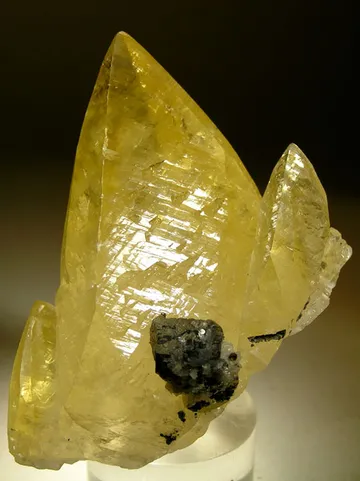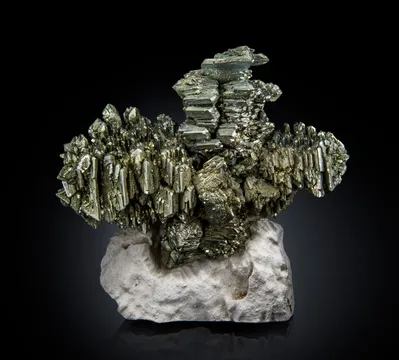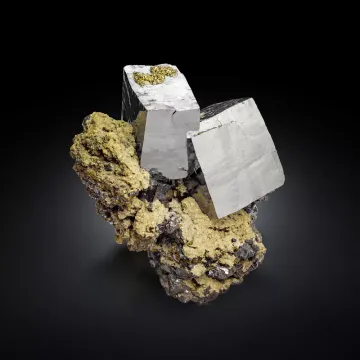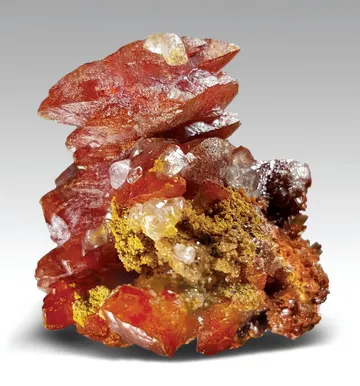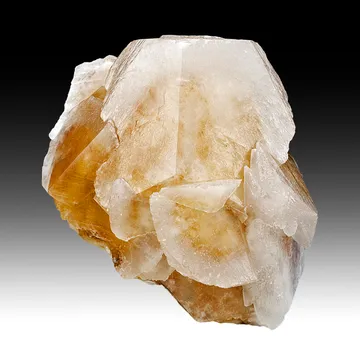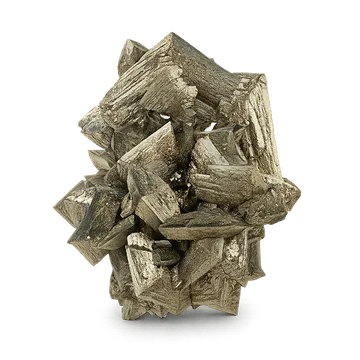
Marcasite from Joplin Field — brassy, blade-like crystals often on galena in the Tri-State district, prized for sediment-hosted texture and striking contrast.
Key facts
Marcasite from the Joplin Field is one of the classic visual signatures of the old Tri-State lead-zinc district: brassy, metallic, bladed crystals riding on galena, sphalerite, quartz, calcite, chert, and jasperoid from the mines around Joplin, Webb City, Oronogo, Duenweg, and nearby camps in southwestern Missouri. The best pieces have the look collectors mean when they say “Joplin marcasite”: sharp cockscomb or bladed aggregates, sometimes epitaxially arranged on lead-gray galena cubes or octahedrons, with ruby-jack sphalerite and sparkling quartz or calcite giving the whole specimen a dense, old American ore-district character.

Photo: Wikimedia Commons
Mineralogically, the appeal is not simply that marcasite is present; it is the way it is placed. Joplin specimens often show marcasite as a late, glittering sulfide accent on earlier ore minerals. In old descriptions of the district, iron disulfide was observed after galena and sphalerite, and marcasite was noted in corrosion cavities in galena as well as in later generations on calcite. That paragenetic position gives many Joplin pieces their distinctive architecture: a structural mass of galena, sphalerite, chert, quartz, or calcite, enlivened by bright, brassy marcasite blades and clusters.

Photo: Wikimedia Commons
The geological setting is the Mississippi Valley-type lead-zinc mineralization of the Tri-State District, hosted chiefly in Mississippian carbonate rocks and their cherty, silicified, jasperoid-rich equivalents. These ores formed in open spaces, fractures, breccias, replacement zones, sheet ground, runs, and sinkhole-related “circle” deposits. In the collector’s cabinet, this translates into specimens that feel unmistakably sediment-hosted: chert and jasperoid matrices, galena cubes and modified cubes, reddish to brown sphalerite, drusy quartz, calcite of many habits, chalcopyrite sparks, and marcasite as the crisp brassy finish.
Historically, Joplin material belongs to one of the great American mining districts. Mining in the Tri-State region began in the mid-19th century and transformed southwestern Missouri from rural land into a world-class lead-zinc producer. The district’s output and its long mining culture made Joplin a familiar name to economic geologists, mineral collectors, and museums. Today, nearly all desirable marcasite-bearing specimens are old stock, estate pieces, or material recycled through collections rather than new mine production. Good provenance matters.
Search for specimens: View all marcasite specimens from Joplin Field, USA
The Joplin Field is a mining-field locality within Jasper County, Missouri, in the Missouri part of the Tri-State Mining District of Missouri, Kansas, and Oklahoma. In mineral-specimen usage, “Joplin Field” is often used for older pieces whose exact mine or lease was not preserved on the label. More precise labels may name individual Joplin Field mines and localities such as the Combination Mine, Empire Mines, Zig Zag Mine, Firecracker Mine, Lone Elm Mine, Blakie No. 2 mine, or Roach Cave; collectors should preserve those names whenever they appear.
The deposit type is Mississippi Valley-type lead-zinc mineralization. In the Tri-State District, lead and zinc ores occur in carbonate-hosted and silicified rocks, especially Mississippian units, with important development in limestone, dolomite, chert, and jasperoid. The ore minerals are chiefly sphalerite and galena, accompanied by marcasite, pyrite, chalcopyrite, calcite, dolomite, quartz, and secondary lead-zinc minerals in oxidized zones. Joplin-area specimens are especially valued because mining opened cavities where large, well-formed crystals could be recovered rather than merely massive ore.
The old mining literature uses a vocabulary that still helps collectors understand Joplin specimens. “Runs” were linear ore bodies following fracture or shear zones and commonly associated with replacement by silica or jasperoid. “Sheet ground” described mineralization along bedding planes or other horizontal features. “Circle” deposits were associated with sinkholes and were famous in parts of the Tri-State District. These ore-body styles explain why Joplin specimens can range from chert-breccia plates sprinkled with sulfides to open-cavity combinations of galena, sphalerite, calcite, quartz, chalcopyrite, and marcasite.
Mining began in the region in the mid-19th century, with early lead mining near Joplin and a later shift toward zinc as sphalerite became economically important. Zinc dominated much of the district’s production history, and Missouri’s portion of the Tri-State District produced zinc and lead until 1957. Organized commercial mining in the broader district had ended by the late 1960s and early 1970s, after which groundwater rose and many workings flooded.
Collecting access today should be regarded as essentially historical rather than active. Former mine lands around Joplin include private property, reclaimed ground, contaminated mine waste, tailings, subsidence hazards, open shafts, and areas affected by Superfund cleanup. Serious collectors should not expect legal or safe access to old workings. The practical source of Joplin marcasite is the secondary market: old collections, estate material, museum deaccessions where available, dealer stock, and auction material with inherited labels.
Notable finds from the Joplin Field include marcasite cockscombs, marcasite epitaxial or oriented on galena, marcasite with ruby-jack sphalerite on brecciated chert, marcasite on quartz, marcasite balls or botryoidal groups on calcite or galena, and marcasite-bearing calcite specimens. The broader Joplin Field is also famous for galena, sphalerite, and especially calcite, including large scalenohedrons, rhombohedrons, twins, doubly terminated crystals, clusters, and very large crystals from cavity environments.
Joplin Field marcasite is most sought after when it forms sharp, lustrous, brassy, bladed crystals in cockscomb aggregates. Marcasite is orthorhombic FeS2, dimorphous with pyrite, and its repeated twinning can produce the familiar cockscomb and spearhead forms. At Joplin, these forms commonly occur not as isolated textbook crystals but as part of a dense sulfide assemblage: blades on galena, patches on sphalerite, sprays on quartz, or bright metallic accents on calcite and chert.
Color ranges from pale brass-yellow to bronze-yellow and silvery-brassy, often darkening or tarnishing with age. Fresh, clean surfaces can be highly metallic, while older pieces may show bronze, gray, greenish, or iridescent tarnish. The best Joplin marcasites retain sharp edges, bright luster, and a crisp contrast against darker galena, reddish-brown sphalerite, pale quartz, or light gray calcite.
Typical crystal sizes vary widely. Fine blades may be only a few millimeters, forming dense sparkling crusts or compact cockscombs. Historic descriptions of the district noted marcasite crystals in cavities reaching one-half inch or more, while many disseminated marcasites in jasperoid and rock are microscopic. On cabinet specimens, marcasite is often a secondary player rather than the largest mineral present: a 5 mm rosette, a brassy cockscomb over galena, or a glittering druse on quartz may be more typical than a large free-standing marcasite crystal.
The strongest associated minerals for Joplin marcasite are galena, sphalerite, chalcopyrite, calcite, quartz, dolomite, and pyrite. Galena associations are especially prized. Fine examples show marcasite blades perched on lustrous galena cubes or modified cubes, sometimes with ruby-jack sphalerite on a chert or jasperoid base. Quartz-associated pieces can be striking: white to clear drusy quartz forms a bright stage for the brassy marcasite. Calcite associations vary from tiny marcasite inclusions or peppering to marcasite balls and hemispherical growths on calcite surfaces.
Quality depends on more than size. Collectors look for luster, sharpness, intact cockscomb habit, stable condition, aesthetic placement, and credible old provenance. A miniature with brilliant marcasite blades on a well-formed galena crystal may be more desirable than a larger, dull, oxidized mass. Matrix matters: brecciated chert with ruby-jack sphalerite, clean quartz druse, or lustrous galena crystals can elevate a marcasite-bearing piece from merely representative to truly classic Joplin.
The most distinctive Joplin combinations show a layered ore-district story in a single specimen: chert or jasperoid below, sphalerite and galena as the main ore minerals, quartz or calcite in open spaces, chalcopyrite in small brassy accents, and marcasite as late bladed or cockscomb growth. That sequence and texture are what make the best pieces immediately recognizable.
The main condition issue is marcasite stability. Marcasite is brittle and can undergo “pyrite disease” or marcasite decay in the presence of moisture and oxygen, producing iron sulfates and acidic products that can damage the specimen, labels, boxes, and neighboring sulfides. Joplin cockscombs that remain sharp, bright, and intact are therefore significantly more desirable than pieces with powdery surfaces, sulfurous odor, loose grains, orange-brown staining, white efflorescence, or crumbling edges. Store Joplin marcasite dry, away from damp basements and wooden or acidic storage materials, and isolate any specimen that shows active decay.
Authenticity concerns are usually matters of identification and labeling rather than elaborate fakery. Small brassy crystals on Joplin galena may be marcasite, chalcopyrite, or both, and older labels can use names loosely. Marcasite and pyrite share the same formula, FeS2, but they are different minerals; jewelry-trade “marcasite” is also a separate source of confusion because it commonly refers to pyrite used in ornament rather than true marcasite mineral specimens. For Joplin pieces, crystal habit, association, luster, and—when necessary—analytical confirmation are the safest basis for identification.
Locality precision is another issue. “Joplin,” “Joplin Field,” “Joplin District,” and “Tri-State District” appear on old labels with varying specificity. A specimen labeled simply “Joplin, Missouri” may be perfectly legitimate, but it should not be promoted as a specific mine unless the label or collection history supports that. Conversely, an old label naming a specific Joplin Field mine or lease adds real locality value and should stay with the specimen.
There are no common treatments that define the Joplin marcasite market in the way acid cleaning defines some carbonate localities, but cleaning can change the appearance of sulfides. Overcleaned pieces may lose natural patina or reveal corrosion. Coatings, oils, or consolidants should be disclosed if present, particularly on unstable marcasite. On a fine old piece, original surface, old label, and undisturbed condition are usually preferable to an artificially brightened look.
Availability is uneven. Small to modest Joplin marcasite-bearing pieces still appear at shows, online auctions, and in old American collections, but sharp, robust, stable cockscombs and aesthetic marcasite-on-galena combinations are much harder to replace. Recent auction records and dealer listings show miniatures and small cabinets circulating, often as galena or calcite specimens with marcasite as an important association rather than as pure marcasite display pieces. Top-value examples combine old provenance, strong aesthetics, undamaged sulfides, and recognizable Joplin-style mineral association.
Crystal Cave is the great Joplin mineral story, even though its celebrity rests on calcite rather than marcasite. The cave was discovered by accident by miners and was remembered locally as possibly “the largest geode in the world.” The scale is the detail that stops a collector cold: a six-story room, with floor, walls, and ceiling covered in calcite crystals, some more than two feet long. In a district built to break, mill, and ship ore, the survival of such a cavity depended on restraint. Mr. Roach and Mr. Weymann chose preservation over mining, and that decision turned a mineralized void into a legend rather than just another stope.
The mining itself had a rhythm that is hard to reconcile with the elegance of the specimens. In the early period, a miner working with a large metal shovel was expected to fill 80 buckets a day. Each bucket held 1,200 pounds. Pay was counted by the bucket: 4 1/2 cents per bucket, with superior miners earning 6 1/2 cents for buckets filled over the first 100. Those figures give Joplin specimens their human weight. A cabinet piece with galena, sphalerite, quartz, and marcasite is not only a crystallized chemical system; it is part of a district where ore was moved by the bucket before the age of fully mechanized mining.
The museum history has its own collector’s thread. Everett Ritchie, a chemical engineer at Eagle Picher, served for more than thirty years as curator of the Tri-State Mineral Museum. In 1994 he organized the mineral displays that formed the core of the museum wing later renamed in his honor. The Joplin History & Mineral Museum describes the Everett J. Ritchie Tri-State Mineral Collection as one of the exceptional collections of minerals from the district, the kind of regional collection that preserves not just fine specimens but the memory of labels, mines, habits, and mining families.
Even in downtown Joplin, ore specimens became civic objects. Spiva Park received mineral samples from Matt Vickery, curator of the Tri-State Mineral Museum in 1966. The largest was a 700-pound chunk of lead and zinc ore. Such public specimens are rarely delicate enough to show the best marcasite, but they capture the scale of local identity: galena, sphalerite, dolomite, chert, and calcite set out in the city as reminders that Joplin’s streets and institutions grew from the same mineralized ground that produced the cabinet pieces collectors prize today.