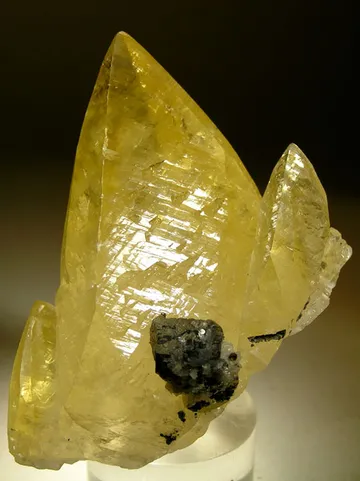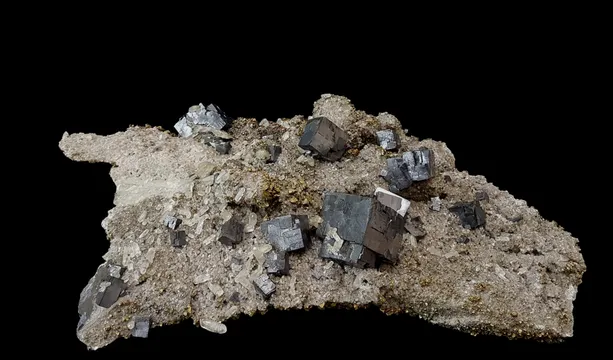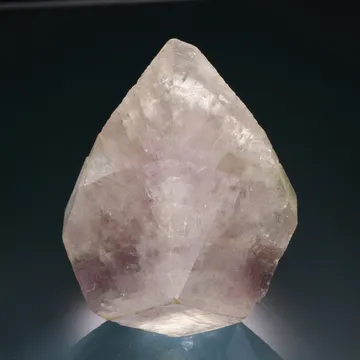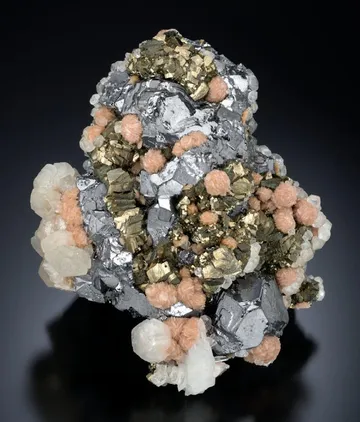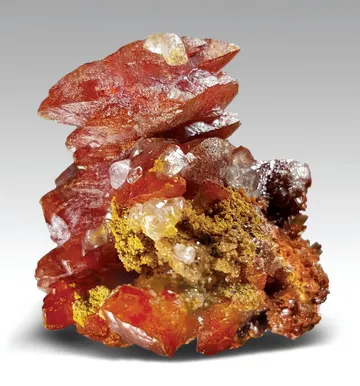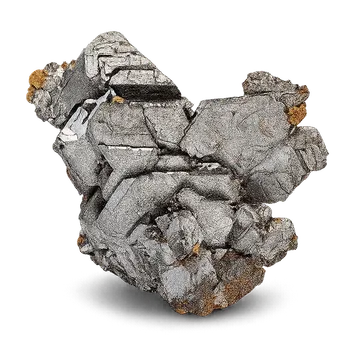
Galena from Joplin Field, USA: heavy architectural steel-gray cubes on chert, iconic Tri-State lead-sulfide; historic mining context adds collecting value.
Key facts
Galena from the Joplin Field is the American Midwest’s classic lead-sulfide specimen: heavy, architectural, steel-gray to battleship-gray crystals from the old Tri-State Mining District, usually riding on pale chert, silicified limestone, dolomite, calcite, or dark sphalerite. The best pieces have the look serious collectors hope for in a historic galena—sharp cubes, modified cubes, cuboctahedra, octahedral growth, hoppered or “fortification” surfaces, and that unmistakable metallic luster that can shift from bright lead-gray to subdued gunmetal on old cabinet pieces.
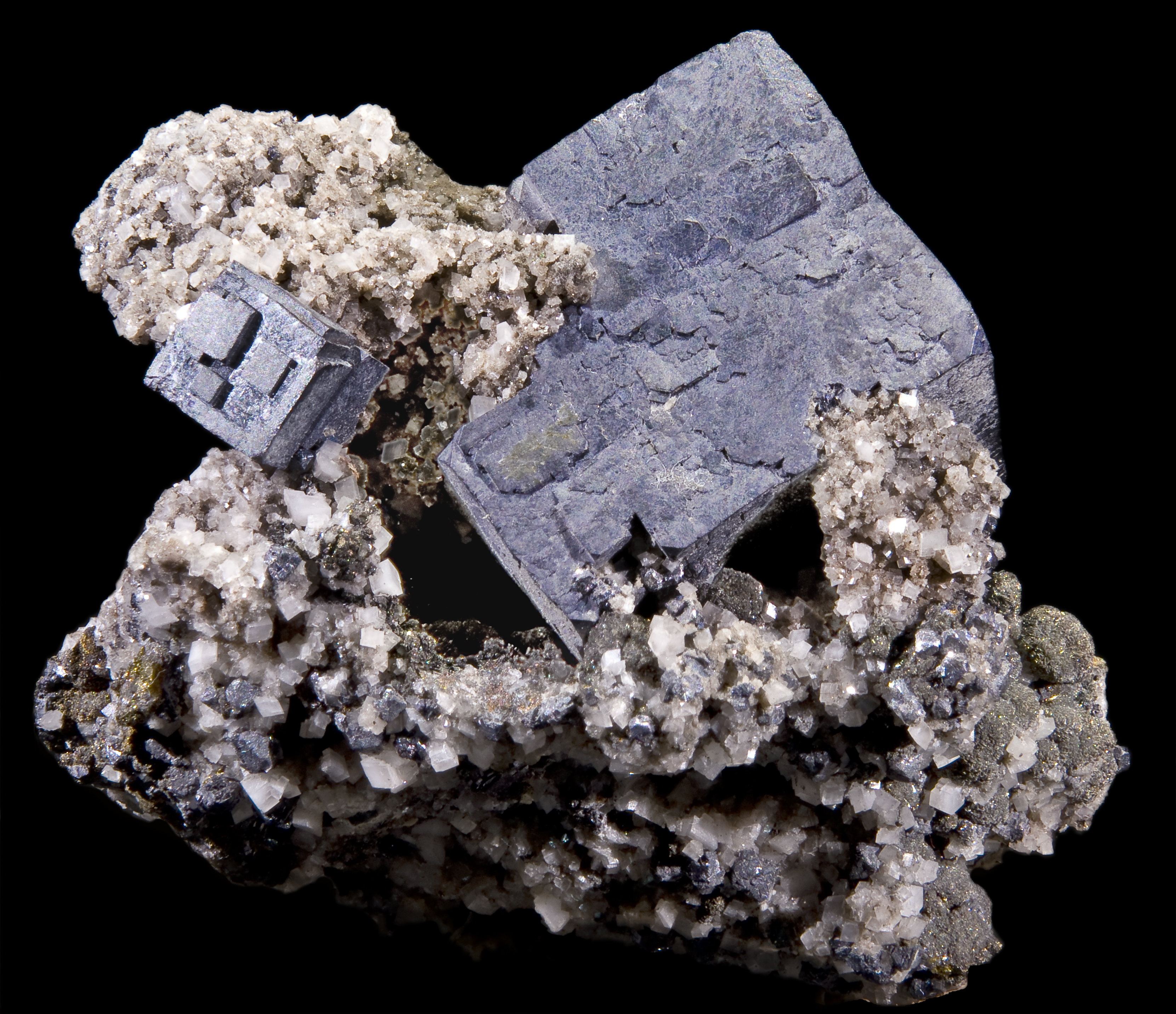
Photo: Wikimedia Commons
The mineralogical setting is Mississippi Valley-type lead-zinc mineralization in the cherty Mississippian carbonate rocks of southwest Missouri and adjoining Kansas and Oklahoma. In the Joplin area, galena and sphalerite were the economic sulfides, with marcasite, pyrite, chalcopyrite, dolomite, calcite, quartz, chert, jasperoid, and a suite of oxidized or secondary minerals in the weathered zone. The old USGS description of the district emphasized that galena occurred as crystals and crystal aggregates on cavity walls, disseminated grains in jasperoid and other gangue, and massive granular material in seams and as cement in chert breccia. That last setting matters to specimen collectors: many fine Joplin galenas are not isolated “single crystals” but sculptural ore-pocket pieces, with the crystal geometry emerging from pale, broken, silicified carbonate rock.
Joplin’s importance is not merely aesthetic. The field belongs to one of the great lead-zinc mining provinces of North America, and the Joplin camp’s rise in the 1870s helped transform a creek valley mining settlement into a regional city. The specimens are therefore doubly collectible: they are attractive mineral objects and documents of a vanished mining culture. Old labels from Joplin, Tri-State, Jasper County, the George Feist collection, A. E. Foote, Robert C. Linck, Arthur Montgomery, Larry Krause, or other older American collections can add as much interpretive interest as a bright crystal face.

Photo: Wikimedia Commons
Collectors look for well-separated crystals on matrix, crisp cubic or cuboctahedral form, broad metallic faces, hoppered or stepped growth that reads clearly under light, and associations that say “Joplin” at a glance: red to brown “ruby jack” sphalerite, black sphalerite, pale dolomite rhombs, brassy chalcopyrite, marcasite dustings or blades, golden to amber calcite, and off-white chert or silicified limestone. Miniatures and small cabinets with 1–3 cm crystals are the backbone of the locality. Larger cabinet specimens with pristine cubes around 5 cm on edge are much less common and, when aesthetic and well provenanced, move into the top tier of Joplin galena.
Search for specimens: View all galena specimens from Joplin Field, USA
The Joplin Field is in Jasper County, Missouri, within the Tri-State Mining District, the historic lead-zinc province spanning southwest Missouri, southeast Kansas, and northeast Oklahoma. Modern mineral databases use “Joplin Field” both as a mining-field locality and, in some contexts, as a catch-all label when no more precise mine is known. That is important for collectors: many old labels say simply “Joplin,” “Joplin, Missouri,” or “Tri-State District,” because the specimens entered commerce when mine-by-mine locality recording was not consistent.
Geologically, the field is part of a Mississippi Valley-type lead-zinc system. Ore minerals were deposited in carbonate host rocks rather than in igneous veins; the Joplin and broader Tri-State ores are especially associated with cherty Mississippian limestones. Missouri sources describe much of the district ore as lying in the Burlington-Keokuk and Warsaw formations, while classic older literature often discusses the Boone limestone and its cherty phases. The ore bodies were irregular and commonly developed in brecciated chert and limestone, cemented or impregnated by dolomite, jasperoid, calcite, sphalerite, galena, and iron sulfides. In district-scale terms, these were low-temperature hydrothermal lead-zinc ores formed by basinal brines moving through carbonate strata, encountering permeable zones, folds, fractures, breccias, and chemical traps.
The historical outline is unusually clear. Lead mining was under way near Joplin by 1848, about two miles east of the later city at Leadville. The Granby area was a major Missouri producer from about 1850 to 1870, but the 1870 discovery of ore in Joplin proper was the spark that made the Joplin district nationally prominent. Lead was the only metal recovered until 1872; zinc, locally called “jack,” soon became the dominant economic product. A rail spur completed in 1870 allowed ore shipment to St. Louis smelters, and the first zinc works in Missouri were operating at West Joplin by 1881.
Mining was organized for decades around lease and royalty arrangements. Landowners divided holdings into small claims, sometimes only a few hundred feet square, and miners or companies leased the ground. This created a dense, competitive mining landscape in which many small shafts, leases, and claims operated close together. The system helps explain why fine specimens from the old district so often have broad labels instead of exact mine names: material could pass rapidly from a small lease to a local dealer, miner, family collection, or early mineral house without preserving detailed underground provenance.
Production reached extraordinary scale. Missouri recorded a peak year in 1916 with 155,527 tons of zinc and 30,827 tons of lead, valued at $46 million. Broader Tri-State production continued through the first half of the twentieth century, with the Missouri portion closing in 1957 and the district as a whole effectively finished by 1970. For collectors, this means Joplin galena is not a modern mine product; the best examples are old-time specimens, recovered during active mining and preserved through private collections, institutional holdings, and dealer inventories.
Collecting access today is essentially historical-market access. The old mine workings are closed, much of the area is private land, and parts of the southwest Missouri mining belt are involved in long-running lead, zinc, and cadmium cleanup. The Oronogo-Duenweg Mining Belt Superfund site in the Joplin region covers hundreds of square miles affected by historic mining, milling, and smelting wastes. Field collecting from old mine dumps or workings is not a casual rockhounding proposition; it involves landowner permission, safety hazards, environmental restrictions, and heavy-metal contamination concerns. Serious collectors should treat contemporary Joplin galena as a specimen-market locality, not as a present-day collecting destination.
Notable finds include sharp cubic galenas on silicified limestone, galena with ruby-jack sphalerite on chert, galena-calcite combinations, galena with marcasite, and rarer iridescent or strongly hoppered examples. The old USGS folio recorded skeletal galena locally and described intricate stalactitic intergrowths of fine-grained galena and radial sphalerite at the Combination mine east of Joplin—the “combination ore” that was troublesome to mill but fascinating mineralogically. Modern gallery and auction records show the collector side of that story: etched, skeletal, fortification, and hoppered galena are among the most distinctive Joplin expressions.
Joplin galena is primarily a crystal-form locality rather than a color locality. The color range is the classic lead-gray to silver-gray of PbS, often mellowed by age to gunmetal, battleship-gray, or darker steel-gray. Fresh cleavages can be bright and silvery, but old cabinet specimens commonly have a soft metallic patina. Some pieces show thin secondary coatings or subtle iridescence; strong peacock-blue or golden iridescence on Joplin galena is unusual and should be evaluated carefully for naturalness, continuity, and provenance.
The dominant habits are cubes, modified cubes, cuboctahedra, and octahedral growths. Many of the most desirable crystals show stepped, hoppered, or epitaxial “fortification” growth—geometric terraces on cube or octahedral faces that give the specimen depth and movement under light. Older USGS observations noted that Joplin galena crystals were generally combinations of cube and octahedron and that crystals over about 2 inches were unusual in the district. Modern specimen records bear that out: many fine pieces have crystals in the 1–3 cm range, while well-formed crystals around 5–6 cm are notable. Large cabinet plates exist, but the combination of size, sharpness, luster, matrix, and low damage is not common.
Typical matrices are chert, brecciated chert, silicified limestone, limestone, dolomite, and sphalerite-rich ore. Off-white chert provides one of the best display contrasts, especially when galena crystals are isolated on a pale bench with red sphalerite scattered nearby. Dolomite may form pale, pinkish, or white rhombs; calcite may occur as golden, amber, colorless, or pale crystals and is a major supporting species from the field. Chalcopyrite adds small brassy sparks, while marcasite can occur as brassy crystals or blades on or near the galena.
The most characteristic associated ore mineral is sphalerite, which occurs in dark “black jack” and red to brown “ruby jack” varieties. In Joplin combinations, ruby-jack sphalerite can be a decisive aesthetic feature: small lustrous red-brown crystals on chert or dolomite give warmth to the cool gray galena. Black sphalerite provides stronger tonal contrast, especially with pale dolomite or calcite. Other recorded associated minerals in the Joplin Field include cerussite, anglesite, smithsonite, hemimorphite, greenockite, pyrite, quartz, wurtzite, baryte, and pyromorphite, but these are not all equally common in collectible galena specimens.
Quality is judged by crystal definition first. A good Joplin galena should show readable geometry: cubes with clean edges, cuboctahedra with balanced modifications, octahedral clusters with crisp faces, or hoppered faces with visible stepped growth. Luster comes next. The best examples have bright metallic flash rather than dull, granular ore texture. Matrix aesthetics matter strongly; an isolated cube on chert or limestone is usually more desirable than an equally large but crowded mass. Association also matters: galena with ruby-jack sphalerite, calcite, marcasite, chalcopyrite, or dolomite can command more attention than plain galena if the associations are undamaged and well placed.
Size alone is not enough. Some large Joplin specimens are heavy, blocky ore pieces with bruised corners, rough faces, and limited display value. Conversely, a small miniature with a pristine hoppered cuboctahedron and red sphalerite on chert may be far more collectible. The best Joplin material has an old American classic look: balanced, metallic, heavy in the hand, and clearly tied to the Tri-State ore environment.
The principal authenticity issue with Joplin galena is locality precision. Many older labels use “Joplin,” “Joplin District,” or “Tri-State District” broadly. Because the Tri-State mineralized area extends beyond Jasper County into Kansas and Oklahoma, an old “Tri-State” label does not automatically prove Joplin Field, Jasper County. Conversely, many legitimate Joplin pieces were labeled only generally because they were collected during active mining, before modern locality standards. Provenance should be read as a chain of evidence: old label, collection history, specimen style, associations, and any accompanying dealer or museum documentation.
I do not know of a well-established, Joplin-specific class of fake galena specimens comparable to the notorious fabricated or treated material known from some other mineral species and localities. The more common risks are repaired crystals, reattached matrix, enhanced presentation, overly optimistic locality attribution, and unreported cleaning. Galena is dense and brittle with perfect cubic cleavage, so broken and re-glued cubes are always worth checking. Use a loupe to inspect suspicious junctions, unnatural glue menisci, mismatched patina across a break, matrix crumbs trapped in adhesive, or crystal edges that do not align naturally with the surrounding matrix.
Condition issues are predictable for the species and the locality. Corners bruise easily; cleavage chips appear as bright or dull flat breaks; broad faces may be scuffed from old handling; and heavy cabinet pieces can suffer from pressure damage where crystals contact a shelf or box. On Joplin pieces with calcite or dolomite, aggressive acid cleaning may remove or dull carbonate associations, leaving galena looking isolated or the matrix unnaturally etched. On marcasite-bearing specimens, humidity control is important because iron sulfides can degrade in poor storage conditions; keep such specimens dry, stable, and away from rapid humidity swings.
Tarnish and patina should be judged with nuance. A thin gray patina on an old Joplin specimen can be entirely normal and even desirable, especially when it is even and does not obscure crystal form. Bright, freshly exposed cleavage surfaces on an otherwise old specimen may indicate damage or trimming rather than improvement. Iridescence is attractive but should be approached conservatively: natural iridescent Joplin galena is documented in the market, but the color should look integrated with the surface, not like an artificial film sitting on top of a dulled crystal.
Rarity is tiered. Small Joplin galenas and modest old-time pieces appear regularly. Good miniatures and small cabinets with 1–3 cm crystals on chert, limestone, or sphalerite matrix are obtainable with patience. Large, pristine cabinet specimens with sharp 5 cm-class cubes, balanced matrix, and old provenance are genuinely scarce. Iridescent, highly hoppered, skeletal, or especially aesthetic galena-sphalerite-calcite combinations are scarcer still. The market currently treats Joplin galena as a classic American locality: affordable examples still exist, but the top pieces with strong labels and low damage have moved well beyond casual pricing.
The first Joplin galena story begins not with a formal mine but with a hillside, a creek valley, and a chunk of lead ore. Local historical markers preserve the old account that chunks of lead ore were found in 1849 on land belonging to John C. Cox, the first settler in what is now Joplin. A year or two later, one of Cox’s enslaved workers reportedly found a piece of galena while digging for fishing worms near Joplin Creek. Cox had the mineral smelted into lead and opened a shaft at the discovery point. Small-scale mining followed, then stalled as the Civil War approached. For collectors, that account is a reminder that galena was not an abstract commodity in Joplin; it was the heavy gray rock that quite literally drew people to the creek.
The boom story is sharper still. In the spring of 1870, J. Morris Young, superintendent of the Granby Mining and Smelting Company at Oronogo, offered a $500 prize to the miner or group of miners who could take the most lead from a single shaft in four months. Elliot Moffet and John Sergeant won. They used the money to lease 10 acres from John C. Cox, pitched a tent in the Joplin Creek valley in August 1870, and sank the discovery shaft that launched the camp. Historical-marker accounts give the astonishing figure: within a couple of months the shaft reportedly yielded about $60,000 in lead. Another local history gives the first 90 days at $64,000. Either number explains what happened next. Tents and shacks filled the valley; miners and merchants arrived; by March 23, 1873, Joplin had been incorporated as a Missouri city.
The city itself began as a rivalry. John C. Cox laid out Joplin City on the hill east of the mining camp, naming it for the Reverend Harris G. Joplin and the nearby creek and spring. Patrick Murphy and his partners laid out Murphysburg west of Joplin Creek, a 40-acre town tract on the other side of the valley. The two mining communities quarreled, merged, separated, and finally merged permanently as Joplin. The urban map still carries the memory: Murphysburg Historic District, with its late-nineteenth-century houses, grew out of the wealth and civic ambition of the mining years.
The work underground was as concrete as the crystals are beautiful. Modern accounts from the Joplin History and Mineral Museum describe early miners using large shovels and being required to fill enormous ore buckets. The museum’s exhibit text notes that a miner had to fill 80 buckets a day; each bucket held 1,200 pounds; pay was 4 1/2 cents per bucket, with 6 1/2 cents for buckets beyond 100. A recent KRPS feature gives another version of the later routine: four men squeezed into a steel bucket to descend about 160 feet underground, sometimes with a leg exposed; drilling teams punched grids of 2–3 inch holes into the mine face; “Powder Monkeys” loaded dynamite and measured fuses so blasts detonated in sequence; after the warning cry of “Fire in the Hole!”, a pound of dynamite was expected to bring down a ton of rock. Then came the shoveling—1,500-pound cans of “mine dirt,” 60 to 70 cans a shift, with an extra five cents for buckets filled beyond 70.
The scale of hand labor is almost impossible to picture until someone gives it a comparison. Missouri Southern State University historian Brad Belk calculated that between 1900 and 1930, men using the standard 21-pound shovel moved more than 600 billion pounds of earth—an amount he compared to 820 Empire State Buildings. That number belongs beside any fine Joplin galena in a cabinet. The shining cubes were saved from a mining world built on repetitive drilling, blasting, hoisting, hand loading, and milling.
The district’s darker history is also inseparable from the specimens. The 1940 documentary Men and Dust, produced by Lee Dick and shot by Sheldon Dick, focused on conditions in the Tri-State lead-zinc mines, especially around Picher, Oklahoma. It showed the human cost of dust, poor housing, silicosis, and mining-town poverty. When the Library of Congress added the film to the National Film Registry, it described it as a culturally and historically important record of landscapes transformed by extractive industry. A Joplin Globe account reported that miners in the Missouri-Kansas-Oklahoma corners were making only 13 to 14 cents for every 1,650 pounds of ore loaded, and that the district was then producing 10 percent of the nation’s lead and 38 percent of its zinc. The film made the Tri-State district nationally visible not for beautiful mineral specimens, but for the bodies and towns that paid for the ore.
One of the most vivid modern memories comes from Henry Robertson, interviewed in 2025 at age 96. His father and grandfather had owned a mine, and Robertson went underground when he was only ten years old. He remembered the mine as dark and damp, but also formative. “It was educational and it was inspirational,” he said, because it showed him “what could be done with this certain industry.” That is Joplin in miniature: a place where galena and sphalerite built fortunes, neighborhoods, hospitals, rail links, museums, and also left shafts, chat piles, contaminated soil, and hard family memories.
William S. T. Smith and Claude E. Siebenthal, “Joplin District folio, Missouri-Kansas,” U.S. Geological Survey Geologic Atlas Folio 148, 1907 — The foundational USGS folio for the Joplin district, with classic descriptions of the ore bodies, galena habits, gangue minerals, and district geology.
Claude E. Siebenthal, “Origin of the zinc and lead deposits of the Joplin region, Missouri, Kansas, and Oklahoma,” U.S. Geological Survey Bulletin 606, 1915 — A major early monograph on the origin of the Joplin-region lead-zinc deposits.
Douglas C. Brockie, Edward H. Hare, and Paul R. Dingess, “The Geology and Ore Deposits of the Tri-State District of Missouri, Kansas, and Oklahoma,” AIME, 1968 — A district-scale treatment noting the Tri-State district’s cherty Mississippian host rocks, long production history, and major ore-zone patterns.
Edwin T. McKnight and Richard P. Fischer, “Geology and Ore Deposits of the Picher Field, Oklahoma and Kansas,” U.S. Geological Survey Professional Paper 588, 1970 — Focused on the Picher Field but essential for understanding the broader Tri-State mineralizing system and its ore geology.
Raymond Lasmanis, “Tri-State and Viburnum Trend Districts: An Overview,” Rocks & Minerals, vol. 72, no. 6, pp. 400–419, 1997 — A modern overview of two major Missouri-related Mississippi Valley-type districts, with history, geology, mineralogy, and specimen context.
Richard D. Hagni, “Mineral paragenesis and trace element distribution in the Tri-State zinc-lead district Missouri, Kansas, Oklahoma,” Missouri University of Science and Technology, 1961 — A detailed academic study of paragenesis and trace-element distribution in Tri-State ores.
H. T. Evans and E. T. McKnight, “New wurtzite polytypes from Joplin, Missouri,” American Mineralogist, vol. 44, pp. 1210–1218, 1959 — Not a galena paper, but a notable Joplin mineralogical record because Mindat lists ‘Wurtzite-10H’ from the Joplin Field as a first recorded locality entry tied to this publication.
Mindat locality page: Joplin Field, Jasper County, Missouri, USA — Useful for locality hierarchy, mineral list, photographs, and the caution that this is a catch-all locality where no more precise mine information is available.
Mindat gallery: Joplin Field specimens — A visual record of Joplin Field galena, sphalerite, calcite, dolomite, chalcopyrite, marcasite, and related old-time specimens, including examples with historic collection provenance.
Wikimedia Commons: “Galena-149234.jpg” — Rob Lavinsky photograph of an 8.1 x 4.6 x 3.1 cm naturally etched or skeletal galena intergrown with sphalerite from the Richard Hauck collection.
Wikimedia Commons: “GalèneJoplinII.jpg” — Didier Descouens photograph of a 6.3 x 6 cm galena with chalcopyrite and dolomite from Joplin Field.
The Ozarks Uplift: The Story of Tri-State Mining — OPT Documentaries / PBS — A 54-minute documentary on the Ozark setting and the lead, zinc, and coal mining that built towns such as Joplin, Granby, and Miami.
“Digging Up the Past: How Lead and Zinc Mining Shaped Joplin’s History and Future” — Rachel Schnelle, KRPS — A five-minute audio feature with Joplin historians on mining labor, production, museum interpretation, and the long aftermath of the district.
“VIDEO: 74-year-old labor film about lead, zinc mining joins National Film Registry” — Republic of Mining / Joplin Globe republication — Background on Men and Dust, the 1940 labor documentary about Tri-State lead-zinc mining conditions and silicosis.
Missouri DNR: History of Lead Mining in Missouri by County or District — Best concise official summary of the Tri-State district’s Missouri production history, mining dates, geology, and closure.
Missouri DNR: Tri-State and Viburnum Trend Districts overview — Publication record for Raymond Lasmanis’s important Rocks & Minerals overview of Missouri’s two major Mississippi Valley-type districts.
USGS Publications Warehouse: Joplin District Folio — Primary USGS source for the early twentieth-century geological and economic description of the Joplin district.
USGS Publications Warehouse: Origin of the zinc and lead deposits of the Joplin region — Siebenthal’s 1915 USGS Bulletin, a core historical reference for the Joplin-region ore deposits.
Mindat: Joplin Field, Jasper County, Missouri, USA — Essential collector reference for locality hierarchy, mineral species, photographs, and associated sublocalities.
Mindat gallery: Joplin Field specimens — Large visual reference set for comparing Joplin galena habits, matrices, and common associations.
Joplin History & Mineral Museum: Everett J. Ritchie Tri-State Mineral Collection — Local museum resource for Tri-State minerals, mining tools, labor history, and preserved mining-era interpretation.
Joplin Historical Neighborhoods Museum: Joplin & Local History — Clear local-history account of Joplin’s mining boom, incorporation, Murphysburg, and mining-era growth.
Historic Marker Database: Discovery of Lead, Joplin — Transcription and photographs of the marker recounting early lead discoveries, Cox, Moffet, Sergeant, and the 1870 boom.
Historic Marker Database: First Major Lead Strike — Marker record focused on the 1870 Moffet and Sergeant strike near Joplin Creek.
EPA: Superfund Sites in Reuse in Missouri — Oronogo-Duenweg Mining Belt — Current environmental context for the historic Joplin-area mining belt and its cleanup.
GeoKansas: Galena — Accessible geological note on galena and the Tri-State district’s importance in southeastern Kansas and adjoining states.