






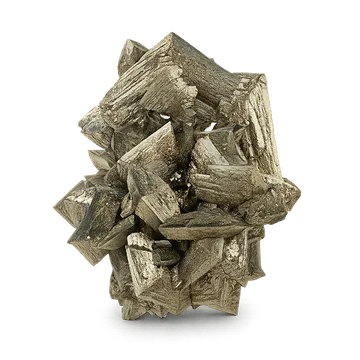
Cap Blanc-Nez, France — a premier locality for marcasite in chalk, prized for sharp bladed crystals and the key distinction from pyrite for collectors.
Key facts
Cap Blanc-Nez is one of the few European localities where marcasite has entered the collector’s imagination as a locality specimen rather than merely as an accessory sulfide. The appeal is immediate: metallic, steel-gray to brassy clusters of sharply bladed crystals, often twinned into spearhead-like “sperkise” forms, perched against pale Cretaceous chalk. The best pieces have the improbable look of a dark metallic flower lifted from a white cliff.

Photo: Wikimedia Commons, Didier Descouens
The locality sits on the Opal Coast between Boulogne-sur-Mer and Calais, where the chalk cliffs expose Cenomanian to Turonian strata broadly comparable in character to the famous White Cliffs across the Channel. The iron sulfides formed as sedimentary-diagenetic bodies within chalk: nodules, aggregates, and—more rarely in collector grade—crystal clusters that can be liberated from chalk matrix. The visual contrast between the soft, light carbonate host and the metallic marcasite is a defining part of the locality’s character.
Cap Blanc-Nez also has a long-standing identification problem that serious collectors must understand. Much material from the site, especially rounded fibrous or radiating nodules from the beach, is pyrite rather than marcasite. The two species share the formula FeS2, but pyrite is isometric and marcasite is orthorhombic. At Cap Blanc-Nez, habit matters: classic marcasite is sought as bladed, twinned, spearhead or cockscomb-like crystal groups, while many globular or octahedral aggregates belong to pyrite. The distinction is not merely pedantic; it affects labeling, value, and long-term stability.

Photo: Wikimedia Commons, Oryctes
Historically, the locality produced specimens considered among the finest for the species in France. One celebrated Cap Blanc-Nez marcasite in the Jussieu university collection was reportedly used as the model for one of France’s mineral postage stamps issued in the 1980s. For collectors today, the most desirable examples are sharp, lustrous, well-separated twinned groups, ideally with enough chalk matrix to prove the setting yet not so much chalk that the marcasite is visually buried.
Search for specimens: View all marcasite specimens from Cap Blanc-Nez, France
Cap Blanc-Nez is a coastal chalk locality at Escalles, in Pas-de-Calais, Hauts-de-France. It is not a mine in the usual sense. Collectors’ specimens come from the natural cliff-and-beach system: chalk blocks, fallen material, and weathered iron-sulfide bodies exposed by marine erosion. The cliff is a high chalk headland rather than a projecting rocky cape, and the sea has cut directly into the chalk ridge.
The mineralization is sedimentary and diagenetic. Iron sulfides formed in chalk and associated carbonate-rich sediments under reducing conditions, producing both pyrite and marcasite. The classic collector’s marcasite occurs as clusters of crystals in chalk, sometimes requiring careful preparation to reveal the metallic crystal groups. Mindat’s locality description captures the field reality well: the marcasites can be “trapped” in massive chalk blocks that initially look like ordinary chalk boulders, except that they are noticeably heavier.
The stratigraphic setting is part of the Cretaceous chalk succession of the Boulonnais. Published work on the Cap Blanc-Nez chalks treats the section as an important Cenomanian–Turonian reference area, with glauconitic basal beds, marly chalk intervals, rhythmic chalk-marl units, and higher chalks. For the mineral collector, the key point is simpler: the marcasite belongs to a chalk-cliff environment, and the matrix is part of the specimen’s identity.
There is no meaningful “mining history” for marcasite here, only a collecting history. Specimens have circulated in French and Belgian collections for decades, with published mineralogical attention by the 1970s and renewed discussion in later French collector literature. Notable older finds include well-formed clusters in the 3–8 cm range, some as matrix specimens and some as loose floaters. Mindat photo records document Cap Blanc-Nez marcasite groupings around 65–75 mm, with individual crystals reported up to about 35 mm in one photographed group.
Collecting access requires caution and current local compliance. The cliffs are vertical, the tides are fast, and the beach can become hazardous with no easy exit. Modern visitors should treat the site as a protected and regulated coastal landscape, not as an open dig. At minimum, any collecting plan must respect tides, cliff-fall danger, posted rules, protected-biotop restrictions, and the legal distinction between loose beach observation and extraction. Historic specimens are common enough in collections that buying old, well-documented material is the cleaner route for most serious collectors.
The hallmark habit is the sperkise twin: flattened, spearhead-like crystals, commonly gathered into rosettes, sprays, cockscomb aggregates, and compact metallic clusters. The crystals can look triangular or bladed from a distance, with faces that flash bright silver-white, steel-gray, or pale brass depending on freshness, surface coating, and lighting. Some specimens show darker tarnish or limonite/goethite oxidation, especially where weathered.
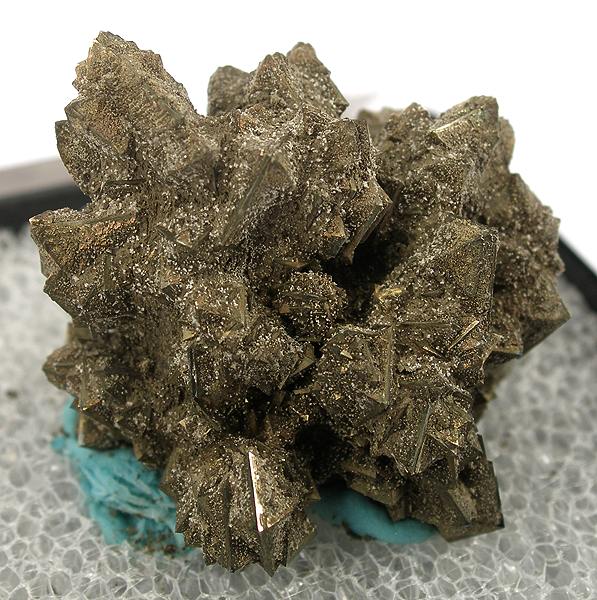
Typical cabinet-quality specimens are small: miniature to small-cabinet pieces are the norm, with individual clusters commonly a few centimeters across. Documented examples include a 3.3 x 3.2 x 2.9 cm floater cluster, a 7.2 x 5.5 x 4.7 cm chalk-matrix piece carrying a rosette about 3 cm across, and photographed older collection groups in the 65–75 mm range. Larger, sharp, attractive matrix specimens are significantly less common than loose or partly prepared clusters.
The best Cap Blanc-Nez marcasite has four qualities at once: sharp twinning, bright metallic luster, three-dimensional crystallization, and honest chalk context. A specimen that sits naturally on chalk matrix is especially desirable because many clusters are found or prepared as loose groups. Fine examples can be nearly complete all around, but collectors should still inspect the backs and edges carefully; small broken blades are common and can be easy to miss in dense rosettes.
Associated and related minerals from the locality include pyrite, calcite, aragonite, gypsum, melanterite, native sulfur, quartz/chalcedony, vivianite, and iron-oxide alteration products traditionally grouped under “limonite.” For practical specimen evaluation, the most important association is pyrite: it occurs abundantly at the same locality and is the source of many labeling mistakes.
The visual boundary between pyrite and marcasite at Cap Blanc-Nez can be subtle. Classic pyrite from the site may form rounded nodules, radiating aggregates, and stacked octahedral-looking crystals, while marcasite gives the flatter, bladed, orthorhombic spear forms that collectors call sperkise. Mixed pyrite–marcasite specimens are possible, and some attractive pieces show both habits together.
Cap Blanc-Nez marcasite is a locality where authentication is mostly about correct species identification, not elaborate fakery. No well-documented epidemic of manufactured fakes is associated with the locality, but mislabeling is common enough to matter. Rounded nodules and bright yellow octahedral aggregates should not be accepted as marcasite without evidence; many are pyrite. For high-value pieces, morphology should be consistent with marcasite, and analytical confirmation by XRD is ideal when the habit is ambiguous.
Preparation is also part of the story. True marcasite clusters may be etched or otherwise carefully cleaned from chalk. That is not automatically a defect, but it means collectors should look for natural-looking attachment, preserved chalk matrix where present, and no suspicious glue lines or reconstructed contact points. Matrix specimens deserve special scrutiny because intact marcasite on chalk is more desirable than a loose cluster artificially set into chalk.
Condition issues are real. Iron sulfides from chalk environments can oxidize, and pyrite disease is particularly notorious in nodular material from Cap Blanc-Nez. Signs of trouble include sulfurous odor, white or greenish efflorescence, cracking, crumbling, or powdery halos in a storage box. The safest storage practice is dry, stable, low-humidity conditions with ventilation and regular inspection. Avoid washing or soaking old sulfide specimens unless the cleaning method is well understood.
Market availability is intermittent. Ordinary pyrite nodules and small iron-sulfide pieces from the area appear regularly in northern European shows and online listings, but sharp, unquestionable marcasite sperkise clusters—especially on matrix—are scarcer. Old French and Belgian collection pieces remain the most attractive source. Expect loose miniatures to be more obtainable than balanced, cabinet-quality chalk-matrix specimens.
At a small mineral show in Strée, Belgium, on February 26, 2023, Antoine Barthélemy found two flats of Cap Blanc-Nez iron sulfides on a friend’s table. The locality was familiar enough at Belgian shows: cheap rounded pyrite nodules for beginning collectors, and, more prized, marcasite clusters prepared from chalk. But one specimen in the flat did not look like the usual Cap Blanc-Nez marcasite. It was nearly spherical, bright brass-yellow, velvety, and in excellent condition. It was clearly an iron sulfide, but its habit sat uneasily between expectation and label.
The seller introduced Barthélemy to the field collector who had gathered the material. The collector called the pieces pyrite, pointing to compound crystals that seemed to be built from stacked octahedra. Barthélemy bought two of the odd specimens anyway, attracted first by their beauty. The real argument began only after photography. Once the images were posted online, collectors started pushing back: many thought the pieces were marcasite. The debate sharpened when the second specimen was chosen as Mindat Photo of the Day on April 15, 2023. Experienced collectors and Mindat managers weighed in. Pyrite advocates saw staggered octahedra; marcasite advocates saw faces too steep and elongated to be ordinary octahedral pyrite.
The question was finally settled by analysis rather than opinion. James Murowchick offered to run powder X-ray diffractometry on a sample. Barthélemy had already sold the two photographed specimens, so he obtained another smaller piece of the same habit from a friend and sent it to the United States. XRD showed the material to be pyrite. SEM imaging then looked for tiny pores that might suggest marcasite had been replaced by pyrite; instead, the images supported primary pyrite, with stacked octahedra, cube truncations, and pyritohedral faces. The episode is now a useful cautionary tale for Cap Blanc-Nez collectors: attractive iron sulfides from this locality can fool excellent eyes, and habit alone is sometimes not enough.
The same discussion later drew comments from collectors deeply familiar with Cap Blanc-Nez material. Jean-Marie Claude described specimens in which steel-gray marcasite crystals occur intimately with yellow pyrite octahedra, producing attractive mixed pieces. Jolyon Ralph, drawing on years collecting comparable chalk-cliff material across the Channel at Dover, noted the same distinction: pyrite and marcasite can occur together, but their color and morphology can be visibly different once the eye is trained.

.JPG)
