







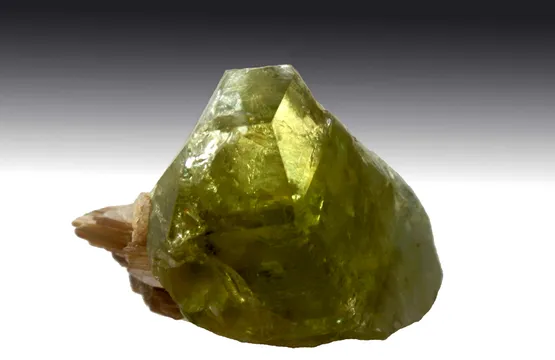
Linópolis, Brazil — phosphate-rich pegmatites yielding brazilianite, scorzalite, and souzalite; Córrego Frio and Telírio mines produce brazilianite on muscovit…
Key facts
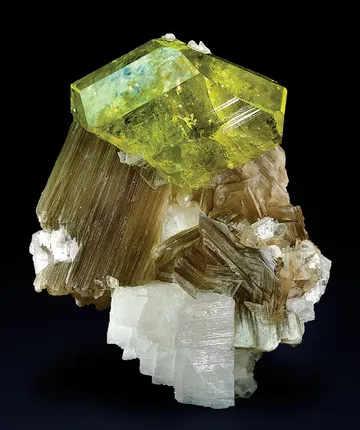
Linópolis is one of the great phosphate-pegmatite names in mineral collecting: a small district in the Rio Doce country of eastern Minas Gerais whose specimens gave the world brazilianite, scorzalite, and souzalite, and whose later mines kept brazilianite in the cabinets of serious collectors long after the first Córrego Frio crystals had become historic objects. The locality as used by collectors centers on the Linópolis district of Divino das Laranjeiras, close to the Mendes Pimentel boundary, within the Conselheiro Pena pegmatite district of the Eastern Brazilian Pegmatite Province. Geologically it belongs to the Araçuaí Orogen and the Rio Doce magmatic belt, where granitic pegmatites intrude schistose metasediments of the São Tomé/Rio Doce succession. In collector terms, that means phosphate-rich, albite–muscovite–quartz pegmatites, not just gem pockets: the best specimens show lemon-yellow to greenish-yellow brazilianite crystals perched on silvery muscovite books, white albite or cleavelandite, and occasionally quartz, with a distinctive Minas Gerais brightness that is hard to confuse once seen.
Regional View
Country View
The name Linópolis on an old label may cover several closely related workings. Córrego Frio, also known locally as Lavra do Duquinha, is the classic type-locality mine: a small, zoned, tabular pegmatite famous far beyond its dimensions. Telírio became the long-running modern standard for attractive brazilianite matrix specimens, producing brilliant greenish-yellow crystals, many doubly terminated, commonly on white microcline/albite, lamellar muscovite, or, more rarely, pale smoky quartz. Sebastião Cristino contributed an important later pulse of brazilianite production and became the type locality for ferroqingheiite. Around these names are the usual confusions of a working pegmatite district: “Linópolis,” “Divino das Laranjeiras,” “Mendes Pimentel,” “Conselheiro Pena,” and “Doce Valley” have all appeared on labels, but the most useful collector label today names the specific claim whenever possible.

Photo: Lech Darski / Wikimedia Commons

Search for specimens: View all specimens from Linópolis, Brazil
Linópolis lies in the Galiléia–Mendes Pimentel sector of the Conselheiro Pena pegmatite district, one of the phosphate-rich belts of the Eastern Brazilian Pegmatite Province. The pegmatites of the district are granitic bodies emplaced in schists and related metasedimentary rocks during the long evolution of the Araçuaí Orogen. The brazilianite-bearing bodies studied in the Linópolis–Divino das Laranjeiras area are small by industrial pegmatite standards, generally thin tabular bodies rather than huge open quarries, and they are notable for relatively low differentiation compared with the great Li-Cs-Ta pegmatites elsewhere in the province. Their importance is not tonnage but paragenesis: montebrasite, albite, muscovite, quartz, and a remarkable suite of secondary phosphates created the conditions for brazilianite and its rarer companions.
Córrego Frio is the district’s historic anchor. It is a tabular pegmatite striking roughly east-west and dipping steeply north, enclosed in biotite-garnet schist. Classic descriptions divide the body into a massive border zone, a crystal-cavity zone, and a quartz lens. The border zone is principally massive albite with subordinate quartz and muscovite; the central parts carried quartz, cleavelandite, muscovite, and the phosphate minerals. Córrego Frio’s mineralization is concentrated between the albite-rich border zone and the quartz core, and the old literature emphasizes the overwhelming dominance of albite, muscovite, and quartz, which together make up almost all of the pegmatite. The phosphates are the glory: brazilianite, fluorapatite, scorzalite, souzalite, and several secondary iron-manganese phosphates occur with rarer accessories such as tapiolite and zircon.
The mining history of Córrego Frio is unusually well documented for a small pegmatite. Brazilianite-bearing material was discovered in the early 1940s, during the same broad wartime period when eastern Minas Gerais pegmatites were being worked for industrial minerals. Frederick H. Pough and Edward P. Henderson described brazilianite in 1945, after material first thought by the owner to be chrysoberyl proved to be a new sodium aluminum phosphate. In late 1944 the American mineral dealer E. R. Swoboda, recognizing the rarity of the crystals, leased the locality and supervised additional excavation. During 1945 and 1946 he offered brazilianite crystals to museums, dealers, and collectors in the United States, which helped make the new species immediately visible in important collections.
Córrego Frio was never a large mine in the modern sense. Early descriptions record an exposed length of about 18 meters, about 10 meters of vertical exposure, and a thickness narrowing from roughly 3 meters near surface to about 1.5 meters in the lower crosscut. The quartz lens had already been mostly removed by the time of the classic 1949 description; miners described it as having once cropped out for about 5 meters along strike, with a thickness of about half a meter to one meter, thinning downward and disappearing by roughly 4 meters depth. Later field studies record the old Córrego Frio working as internally collapsed, so specimens from the classic mine should be treated as historic rather than as material likely to be collected casually today.
Telírio is the modern collector’s Linópolis. Located about 7 kilometers north of Linópolis and roughly 500 meters west of the MG-417 road between Linópolis and Mendes Pimentel, the Telírio mine complex has been described as the principal Brazilian source of beautiful brazilianite specimens for more than four decades. The mine area includes named workings such as Lavra do Duquinha, Lavra Joaquim Gabriel, Lavra do Elias, and Lavra do João Modesto in the broader Telírio–Córrego Frio cluster. The Telírio pegmatite is hosted by biotite schist, is zoned but not highly evolved, and reaches about 7 meters in maximum thickness. Its narrow, discontinuous quartz core is surrounded by an intermediate zone with microcline/albite, quartz, muscovite, beryl, almandine, cassiterite, and montebrasite. The economically and aesthetically important minerals occur in replacement bodies near the core, including small semi-spherical pockets known locally to miners as “ximboquinhas,” as well as massive phosphate blocks.
Those Telírio replacement bodies are crucial for understanding the specimens. Brazilianite there is not simply sprinkled through pegmatite as a random accessory; it is tied to phosphate alteration, especially the alteration of montebrasite during an early hydrothermal stage. The associated suite includes beryllonite, eosphorite-childrenite, fluorapatite, frondelite, heterosite, greifensteinite, moraesite, vivianite, and zanazziite. Montebrasite itself continues to be recovered and has often been miscalled amblygonite in the trade, a common old pegmatite-label habit because the amblygonite–montebrasite series is visually treacherous without analysis.
Sebastião Cristino, named for the landowner, sits southeast of the Córrego Frio area and is a different style of deposit. It produced roughly a ton of brazilianite in a relatively short production episode around the early 2000s, including aggregates reported up to about 50 kilograms, but the working was later suspended. The pegmatite is about 6 to 7 meters thick, trends northeast, dips gently northwest, and cuts across the foliation of a biotite-garnet schist host. It includes abundant xenoliths of that schist and lacks the obvious zoning of Córrego Frio. Quartz, microcline/albite, almandine, schorl, beryl, and fluorapatite are the main framework minerals, with brazilianite accompanied by secondary phosphates such as frondelite, jahnsite-group minerals, and cyrilovite. Material from the dump also yielded ferroqingheiite, later recognized as a new phosphate species.
Collecting access today should be viewed realistically. These are not public fee-dig sites. The important workings are private or cooperative mining areas, and some, especially old Córrego Frio, are inactive or unsafe. Specimens reach collectors through local miners, Brazilian dealers, older collections, and international dealer stock. For field collectors, permission, local guidance, and current safety conditions matter more than any map coordinate; for specimen buyers, the key is locality precision and honest separation between Córrego Frio type-locality material, Telírio production, Sebastião Cristino production, and pieces that merely carry the broad “Linópolis” label.
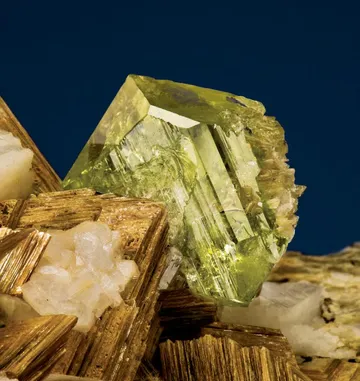
Brazilianite from Linópolis is the world standard for the species: yellow to greenish-yellow, commonly lustrous, and, in the best Telírio examples, bright enough to look almost gem-like even when the crystal is only partly transparent. Córrego Frio supplied the type material and the great early history, with crystals in the classic study ranging from small splendent individuals to major crystals and with many well-developed, doubly terminated forms carrying numerous faces. Telírio specimens typically appeal more to modern aesthetics: sharp prismatic crystals, many doubly terminated, in sculptural sprays or isolated crystals on white albite, cleavelandite, microcline, muscovite, or uncommon quartz combinations. Sebastião Cristino material can occur as larger aggregates and is historically important for volume, but the finest collector pieces are judged by transparency, saturated lemon-to-greenish color, strong luster, undamaged beveled terminations, and a matrix that gives the crystal air and contrast rather than burying it in massive feldspar.
Albite is the structural backbone of the Linópolis pegmatites as well as the most important matrix mineral for many specimens. At Córrego Frio the massive border zone is chiefly albite, with cleavage faces reported up to about 15 cm wide, while the crystal-cavity zone contains cleavelandite, porous albite, quartz, and muscovite around the phosphate pockets. At Telírio, white albite and cleavelandite provide the classic pedestal for greenish-yellow brazilianite and pale montebrasite; the best pieces show sparkling, clean, well-separated albite that frames the phosphate crystals rather than overwhelming them. Ordinary albite from the district is common matrix material, but collector-grade albite is the crisp white, lustrous, platey or blocky material that creates contrast with brazilianite, beryllonite, montebrasite, and the rarer secondary phosphates.
Montebrasite from Linópolis, especially Telírio, is more than a supporting species: it is the primary phosphate from which brazilianite is thought to form by early hydrothermal alteration, and it remains one of the district’s diagnostic collector minerals. Specimens are typically pale yellowish, cream, or translucent to cloudy, often associated with albite, quartz, muscovite, brazilianite, beryllonite, fluorapatite, eosphorite-childrenite, frondelite, moraesite, vivianite, and zanazziite in the replacement bodies near the quartz core. Older and commercial labels may call this material amblygonite, but the studied Telírio phosphate is montebrasite-dominant. The best specimens are not just chunks of pale phosphate; they show recognizable crystal form, attractive translucency, good scale on contrasting albite, and, ideally, a paragenetic link to brazilianite-bearing pocket material.
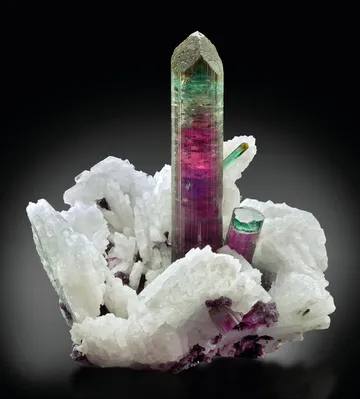
Beyond those three collector staples, Linópolis is important for a deep phosphate suite. Córrego Frio is the type locality for scorzalite and souzalite as well as brazilianite, and the classic mineral list includes fluorapatite, beraunite, childrenite/eosphorite, dufrénite, frondelite, jahnsite-group minerals, roscherite, sabugalite, strunzite, wyllieite, tapiolite, and zircon. Telírio adds beryllonite, greifensteinite, heterosite, moraesite, vivianite, and zanazziite to the collector conversation, while Sebastião Cristino is the type locality for ferroqingheiite, a rare alluaudite-group phosphate occurring as thin reaction rims around frondelite grains. For advanced collectors, these rarities are the reason to look twice at dull-looking phosphate masses from old Linópolis material: what appears at first to be brown or green alteration can carry the district’s most interesting mineralogy.

Photo: Slashme / Wikimedia Commons
The main authenticity issue with Linópolis specimens is not usually outright faking, but locality precision. “Linópolis” is a valid and useful district label, yet it is less informative than Córrego Frio, Telírio, Sebastião Cristino, Jove Lauriano, or another named claim. Older pieces may be labeled Conselheiro Pena because the old administrative and mineral-trade geography placed the discovery in that broader district; others may say Galiléia, Doce Valley, or simply Minas Gerais. A Córrego Frio attribution carries special significance for brazilianite, scorzalite, and souzalite because of type-locality status, so it should be supported by an old label, collection history, or a trusted dealer record.
Condition is the decisive quality factor in Linópolis brazilianite. The crystals have perfect to good cleavage directions and can be brittle at terminations, so bruised tips, contacted back sides, repaired breaks, and edge nicks are common. Many otherwise attractive crystals are cloudy, internally veiled, or “crazed,” especially in larger or thicker examples. That does not make them bad specimens—some of the largest Telírio crystals are naturally less transparent—but it does separate cabinet-quality pieces from top-tier examples. The best pieces combine saturated greenish-yellow color, glassy luster, complete terminations, and a balanced matrix of white albite or silvery muscovite.
Montebrasite and albite labels deserve caution. Pale montebrasite from Telírio has often been called amblygonite in old trade usage, and without analytical data that distinction can remain uncertain in mixed-series material. Albite, cleavelandite, and microcline are also easily simplified or misnamed on old labels; for most collectors this matters less than the overall locality, but for systematic collectors it is worth keeping the original label and any later analytical correction together.
Color treatment is a subtler issue. Studies of brazilianite from Minas Gerais, including Córrego Frio and Telírio material, show that yellow coloration is tied to near-ultraviolet absorption associated with fixed O1- hole centers, and that heating can reduce yellow color while irradiation can restore or modify it in some cases. The green component appears more stable under those experiments. In the collector market, intensely colored Linópolis brazilianite should still be judged first by normal specimen standards—natural-looking tone, even color, provenance, and absence of damage—but high-end gemmy crystals deserve a frank conversation about treatment history if they have passed through lapidary or gem channels.
Rarity varies strongly by species and by specificity. Telírio brazilianite remains obtainable in the market, especially thumbnails, miniatures, and small cabinet pieces, though pristine gemmy matrix examples have become progressively more selective. Old Córrego Frio type-locality specimens are scarcer and command a premium when the label history is convincing. Linópolis scorzalite, souzalite, ferroqingheiite, good montebrasite crystals, beryllonite, zanazziite, moraesite, and well-identified secondary phosphate specimens are all substantially harder to replace than ordinary brazilianite on albite.
In the origin story of brazilianite, the first surprise was a mistake. The owner of the material thought the yellow-green crystals were chrysoberyl, a reasonable guess in Minas Gerais gem country, but Frederick H. Pough recognized that the habit did not fit. The result was one of the rare moments when a new mineral also arrived as a plausible gemstone. Nature’s brief 1946 notice treated the discovery as newsworthy not simply because it was a new species, but because it was “a new gem stone,” a modern gem-mineral discovery at a time when such finds were exceptional.
The Córrego Frio pegmatite was small enough to describe almost by the meter, yet it entered mineralogical history three times. By the late 1940s, it had yielded brazilianite, scorzalite, and souzalite. The classic U.S. Geological Survey study reads like an autopsy of a pocket: a tabular pegmatite only about 18 meters exposed at surface, narrowing downward, with a quartz lens already largely mined out, and with a tiny suite of phosphate minerals doing the work of a much larger locality. In late 1944, E. R. Swoboda leased the site and pushed additional excavation; by 1945 and 1946, crystals from this little Brazilian working were being offered to museums, dealers, and collectors in the United States.
One early episode still stings every collector who reads it. Between 1943 and 1946, roughly 30 kg of gem crystals and about 200 kg of specimen-grade “pound material” were recovered. Many of the gem crystals were destroyed before or during cutting. Two miners reported that a many-faced crystal found in 1943 weighed about two kilograms; it was broken up in an attempt to obtain gem-clear pieces. The largest surviving crystal known to the authors of the classic study weighed about one kilogram and was displayed at the U.S. National Museum in Washington. It is the familiar tragedy of early gem discoveries: the material was valuable before everyone understood exactly what kind of value it had.
Telírio changed the collector image of the district. Córrego Frio gave brazilianite its scientific identity; Telírio gave later generations the bright, sculptural, matrix pieces that became the modern visual standard. Brazilian researchers describe the best Telírio crystals as bright greenish yellow, commonly doubly terminated, sometimes grouped into forms that look like little natural sculptures. Many sit on white microcline or albite; rarer pieces rise from sparkling albite or pale smoky quartz. The mine’s local geology even has its own vocabulary: the small semi-spherical replacement pockets near the quartz core are called “ximboquinhas” by miners, a wonderfully specific word for the little phosphate chambers that produced the district’s cabinet specimens.
Sebastião Cristino supplied a different kind of astonishment. In the early 2000s it produced about a ton of brazilianite, sometimes in aggregates up to 50 kg, an enormous figure for a mineral most collectors meet as thumbnails and miniatures. The same working later gave mineralogy a quieter prize: ferroqingheiite, found in material from the mine dump as thin reaction rims around frondelite. That is Linópolis in miniature—commercially visible as yellow-green crystals, scientifically inexhaustible as phosphate alteration.

