L'Etoile du Congo Mine, DR Congo — a classic Katanga locality known for cornetite, malachite, and chrysocolla; notable oxide-cap specimens and blue-green druse…
Key facts
L'Etoile du Congo is one of the classic names of the Katanga Copper Crescent: an old copper-cobalt mine on the northeastern edge of Lubumbashi, historically known also as the Star of the Congo Mine and the Kalukuluku Mine. To specimen collectors it matters less for primary ore than for the intensely oxidized upper part of the deposit, where copper and cobalt minerals formed a vivid secondary suite. The mine is the type locality for cornetite, Cu3(PO4)(OH)3, and its best specimens combine the three colors that define the locality at a glance: malachite green, chrysocolla turquoise, and cornetite blue, often against black heterogenite or pale altered sedimentary matrix.
Geologically, Etoile is a stratiform copper-cobalt deposit in the DRC-Zambian Copperbelt. The ore is hosted in Lower Roan Group dolomites, shales, and sandstones, and the mined zone includes an enriched oxide cap, a mixed zone, and deeper sulphide mineralization. For collectors, that supergene oxide cap is the essential part of the story: it supplied botryoidal and stalactitic malachite, pale to saturated blue chrysocolla crusts, black heterogenite skins, and small but electric cornetite crystals in rosettes, pseudo-octahedrons, crusts, and glittering druses.
Regional View
Country View
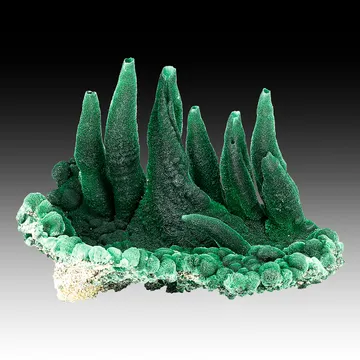
The strongest Etoile specimens are not merely “Congo copper color.” They have a particular layered look: malachite may appear as fibrous botryoids, mammillary crusts, stalactitic masses, or banded polished sections; chrysocolla may form bright blue botryoidal crusts and coatings; cornetite gives the rarer specimens a crystalline sparkle in deep indigo to teal-blue rosettes; and heterogenite supplies the glossy black contrast that makes the blues and greens read sharply. Cabinet pieces that retain undamaged rounded surfaces and a natural, unpolished sculptural form are especially desirable; polished slices are collected separately for their dramatic concentric “eyes” and banding.

Photo: Wikimedia Commons

Photo: Wikimedia Commons

Photo: Wikimedia Commons
Search for specimens: View all specimens from L'Etoile du Congo Mine, DR Congo
L'Etoile du Congo is a surface copper-cobalt mine at Kalukuluku, near Lubumbashi in Haut-Katanga. The deposit lies in the southern Katangan portion of the Central African Copperbelt, in the same broad metallogenic province that links the DRC Copper Crescent with Zambia. The orebody is stratiform, with copper and cobalt mineralization hosted by Lower Roan Group dolomites, shales, and sandstones. Mine descriptions record mineralization along about 1.4 km of strike, drilled to about 250 m depth, in two principal horizons referred to as the Upper and Lower orebodies.
The upper orebody is the collector’s zone: an oxidized, tabular, supergene-enriched cap, reported at roughly 50 m thick, above an inclined sulphide body. It is structurally complicated, with folding and thrust faulting, and the mineralized sequence is cut off at depth by a steeply dipping fault regarded in the older operator literature as a deposit boundary. The oxide portion was attractive to miners because it was close to surface and amenable to open-pit truck-and-shovel extraction; it was attractive to collectors because the same weathering system generated the mine’s copper carbonates, silicates, phosphates, cobalt oxides, and cobalt carbonates.
The historical sequence is long by Katangan standards. Tanganyika Concessions dug pits and trenches in the area in 1907. Union Minière du Haut Katanga discovered the Etoile orebody in 1911, the same period in which Henri Buttgenbach collected the material that led to cornetite’s recognition. The deposit was originally known as Kalukuluku, after the nearby village, and later acquired the French name L'Etoile du Congo, the Star of the Congo. Under UMHK and then Gécamines, the mine and nearby Ruashi were quarried intermittently for high-grade copper ore. Gécamines worked Etoile until the 1960s; after that, artisanal miners worked the area for decades. Around 2000 the Ruashi-Etoile concession was divided, and Etoile was signed over to Chemaf in 2003.
Chemaf reopened Etoile in 2005 and began refined copper production in 2007. Older Shalina Resources material described Etoile as an uncomplicated surface mine with an oxide upper orebody, a mixed middle section, and sulphides below; ore from Etoile was moved to processing facilities in Lubumbashi, including the Usoke plant in earlier operations. A 2008 assessment reported 13.5 million tonnes of in-pit resource grading 3.3% Cu and 0.55% Co, while JORC figures compiled in 2007 listed total copper resources of 21.43 Mt at 3.02% Cu and total cobalt resources of 15.08 Mt at 0.61% Co. In 2016, Chemaf commissioned a modern Etoile processing plant; in 2019 the operation was described by Chemaf as one of the world’s major cobalt producers. In 2026, the DRC Ministry of Mines and Gécamines approved the acquisition of Chemaf by Virtus Minerals, leaving the mine a current industrial copper-cobalt asset rather than a casual collecting locality.
For collectors, this modern operating status matters. Etoile specimens on the market are best understood as a mixture of older mine material, artisanal-period material, material dispersed through Lubumbashi traders, and pieces from the long commercial stream of Congolese copper minerals that passed through dealers in Europe, South Africa, and the United States. The mine is not a public collecting site. Reliable locality attribution depends on old labels, documented dealer provenance, distinctive assemblage, and comparison with photographed and published material; generic “Lubumbashi” labels should be treated cautiously, because that city has long been a trading hub for specimens from many Katangan mines.
The most collectible Etoile pockets and finds are represented by three families of specimens. The first is malachite: botryoidal, mammillary, stalactitic, banded, fibrous, or drusy material, sometimes cut and polished to show concentric tubes. The second is chrysocolla-rich material: bright blue to turquoise botryoidal crusts on breccia, sandstone, or older copper mineralization, often in large quantity but variable quality. The third, and scientifically most important, is cornetite-bearing material: dark to sky-blue rosettes, pseudo-octahedrons, and crusts associated with malachite, chrysocolla, pseudomalachite, libethenite, and heterogenite. Those cornetite specimens are the pieces that make Etoile a locality every systematic collector recognizes.
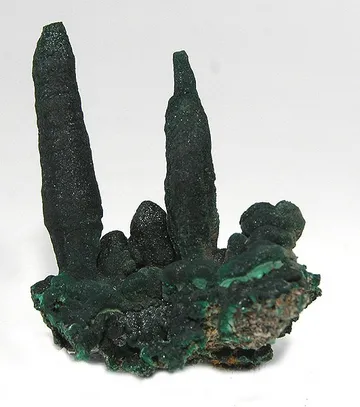
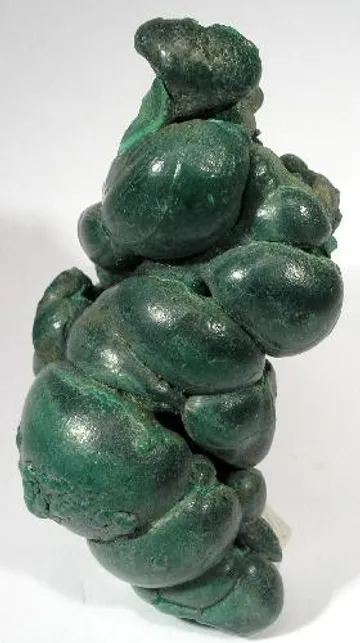
Malachite from L'Etoile du Congo ranges from light to dark green botryoidal and mammillary masses to stalactitic aggregates, banded slices, and local druses of tiny crystals; at the Star mine, experienced collectors distinguish the true malachite as banded masses or needles, while the blue-green “gluey” botryoidal material on mixed specimens is often pseudomalachite or chrysocolla. Good Etoile malachite is judged by saturated color, intact rounded surfaces, crisp fibrous or stalactitic growth, and strong contrast with chrysocolla, cornetite, or black heterogenite; ordinary pieces are massive, bruised, poorly attributed, or polished only for lapidary color rather than specimen character.
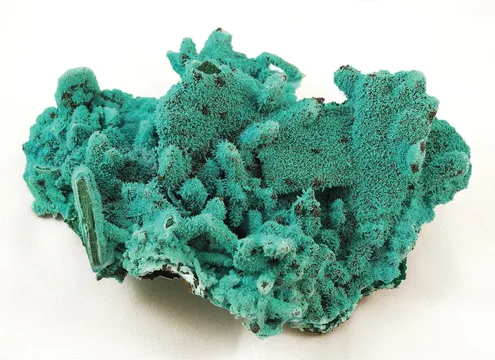
Chrysocolla is one of Etoile’s signature specimen minerals, typically forming pale blue, turquoise, or rich blue botryoidal crusts, rounded “balls,” coatings on malachite, and blue patches in mixed cornetite-pseudomalachite-heterogenite pieces. Large quantities of bright botryoidal chrysocolla from Etoile entered the specimen trade during and after the artisanal period, but the best pieces are not merely colorful lumps: they show undamaged lustrous or satiny botryoids, clean sculptural relief, vivid contrast against green malachite or black heterogenite, and, on finer mixed specimens, tiny sparkling cornetite crystals set into or over the blue crust.
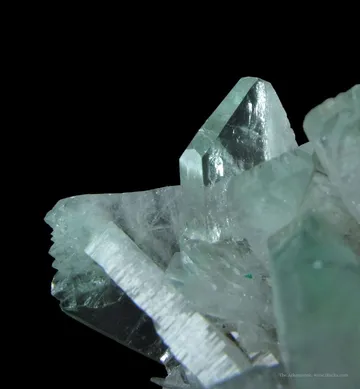
Cornetite is the mineral that gives L'Etoile du Congo its permanent place in mineralogical history: the mine is the type locality for this copper hydroxy-phosphate, and Etoile specimens show dark blue to teal or sky-blue crystals as pseudo-octahedrons, rosettes, crusts, and sparkling drusy carpets. Single crystals used in structural work from Mine de L'Etoile were subhedral prisms about 0.30–1.0 mm, which is typical of the species’ small scale here; the most desirable specimens make up for that size with richness, brilliance, and contrast, especially where cornetite covers chrysocolla or pseudomalachite and is framed by malachite needles or black heterogenite.
Other documented minerals from L'Etoile du Congo include allophane, cacoxenite, dolomite, hematite including martite, heterogenite, libethenite, pseudomalachite, quartz, spherocobaltite, and tenorite. The phosphate suite is especially important: pseudomalachite occurs as small bluish-green botryoidal crusts, libethenite appears in the association on cornetite-bearing specimens, and cornetite is the mine’s type-locality mineral. Heterogenite is the principal cobalt oxide of collector interest at Etoile, forming black botryoidal crusts and stains, commonly in sharp visual association with malachite, chrysocolla, cornetite, and pseudomalachite.
The first collecting issue with Etoile is attribution. Lubumbashi is both the nearest city and a major mineral-trading center, so old labels reading only “Lubumbashi,” “Katanga,” or “Congo” may refer to Etoile, but they may also refer to Ruashi, Kipushi, Luiswishi, Kambove-area mines, Kolwezi-area mines, or simply dealer stock assembled in the city. Strong Etoile attribution is easiest for classic cornetite-bearing pieces, especially those with old labels, documented dealer history, or close matches to the known assemblage of cornetite, chrysocolla, malachite, pseudomalachite, heterogenite, and libethenite.
Malachite authenticity deserves particular caution. Genuine Etoile and Katangan malachite stalactites absolutely exist, but the market has also seen assembled, repaired, and fabricated “Congo malachite” made with broken stalactites, powdered malachite, resin, glue, wire, or reconstructed bases. Warning signs include repeated unnatural finger shapes, resin at attachment points, central supports that look manufactured rather than naturally hollow, sparkling coatings that wrap over broken edges, and suspiciously uniform green surfaces lacking fibrous or banded internal structure. A polished slice should show coherent concentric growth, not random green filler or seams.
Condition issues are predictable for this assemblage. Cornetite is usually small and occurs as drusy crusts or tiny crystals, so abrasion quickly reduces a lively blue sparkle to dull blue patches. Chrysocolla and pseudomalachite crusts may bruise, chip, or flake at edges, especially on thin breccia fragments. Malachite stalactites and botryoids often have repaired tips, sawed bases, or polished faces; these are not automatically defects if disclosed, but they place the specimen in a different collecting category from an untouched natural cabinet piece. Heterogenite coatings can look glossy and attractive but may conceal broken or altered areas underneath.
Fluorescence is not a selling point for the main Etoile suite. Mindat records cornetite, malachite, heterogenite, pseudomalachite, and cacoxenite from the locality as not fluorescent. Handling is straightforward: keep fibrous malachite and powdery or crustose secondary copper minerals out of water and acids, avoid ultrasonic cleaning, and do not use acetone testing on a valuable specimen unless you are prepared for damage. Acetone is sometimes discussed as a way to detect resin-bound fakes, but it is a destructive test and should not be a routine authentication method.
Availability is uneven. Chrysocolla and malachite from Etoile appear regularly, from modest decorator-grade pieces to fine small cabinets. Cornetite is much scarcer and is priced by richness, sparkle, crystal definition, and type-locality desirability. The best mixed specimens—blue cornetite on chrysocolla or pseudomalachite with green malachite and black heterogenite—remain the most characterful Etoile pieces for systematic collectors because they show both the mine’s scientific identity and its unmistakable Katangan color.
In 1997, mineral dealer Rock Currier reached Lubumbashi in the turbulent aftermath of Mobutu Sese Seko’s fall, chasing the legendary copperbelt minerals of what had just ceased to be Zaire. His account is one of the most vivid specimen-buying narratives connected with Etoile. At Sam Benatar’s malachite factory in Lubumbashi, Currier found about 20 runners gathered outside the little office building, their specimens spread directly on the ground. The display was not a neat bourse table but a street-level mineral carpet: pink glittering cobaltoan dolomite, then green sparkling malachite, then what he described as a “blue swath” of bubbly chrysocolla and cornetite from nearby Etoile. He noted that most of the chrysocolla and malachite were botryoidal, while some malachite consisted of druses of microcrystals only a millimeter or two across—interesting, perhaps, to micromounters, but much of it not worth air freight.
The same trip gives a useful snapshot of Etoile at a hinge point in its specimen history. Currier described the mine as abandoned and just outside Lubumbashi, explaining that labels might say Star mine because Etoile means star in French, while local people knew it as Kalukuluku after the nearest village. He had the dealer’s problem every buyer of bulk Congo copper minerals knows: irresistible color, brutal shipping economics. He bought 50 kilograms of Etoile chrysocolla, mostly breccia fragments coated with bright blue botryoidal material, and predicted that if export ever became cheap, such specimens would become common in Europe and the United States.
The logistics around those specimens were as memorable as the minerals. Currier’s party decided to use a new air service from Lubumbashi to Johannesburg on its first flight, forcing a rush to pack minerals, produce paperwork, negotiate permits, and survive the “usual squeeze.” They worked into the small hours. Air freight, brokerage, and informal payments could drive costs above $10 per kilogram, which explains why so many colorful but heavy Etoile pieces stayed close to source or were converted to lapidary stock. At the airport, the terminal still bore damage from the revolution: broken glass in the doors and no chairs because they had been stolen. Immigration then declared Currier and Victor illegally in the country because their visas were valid for only a week; it cost each of them $75 extra to board the plane.