






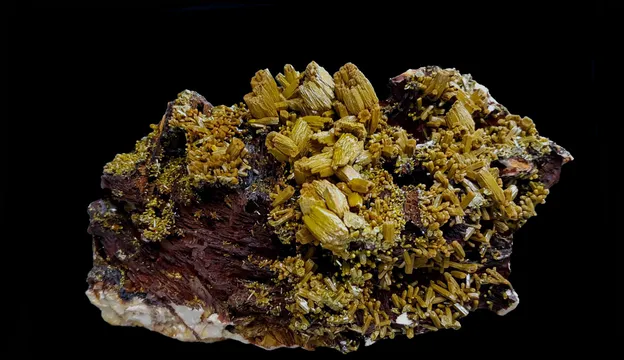
Les Farges Mine, France — renowned lead–pyromorphite locality, producing green to mustard-tipped barrel pyromorphites on baryte and quartz, highly collectible.
Key facts
Les Farges is one of the great modern classics of European lead mineral collecting: a short-lived but extraordinarily productive lead–silver–barite mine near Ussel, in Corrèze, whose reputation rests less on tonnage than on a single species rendered almost iconic here—pyromorphite. The deposit is a hydrothermal barite–quartz–galena vein in the Ussel granite, part of the mineralized setting of the French Massif Central. In the mine, white barite, quartz, argentiferous galena, and minor fluorite formed a banded vein filling; later oxidation of the lead ore generated the green, yellow-green, brown, honey, and mustard-tipped pyromorphites that made Les Farges famous.
The best specimens have a look collectors recognize instantly: glossy barrel-shaped prisms, often with hoppered or polycrystalline terminations, scattered or heaped over white baryte, quartz, goethite-limonite, or dark oxide-stained matrix. Some pieces show the celebrated “mustard touch”—olive to brown prisms capped by yellow or yellow-green tips. Others are all deep apple-green, almost wet-looking, with squat barrels or airy branching aggregates. The finest cabinets combine French refinement with real visual force: high contrast, sculptural matrix, crystals large enough to read individually, and enough color zoning to make the piece unmistakably Les Farges.
Regional View
Country View
The mine’s collecting importance is inseparable from its compressed history. Modern exploration and development moved quickly, the main mining life was essentially the 1970s into 1981, and yet the locality entered the same collector vocabulary as much older European classics. Les Farges pyromorphite is not simply “good French pyromorphite”; it is the standard by which many later green barrel pyromorphites have been compared.

Photo: Géry Parent / Wikimedia Commons

Photo: Géry Parent / Wikimedia Commons
Search for specimens: View all specimens from Les Farges Mine, France
Les Farges lies just east of Ussel in the Corrèze department of Nouvelle-Aquitaine, in the central part of the French Massif Central. The mine worked a steep, NNE-trending barite–quartz vein carrying argentiferous galena, with subordinate sphalerite, pyrite, chalcopyrite, fluorite, and a complex suite of silver and lead sulfosalts. The vein is hosted by the Ussel granite and is aligned broadly parallel to the regional Grand Sillon houiller. It was recognized over several kilometres; underground extraction worked only a more limited productive portion, on the order of hundreds of metres along strike and down to about 250 m depth.
The vein filling was classically banded. Contemporary underground photographs and geological descriptions show white barite bands alternating with grey quartz and galena-rich bands, with fragments of wall rock locally cemented along the vein margin. Reported vein thickness varies from less than a metre to more than 5 m, with an average mining width around 2.5 m in the exploited zone. A useful rule of thumb for the deposit is that barite was more important toward the upper parts, while lead enrichment became more significant at depth. The gangue was dominantly quartzo-barytic; fluorite, usually yellow to honey-yellow at Les Farges, is a comparatively scarce but desirable accessory.
The primary ore was galena, notably argentiferous, and the mine’s economic metals were lead and silver, with barite as a major co-product. A BRGM production summary from the operating period gives an annual run-of-mine output of about 180,000 tonnes, with average lead grades around 5–5.5% and barite around 20–25%. Annual concentrates were listed as about 30,000 tonnes of high-grade barite concentrate and 10,000 tonnes of lead concentrate, the lead concentrate carrying silver at about 1.5 kg per tonne. Cumulative modern production is commonly given as roughly 700,000–800,000 tonnes of run-of-mine ore, about 31,000 tonnes of lead metal, 100,000 tonnes of barite, and about 80 tonnes of silver.
The mining history is older than the modern headframe suggests. Surface workings on the vein have been attributed to Gallo-Roman exploitation for silver-bearing galena, and later attempts were made before the deposit became a modern industrial operation. Victor Lassalle took interest in the site in the early twentieth century, and BRGM work in the 1960s and early 1970s turned a long-known barite–lead vein into a mineable project. The Société Minière de Corrèze, associated with the C.I.M. / Rhône-Progil group and partners including CRAM and Vieille-Montagne, developed and operated the mine. Modern production began in the mid-1970s and ended in 1981.
Mining conditions were not trivial. The granite near the vein was strongly altered, giving poor wall-rock stability, and water inflows were significant. The originally planned upward mining method had to be abandoned in favor of descending slices with backfill made from waste material and cement. Those practical mining details matter to collectors because they explain the short-lived but intense exposure of oxidized and partly oxidized mineralized zones from which specimen pockets could be recovered.
The pyromorphite formed as a secondary lead phosphate in the oxidized portions of the galena-bearing vein. One key point at Les Farges is the depth of oxidation: pyromorphite has been reported as present down to about 200 m in the vein, a remarkable depth for a mineral many collectors think of simply as a near-surface gossan product. The oxidized mineralization is generally linked to old, probably Tertiary to early Cenozoic weathering events; later authors have tied the alteration episode to broader Cenozoic tectonic and geomorphic evolution.
Today Les Farges is not an open collecting site. The installations were dismantled or destroyed after closure, underground workings are flooded, and the land is private. Some later collecting occurred from dumps and from temporary exposures, most notably when A89 motorway works cut another part of the vein in 1998 and allowed collectors to recover new pyromorphite specimens. In the modern market, however, serious Les Farges specimens overwhelmingly come from old mine-period material, old French collections, dealer inventories, or pieces dispersed from named private collections.
Pyromorphite is the defining Les Farges mineral, occurring as lustrous barrel-shaped to prismatic crystals, commonly olive-green, apple-green, forest-green, yellow-green, honey-brown, orange-brown, or khaki, and often with paler yellow to mustard-yellow terminations. Individual crystals on good specimens are commonly several millimetres to around a centimetre, with exceptional pieces carrying larger composite or barrel groups; the famous “La Faynel” specimen has been recorded at about 20 x 17 x 8 cm. The most typical matrix is white baryte or baryte-coated vein material, though quartz, goethite-limonite, oxides, and galena-rich dark matrix also occur. The best pieces show sharp undamaged prisms, wet to waxy luster, strong contrast against white baryte, attractive zoning, hoppered or polycrystalline caps, and a sculptural arrangement rather than a flat crust; ordinary pieces tend to be rubbed, dull, patchy, or too massive to show the crystal individuality that makes Les Farges pyromorphite so desirable.
Barite at Les Farges was not merely an accessory collector species; it formed a major part of the vein filling and was mined as an economic product. In specimens it is most familiar as the white to cream barytic matrix beneath pyromorphite, often bladed, ridged, crested, or massive to crystalline, and its collector value is usually tied to contrast and architecture rather than isolated perfection. Fine Les Farges pyromorphites commonly sit on baryte ridges or draperies, with green, brown, or mustard-zoned prisms cascading across white barite faces; the strongest pieces keep enough exposed barite to frame the pyromorphite cleanly, while lesser examples are visually muddied by iron staining, broken ridge edges, or dull secondary coatings.
Baryte, using the spelling most often seen in European locality descriptions, is the classic Les Farges gangue species and the white half of the locality’s best-known color pairing. Underground descriptions of the vein emphasize regular banding in which white baryte alternates with grey quartz and galena-rich material; in collector specimens this translates into tabular, bladed, crusted, and crested baryte surfaces that host pyromorphite, yellow fluorite, quartz microcrystals, galena blebs, and oxidation minerals. For baryte-labeled Les Farges specimens, the desirable pieces are those with crisp white crystal texture and a balanced association—especially pyromorphite or rare fluorite—rather than anonymous massive barite fragments from the ore vein.
Quartz is a fundamental gangue mineral at Les Farges, forming part of the banded vein filling with baryte and galena, and appearing in collector specimens as brown to grey quartz-rich matrix, small clear to smoky or oxide-stained crystals, and fine drusy coatings on baryte, fluorite, or galena-bearing vein material. Pyromorphite can occur on quartz matrix, including pieces with green barrel crystals and finer acicular growths, and some dealer descriptions note quartz crystals darkened by galena inclusions or coatings. The best quartz-associated Les Farges specimens are valued not for standalone quartz perfection but for locality character: sharp pyromorphite on quartz-rich brown matrix, yellow fluorite with baryte and quartz, or a contrasting quartz/gossan base that sets off the lead secondary minerals.
Les Farges also produced a rich secondary and primary mineral suite beyond the familiar pyromorphite–baryte association. Collector-relevant species include cerussite, sometimes in good crystals; rare orange tabular wulfenite; mimetite; vanadinite; descloizite; phosgenite; fluorite; calcite; galena; sphalerite; pyrite; chalcopyrite; goethite; and an unusually diverse suite of silver and lead sulfosalts and related ore minerals, including acanthite, native silver, dyscrasite, pyrargyrite, proustite, pearceite, freibergite/tetrahedrite-group minerals, bournonite, boulangerite, freieslebenite, geocronite, semseyite, and fizélyite. Les Farges is not known as a type locality for these species, but as a specimen locality it is unusually strong because the same short-lived mine supplied both display-quality secondary lead minerals and a serious microscopic-to-ore-mineral paragenesis.
The principal authenticity issue with Les Farges is not widespread treatment; it is provenance. Good pyromorphite from other localities—especially Chinese Daoping material and some other European green pyromorphites—can resemble the Les Farges look closely enough that labels matter. In fact, “Les Farges green” became a comparison term for some later Chinese pyromorphite, precisely because the color and short barrel habit invited comparison. A sound attribution should rest on old labels, collection history, matrix, habit, and color together: white baryte, quartz-rich brown matrix, olive or brown barrels with mustard-yellow caps, deep green waxy crystals, hoppered terminations, and known mine-period provenance all strengthen a Les Farges call.
Condition is the bigger practical concern. Pyromorphite is brittle and only moderately hard, and Les Farges crystals often project from baryte ridges where terminations, edges, and little branching aggregates are exposed. Yellow-tipped pieces show damage quickly because a broken prism interrupts the color-zoned cap. Acicular or mossy secondary growths can be rubbed flat; darker oxide or galena-coated surfaces may hide bruising until viewed under strong light. On baryte matrix, watch for cleaved or freshly broken white edges at the base and for old glue or acrylic mounting residue on specimens removed from custom stands.
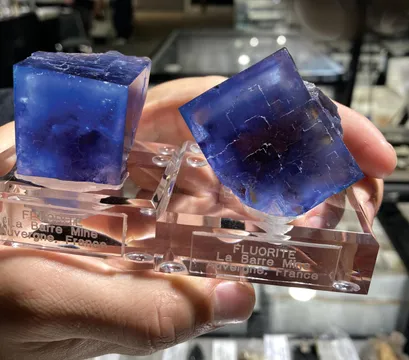
Les Farges pyromorphite is not rare in the sense of being almost unobtainable, but genuinely fine examples are now old-collection pieces and command respect. Small thumbnails and miniatures appear regularly; balanced cabinet specimens with rich color, strong coverage, and minimal damage are much scarcer. Large, sculptural pieces with centimeter-class barrels, deep green color, or the classic yellow-capped brown habit are European classics and should be treated as locality-level reference specimens. Fluorite from Les Farges, especially attractive yellow fluorite with baryte, quartz, and galena, is far less common on the market than pyromorphite and is pursued by specialists in French fluorite as well as Les Farges collectors.
From a handling standpoint, store pyromorphite specimens away from abrasion and loose contact with harder minerals. Avoid aggressive wet cleaning: baryte and quartz can tolerate much, but the value of Les Farges pieces is in small lead-phosphate crystal surfaces, subtle zoning, and delicate terminations. Use a blower or very soft brush only where necessary, and never assume that a dark or metallic-looking surface should be cleaned away; some deep green Les Farges pyromorphite has been described with a possible thin galena coating that may be part of the specimen’s character.
The oldest Les Farges story begins before the mine had a modern name in the mineral trade. Surface scrapings on the vein have been interpreted as possible Gallo-Roman work for silver-bearing galena, and later local tradition attached the place-name “Farges” to the idea of forges. Whether one imagines ancient trenches or the twentieth-century headframe, the attraction was the same heavy grey ore: galena carrying silver. The irony, of course, is that the mine became world-famous not for the metal that paid the bills, but for the green lead phosphate that had no industrial purpose at all.
A second story belongs to the specimen era. Henri-Jean Schubnel, long associated with the mineral collections of the Muséum national d’Histoire naturelle in Paris, is specifically remembered in the literature around Les Farges for a collecting trip made underground to recover pyromorphite in place for public collections. That detail says much about the status the locality achieved while still young: Les Farges was not merely a commercial mine yielding souvenirs from the dumps, but a site where museum-grade French mineral heritage was being gathered while the workings were still accessible.
Then came the 1998 A89 motorway episode. Years after the mine had closed and the underground workings had flooded, construction between Bordeaux and Clermont-Ferrand reportedly cut another part of the Les Farges vein. For collectors, it was a brief resurrection: an engineering project opened fresh rock where the mine itself no longer could, and local geology enthusiasts recovered new pyromorphite specimens from a deposit already considered historic. Few modern classics get such a second act.
A. Brousse, “Famous Mineral Localities: The Les Farges Mine [France],” The Mineralogical Record, vol. 13, no. 5, 1982, pp. 261–268. A core English-language collector reference for the locality and its mineral suite. URL: https://www.mindat.org/reference.php?id=12907620
Michel Jébrak, Le filon des Farges et les minéralisations à barytine, fluorine et galène du district d'Ussel dans leur cadre géologique (Massif Central français), thesis, Université d’Orléans, 1978. The foundational geological study repeatedly cited for the vein structure, paragenesis, and district setting. URL: https://www.spathfluor.com/_private/_private_fr/fr_textes/min_france/ussel.htm
E. Gerard, Le filon de barytine et galène des Farges (Corrèze-France), mémoire, Université de Liège, 1972. An early academic treatment of the barite–galena vein before and during the transition into modern exploitation. URL: https://www.spathfluor.com/_private/_private_fr/fr_textes/min_france/ussel.htm
BRGM, Fiches signalétiques de digues à stériles concernant…, report 80-SGN-433-GEG, 1980. Includes an operating-period summary of the Les Farges mine, its operator, grade, mining method, and concentrate production. URL: https://infoterre.brgm.fr/rapports/80-SGN-433-GEG.pdf
BRGM, Réactualisation de l’inventaire des petits indices de barytine, avec ou sans sulfures de plomb/zinc, sur le granite d’Ussel, report 79-RDM-041-FE, 1979. Places Les Farges in the broader Ussel granite barite–lead district and records follow-up exploration after the success of the Les Farges vein. URL: https://infoterre.brgm.fr/rapports/79-RDM-041-FE.pdf
Julien Lebocey and Roger de Ascenção Guedes, with contributions including Michel Jébrak and Éric Marcoux, Les Minéraux de la Mine des Farges, Ussel (Corrèze), Le Règne Minéral, Hors-Série XV, 2009. A major French monographic special issue devoted to the mine, its geology, specimen history, pyromorphite habits, and associated species. URL: https://www.geoforum.fr/topic/16964-le-regne-mineral-hors-serie-2009-la-mine-des-farges-il-arrive-enfin/
A. R. Kampf, I. M. Steele, and R. A. Jenkins, “Phosphohedyphane, Ca2Pb3(PO4)3Cl, the phosphate analog of hedyphane: description and crystal structure,” American Mineralogist, vol. 91, 2006, pp. 1909–1917. Includes analytical comparison of Les Farges pyromorphite, distinguishing deep green and yellow Les Farges material in the broader apatite-group chemistry survey. URL: https://rruff.info/rruff_1.0/uploads/AM91_1909.pdf
“Les mines du Limousin : la mine de plomb des Farges, à côté d'Ussel” — France 3 Nouvelle-Aquitaine / France Lemaire — Regional report featuring the mine’s history, two former Les Farges miners, and a local amateur geologist. URL: https://france3-regions.francetvinfo.fr/nouvelle-aquitaine/correze/ussel/les-mines-du-limousin-la-mine-de-plomb-des-farges-cote-d-ussel-1051601.html
“Pyromorphite, Mine des Farges, Ussel, Corrèze, Limousin” — Minerals and Crystals / Les Minéraux — Short specimen video accompanying a sold 13.5 x 8 x 4.5 cm green pyromorphite on brown quartz matrix. URL: https://www.minerals-and-crystals.com/wp-content/uploads/2022/09/video-d011c071-47d9-4152-8fd9-e00f323a5af6-1662210838.mp4
“Fluorite, Baryte, Quartz et Galène, Mine des Farges, Ussel, Corrèze” — Les Minéraux — Short specimen video tied to a sold Les Farges fluorite–baryte–quartz–galena specimen, useful because attractive fluorite from the locality is much less commonly seen than pyromorphite. URL: https://www.les-mineraux.fr/wp-content/uploads/2023/05/346913238_5910403589068439_3903611488494208589_n.mp4
Mindat: Les Farges Mine locality page — The best single online reference for coordinates, mineral list, commodity list, photographs, and bibliography.
Spathfluor: Ussel / La mine des Farges et sa fluorine — Detailed French overview of the geological setting, vein morphology, production, fluorite, and historical access notes.
BRGM report 80-SGN-433-GEG — Operating-period technical data on the Société Minière de Corrèze mine, including grades, mining method, and annual concentrate production.
BRGM report 79-RDM-041-FE — District-scale exploration context for barite ± lead/zinc veins in the Ussel granite after Les Farges proved economically important.
Le Règne Minéral Hors-Série XV discussion on Géoforum — Useful contemporary notice of the major 2009 French monograph on the mine, including notes on geology, paragenesis, and the Schubnel collecting account.
Wikimedia Commons: Pyromorphite from Les Farges Mine — High-resolution photograph of a classic Les Farges pyromorphite specimen by Géry Parent.
Wikimedia Commons: Pyromorphite and wulfenite from Les Farges Mine — Useful image documenting the much rarer wulfenite association with Les Farges pyromorphite and baryte.
Fabre Minerals: Pyromorphite on Baryte with Wulfenite — Dealer record documenting color-zoned brown-and-yellow pyromorphite on white barite with a small orange wulfenite crystal.
Minerals and Crystals: Pyromorphite from Les Farges — Detailed sold specimen page for a large green pyromorphite on brown quartz matrix with associated specimen video.
Les Minéraux: Fluorite, Baryte, Quartz and Galena from Les Farges — Sold specimen page illustrating the rare fluorite association from the mine.
France 3 / Patrimoine en Dauphine mirror: La mine de plomb des Farges — Regional history article summarizing the mine’s short modern life, former miners, and the 1998 A89 rediscovery episode.
_0852.jpg)
