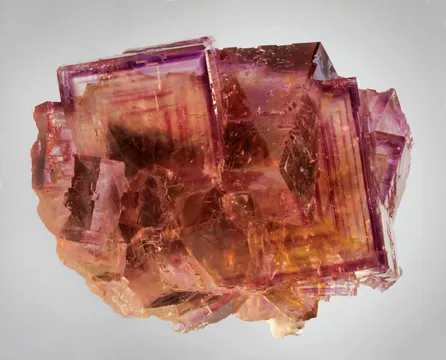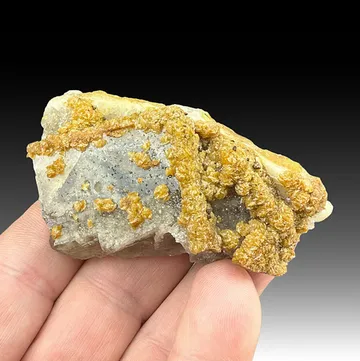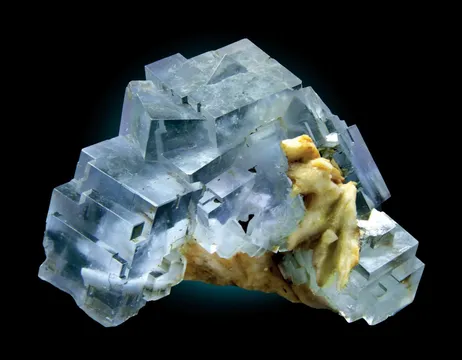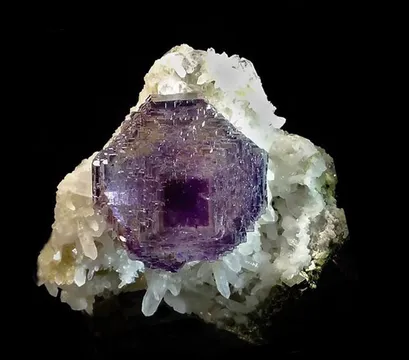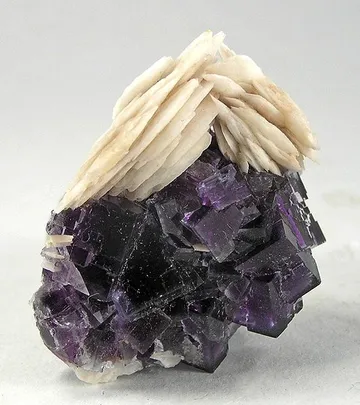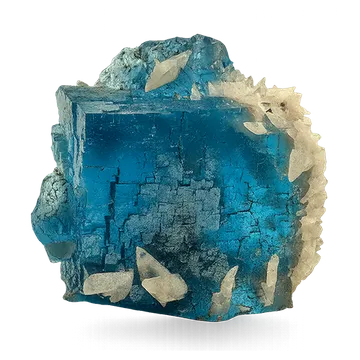
Berbes, Asturias, Spain - classic fluorite locality famed for purple-blue cubes with violet cores, white baryte contrasts, and prized collector specimens.
Key facts
Berbes is one of the classic European fluorite localities: a coastal Asturian mining district where purple, blue-violet, lilac, and sometimes nearly colorless fluorite cubes grew in open cavities with white baryte, quartz, and calcite. The best pieces have a very particular look: glassy cubic crystals with saturated violet cores, concentric phantom zoning, sharp edges, and the bright contrast of bladed white baryte. When a Berbes fluorite is especially transparent, the color seems suspended inside the cube rather than painted on the surface—one reason serious collectors prize the locality so highly.

Photo: Wikimedia Commons
The district lies around Berbes, in the municipality of Ribadesella, Asturias, near the northern Spanish coast. Mineralogically it belongs to the Caravia-Berbes fluorite district, one of the great fluorspar-producing areas of northern Spain. The ores are low-temperature hydrothermal fluorite-baryte-quartz mineralizations, controlled by faults, veins, stockworks, and karstic openings in Carboniferous limestone and dolomitized limestone beneath Permotriassic cover rocks. That structural and karstic setting explains the collector specimens: open space allowed fluorite cubes, baryte blades, and doubly terminated quartz crystals to develop with freedom rather than as massive ore.
Berbes is especially famous for the Ana vein and its related workings: La Cabaña, El Frondil, Los Cobayos or La Paredona, Valdelmar, Cuetu l’Aspa, and La Busteriza. La Cabaña is the collector’s name that appears again and again on fine labels, because it yielded many of the most balanced fluorite-baryte combinations and the celebrated double-terminated quartz crystals with hydrocarbon inclusions. Some Berbes quartz crystals contain visible bubbles and organic inclusions; these are not merely curiosities, but part of the same petroleum-bearing hydrothermal story that gave the district its distinctive mineralogy.

Photo: Wikimedia Commons
Historically, Berbes sits at the intersection of industrial fluorspar mining and specimen collecting. The ores were worked for fluorspar, but pockets in and around the mined zones produced cabinet specimens now regarded as Spanish classics. The collecting literature records older finds from the 1980s and early 1990s, and the best old-label specimens can often be recognized by their style: sharp cubes with purple phantoms, baryte rosettes or blades, drusy quartz, and the unusually crisp, “watery” luster that marks top Berbes material.
Collectors look first for transparency, zoning, color saturation, crystal sharpness, and condition. A small, perfect purple cube with a strong phantom and a clean baryte setting can outrank a much larger but dull or bruised cluster. Large matrix pieces with balanced white baryte and violet fluorite are increasingly hard to replace, while fine floaters, pocket groups, and specimens with documented pocket or collection provenance command special attention.
Search for specimens: View all fluorite specimens from Berbes, Spain
The Berbes mining area lies in Ribadesella, Asturias, along the coastal belt between Berbes and Vega. The geological interest area covers roughly 2.5 km2, and the historic workings are grouped around the Ana vein system and the Cuetu l’Aspa–La Cabaña–El Frondil–Los Cobayos sector. In the field, this is a place of restored open cuts, old underground entries, spoil, pasture, forested ground, and karstified limestone—mining landscape partly absorbed back into the Asturian coast.
The deposit is a low-temperature hydrothermal fluorite-baryte-quartz system. At Berbes, the mineralization is more strongly vein-controlled than the stratiform-style ores of nearby Caravia. The principal host is Carboniferous limestone, commonly silicified and locally dolomitized, with Permotriassic red beds forming an important cover and sealing relationship. The Ana vein trends NW-SE and is subvertical; official geological descriptions give it an average thickness of about 8 meters, with irregular swellings that locally exceeded 30 meters. In addition to the main vein, the district includes secondary veins, stockworks of smaller mineralized veinlets, and partial fillings of karst cavities.
The main minerals are fluorite, baryte, quartz, and calcite. Pyrite and chalcopyrite occur as accessory sulfides, and supergene alteration of copper sulfides accounts for local azurite and malachite. Cinnabar, tetrahedrite-group minerals, goethite, stibiconite, pyrobitumen, and hydrocarbon-bearing quartz are recorded from the broader area. For collectors, the practical paragenesis is simpler: violet fluorite, white or cream baryte, sparkling quartz, and occasional calcite, with bitumen or hydrocarbon inclusions adding locality character.
Mining history at Berbes began before the great specimen fame. The Ana mine concession was first registered in 1910 for iron. From the 1930s onward, several entrepreneurs and companies worked the area, including early extraction and collection of detrital fluorite from surfacing veins near Frondil. After the Spanish Civil War, concessions changed hands, underground work followed the Ana vein and parallel structures, and unsupported workings contributed to collapses and financial difficulty. Minersa became central to the district after the late 1940s, deepening the Ana shaft and later consolidating mining and processing.
Mina Ana was the emblematic underground operation. In the late 1940s Minersa sank a vertical shaft; a wooden headframe was later replaced in 1954 by a metal headframe about 9 meters high to the pulley axis, and the shaft was deepened to about 110 meters. The mine worked nearly 700 meters of the Ana vein. It closed in May 1968, reportedly because the deposit was becoming poorer and water caused persistent problems in the deeper workings. The surface installations were later demolished; the shaft itself survived and has been used for water supply.
In the 1970s, exploration and drilling led to renewed attention to Cuetu l’Aspa and La Cabaña. Open-pit work and related collecting in these areas made La Cabaña one of the most important specimen names in Spanish fluorite. The district’s industrial mining is now abandoned, and many open cuts have been restored or partly restored. Underground access is not a collecting option: old entries are closed, unstable, or unsafe, and the area includes private, restored, agricultural, and forest uses. Any legal collecting today requires permission and careful local knowledge; old-stock specimens and documented collection pieces remain the normal route for acquiring high-quality Berbes fluorite.
The broader Caravia-Berbes district has been interpreted as part of an MVT-like hydrothermal system. Paleomagnetic work on Caravia-Berbes fluorite ores has placed a major ore-forming event at about 206 ± 8 Ma, around the Triassic-Jurassic boundary and the early breakup of Pangea, with later hydrothermal remagnetization in Carboniferous host rocks around 115 ± 3 Ma during Biscay rifting. That deep-time framework gives the specimens a wider significance: the violet cubes in collections are the visible, pocket-grown expression of basin brines, hydrocarbons, faults, carbonate replacement, and repeated fluid movement along the northern margin of Iberia.
Berbes fluorite is overwhelmingly a cubic fluorite locality. The classic crystals are sharp cubes, often transparent to translucent, with high vitreous luster and internal color zoning. Many cubes show pale outer zones with deeper purple cores, or multiple concentric phantoms visible through the faces. In top specimens, the phantom is geometrically centered and clearly readable from more than one direction.
Colors range from nearly colorless and pale lilac to blue-violet, lavender, rich purple, and occasionally pinkish-purple or deeper wine-purple tones depending on light. Some specimens shift visually between blue in daylight and more magenta or purple under warmer artificial light. The finest examples have a color that is strong but not muddy: the crystal must still transmit enough light for the internal zoning to appear.
Crystal modifications are common. Edges may be beveled by dodecahedral faces; some crystals are stepped, nested, or slightly modified toward octahedral forms. A few notable pieces show cubes heavily modified by octahedron faces, and many specimens have multistepped growth or small raised crystal plates on larger cube faces. Dissolution textures also occur, producing etched or naturally corroded faces on some blue to purple crystals.
Typical collector specimens range from thumbnails with millimetric to 1 cm cubes through miniatures and small cabinets with crystals of 1–3 cm. Exceptional documented specimens have individual cubes several centimeters across, and cabinet pieces with crystals around 5–8 cm are known from important collections and auctions. Large plates are rarer and more vulnerable to damage; a broad matrix piece with good fluorite coverage, upright baryte, and undamaged display faces is far less common than a small loose cluster.
Baryte is the signature associated mineral. It forms white, cream, pale tan, or iron-stained bladed aggregates, rosettes, lamellar sprays, and “oakstone” varieties in the La Cabaña area. The visual contrast between violet fluorite and bone-white baryte is the classic Berbes aesthetic. Quartz is also important: it may occur as drusy sparkling matrix, as clear doubly terminated crystals, or as larger “Herkimer-style” quartz groups with hydrocarbon and bitumen inclusions. Calcite is less prominent on specimen labels but belongs to the same paragenesis.
The best Berbes specimens are judged by a cluster of factors rather than size alone. Fine examples have sharp, unworn cube edges; bright luster; open, three-dimensional composition; vivid but transparent color; strong phantom zoning; and stable, aesthetic contrast with baryte or quartz. Damage is common on edges and corners, so pristine cubes carry a premium. Matrix balance matters greatly: fluorite perched cleanly on white baryte is more desirable than fluorite buried in baryte or scattered without composition.
Fluorescence is variable. Some Berbes fluorites show modest purple or red responses under ultraviolet light, and a documented specimen with baryte from Berbes shows red fluorescence under longwave 365 nm UV. However, fluorescence is not universal, and lack of a UV response should not be treated as evidence against a Berbes attribution. For this locality, visible-light character—cubic habit, violet zoning, baryte association, and provenance—is more important than UV behavior.
The first authenticity issue with Berbes fluorite is locality precision. Labels may say “Berbes,” “Berbes Mine,” “La Cabaña,” “Ana Mine,” “Valdelmar,” “El Frondil,” “Los Cobayos,” or “Cuetu l’Aspa,” and those names are not always used consistently by dealers or older collections. Some specimens were historically mislabeled between Asturian districts, particularly when old labels used broad names such as La Collada, Berbes, or Oviedo-area fluorite. A serious Berbes piece deserves a label trail, and the strongest provenance includes a named sublocality, an old dealer label, an illustrated reference, or collection history.
The second issue is condition. Fluorite has perfect octahedral cleavage and a hardness of only 4, so Berbes cubes commonly show small bruises, cleaved corners, edge nicks, and baryte rubs. White baryte blades are also fragile and often chipped at terminations. On matrix pieces, examine the highest fluorite cubes, exposed baryte ridges, and underside contacts. Tiny peripheral damage is normal; repaired major cubes, glued baryte groups, or reconstructed matrix should be disclosed.
Documented fakes or systematic treatments specific to Berbes fluorite are not a major theme in the serious literature or reputable dealer market. The more realistic concerns are repaired specimens, enhanced photography, vague locality labels, and pieces from other Asturian districts being sold under the more famous Berbes name. Heat treatment and dyeing are known concerns for fluorite generally, but they are not the normal explanation for Berbes color. Natural Berbes color is characteristically internal and zoned; dye-like color concentrated in cracks, an unnaturally uniform surface color, or a piece without credible provenance should be treated cautiously.
Old collection Berbes material remains available, but fine examples are no longer casual purchases. Miniatures with nice zoning and small chips can still be found at accessible prices, while balanced fluorite-baryte cabinet pieces, large undamaged cubes, and old-pocket specimens with provenance can bring strong auction results. Recent market records show a wide spread: modest small cabinets in the low hundreds of dollars, attractive baryte combinations in the mid to high hundreds, and exceptional cabinet specimens or illustrated pieces reaching into the low thousands and beyond.
Newer material occasionally appears. A small 2024 recovery circulated through dealers as sharply zoned Berbes fluorite with deep purple cores and stepped faces, and several listings noted coverage in the July 2024 issue of Le Règne Minéral. Such finds are welcome because the locality is historic and largely inactive, but collectors should distinguish a modern small recovery from the classic 1980s and early 1990s pockets that supplied many of the best large display specimens.
For buying, prioritize the following: transparent purple cubes with readable phantoms; sharp edges; little or no repair; attractive baryte or quartz contrast; a specific sublocality if available; and old labels or published provenance. Avoid paying a premium for merely “purple fluorite from Spain” unless the Berbes attribution is convincing. When in doubt, compare the specimen with illustrated Berbes examples: the locality has a recognizable grammar of violet cubes, white baryte, drusy quartz, and internal zoning that becomes familiar after seeing enough authentic pieces.
The Ana mine story begins with a mismatch between paperwork and destiny. Its first recorded claim, number 17394, was filed in 1910 not for fluorite but for iron. Four decades later, Minersa turned that same ground into one of Spain’s classic fluorspar operations. The company sank a vertical shaft, first with a wooden headframe and later, in 1954, with a metal one rising about 9 meters to the pulley axis. The shaft reached 110 meters. Below it lay almost 700 meters of the Ana vein, averaging 8 meters thick but swelling irregularly, in places to more than 30 meters. The mine closed in May 1968, not with a single dramatic collapse but with the slower logic of mining: poorer ore and persistent water in the deeper workings.
Before Minersa’s more systematic phase, the district had a frontier quality. Early Asturian fluorite mining around Berbes included Celestino Llaneza, advised by Frédéric Edward Otlet Dewolf, extracting fluorite at El Taraniello and gathering detrital fluorite where erosion and the sea had washed mineral from surfacing veins in the Frondil area. Federico Lipperheide Henke worked the central-southern part of the Ana vein. After the Civil War, Enrique Fernández Alberdi claimed concessions named Rosario, Ampliación a Rosario, Concha, and Leonor y Tere, later selling them to Aldecoa. Those underground workings followed mineral concentrations without ground support; the galleries collapsed, and Aldecoa went bankrupt in 1949—the same year Minersa began deepening the main Ana shaft.
La Cabaña’s fame came later, after drilling and renewed work in the Cuetu l’Aspa area opened the way to the pockets collectors now remember. This was the zone where blue-violet fluorite cubes sat with baryte, and where double-terminated quartz crystals trapped multiphase inclusions. In the best quartz, the inclusions are not microscopic abstractions but visible little worlds: hydrocarbon fluid, gas bubbles, brown organic matter, and sometimes bubbles that can move. One Mineralogical Record account notes bubbles moving several centimeters inside larger crystals, with inclusions fluorescing an intense yellow-green. It is hard to imagine a more Berbes detail: a quartz crystal from a fluorite mine, carrying a tiny moving relic of petroleum migration through Asturian limestone.
The collector literature preserves several pocket memories in fragments. A La Cabaña specimen now illustrated through Wikimedia carries a striking correction from José Ramón García, who recognized the style and objected to an old label. He believed the piece came from the “Llisu” pocket in the Ana mine area called La Cabaña, and recalled that pocket being found in March 1993 with “100 pieces more or less.” The specimen itself is a visual argument for why such details matter: one transparent lilac cube with a deep purple zoned center, paired with a more octahedrally modified purple crystal, only 5.2 x 3.7 x 3.1 cm overall, but distinctive enough for a field collector to remember the find decades later.
Another remembered find belongs to December 1987 at Valdelmar. A Mineralogical Record figure describes a 10 cm fluorite with quartz, called the finest quartz cluster with fluorite and baryte from that pocket, dug by José Ramón García. The detail is important because matrix quartz specimens from La Cabaña are unusual; quartz was more often found as separate doubly terminated crystals or floaters. A quartz-fluorite-baryte matrix piece from that specific pocket is therefore not just pretty—it is a rare intersection of habits from a locality where the components often separated into different collectible styles.
The 1980s pockets also generated the old-stock Berbes specimens that still define the market. A documented 1985-pocket fluorite from Berbes, sold from the Sam Cooper collection, had razor-sharp crystals to 4.5 cm, glassy clarity, and both yellow and purple phantoms inside. The auction description noted that “each year and style was identifiable, to those who know,” a telling sentence for Berbes collecting. This is a locality where pocket style matters: the internal zoning, hue, matrix, and even the way the faces stepped can point experienced Spanish collectors toward a time and place within the district.
Even in the twenty-first century, Berbes has not entirely stopped surprising collectors. Small 2024 pieces appeared with sharply zoned cubes, stepped faces, and deep purple cores, offered as a new recovery from the old district. They do not replace the great La Cabaña classics, but they remind us that Berbes is not only a historical label. It is a living landscape of restored cuts, buried workings, hard limestone, old pockets, and occasional fresh reminders that the veins still contain the visual language that made the locality famous.
Raúl Sanabria Orellana and Jordi Fabre Fornaguera, “The Berbes Fluorite District, Asturias, Spain,” The Mineralogical Record, Vol. 55, No. 1, January–February 2024, pp. 17–74 — The modern major collector treatment of Berbes fluorite, with pocket history, sublocality detail, and illustrated specimens.
Carles Curto Milá and Jordi Fabre Fornaguera, “Fluorite and Associated Minerals from Asturias, Spain,” The Mineralogical Record, Vol. 23, No. 1, January–February 1992, pp. 69–76 — Classic overview of Asturian fluorite localities, including Berbes and its associated minerals.
Miguel Gutiérrez Claverol, Carlos Luque Cabal, José Ramón García Álvarez, and Luis Miguel Rodríguez Terente, La fluorita: un siglo de minería en Asturias, Universidad de Oviedo, 2009 — The essential Spanish-language book-length reference on a century of Asturian fluorite mining.
IGME / IELIG CA063, “Yacimientos de barita y fluorita de Berbes” — Official geological heritage file with deposit geology, mining history, ore grades, reserves, and conservation context.
David T. A. Symons, Kazuo Kawasaki, Fernando Tornos, Francisco Velasco, and Idoia Rosales, “Temporal constraints on genesis of the Caravia-Berbes fluorite deposits of Asturias, Spain, from paleomagnetism,” Ore Geology Reviews 80, 2017, pp. 754–766 — Paleomagnetic dating paper placing the main Caravia-Berbes fluorite mineralization at about 206 ± 8 Ma.
J. García-Iglesias and J.-C. Touray, “A fluorite-calcite-quartz paragenesis with liquid and gaseous organic inclusions at La Cabaña, Berbes, Asturias fluorspar district, Spain,” Economic Geology 72, 1977, pp. 298–303 — Important early paper on the organic inclusions that make La Cabaña quartz and fluorite scientifically distinctive.
J. García-Iglesias and J.-C. Touray, “Hydrocarbures liquides en inclusions dans la fluorite du gisement de ‘La Cabaña’ (Berbès, Asturies, Espagne),” Bulletin de la Société française de Minéralogie et de Cristallographie 99, 1976, pp. 117–118 — Short French paper documenting liquid hydrocarbon inclusions in La Cabaña fluorite.
C. Menor-Salván, F. Tornos, M. Ruiz-Bermejo, D. Fernández-Remolar, and R. Amils, “Biomarkers preserved in fluid inclusions in quartz from the Berbes fluorite deposit (N Spain),” Goldschmidt Conference abstract, 2008 — Abstract linking Berbes quartz inclusions to hydrocarbons and biomarkers.
“Hydrocarbons in silica: PVTX properties of fluids and the genesis of diamond quartz from Caravia-Berbes Fluorite district (Asturias, Spain),” Marine and Petroleum Geology — Technical study of the hydrocarbon-bearing double-terminated quartz crystals associated with the district.
“Quartz with hidrocarbons inclusions from La Cabaña, Berbes mining area, Spain” — Fabre Minerals — Video of a 10.3 x 9.2 x 6.6 cm La Cabaña quartz specimen with mobile hydrocarbon inclusions and UV-fluorescent hydrocarbons.
“Fluorite with Red Fluorescence and Baryte - Berbes, Spain” — Daniel C. Montero, Fluorescent Mineral Society FMDB — Media record of a 13 x 15 cm Berbes fluorite-baryte specimen showing red longwave UV fluorescence.
“FluoriteBerbes.jpg” — Didier Descouens, Wikimedia Commons — High-resolution image of a large fluorite-baryte specimen from Berbes.
“Barite-Fluorite-fluoritespain.jpg” — Rob Lavinsky, iRocks.com, Wikimedia Commons — Classic image of a purple fluorite cube perched on bladed white baryte from Berbes.
Mindat: Berbes mining area, Ribadesella, Asturias, Spain — Best general mineralogical locality page, with history, sublocalities, species list, and specimen photos.
Mindat: Berbes parish locality page — Useful for the broader Berbes locality hierarchy and fluorite occurrence information.
Mindat: Fluorite from Berbes — Focused fluorite occurrence page with mineral association data and photo links.
IGME / IELIG CA063: Yacimientos de barita y fluorita de Berbes — Official Spanish geological heritage description of the Berbes barite-fluorite deposits.
Mineralogical Record Vol. 55, No. 1, 2024: Berbes! — Purchase and issue page for the definitive modern article on the Berbes fluorite district.
Mineralogical Record Vol. 23, No. 1, 1992 — Issue page for the classic Asturias fluorite article by Carles Curto Milá and Jordi Fabre Fornaguera.
BCNROC record: Fluorite and associated minerals from Asturias, Spain — Institutional repository record for the 1992 Mineralogical Record article.
CAB publication page: Temporal constraints on genesis of the Caravia-Berbes fluorite deposits — Accessible abstract and citation for the 2017 Ore Geology Reviews paleomagnetic dating paper.
Persée: Hydrocarbures liquides en inclusions dans la fluorite du gisement de La Cabaña — Full bibliographic page and text for the 1976 French note on hydrocarbon inclusions.
MTI Blog: Mina Ana, Berbes, Ribadesella — Concise Spanish mining-history note on the Ana mine shaft, headframe, depth, and closure.
MTI Blog: Fluorita de Cuetu l’Aspa, Berbes — Photographic note on Cuetu l’Aspa fluorite, including reflected and transmitted-light views.
Fluorescent Mineral Society FMDB: Fluorite with Red Fluorescence and Baryte - Berbes, Spain — Useful reference for UV response in a documented Berbes fluorite-baryte specimen.