Karur District, India — quartz locality famous for hematite-phantom and amethyst-overgrown crystals, with Kattumunnur Mines specimens prized by collectors.
Key facts
Karur District sits in the hard-rock interior of Tamil Nadu, where the collector’s locality name “Karur” usually points not to a single mine with a neat entrance portal, but to a cluster of quarries and gem-bearing pockets in a high-grade metamorphic terrane. Its reputation in specimen circles rests above all on quartz: glassy, sharp crystals and clusters carrying red to orange hematite phantoms, purple amethyst overgrowths, sceptre forms, and, more rarely, rutile-included quartz. The geological setting is unusually consequential. Karur lies in the Southern Granulite Terrane, within the Palghat-Cauvery shear-zone system and the northern Madurai Block, a region repeatedly cited in the petrological literature for ultrahigh-temperature metamorphism, partial melting, sapphirine-corundum granulites, and gem corundum.
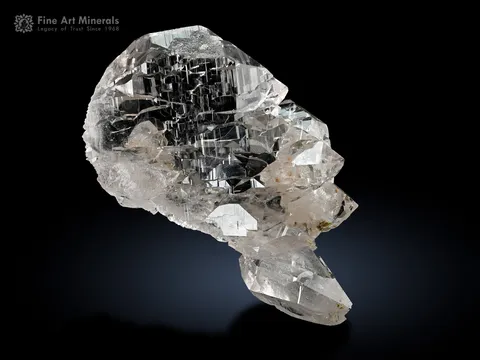
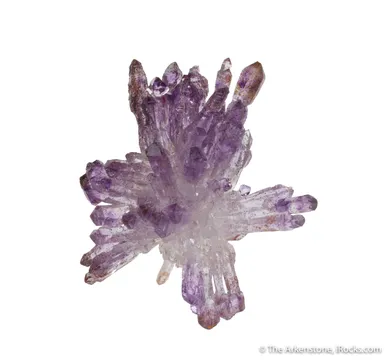
The best Karur specimens have an unmistakable look. In the classic hematite phantom pieces, transparent quartz prisms preserve earlier growth surfaces as red, rust-orange, brick-red, or smoky internal ghosts, sometimes stacked like topographic contours inside the crystal. In the amethyst material, small but intensely colored purple caps and sceptres sit on colorless or milky quartz, with orange hematitic zones giving the better examples a warm, sunset-like contrast. The locality’s scientific interest and its market appeal converge in the same object: included quartz that is not merely pretty, but a hand-specimen expression of a metamorphic system hot enough to interest granulite petrologists.
Regional View
Country View
For collectors, the name needs careful handling. Many labels in circulation read “Kakamunurle,” “Kakamunrle,” or variants of the same spelling. Current locality work ties the principal specimen-producing area to the Kattumunnur Mines, near the hamlet of Kattumunnur in Munnur Village, Pugalur Taluk, Karur District. The older “Kakamunurle” name appears to have entered the mineral trade through a typo or misunderstanding and then became entrenched because fine amethyst and hematite-quartz specimens had already moved through dealers, collections, and publications under that label. Good modern labels should preserve the historical wording if it belongs to an old tag, but should add the corrected Kattumunnur/Karur attribution.
Search for specimens: View all specimens from Karur District, India
Karur District belongs to the crystalline basement of southern India. District geological summaries describe the area as part of an Archean gneissic complex with charnockite, biotite gneiss, migmatite, anorthosite, calc-granulite or crystalline limestone, garnet-sillimanite gneiss, quartzite, and later pegmatite and quartz veins. In collector terms, that means the famous specimens are not coming from a simple low-temperature epithermal vein system. They are tied to a deeply metamorphosed terrain in which quartz veins, pods, and pegmatitic segregations cut or lie within granulite-facies rocks, and in which the gem and specimen minerals record both high-temperature metamorphism and later open-space crystallization.
The Kattumunnur Mines area is described as a group of active quarries close to Kattumunnur, about 26 km from the town of Karur. Rather than one underground mine, the district contains numerous privately operated quarries over a roughly 10 sq km area, worked mainly for basalt or rough stone used in building and construction. Modern quarry paperwork for the wider Pugalur and Munnur area records ordinary stone, gravel, rough stone, and blue-metal operations, typically small open-cast mechanized or semi-mechanized quarries with finite lease periods, environmental clearances, and district-level oversight. Specimen recovery is therefore opportunistic: pockets, veins, vugs, and quartz-rich zones exposed during commercial quarrying can yield collectible material, but the mines are not public collecting grounds.
The district also has a wider industrial-mineral framework. Official district summaries list limestone, quartz, feldspar, magnesite, dunite, granite, rough stone, and gravel among exploited resources. Pegmatite veins with glassy quartz and potash feldspar are specifically noted from Nagampalli and Pungambadi in Aravakurichi Taluk, while the better-known specimen quartz and amethyst of the trade is associated especially with the Kattumunnur/Karur material. Gem varieties reported from the district include ruby, sapphire, aquamarine, amethyst, moonstone, and glassy crystallized quartz, although the ornamental-gem occurrences and the collectible quartz pockets should not be assumed to be the same working unless a label gives a precise sublocality.
The scientifically studied included quartz from the Karur region occurs as rutile-bearing quartz and hematite-bearing quartz in conformable veins, pods, and segregations within ultrahigh-temperature granulite-facies rocks. The key study found spectacular, oriented inclusions in quartz: rutile in one category and hematite in another, with rutile and hematite not occurring together in the same specimens examined. Fluid inclusions in that quartz were characterized as a CO2 + H2O mixture, and Ti-in-quartz thermometry gave minimum temperatures near 1190°C for the rutile-bearing quartz, linking the material to extreme crustal metamorphism and partial melting. This is one reason Karur quartz has a scientific literature footprint unusual for a modern cabinet-specimen locality.
Collecting access today should be treated as closed unless arranged with the landholder, quarry operator, and any relevant mineral-rights authority. The Kattumunnur workings are active or recently active private quarries, not a fee-dig locality. Blasting, bench faces, haul roads, crushers, monsoon runoff, and heavy-equipment traffic are real hazards. The safest and most ethical route for collectors is to acquire specimens through dealers who can provide a coherent chain of labels, ideally giving “Kattumunnur Mines, Munnur Village, Pugalur Taluk, Karur District, Tamil Nadu, India,” while retaining any older “Kakamunurle” label as historical context rather than discarding it.
Quartz from Karur District is most prized as transparent to translucent crystals and clusters with vivid hematite phantoms, amethyst caps, and sceptre or inverse-sceptre habits, especially from the Kattumunnur Mines material long traded under the erroneous “Kakamunurle” name. Sizes range from thumbnail and miniature crystals with crisp internal red ghosts to cabinet clusters over 10 cm, with documented dealer examples including large amethyst-with-hematite groups around 13.5 × 11.8 × 7 cm and individual crystals around 4 cm, while later market finds include clear phantom clusters and amethyst sprays on quartz matrix. The best pieces combine water-clear quartz, undamaged terminations, centered and sharply bounded hematite phantoms, strong luster, and attractive three-dimensional architecture; ordinary pieces are more heavily stained, cloudy, bruised on the tips, or show diffuse reddish coloration without a clean phantom boundary.
Hematite from Karur District is chiefly a specimen-forming inclusion and phantom mineral within quartz rather than a market-famous source of freestanding metallic hematite crystals. In the studied Karur quartz, hematite occurs as red inclusions visible in hand specimen and microscopically as inclusions associated with fluid inclusions; in trade specimens it forms red, orange, and brown phantom surfaces, flecks, internal dustings, and locally glittering platelets inside clear quartz and amethyst. The finest hematite specimens from the district are therefore judged through the quartz: the value rises when the hematite defines a sharp crystal-shaped phantom, sits just below a transparent termination, creates strong contrast with purple amethyst or colorless quartz, and is not confused with mere external iron staining. Because Karur material has sometimes been casually labelled as lepidocrocite-included quartz, a conservative collector should prefer “hematite included quartz” unless there is analytical evidence for another iron oxide or oxyhydroxide.
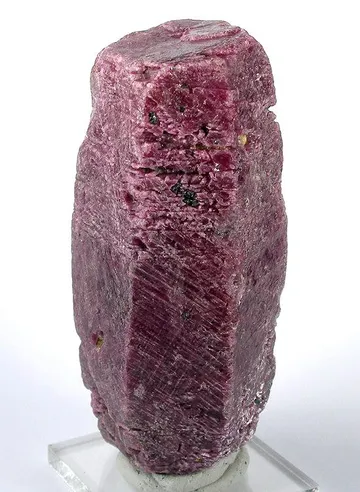
Other minerals documented from Karur District and its sublocalities include goethite, beryl var. aquamarine, corundum var. ruby and sapphire, fluorapatite, schorl, and a scapolite-group entry, with the Kattumunnur Mines list also including quartz var. amethyst and sceptre quartz. The district is not known as the type locality for an approved mineral species in the way classic type localities are; its rarities are instead petrological and gemological. Sapphirine- and corundum-bearing granulites at Lachmanapatti and Malappatty, rubies with inclusions of sapphirine, zircon, apatite, biotite, muscovite, spinel, and rutile, and rutile-bearing quartz from the Karur region make the district important well beyond the few species normally represented as loose mineral specimens.
Karur labels require unusually close scrutiny. The most common historical issue is the “Kakamunurle” name, which appears on many legitimate older specimens but is now understood as a mistaken name for the Kattumunnur material. Do not reject a fine specimen merely because an old label says “Kakamunurle”; instead, keep the old label and add a corrected modern one. Conversely, be wary of vague labels that say only “India,” “Tamil Nadu,” or “Karur” when the price depends on a precise Kattumunnur attribution.
The second recurring problem is inclusion misidentification. Red phantoms in Karur quartz are often hematite, and the analytical work on Karur included quartz confirmed a hematite-bearing category distinct from rutile-bearing quartz. Trade descriptions sometimes use “lepidocrocite,” “iron oxide,” “red rutile,” or mixed “rutile and hematite” wording loosely. Rutile-included quartz from the Karur region is real, but in the studied material rutile and hematite were not found together in the same quartz specimens. A claim that a single Karur crystal contains both golden rutile and red hematite should be treated as possible only with good microscopy or analytical support, not as a default assumption.
Condition is a major value driver. Karur quartz can be wonderfully glassy, but many clusters show chipped terminations, bruised points, contact damage along the base, or iron staining that obscures the internal phantom. On amethyst sceptres, check the tips and the raised purple caps carefully; small broken points can hide among dense sprays. Matrix specimens and complete floaters are more desirable than loose broken singles, especially where the amethyst or hematite zoning is visible from multiple viewing angles.
No well-documented locality-specific treatment epidemic is known for Karur specimen quartz, but normal quartz-market cautions apply. Avoid pieces with suspiciously uniform surface color, resin-filled cracks, glued points, or overly aggressive acid cleaning that has left a chalky or etched look on associated material. Quartz itself is chemically robust, but included hematite phantoms and iron staining are part of the locality’s visual identity; an over-cleaned specimen can lose both context and charm. Amethyst should be kept out of long-term intense sunlight, and large quartz clusters should be handled by the matrix or base rather than by projecting crystals.
In the current market, small hematite phantom quartz clusters from Karur are readily encountered, while top examples with size, transparency, centered phantoms, strong amethyst color, and little damage are much scarcer. High-end Karur pieces tend to be bought for aesthetics rather than species rarity: the difference between a common $20–$100 small cluster and a serious cabinet specimen can be the difference between a muddy red stain and a sharp, glowing internal phantom in water-clear quartz.
The most revealing Karur story is not a dramatic mine rescue or a legendary pocket, but a label correction that changed how collectors should read two decades of tags. For years, dealers and collectors repeated “Kakamunurle Mine” or “Kakamunrle Mine” on amethyst and hematite-quartz labels. The name appeared on fine specimens, dealer catalogues, and published reference photographs, so it acquired the authority that repetition gives. Later locality work tied the material to Kattumunnur, near a small hamlet in Munnur Village, and concluded that “Kakamunurle” was not a real mining area in Karur District at all. That leaves collectors with an odd but familiar mineralogical problem: the wrong name is part of the historical record. A careful label now has to do two things at once—respect the provenance trail of older specimens and correct the geography for future scholarship.
The 2006 amethyst material is another touchstone. Fine specimens reached the international trade as bright, deeply colored amethyst with hematite inclusions, often as sceptres and inverse sceptres. One widely illustrated example measured 13.5 × 11.8 × 7 cm, with a main crystal 4.3 cm long, and was notable enough to be published as a locality reference in Lapis in 2022. That is large for the style: the best Karur amethyst is often miniature to small-cabinet material, where the power of the specimen comes from color, luster, and architecture rather than sheer bulk. When a piece combines purple sceptres, glassy faces, hematite warmth, and a balanced cluster, it explains why a small quarry locality could become internationally recognizable.
The scientific story runs deeper than the pocket finds. In the Karur region, petrologists studying quartz veins and pods in granulite-facies rocks found quartz full of oriented needles—some pure rutile, others hematite. The rutile-bearing quartz was sufficiently unusual that the inclusions became a thermometer for the lower crust. Titanium in the quartz yielded minimum estimates near 1190°C, and the authors connected those temperatures with ultrahigh-temperature metamorphism, partial melting, and the breakdown of Ti-bearing biotite or phlogopite in the deep crust. In a display case the specimen may read as a beautiful included quartz; under the analytical instrument, it becomes a record of continental collision and Gondwana assembly.