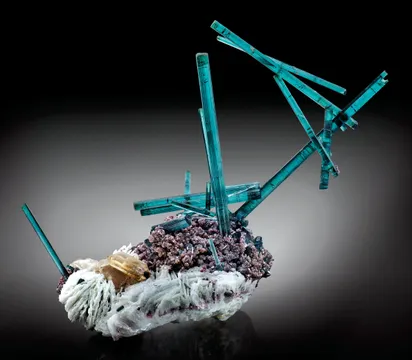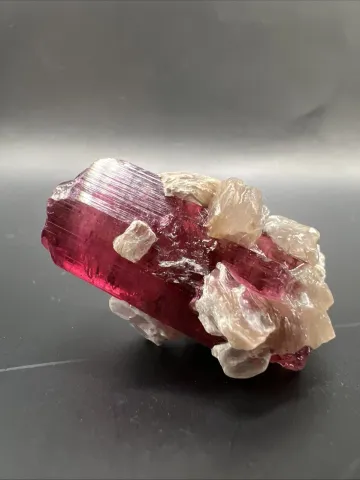
A collector's guide to Jonas Mine, Brazil: its geology, mining history and notable minerals, illustrated with the 243 specimens documented from this locality on EarthWonders.
Key facts
Jonas Mine is one of the great one-pocket legends of mineral collecting: a small hard-rock lithium pegmatite on the Itatiaia hillside near Conselheiro Pena, Minas Gerais, that produced a rubellite discovery so rich, clean, and visually memorable that later red tourmalines are still compared against it. The locality belongs to the Conselheiro Pena pegmatite district of the Eastern Brazilian Pegmatite Province, a belt of complex granitic pegmatites famous for lithium minerals, gem tourmaline, phosphates, and cabinet specimens. Jonas is not remembered because it was large or long-lived. It is remembered because, in 1978, a miarolitic pocket lined with cranberry- to magenta-red elbaite was opened at just the right moment, yielding immense crystals, gem rough, and classic matrix specimens of red tourmaline with lepidolite, albite or cleavelandite, and quartz.
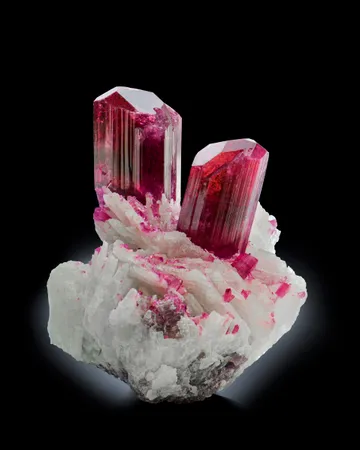
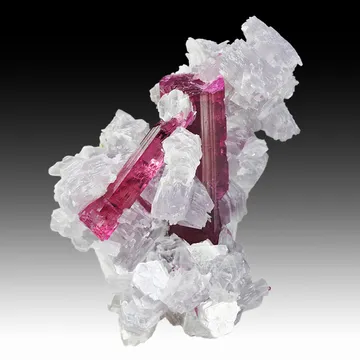
The finest Jonas specimens have a look that is instantly recognizable to experienced collectors: saturated red to raspberry-red prismatic tourmalines, commonly lustrous and translucent to gemmy in transmitted light, rising from pale lilac lepidolite, snow-white albite or cleavelandite, and colorless to pale citrine quartz. Good pieces are not merely “Brazilian rubellite.” They carry the distinctive pocket aesthetic: strong color, comparatively clean surfaces, thick crystals, and dramatic contrast between red tourmaline and light matrix. The locality also has a rare narrative weight. Named specimens such as the Joninha, the Rocket, Tarugo, Fleur de Lis, and Rose of Itatiaia gave Jonas a place in the mythology of mineral collecting alongside the Tourmaline Queen blue-cap pocket, Pederneira, Cruzeiro, and the greatest historic gem pegmatite finds.
Regional View
Country View
Jonas Mine was also known historically as the João Pinto Mine and Lavra do Fiote. Its setting near Itatiaia links it to an older generation of multicolored tourmaline production, including the famed “parrot” tourmalines of the nearby Itatiaia workings. Yet the Jonas reputation rests overwhelmingly on the 1978 bamburrio, or jackpot, pocket and on the second, smaller but unforgettable pocket of 1979 that produced the Rose of Itatiaia. In a market crowded with excellent Minas Gerais tourmalines, Jonas remains a locality where provenance is not a label afterthought; it is the principal value driver.

Photo: Wikimedia Commons

Photo: Wikimedia Commons
Search for specimens: View all specimens from Jonas Mine, Brazil
Jonas Mine lies a few kilometers south to southeast of Conselheiro Pena, on the Itatiaia hillside overlooking the local valley and drainage of the same name. The mine is part of the Conselheiro Pena pegmatite district, in the broader Eastern Brazilian Pegmatite Province, where granitic pegmatites intrude Precambrian metamorphic country rocks and locally develop lithium-, boron-, beryllium-, tantalum-, tin-, and phosphate-bearing assemblages. The district as a whole is one of the most important gem-pegmatite regions in Minas Gerais; Jonas is one of its most famous individual mines.
Descriptions of the body differ slightly because different authors measured or interpreted different exposed and mined portions. In one account attributed to Ailton Barbosa, the pegmatite was described as approximately 12 meters wide and 200 meters long, trending nearly horizontally through the hillside in a N 30° E direction, with only about 30 meters of the body worked by Jonas Lima’s operation during the great discovery. Brazilian geological summaries describe the pegmatite as tabular, roughly parallel to the schist foliation, with a maximum thickness near 10 meters. Cassedanne and Roditi recorded a body extending about 70 meters in outcrop and 70 meters vertically, reaching about 11 meters in width, and noted that 23 pockets had been reported. Whatever the exact working dimensions, the essential point for collectors is that Jonas was not a giant continuous producer like Cruzeiro; it was a relatively small, pocket-driven hard-rock pegmatite whose fame came from a spectacularly productive section.
The productive pockets were irregular miarolitic chambers within the pegmatite, reached through underground workings and crosscuts. The most famous pocket was an oval walk-in cavity lined with red elbaite and a simple, highly effective matrix assemblage: albite to cleavelandite, quartz, and lithium mica. Contemporary and later accounts emphasize how unusually clean the pocket was. Unlike many tourmaline pockets where crystals are corroded, clay-coated, or chemically altered, the Jonas rubellites were fresh enough that some specimens reportedly needed little washing. This cleanliness helps explain the crisp collector aesthetic: glossy red tourmaline against pale mica and feldspar rather than rubellite buried in muddy alteration.
Mining began well before the famous find. The hard-rock pegmatite later called Jonas was first tunneled by local farmer João Pinto in the early 1940s and produced fine multicolored tourmaline crystals, reportedly up to about 12 cm, during that early period. The modern chapter began in 1977, when Ailton Barbosa interested gem dealer Jonas Lima of Governador Valadares in leasing and working the Itatiaia hillside. Ailton supervised a small crew while Jonas supplied operating capital. After months of costly digging and blasting, the miners encountered discouraging pockets of black tourmaline and albite before finally breaking into the rubellite pocket on Good Friday, 1978.
The first Jonas pocket was cleaned out quickly and produced a staggering mixture of specimen and gem material. Published estimates vary depending on whether authors count total tourmaline, cutting rough, or collector specimens, but the classic figures are around 200 kg of fine cuttable cranberry-red material and approximately 3,600 kg of rubellite-bearing specimens. Cassedanne and Roditi also record about 1,800 kg of gem-quality production, including 200 kg of especially fine raspberry- to magenta-red material, while Proctor’s account gives the collector-specimen total at about 3,600 kg. The pocket produced several world-famous large specimens: the Joninha, an enormous two-crystal matrix group; the Rocket, a repaired giant rubellite on quartz; Tarugo, a short, thick, unrepaired-looking giant crystal; and Fleur de Lis, a rubellite associated with a large quartz crystal.
After a dispute over the lease, Jonas Lima abandoned the operation in mid-1978 and reportedly blasted the tunnel shut. A later lessee, Dilermando de Melo, known as Dilo, accessed the pegmatite through another adit and drove a longer tunnel. His work found small dark green tourmalines on albite, occasional rubellite specimens, and some excellent blue tourmalines, but only one discovery rivaled the fame of the original find: the 1979 second pocket, a sand-filled cavity that yielded the Rose of Itatiaia, a 35 cm rubellite crystal on white cleavelandite/albite matrix. Unlike the first pocket, this second large cavity is remembered for producing essentially one great rubellite specimen.
Collecting access today should be regarded as effectively unavailable to casual collectors. Jonas is a historic mine on private ground, long past its main productive period, and later accounts characterize the hard-rock operation as inactive or essentially abandoned because further mining would be expensive and speculative. Collectors encounter Jonas material through old collections, dealer inventories, auction resales, and museum holdings, not by visiting the mine and collecting fresh pockets. For serious buyers, old provenance, pocket attribution, and condition disclosure are as important as the mineral identification itself.
Jonas tourmaline is overwhelmingly valued through its elbaite-rubellite expression, but the mine also yielded green, black, pink-topped, and blue tourmalines in less famous zones and pockets. Early in the 1977–1978 work, the crew found small green “matchstick” crystals on white albite, then larger but worthless black tourmalines mixed with albite, mud, quartz, and mica; Dilo’s later workings also produced small dark green tourmalines on white albite and a surprising quantity of gem blue tourmaline. The collector standard, however, is the 1978 pocket material: thick, vertically striated, red to cranberry-red prisms, sometimes doubly terminated, commonly associated with lepidolite, albite/cleavelandite, and quartz. Good Jonas tourmaline is separated from ordinary Minas Gerais tourmaline by a combination of saturated red body color, gemmy internal glow, historic pocket provenance, and matrix integrity.
Rubellite is the signature mineral of Jonas Mine and the reason the locality is legendary. The best pieces came from the 1978 bamburrio pocket, where red elbaite crystals lined a walk-in cavity with snow-white albite, transparent quartz, and pink lithium mica; the celebrated crystals ranged from miniature and cabinet specimens to giants, including one repaired specimen more than a meter tall and individual crystals described as forearm-thick. The color is typically described as cranberry, raspberry, magenta-red, or deep red-pink, and many specimens show the classic Jonas contrast of red tourmaline rising from pale lilac lepidolite or white feldspar. Excellent examples have strong luster, saturated color that remains lively in display light, clean prism faces, intact or honestly disclosed repaired terminations, and believable old provenance to the 1978 or 1979 production.
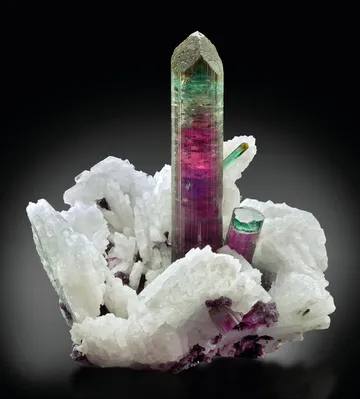
Elbaite from Jonas is best understood as the mineral species behind the mine’s rubellite fame, with red, pink, green, blue, and multicolored expressions documented from the workings. The early João Pinto phase produced pristine four- and five-colored tourmalines up to about 12 cm, linking the mine to the older Itatiaia tradition of multicolored “parrot” tourmalines, while the later Jonas pocket produced the red elbaite that made the locality world-class. In hand specimens, elbaite occurs as striated trigonal prisms, commonly terminated, locally doubly terminated, and typically set with lepidolite, albite/cleavelandite, and quartz. For collectors, the most desirable Jonas elbaites are those that combine identifiable mine character with aesthetics: clean red to red-pink crystals on natural matrix, strong translucency, crisp terminations, and minimal restoration.
Lepidolite at Jonas is the principal visual matrix mineral for many of the classic rubellite specimens, appearing as pale pink, lilac, silvery, or nearly whitish mica books and crystalline aggregates around red tourmaline. Ailton Barbosa reportedly treated patches of lepidolite in the pegmatite wall as a favorable guide while deciding whether to continue the failing 1978 operation, and in the great pocket, clusters of small gemmy pink lithium mica crystals surrounded many of the smaller red tourmalines. Because “lepidolite” is now used as a series or group-style name rather than a single modern species, Jonas mica may be catalogued more precisely as lithium mica, including trilithionite in mineral lists. The best lepidolite-bearing Jonas pieces are not plain mica specimens; they are rubellite-on-lepidolite combinations where the mica is sharp, undamaged, naturally integrated, and clearly part of the pocket assemblage rather than loose padding or reconstructed matrix.
Quartz was one of the essential pocket minerals at Jonas, present as transparent to pale citrine crystals in the same cavities that produced the rubellite. The most famous quartz associations are on the large named specimens: the Joninha included two large quartz crystals supporting the enormous rubellites and a pale citrine crystal hanging beside the larger red tourmaline, while the Rocket rose from a matrix of doubly terminated quartz crystals. Smaller collector pieces may show a single colorless doubly terminated quartz accent beside red tourmaline and lepidolite, an association that reinforces the Jonas pocket identity. The best quartz on Jonas specimens is not judged as a standalone species but as composition: clear, undamaged crystals that frame or balance the rubellite without overwhelming the red tourmaline.
Albite is a major Jonas matrix mineral, ranging from compact white feldspar to more bladed cleavelandite habit, and it occurs repeatedly in accounts of both unproductive and world-class pockets. The miners first recovered small green tourmalines on white albite, then black tourmalines mixed with albite, before finally entering the rubellite cavity where albite formed part of the pale matrix into which red elbaite crystals were set. In the 1979 second pocket, the Rose of Itatiaia was found attached to a white albite/cleavelandite-rich matrix after a slab of inner pocket wall was pried loose and turned over. Good Jonas albite matters when it is clean, white, sharp enough to contrast with the rubellite, and visibly natural at the tourmaline contact; massive or broken feldspar without tourmaline is far less significant to collectors.
Cleavelandite, the platy variety of albite, gives some Jonas specimens their finest white, bladed matrix texture, especially in the classic red tourmaline combinations. Published descriptions of the great pocket mention snow-white albite and cleavelandite-like matrix intergrown with quartz and lithium mica, while the Rose of Itatiaia is commonly described as a large rubellite crystal on white cleavelandite crystals. Collectors value cleavelandite here for contrast and authenticity: delicate white blades around red tourmaline help place a specimen in the Jonas pocket style and can elevate even a small crystal into a highly recognizable miniature. The best pieces show undisturbed cleavelandite blades at the base or around the tourmaline, with no obvious glue sheen, powdered fill, or rebuilt contact.
Other documented Jonas minerals include bertrandite, cassiterite, fluorapatite, microcline, microlite-group minerals, monazite-group minerals, muscovite including sericite, rossmanite, spessartine, and trilithionite. Several of these are important more as locality records than as market staples. Sharp cassiterite, pink fluorapatite, microlite-group crystals, and unusually sharp monazite microcrystals were noted from the pegmatite, while spessartine occurred on the dumps rather than as a characteristic mineral of the great rubellite pockets. Jonas is not chiefly a type-locality mine; its scientific interest lies instead in the unusually clean lithium-pegmatite pocket assemblage and in the coexistence of classic elbaite-rubellite with recorded lithium mica, rossmanite, tantalate, tin oxide, phosphate, and rare-earth phosphate minerals.
The first collector problem with Jonas material is attribution. Minas Gerais produced red and pink tourmalines from many famous pegmatites—Cruzeiro, Pederneira, Santa Rosa, Golconda-area deposits, Barra do Salinas, and others—so a red Brazilian elbaite is not automatically Jonas. True Jonas rubellite should have persuasive provenance, preferably old labels, publication history, dealer records, or a collection chain traceable to the post-1978 market. Visual clues help but do not prove the locality: cranberry-red to magenta-red color, pale lepidolite, white albite or cleavelandite, quartz, and the compact Jonas matrix style are all supportive, but not a substitute for documentation.
Repair and restoration are common practical concerns. Large Jonas crystals were extracted from a blasted hard-rock pegmatite, and even smaller crystals may have been repaired at contacts or bases. Some documented dealer and auction examples openly disclose one or more repairs, restored corners, or sawed bottoms where gem nodules were removed. A repair is not automatically fatal on a Jonas specimen, especially if the color, luster, and provenance are exceptional, but undisclosed reconstruction should materially affect value. Inspect terminations, prism breaks, and tourmaline-to-matrix contacts under magnification and ultraviolet light; look for glue lines, filled gaps, unnatural mica packing, crushed lepidolite used to disguise joins, and mismatched feldspar or quartz.
Condition expectations must be realistic. Tourmaline is hard, but Jonas rubellite crystals can show bruised termination edges, rehealed-looking fractures, chips along prism ridges, and old extraction scars. Lepidolite and cleavelandite are far more delicate: mica books can cleave, shed, and take on a rubbed or greasy appearance, while albite blades break easily. On matrix pieces, the key question is whether the damage distracts from the red tourmaline and whether the contact looks natural. For small miniatures, pristine terminations and undisturbed matrix command a strong premium.
Treatment issues differ between gemstones and specimens. Faceted rubellite in the broader gem trade may be heated, irradiated, fracture-filled, or otherwise treated, depending on material and market practice, but classic Jonas mineral specimens are usually evaluated on natural crystal aesthetics, completeness, locality, and repair/restoration disclosure. Avoid applying gem-treatment assumptions too broadly to matrix specimens; instead, ask direct questions about repair, restoration, oiling or resin in fractures, recemented crystals, and any lapidary modification such as trimming or sawing.
Rarity is high for attractive matrix specimens and very high for major pieces. The great production entered the market decades ago, and much of the finest material disappeared into major private and institutional collections. Small crystals and fragments still appear at auction, but strong miniatures and small-cabinet pieces with red gemmy tourmaline, lepidolite, albite/cleavelandite, and quartz are no longer routine purchases. Modern prices vary enormously: a repaired but good single crystal may be far more affordable than a pristine matrix piece, while top-quality examples with classic pocket aesthetics and old provenance can reach levels that reflect history as much as mineral size.
The Jonas story begins with inheritance as much as geology. On the Itatiaia hillside, Barbosa—the father of Ailton Barbosa—had found the famous multicolored “parrot” tourmalines in the early 1930s. Decades later, Ailton carried that memory into the same hill country. In 1977 he convinced Jonas Lima, a prosperous gem dealer from Governador Valadares, to lease ground that Ailton had long wanted to mine. Jonas supplied the operating capital; Ailton supervised the work. The lease was astonishingly modest in hindsight: about 1,000 cruzeiros per month, roughly US$70 at the time, and the landowner reportedly did not insist on a percentage royalty from any gem discovery.
The first months were punishingly unrewarding. Ailton’s crew of only four garimpeiros extended an old short tunnel through schist and pegmatite beginning in October 1977. They found small green tourmalines on 5 cm albite crystals, but not enough to justify the expense. In early February 1978, the miners entered several large pockets and removed three tons of black tourmaline mixed with albite—large, real crystals, but commercially worthless compared with the rubellite they were dreaming of. By the start of April, Jonas Lima was ready to stop. Six months of blasting and digging had eaten money without producing a payoff.
Ailton refused to let the mine die. He had seen patches of lepidolite in the pegmatite wall, a sign he trusted as an indicator of gem tourmaline. He told Jonas three times that they had to continue, promising “a huge gem pocket and rubellites as thick as his forearm.” The promise was almost absurd. Ailton later admitted he had never seen rubellites that large. Still, he had what he described as a strong premonition. Near financial exhaustion, he surrendered the title to his Volkswagen to raise money for food and mining supplies for one final week. When that food and dynamite were gone, he promised, he would quit.
Only days before the great discovery, the miners blasted into another pocket. Again it seemed to be a disappointment: black tourmalines with opaque pink tops, albite, mud, water, quartz, and mica. But Ailton noticed water entering from above and decided another cavity might lie overhead. He worked upward from the chamber, using hand digging and partial sticks of dynamite, carefully making a hole just large enough to thrust his arm through. On Good Friday, 1978, he reached into darkness above him. When he withdrew his hand, it held a large, nearly flawless gem rubellite crystal.
Ailton shone his strongest mining light through the opening and saw the impossible: a cavern glittering red with tourmalines. He and the crew closed the hole immediately. Ailton rushed to Conselheiro Pena, telephoned Jonas in Governador Valadares, and delivered the message that has become part of Jonas lore: “I found the gems, COME ON DOWN.”
Because the first opening had entered the pocket from below, the crew dug a better route. They worked through the night and much of the next day before reaching the cavity again. When they entered, they found a room-sized oval pocket about 3 meters high, 3 meters long, and 2.5 meters wide. It was lined with rubellites and pale pocket minerals. The floor was so rich that rubellite and albite crunched underfoot. The matrix assemblage was strikingly simple: snow-white albite, transparent quartz, and pink lithium-bearing lepidolite. Many rubellites were still fixed to the walls; others had fallen. The pocket was unexpectedly clean, with little alteration and only minor sand on the floor.
The first great specimen that demanded rescue was the Joninha, named for Jonas’s young son. It hung precariously from the ceiling, partly dislodged by the small dynamite charges. The group consisted of two enormous rubellite crystals—one about 50 x 25 cm, the other about 25 x 30 cm—growing with quartz crystals approximately 20 cm and 45 cm long. A pale citrine crystal hung beside the largest rubellite, and albite partly coated the group. With matrix, the specimen weighed about 352 kg. The miners could get their hands behind part of it; the masterpiece was ready to fall.
Ailton’s solution was improvised but brilliant. The crew stacked old tires from the pocket floor almost up to the specimen and covered the upper tires with burlap. Miners pushed upward from all sides while a final crowbar pry freed the Joninha. Instead of crashing to the floor, it dropped gently onto the padded tire column. That same night it was taken toward Governador Valadares. The journey nearly became a disaster: Ailton fell asleep at the wheel, missed a curve, and drove the Jeep down a 20-meter embankment. The specimen survived undamaged.
Other giants emerged from the pocket. The Rocket was found in three pieces on the floor and, when reassembled, rose to 107 cm from a matrix of doubly terminated quartz. It weighed about 135 kg and became famous as one of the largest rubellite crystals known. Tarugo, whose name evokes a short, fat man, was an opaque crystal around 85 cm long, 30 cm wide, and about 82 kg. Fleur de Lis carried a 35 cm tourmaline attached to a 60 cm quartz crystal, though much of the tourmaline was covered by albite. Around smaller wall crystals, delicate clusters of pink lepidolite made natural halos.
Security quickly became part of the legend. The pocket was emptied in only eight days, and the crystals were transported roughly 90 km to Governador Valadares under guards compared in one account to those protecting crown jewels. The mine entrance and storage warehouse became guarded spaces. Gem dealers and collectors found it difficult to view the material. Armed men were visible when viewings or sales took place. The atmosphere fed rumor and theater: accounts say that major specimens, including the Rocket, sat on tables supposedly wired to dynamite beneath them, and Jonas threatened to blow up the cache if robbers—or revenue agents—came too close. By 1980, he was reportedly charging visitors US$8 simply to see the four major pieces.
The second great chapter came one year later, again around Good Friday. After a disagreement with the landowner, Jonas Lima had abandoned the operation by late July 1978 and blasted the tunnel shut about 30 meters inside the entrance. A new lessee, Dilermando de Melo—Dilo—began working through another adit and eventually drove a tunnel about 130 meters long. The work found minor tourmaline pockets, some dark green crystals on albite, occasional rubellites, and unexpectedly good blue tourmalines. Then, in early April 1979, Dilo’s crew struck the outer wall of what looked like another promising pocket below the tunnel floor.
In his excitement, Dilo made a dangerous mistake. After setting off the charge, he did not wait long enough for blast fumes to disperse. He went straight to the opening, leaned over, and was overcome. His foreman took him to the hospital, where Dilo waited impatiently to learn what the dynamite had revealed. When released, he returned immediately to the mine with his partner. The pocket was still not fully open. A thin inner wall of albite, only about 7.5 cm thick, remained. With picks and crowbars they loosened an almost square slab about 45 cm across. Two men lifted it out carefully. When they turned it over, the Rose of Itatiaia was attached to the other side.
The second pocket was a sand-filled oval chamber about 2 to 2.5 meters across. Like the Joninha, the Rose had hung upside down from the ceiling of the geode-like cavity. Astonishingly, it was the only rubellite specimen in that large pocket. The crystal measured about 35 cm long and 12 cm wide, brighter in color than the first-pocket rubellites, and nestled in a bed of gemmy white albite or cleavelandite crystals. Keith Proctor acquired it in 1980, and it became one of the most celebrated mineral specimens in the world.
The later life of the Rose of Itatiaia carried Jonas far beyond Minas Gerais. Proctor displayed it at the Munich Show in 1985, where it won the Viktor Goldschmidt Prize. It was later acquired by Sheikh Saud bin Muhammad Al Thani and entered the National Collection of Qatar. The specimen is now associated publicly with the Houston Museum of Natural Science display, where it stands as perhaps the most famous publicly viewable Jonas rubellite. A mine that worked only a small part of a pegmatite had produced a specimen with the afterlife of an Old Master painting.