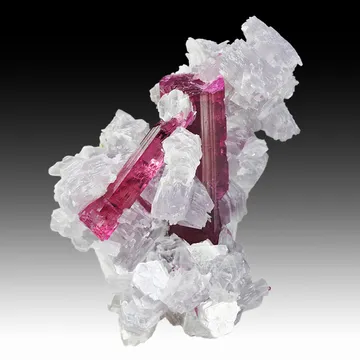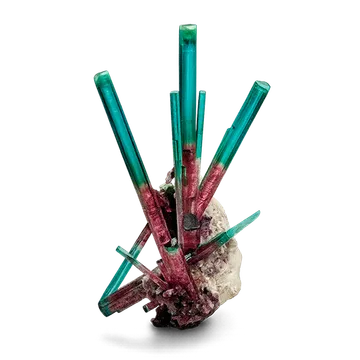
Jonas Mine, Brazil — premier tourmaline locality for deep red rubellite (elbaite) in pegmatites; famed specimens, iconic color, and strong collector appeal.
Key facts
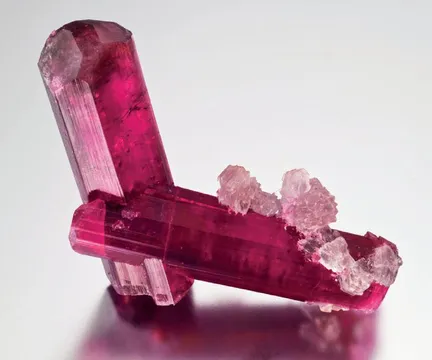
Jonas Mine rubellite is one of the great locality names in tourmaline collecting: instantly recognizable, historically charged, and benchmark-setting for saturated red elbaite. The classic Jonas look is a glassy cranberry- to deep magenta-red crystal, commonly with strong vertical striation, bright luster, and a color that seems denser and more “wine-lit” than most pink tourmaline. Good crystals have the authority of old Brazilian pegmatite classics: simple enough to be elegant, rich enough to dominate a case, and famous enough that even small thumbnails carry the weight of a major discovery.

Photo: Rob Lavinsky, iRocks.com via Wikimedia Commons
The mine lies on the Itatiaia hillside near Conselheiro Pena, in eastern Minas Gerais, within one of Brazil’s classic gem-pegmatite belts. Mineralogically, it is a lithium pegmatite locality, and the red tourmaline is principally elbaite-group material, with both elbaite and rossmanite recorded from the mine. The famous specimens came from miarolitic cavities in pegmatite, where open space allowed tourmaline, albite, quartz, and lepidolite to crystallize as cabinet specimens rather than only as cutting rough.
The reputation of Jonas rests overwhelmingly on the 1978 rubellite discovery. That pocket produced an extraordinary quantity of fine red tourmaline: hundreds of kilograms of cuttable gem rough and several metric tons of matrix and crystal specimens. More important for collectors, it produced named giants—the Joninha, the Rocket, Tarugo, Flor de Lis—and a vocabulary of quality against which red tourmaline from Russia, Nigeria, Mozambique, Madagascar, Afghanistan, and other Brazilian mines is still compared.
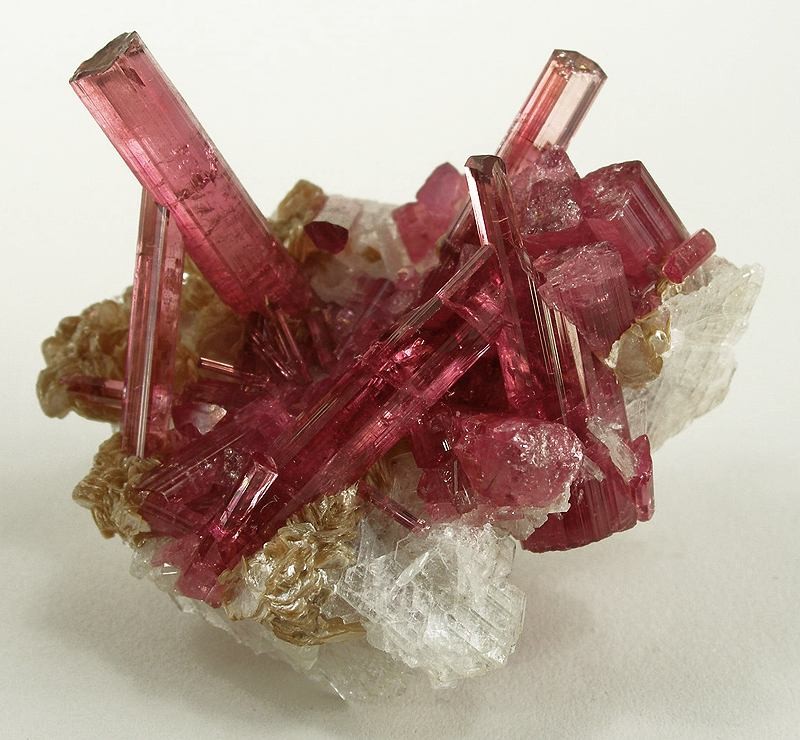
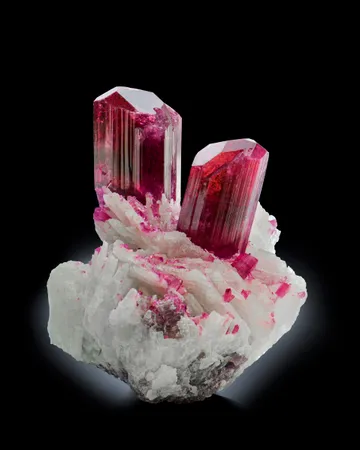
Photo: Rob Lavinsky, iRocks.com via Wikimedia Commons
Collectors look first for color: true Jonas cranberry red, magenta-red, or rich raspberry-red that remains lively in daylight and does not collapse into brownish or murky purple. Then comes luster, transparency, termination quality, and condition. Matrix pieces with lepidolite, cleavelandite albite, and quartz are especially desirable because they preserve the pegmatite context, but strong single crystals are also classic for the locality. Original 1978-pocket provenance is the premium story; a fine Jonas rubellite is not merely a red tourmaline, but a specimen from one of the defining mineral discoveries of the twentieth century.
Search for specimens: View all tourmaline specimens from Jonas Mine, Brazil
Jonas Mine is in the municipality of Conselheiro Pena, Minas Gerais, Brazil, on the Itatiaia hillside overlooking the valley and stream of the same name. Older and alternate names associated with the locality include Lavra do Fiote and João Pinto Mine, and older specimen labels may use Itatiaia, João Pinto, Jonas, Fiote/Jonas, or Conselheiro Pena in various combinations. The locality sits in the Eastern Brazilian Pegmatite Province, a broad and historically productive belt of gem-bearing granitic pegmatites.
The deposit is a lithium-rich granitic pegmatite mined by underground workings. In the classic Jonas pocket, tourmaline grew in an open cavity with snow-white albite, quartz, and lepidolite; the surrounding pegmatite also produced or is recorded for minerals including cassiterite, fluorapatite, microlite-group minerals, monazite-group minerals, muscovite, microcline, bertrandite, spessartine, and quartz. The great 1978 pocket was unusually clean for such a large pegmatite cavity, with little alteration of the crystals and comparatively little clay or pocket mud reported on the most important specimens.
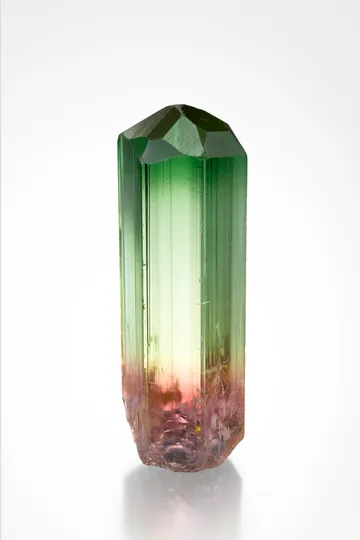
The hard-rock body later known as Jonas was first worked in the early 1940s by João Pinto, a local farmer. That early period produced multicolored tourmalines, including fine four- and five-colored crystals reported up to about 12 cm. The modern history began in 1977, when Ailton Barbosa and Jonas Lima began reopening and extending the workings. Their early efforts were discouraging: small green tourmalines, then large quantities of black tourmaline with albite, but no bonanza. In April 1978, after months of work, the famous rubellite pocket was opened.
The great 1978 cavity is described as roughly 2.5 to 3 meters across in its main dimensions. It yielded an estimated 200 kg of fine cutting-quality rubellite crystals and about 3,600 kg of rubellite-bearing specimens. Within months, the mine had become a guarded, mythic source of red tourmaline. A second major pocket was found in 1979 by Dilermando de Melo, known as Dilo; it produced the Rose of Itatiaia, a single spectacular rubellite on albite rather than a repeat of the huge 1978 production.
After those discoveries, no comparable Jonas rubellite pocket became available to collectors. Later activity and later finds at the locality are part of the broader mine history, but the collector market for Jonas tourmaline is dominated by material from the 1978 pocket and, at the highest museum level, by a small number of named specimens from the 1978 and 1979 discoveries. Collecting access should be treated as private mining property, not as a casual field-collecting destination; any visit would require permission from land and mineral-rights holders and a serious understanding of underground-mine hazards.
The classic Jonas tourmaline habit is a prismatic elbaite crystal with strong vertical striations, glassy luster, and a flat to complex termination. Many specimens are single crystals or small crystal groups; matrix pieces occur on albite, cleavelandite, quartz, and lepidolite. The most desirable crystals have a saturated cranberry-red body color, sometimes with brighter hot-pink outer zones and a warmer salmon-red or rose-red interior visible in transmitted or directed light.
Color is the locality’s signature. Jonas red is not merely “pink tourmaline”; the best crystals have the saturation and depth collectors expect from true rubellite. The tone may range from vivid raspberry-pink through cranberry and deep magenta-red. In thicker crystals the color can become dark, so the best pieces balance saturation with transparency: rich enough to read as red, but not so dense that the crystal appears opaque in normal display lighting.
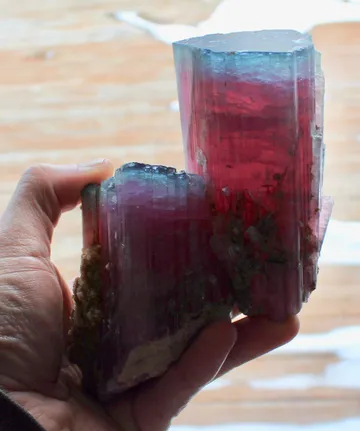
The pocket produced a wide size range. Market specimens are often thumbnail to small-cabinet crystals, from a few centimeters to around 10 cm, but the locality’s fame rests on much larger pieces. The early João Pinto workings produced multicolored crystals up to about 12 cm. The famous Jonas pocket yielded enormous named rubellites: crystals tens of centimeters long, and in the case of the Rocket, a reconstructed giant exceeding a meter. These giants are museum-scale historical objects rather than normal marketplace specimens.
Associations matter. White albite or cleavelandite gives Jonas rubellite the classic Brazilian contrast: red tourmaline rising from a pale, bladed feldspar ground. Pink to lilac lepidolite adds a softer tonal harmony and is common on many collectible pieces. Quartz occurs with some major specimens, including named classics where tourmaline is attached to or partly engulfed by quartz. Cassiterite, fluorapatite, microlite-group minerals, monazite-group minerals, and spessartine are part of the broader pegmatite assemblage, but they are not what most collectors mean when they ask for a “Jonas tourmaline.”
The highest-quality Jonas rubellites combine saturated cranberry-red color, transparency or strong translucency, bright vitreous luster, crisp termination, and minimal damage. Doubly terminated crystals and crystals with intact sidecars are especially prized. Matrix specimens with good composition are less common than loose crystals and command attention when the matrix is original, balanced, and not visually overwhelmed by broken tourmaline sections. A fine Jonas specimen should look alive under light: rich red down the prism, glass on the faces, and enough internal glow to distinguish it from darker, opaque rubellite masses.
The first authenticity concern with Jonas rubellite is provenance. Because the locality is famous and valuable, “Jonas” is a powerful label, and a buyer should expect a credible chain of ownership, an old collection label, dealer history, or a specimen style that fits the 1978 pocket. Labels using Jonas Mine, João Pinto Mine, Lavra do Fiote, Itatiaia, or Conselheiro Pena can all be legitimate, but they should be interpreted carefully. “Brazilian rubellite” is not enough. Other Minas Gerais mines produced excellent red tourmaline, and locality confusion can materially affect value.
The second issue is condition. Tourmaline is hard, but it is brittle, and Jonas crystals were extracted from large pegmatite cavities where crystals could detach, fall, be blasted, or break during removal. Repaired Jonas specimens are not unusual in the marketplace. Some repairs are straightforward reattachments of broken crystal sections; others may involve small restorations at termination corners or edges. A repair is not automatically disqualifying on an important Jonas piece, but it must be disclosed and priced accordingly. Inspect terminations, vertical prism edges, basal contacts, and any sudden change in color or striation continuity. A longwave or shortwave UV light, a strong pinpoint light, and a 10x loupe can reveal glue lines that are otherwise easy to miss.
No well-established locality-specific fake industry is associated with Jonas tourmaline in the way that some gem materials suffer from systematic imitation. The practical risks are more subtle: misattributed red tourmaline from another locality, repaired crystals sold as pristine, polished or restored terminations, glued-on matrix, and ordinary pink elbaite promoted as top rubellite. Faceted Jonas material may also raise the usual gem-tourmaline treatment questions, including irradiation or heating in the broader gem trade, but specimen collectors should focus especially on repairs, restoration, and provenance.
Good Jonas rubellite is scarce on the open market. Small crystals and damaged-but-representative examples appear periodically, but strong, unrepaired cabinet pieces with top color are difficult to buy and often move through specialist dealers, auctions, or private networks. Recent public offerings show why collectors remain aggressive: even repaired examples can attract serious bidding when the color and presence are right, while fine cabinet specimens and matrix pieces can enter five-figure territory. At the top end, the great named Jonas pieces are museum-level objects, not routine commodities.
When evaluating a potential purchase, ask three direct questions: Is it certainly Jonas? Is it from the 1978 pocket or a later/less specific Jonas occurrence? What repairs, restorations, or treatments are present? Then judge the specimen as a mineral: color first, then luster, transparency, termination, aesthetics, and condition. A modest but honest Jonas thumbnail with saturated color can be more satisfying than a larger, heavily restored, poorly documented crystal.
The Jonas story begins before the famous red pocket, with the Itatiaia hillside already carrying tourmaline lore. In the early 1930s, garimpeiro Barbosa found the celebrated multicolored “parrot” tourmalines at nearby Itatiaia. Decades later, his son Ailton Barbosa returned to the same mineralized hillside with a conviction that the ground still held something extraordinary. The old hard-rock workings had once been known as the João Pinto mine, after the local farmer who first tunneled the pegmatite in the early 1940s. Those early tunnels had already shown what the pegmatite could do: pristine multicolored tourmalines, some large enough to matter to gem dealers and collectors.
In 1977, Ailton Barbosa persuaded Jonas Lima of Governador Valadares to take a chance on the property. The lease was almost absurdly modest in hindsight: 1,000 cruzeiros a month, about US$70 at the time, with no royalty percentage demanded by the landowner. Jonas would put up the money; Ailton would supervise the work. The crew was tiny—only four garimpeiros—and the work was hard-rock mining by determination rather than corporate planning. They drove the tunnel forward through schist and pegmatite, month after month, with little to show.
The first returns were discouraging. For four months the miners found only small green tourmalines, some no larger than matchsticks, arranged on white albite crystals about 5 cm across. In early February 1978, hope rose when they broke into large pockets, then fell just as quickly: the pockets contained about three tons of black tourmaline and albite, not gem rubellite. The partnership faltered. Money was draining away. By April 1, 1978, only a week before the discovery, Jonas wanted to stop unless more financial support appeared.
Ailton kept arguing for one more push. He had seen patches of lepidolite in the pegmatite wall, a sign experienced pegmatite miners take seriously. He told Jonas they should continue and promised what sounded like fantasy: “a huge gem pocket and rubellites as thick as his forearm.” He later admitted he had never seen rubellites of that size. The promise was part faith, part instinct, part miner’s reading of the rock.
The mine still made them pay. After drilling and blasting through about 30 meters of schist and only a few meters of pegmatite, Ailton entered another large pocket—again disappointing. It held black tourmaline crystals with opaque pink tops, albite, mud, water, quartz, and mica. Some crystals were about 25 cm long, impressive enough to keep hope alive but not the discovery that would repay the work. Ailton was nearly out of money. To fund food and dynamite for one more week, he surrendered the title to his Volkswagen. When the food and explosives were gone, he told Jonas, he would finally quit.
Then water changed the story. While cleaning out that worthless chamber, Ailton noticed water entering from above and suspected another cavity. He directed the excavation upward and worked carefully, using hand tools and partial sticks of dynamite, until the opening was just large enough to push an arm through. It was Good Friday, 1978. He reached into darkness and brought out a large, nearly flawless gem rubellite crystal. When he shone his brightest mining light into the opening, the cavity beyond sparkled red.
Ailton and the four garimpeiros immediately closed the small hole. He hurried to Conselheiro Pena and telephoned Jonas in Governador Valadares. His message was direct: “I found the gems, COME ON DOWN.” After Jonas arrived, they dug a better entrance, because the first hole had entered the pocket from below. They worked all night and much of the next day. When they reached the cavity again, it was large enough for men to walk into—and underfoot, instead of barren rubble, were rubellites and albites.
The pocket was an oval room roughly 3 meters high, 3 meters long, and 2.5 meters wide. Its walls were lined with red gem tourmaline in a matrix of white albite, transparent quartz, and pink lithium mica. Many crystals remained intact; some had fallen. Many were doubly terminated. The pocket was almost startlingly clean: little alteration, little mud, only some sand on the floor. The specimens were so clean that many did not even need washing. It became known as the bamburrio pocket—the jackpot pocket—and the name was accurate.
The great named specimens announced themselves immediately. The Joninha, named “small Jonas” after Jonas Lima’s young son, hung from the ceiling and consisted of huge rubellite crystals on quartz with albite and a pale citrine crystal. With its matrix, it weighed about 352 kg. It was also in danger: small dynamite charges had partly loosened it from the wall, and miners could get their hands behind part of the specimen. Ailton devised a rescue using old tires piled beneath it and topped with burlap. With men pushing upward from all sides and a crowbar making the final move, the Joninha dropped onto the tires instead of shattering.
Even the escape from the mine became part of the legend. The Joninha was taken out and driven toward Governador Valadares that night. Ailton fell asleep at the wheel, missed a curve, and drove the Jeep down a 20-meter embankment. The specimen survived undamaged.
On the floor of the pocket lay three pieces of a gigantic rubellite crystal. Reassembled, it rose 107 cm from a matrix of doubly terminated quartz crystals about 35 cm long. This was the Rocket, weighing about 135 kg, mostly opaque and not cutting material, but visually and historically tremendous. Nearby was Tarugo, an opaque rubellite about 85 cm long, 30 cm wide, and 82 kg in weight. Another major piece, Flor de Lis, held a 35-cm tourmaline attached to a 60-cm quartz crystal and heavily covered with albite. These were not merely large minerals; they were named characters in a pocket that already sounded impossible.
Security followed immediately. The first pocket was cleaned out in only eight days, and the crystals were transported about 90 km to Governador Valadares under heavy guard. The mine entrance and the warehouse where the gems were stored became restricted zones. Armed guards were visible when dealers and collectors were allowed to view material. The major specimens were reportedly displayed on tables said to be wired with dynamite underneath, a theatrical threat aimed at robbers and tax authorities alike. Jonas eventually charged admission just to see the four major pieces.
The second great chapter came in 1979 under a new lessee, Dilermando de Melo, known as Dilo. Jonas had left the operation after a disagreement with the landowner and had dynamited the tunnel shut about 30 meters inside the entrance. Another adit intersected the pegmatite about 50 meters above the closed tunnel, allowing Dilo to continue. For months he found only lesser pockets, small dark green tourmalines on albite, some occasional rubellite, and surprisingly good blue tourmalines. Then, in early April 1979, the signs of a major cavity appeared again.
Excitement nearly cost Dilo dearly. He set off a dynamite charge to open the pocket and, in his haste, did not wait long enough for the fumes to disperse. He leaned over the blast site and was overcome, then taken to the hospital by his foreman. When he was well enough, he returned at once. Again the date was Good Friday. The pocket still had a thin albite wall, about 7.5 cm thick, sealing the interior. With picks and crowbars, the miners loosened an almost square slab about 45 cm across. They lifted it straight up, turned it over, and found the Rose of Itatiaia attached to the other side.
That second pocket was different from the first. It was a large, moist, sand-filled geode-like cavity, roughly 2 to 2.5 meters inside, but it produced only one major rubellite specimen: the Rose. The crystal, about 35 cm long and 12 cm wide, sat in gemmy albite and was brighter than many of the first-pocket rubellites. It later became one of the most famous public rubellite specimens in the world.
The aftermath of Jonas is part mineral history and part market history. The Joninha eventually sold to a private party in the United States for US$1,300,000, and the Rocket went into the same collection. Flor de Lis entered the Harvard Mineralogical Museum through later collectors and donors. The Rose of Itatiaia passed through Keith Proctor’s collection, won the Viktor Goldschmidt Prize at Munich in 1985, and is now associated with Qatar Museums and public display at the Houston Museum of Natural Science. The mine itself never repeated the event. Considerable pegmatite remained, but the cost of hard-rock mining and the absence of another major rubellite pocket left the 1978–1979 saga standing almost alone.