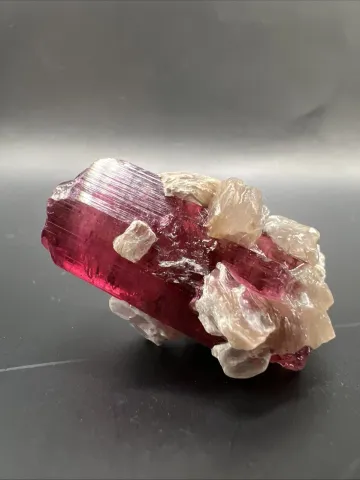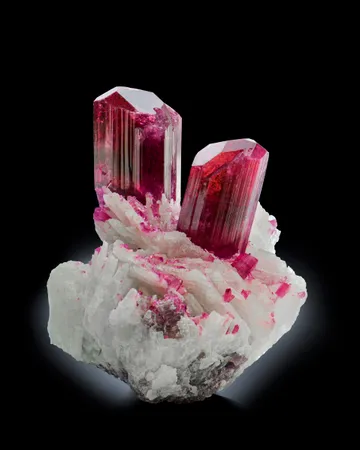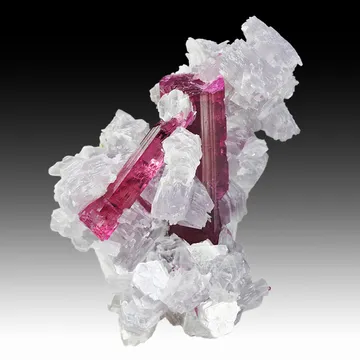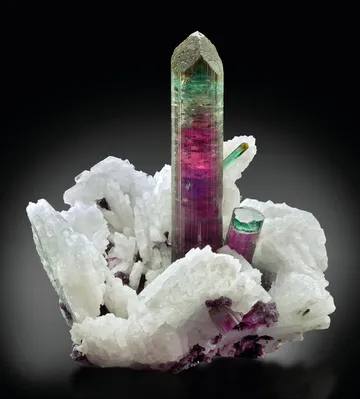
Conselheiro Pena, Brazil — a renowned Rio Doce pegmatite locality producing brazilianite, tourmaline, morganite, apatite, and vivid albite/muscovite specimens.
Key facts
Conselheiro Pena stands for one of the great pegmatite names of eastern Minas Gerais: not a single pit, but a mineral province of schist-hosted granitic pegmatites scattered through the middle Rio Doce country southeast of Governador Valadares. For collectors, the name carries two meanings at once. In the strict modern sense it includes celebrated claims and mines in the municipality of Conselheiro Pena, such as Sapo, Cigana/Jocão, Eduardo, Urucum, Zé Pinto, Macaco, and related Barra do Cuieté and Ferruginha workings. In older specimen commerce it also served as a broader Rio Doce pegmatite label for nearby Galiléia, Linópolis, Divino das Laranjeiras, and Mendes Pimentel material, especially brazilianite from the Córrego Frio–Telírio area. That historical looseness is part of the locality’s story and also one of the main things a serious collector must keep straight.
The geological setting is the Eastern Brazilian Pegmatite Province, within the Araçuaí orogen. The important bodies here are mostly rare-element granitic pegmatites, commonly tabular or lens-shaped, emplaced in amphibolite-facies schists, quartzites, and related Rio Doce Group metasediments. Many are zoned and phosphate-rich. Feldspar, albite, mica, quartz, and beryl made the district economically useful; tourmaline, morganite, aquamarine, kunzite, apatite, brazilianite, hureaulite, and an extraordinary suite of secondary phosphates made it famous.
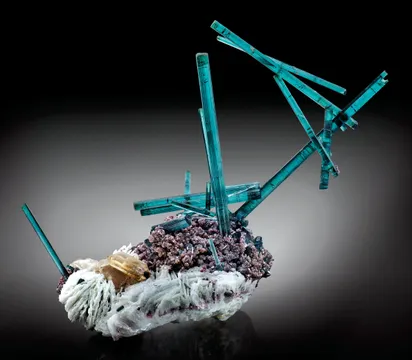
The best Conselheiro Pena specimens have a recognizably Brazilian pegmatite look: bright white albite or cleavelandite, silvery muscovite plates, glassy quartz, and jewel-like accent crystals that seem to float against the matrix. Its classic brazilianites are yellow-green to olive, lustrous, and often beautifully perched with muscovite. Sapo apatites are vivid green, commonly zoned, and sculptural on albite or quartz. Cigana/Jocão phosphates are more intimate but mineralogically richer: pink hureaulite, brown correianevesite, dark rockbridgeite, blue to violet iron phosphates, and tiny species that matter enormously to systematic collectors. The same district also gave the world some of the most dramatic tourmaline pocket stories in Minas Gerais, linking specimen collecting, gem mining, and scientific mineralogy in a way few localities can match.
Regional View
Country View
The district’s importance is not only aesthetic. Córrego Frio, in the broader Conselheiro Pena pegmatite district usage, is the type locality for brazilianite, scorzalite, and souzalite. Sapucaia, also within the broader district, is a classic type-locality pegmatite for several phosphates. Within Conselheiro Pena municipality proper, the Eduardo mine produced césarferreiraite, and the Cigana/Jocão phosphate assemblages have been central to modern work on triphylite alteration, hureaulite chemistry, and correianevesite. Few localities have supplied so many cabinet minerals while also remaining important to academic pegmatite mineralogy.

Photo: Wikimedia Commons

Photo: Wikimedia Commons

Photo: Wikimedia Commons
Search for specimens: View all specimens from Conselheiro Pena, Brazil
Conselheiro Pena is best treated as a pegmatite district locality. The district lies in eastern Minas Gerais, in the middle Rio Doce basin, and has long been grouped with the Aimorés–Governador Valadares pegmatite belt of the Eastern Brazilian Pegmatite Province. Published district summaries describe more than 200 mined pegmatites, many of them large bodies 15 to 50 meters thick and some exceeding 50 meters. They occur as tabular, lens-shaped, and locally balloon-like bodies, most commonly hosted by schists of the São Tomé Formation and related metasediments, with granitic sources and structural controls tied to the Brasiliano-age Araçuaí orogen.
The mineralization is the familiar but highly evolved Minas Gerais rare-element pegmatite suite: quartz, K-feldspar, albite, cleavelandite, muscovite, schorl and elbaite, beryl-group minerals, spodumene, columbite-tantalite minerals, cassiterite, apatite-group minerals, and a remarkable phosphate succession derived especially from primary triphylite, lithiophilite, montebrasite, and related phosphates. In the collector pockets, the large silicates form the architecture: quartz crystals, albite plates, mica books, feldspar masses, tourmalines, and beryls. In the phosphate-rich zones and altered nodules, the district becomes a systematic collector’s locality, yielding hureaulite, eosphorite, rockbridgeite, frondelite, barbosalite, tavorite, strengite, phosphosiderite, laueite-group minerals, jahnsite-group minerals, and other species that may require analysis to identify confidently.
Mining has always been intermittent and pocket-driven. Industrial minerals such as feldspar, albite, mica, quartz, and beryl ore supported many workings, but specimen and gem pockets drove the district’s reputation. Sapo became famous for green apatite, hydroxylapatite/fluorapatite-series material, tourmaline, quartz, albite, and beryl. Cigana, also known as Jocão, is one of the great phosphate pegmatites of the area and has been studied for complex phosphate nodules, hureaulite, correianevesite, and a long list of rare secondary phosphates. Eduardo, near Boa Vista creek, is known to mineralogists for césarferreiraite and other arsenate/phosphate species. Urucum, in Barra do Cuieté, is a significant beryl and morganite locality. Zé Pinto is remembered for striking muscovite and fluorapatite specimens from late-1980s to early-1990s production. Macaco is represented in the modern specimen market by large smoky quartz with albite and muscovite.
Because “Conselheiro Pena” has been used at several levels, labels deserve attention. A label reading only “Conselheiro Pena, Minas Gerais” may be a legitimate old trade label, but it is less informative than one naming Sapo Mine, Cigana/Jocão, Eduardo, Urucum, Zé Pinto, Macaco, or another specific claim. Brazilianite labels are especially tricky: many older specimens were sold under Conselheiro Pena or Doce Valley, while the classic type-locality material belongs to the Córrego Frio pegmatite in the Linópolis–Mendes Pimentel area of the broader district. For modern collecting, the best labels preserve both the historic wording and the corrected mine or district attribution.
Collecting access today should be regarded as private-mine and permission-only. These are not casual public digging localities; they are rural claims, old workings, active or intermittently active industrial-mineral quarries, and privately held garimpos. Fine specimens reach collectors mainly through Brazilian dealers, older collections, show stocks, and occasional new production rather than through open collecting. The best material from classic pockets is increasingly provenance-sensitive: old collection labels, dealer documentation, and references to known finds can add real value.
Brazilianite is the name most strongly tied to the broader Conselheiro Pena pegmatite district, even though the most precise modern label for the type material is Córrego Frio in the Linópolis–Mendes Pimentel area rather than Conselheiro Pena municipality proper. Classic pieces are yellow, yellow-green, or olive-green monoclinic crystals, typically glassy to gemmy, with muscovite, albite or cleavelandite, quartz, apatite, and tourmaline as the collector associations. The best old crystals have saturated color, high luster, sharp terminations, and minimal edge bruising; small cabinet and thumbnail crystals from the early type-locality production can outrank larger but paler or more contacted modern pieces. Matrix examples with bright muscovite or albite are especially desirable because they preserve the pegmatite setting and help distinguish an important specimen from a loose gem crystal.
Quartz from Conselheiro Pena ranges from clear rock crystal through pale citrine to smoky quartz, occurring as pocket crystals with albite, feldspar, muscovite, tourmaline, apatite, and beryl. In the district’s specimen history, quartz is more than a background mineral: it formed the matrix for major tourmaline pockets, lined cavities in phosphate-rich pegmatites, and in some workings occurred as large crystals significant enough to imply pegmatite thicknesses of several meters. Good specimens here are judged by luster, transparency, sculptural form, and the quality of associations; a smoky crystal on bright albite and muscovite, a quartz matrix carrying apatite, or a quartz association with tourmaline or brazilianite is usually more locality-significant than an isolated, ordinary quartz point.
Muscovite is both an industrial mineral and one of the visual signatures of Conselheiro Pena specimens. It occurs as books, platy aggregates, silvery blades, and lustrous matrix plates with quartz, albite, feldspar, brazilianite, apatite, and beryl-group minerals. Zé Pinto is especially noted in the specimen trade for large, well-formed muscovite and muscovite-with-quartz pieces from limited production around 1989–1990, while Sapo, Córrego Frio, and other pegmatites provide the smaller sparkling books that make brazilianite, apatite, and quartz specimens so attractive. The best muscovite specimens are crisp, three-dimensional, bright, and undistorted; ordinary material is abundant, but clean freestanding plates or aesthetic combinations from a named claim are much less common.
Apatite from Conselheiro Pena is most famous through Sapo Mine, where green apatite-group crystals made a major impression on North American and European collectors after notable production in the mid-1980s and again in later finds. Many Sapo pieces are flattened hexagonal or bipyramidal crystals, green to yellow-green, commonly with zoning, perched on albite, quartz, or feldspar with muscovite; some specimens require analytical distinction between fluorapatite and hydroxylapatite, and mixed or zoned apatite-series crystals are part of the locality’s appeal. Good pieces show sharp crystal outlines, lively vitreous luster, visible green zoning, and strong contrast against white matrix; cloudy, oiled, abraded, or poorly identified apatite should be valued more cautiously.
Hureaulite is one of the emblematic rare phosphates of the Cigana/Jocão side of the Conselheiro Pena story. It occurs as pink to rose, vitreous, often striated crystals and crystal groups formed during alteration of primary Fe-Mn phosphates such as triphylite and lithiophilite, with associations including rockbridgeite, strengite, phosphosiderite, correianevesite, triphylite, albite, quartz, and other secondary phosphates. Attractive specimens are usually miniature-scale rather than large-cabinet pieces, but for the species the crystals can be robust, lustrous, and well defined; the best examples have intense pink color, individual crystal identity, and a matrix association that tells the phosphate-nodule story rather than a mere powdery coating.
Fluorapatite from Conselheiro Pena is most collectible from Sapo and from phosphate-rich bodies such as Cigana/Jocão, where apatite-group minerals sit at the intersection of gem appeal and analytical complexity. Sapo fluorapatite is typically green to yellow-green, sometimes in stacked, flattened hexagonal crystals or sculptural aggregates on albite, quartz, feldspar, and muscovite; some specimens formerly offered under broader or questionable apatite names have since been treated more carefully as fluorapatite or hydroxylapatite-bearing material. The best examples combine saturated but natural-looking green color, glassy luster, clean crystal faces, and matrix contrast, while high-value pieces should be accompanied by reliable locality and, where species-level identity matters, analytical support.
Beryl is one of the economic backbone minerals of the Conselheiro Pena pegmatites and appears both as industrial ore and as collectible aquamarine, goshenite, heliodor-like material, and morganite. Urucum in Barra do Cuieté is especially important for beryl and morganite, with associations including muscovite, albite, cassiterite, and schorl; Sapo and other nearby workings also list beryl among their pegmatite species. Collectible beryl from this area is judged by color, transparency, termination quality, etching, and associations: a transparent pink or blue crystal with albite, muscovite, or tourmaline interest is far more desirable than a massive pale beryl fragment, even if the latter is larger.
Smoky quartz from Conselheiro Pena is a classic accessory specimen mineral rather than a rarity, but good pieces are far from generic. The district has produced glassy smoky crystals, sceptered or skeletal forms, compound crystals, and large matrix specimens with albite and muscovite, including modern market examples from Macaco and Sapo-area pegmatites. Color ranges from pale gray-brown to rich smoky brown, and the best pieces retain transparency, sharp faces, glossy luster, and attractive siting on white albite or silvery mica. Damage, contacted backs, and dull rehealed surfaces are common pocket issues, so the premium goes to clean display faces and combinations that clearly read as Minas Gerais pegmatite specimens.
Morganite is the pink beryl variety that gives several Conselheiro Pena and Barra do Cuieté specimens their gem-mineral status. Urucum and the Lavra da Morganita tradition are especially relevant, with crystals ranging from pale blush to deeper pink or salmon tones, commonly etched or sculptural and associated with albite, muscovite, schorl, cassiterite, and other pegmatite minerals. Good morganites from here need not be perfectly prismatic; in fact, late-stage etched forms can be highly characteristic and desirable when the crystal remains transparent, lustrous, and aesthetically balanced. Strong natural color, freedom from major repairs, and a named mine label are what separate a serious Conselheiro Pena morganite from a generic Minas Gerais pink beryl.
Other minerals documented from Conselheiro Pena and its broader pegmatite district make the locality unusually deep for systematic collectors. Cigana/Jocão has produced barbosalite, beusite, ferrisicklerite, ferristrunzite, frondelite, greifensteinite, harrisonite, heterosite, hydroxylapatite, jahnsite-group minerals, leucophosphite, lipscombite, ludlamite, mitridatite, phosphosiderite, rockbridgeite, saléeite, staněkite, tavorite, triphylite, whiteite-group minerals, and zircon in addition to the more familiar silicates. Eduardo is notable for césarferreiraite, an arsenate in the laueite group described from a tiny miarolitic cavity. Correianevesite is tied to the Cigana/Jocão phosphate assemblage and is one of the district’s most important modern rarity names. In the wider historical Conselheiro Pena district sense, Córrego Frio supplied the type material for brazilianite, scorzalite, and souzalite, while Sapucaia produced a celebrated group of phosphate type minerals including barbosalite, faheyite, frondelite, moraesite, and tavorite.
The first authenticity issue is locality precision. “Conselheiro Pena” can mean the municipality, the pegmatite district, the Doce Valley trade region, or an old broad label covering neighboring Galiléia, Linópolis, Divino das Laranjeiras, and Mendes Pimentel production. For casual display collecting, a broad old label may be acceptable; for locality collecting, it is not enough. Whenever possible, preserve the old label but add a modern interpretation: Sapo Mine, Ferruginha; Cigana or Jocão, Barra do Cuieté; Eduardo claim; Urucum claim; Zé Pinto prospect; Macaco mine; or Córrego Frio in the Linópolis–Mendes Pimentel area for classic brazilianite.
Brazilianite is commonly seen as loose crystals, and fine crystals may have repaired terminations or small edge bruises because the mineral has distinct cleavage and is not especially hard. Matrix examples should be examined for glue, added mica, and repaired contacts. The most desirable old type-locality crystals are often small, so size alone is a poor guide to quality. Color, luster, crystal completeness, and provenance are more important.
Sapo apatite has a documented treatment and naming problem. Specimens once promoted as “carbonate apatite” or “carbonate-rich apatite” from Sapo were reported as heavily oiled fluorapatite. Oiling can darken color, increase apparent translucency, and hide fractures or frosty surfaces. Wet-looking, unnaturally glossy, or strongly darkened apatite should be examined carefully. Species names also matter: Sapo material may be fluorapatite, hydroxylapatite, or zoned apatite-series material, and high-priced pieces sold specifically as hydroxylapatite deserve analytical support or strong provenance.
Hureaulite and associated secondary phosphates should be handled gently. They are often small, brittle, and set in altered phosphate matrices that can shed grains or dust. Avoid prolonged soaking, aggressive ultrasonic cleaning, acids, and unnecessary humidity cycling. Rockbridgeite, phosphosiderite, strengite, and related species can look deceptively similar in dark or earthy coatings; analysis is often required for rare phosphate names.
Quartz, smoky quartz, muscovite, and beryl are less likely to be outright faked, but repairs, concealed contacts, and locality inflation are real concerns. Large smoky quartz groups from named mines should be checked for reattachment at the base and along mica or albite contacts. Morganite from Urucum and related localities may be naturally etched; etching is not a defect, but chips, sawn bases, and repaired crystals should be separated from natural pocket corrosion. Good Conselheiro Pena material remains available, but the finest old brazilianite, Sapo apatite, hureaulite-rich Cigana/Jocão phosphate pieces, and named-pocket tourmaline or morganite associations are increasingly collection-to-collection specimens rather than steady mine production.
The Conselheiro Pena story begins, in collector terms, with confusion. Brazilianite, now one of Brazil’s signature mineral species, was first mistaken for something more familiar. Early accounts describe yellow-green gemmy material that was thought to be chrysoberyl before Frederick H. Pough and Edward P. Henderson recognized that its habit and properties did not fit. Their 1945 description gave the mineral a national name, and the Rio Doce pegmatite country entered mineralogical history. The irony is that a specimen now instantly recognizable to serious collectors as brazilianite was, at the beginning, hidden in plain sight by resemblance to a better-known gem mineral.
Córrego Frio added another layer to that history. The pegmatite was later shown to be the source not only of brazilianite but also of scorzalite and souzalite. In descriptions of the body, the productive structure was small and intimate rather than grand: a tabular pegmatite in schist, with border zones of albite, quartz, and muscovite, blue-green phosphate masses, and cavity zones where quartz, brazilianite, limonitic rhombs, and muscovite occurred near the quartz lens. The quartz lens had been almost entirely removed by miners by the time it was studied. For collectors, that is the essential Córrego Frio image: not an enormous open quarry, but a modest phosphate-rich pegmatite whose few meters of favorable structure produced three mineral names that still appear in systematic collections worldwide.
Sapo’s story is different: it is about color arriving suddenly from a pegmatite better known first as a mine than as a publication. In 1985, spectacular green apatite specimens were found there and quickly became prized in the North American and European collector markets. The mine later continued to produce apatite, quartz, albite, beryl, and colored tourmaline into the 2000s. Photographs and descriptions of the locality show why the pegmatite mattered to collectors: green apatite crystals against white albite, quartz crystals large enough to make geologists infer a body thickness exceeding five meters, and the kind of pockets that could shift a working from feldspar and quartz production into specimen fame almost overnight.
The most cinematic episode tied to Conselheiro Pena country is the 1978 Jonas mine pocket, on the Itatiaia hillside a few kilometers from the town. The mine had earlier been worked by João Pinto in the 1940s, producing four- and five-colored tourmaline crystals up to 12 cm long. Its modern chapter opened when Ailton Barbosa persuaded gem dealer Jonas Lima to lease the ground. The rent was only 1,000 cruzeiros a month, about US$70 at the time, and the landowner did not insist on a royalty. Ailton began in October 1977 with just four garimpeiros, extending an old tunnel into schist and pegmatite. For months they found little: matchstick-sized green tourmalines on 5-cm albite, then in February 1978 several pockets that yielded three tons of worthless black tourmaline mixed with albite.
By April 1, 1978, Jonas was ready to quit. Ailton had seen lepidolite in the wall, which he took as the best indicator of gem tourmaline, and he pleaded three times to continue. His promise sounded absurd: a huge gem pocket and rubellites “as thick as his forearm.” A few days later, after more drilling and blasting through about 30 m of schist and only a few meters of pegmatite, the crew hit another discouraging pocket of opaque black tourmaline with opaque pink tops, albite, mud, water, quartz, and mica. Ailton was nearly out of money. He handed over the title to his Volkswagen to raise enough for food and mining supplies for one last week.
On Good Friday, 1978, the water draining from above convinced him there was another cavity. He dug upward carefully, using hand work and partial sticks of dynamite, until he could push an arm into the darkness. When he withdrew it, he was holding a large, nearly flawless gem rubellite. He shone his strongest mining light through the opening and saw a cavern glittering red with tourmaline. The crew closed the hole immediately. Ailton rushed to Conselheiro Pena and telephoned Jonas in Governador Valadares with the laconic message that became part of Brazilian gem lore: “I found the gems, COME ON DOWN.”
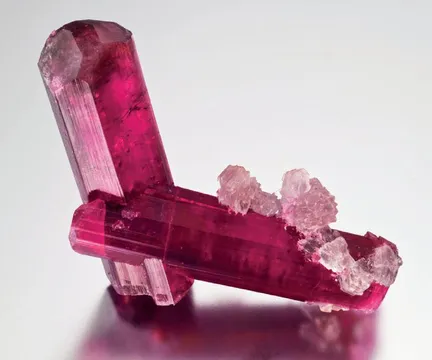
When Jonas arrived, they dug a safer entrance all night and most of the next day. The pocket was so large that they could walk into it, with rubellites and albites crunching underfoot. It measured about 3 m high, 3 m long, and 2.5 m wide, lined with rubellite crystals set among snow-white albite, transparent quartz, and pink lithium-bearing lepidolite. Many rubellites were intact and doubly terminated, and the pocket was so clean that the specimens hardly needed washing.
The named pieces became legends. Joninha, named for Jonas’s young son, consisted of two gigantic rubellite crystals measuring about 50 x 25 cm and 25 x 30 cm on quartz crystals 20 cm and 45 cm long, with albite and a 20-cm doubly terminated pale citrine crystal on the side. With matrix, it weighed 352 kg. It had been loosened and was in danger of falling. Ailton’s solution was wonderfully practical: stack old tires from the floor to just beneath it, add a burlap pad, push upward from all sides, and release it with a crowbar. It reached Governador Valadares that night undamaged, despite Ailton falling asleep at the wheel and driving the Jeep down a 20-m embankment.
Other pieces from the same pocket were scarcely less dramatic. The Rocket, a broken but repairable rubellite crystal on quartz, rose 107 cm when reassembled and weighed about 135 kg. Tarugo was an opaque rubellite about 85 cm long, 30 cm wide, and 82 kg in weight. Fleur de Lis was a 35-cm tourmaline attached to a 60-cm quartz crystal, much of it covered in albite. Although Jonas is a tourmaline story more than a brazilianite or apatite story, it belongs in any serious Conselheiro Pena guide because it captures the district’s essential reality: these pegmatites could be miserly for months, then open into a chamber that rewrote specimen history in a single weekend.