Erzgebirgskreis, Germany — renowned locality for native silver and fluorite; Schneeberg and Niederschlag yield collectible specimens with strong provenance.
Key facts
Erzgebirgskreis occupies the collector’s heart of the Saxon Ore Mountains, a district where mineral specimens are inseparable from mining history. Within its modern borders lie the classic mining camps of Schneeberg, Annaberg-Buchholz, Marienberg, Johanngeorgenstadt, Ehrenfriedersdorf, Pöhla and Niederschlag—names that recur on old European labels for native silver, cobalt and nickel arsenides, bismuth minerals, uranium phosphates and arsenates, fluorite, baryte, quartz, cassiterite, wolframite and skarn minerals. The specimen character is broad because the geology is broad: Variscan metamorphic basement and late-Variscan granites were cut again and again by hydrothermal vein systems, then locally overprinted by younger fluorite-baryte-Pb-Zn-Cu mineralization and by oxidation that produced a remarkable suite of secondary arsenates, phosphates, vanadates and uranyl minerals.
For collectors, the district is most celebrated for two very different faces. One is the old five-element vein association—native silver with bismuth, cobalt-nickel arsenides, arsenic, acanthite, proustite and carbonate gangue—especially at Schneeberg, Annaberg and Johanngeorgenstadt. The other is fluorite: historically scattered through many vein systems, and in modern collecting best represented by Niederschlag, where green, yellow, grey-green, purple and banded fluorite occurs with quartz, baryte and chalcopyrite. The highest-end pieces from the district tend not to be large by global standards; their power is locality pedigree, age, and mineralogical density. A fine Schneeberg silver, a magenta erythrite from the Daniel Mine, a labelled walpurgite from the Weißer Hirsch type locality, or a sharp Niederschlag fluorite can carry more history per square centimetre than a far larger specimen from a younger, more prolific deposit.
Regional View
Country View

Photo: Wikimedia Commons

Photo: Wikimedia Commons
The district’s best specimens also matter because Erzgebirgskreis is a type-locality landscape. Annabergite takes its name from Annaberg. Schneeberg and Neustädtel supplied type material for a long list of species including erythrite, köttigite, walpurgite, zeunerite, atelestite, schneebergite and nickelschneebergite. Johanngeorgenstadt has yielded highly unusual nickel arsenates and bismuth-nickel arsenates, including johanngeorgenstadtite and paganoite. Ehrenfriedersdorf’s Sauberg is central to the early history of apatite and fluorapatite. This is why serious old-European collections often contain multiple small Erzgebirge specimens: the locality is not a single mine but a compact mineralogical library.
Search for specimens: View all specimens from Erzgebirgskreis, Germany
Erzgebirgskreis covers the German side of a long metallogenic province along the Saxon-Bohemian border. The bedrock framework belongs largely to the Saxo-Thuringian Zone of the Variscan belt: Neoproterozoic to Paleozoic metasedimentary and metaigneous rocks, gneisses, schists and phyllites, intruded by late-Variscan granites and cut by numerous faults and vein systems. In collector terms, that means a district where the “ore” is not a single body but a repeated sequence of veins, greisens, skarns and alteration zones formed during several hydrothermal events.
The classic ore style at Schneeberg, Annaberg, Marienberg and Johanngeorgenstadt is the Bi-Co-Ni-Ag-U, or “five-element,” vein association. These veins may contain native silver, native bismuth, arsenic, uraninite, acanthite, cobalt-nickel arsenides such as skutterudite, nickelskutterudite, rammelsbergite, safflorite and nickeline, plus carbonates and quartz. In the oxidized parts of the veins, that primary assemblage breaks down into the brilliant species that made the district a textbook locality: green annabergite, magenta erythrite, yellow to orange uranyl arsenates, bismuth arsenates, phosphates and vanadates, and a wide range of rare micro-minerals.
Niederschlag, near Bärenstein and Oberwiesenthal, is the district’s modern fluorite-baryte reference locality. It lies on a regional NW-striking fault system continuing toward Kovářská on the Czech side. The main ore body is a steep vein several metres thick, with a strike length of roughly a kilometre on the German side. Its paragenesis is multi-stage: shallow parts carry older uranium and five-element mineralization, while deeper parts host fluorite-quartz and later fluorite-baryte-sulfide assemblages. Modern studies distinguish an older fluorite-quartz stage with complex breccia and replacement textures from a younger fluorite-baryte stage that forms banded and coarse open-space infill.
Mining history here is measured in centuries. Schneeberg’s silver discoveries in the later 15th century helped trigger the great Ore Mountain mining rush. Annaberg followed with the 1491 discovery on the Schreckenberg, where Caspar Nietzel’s find led to the founding of the new mining town that became Annaberg and to the minting of the Schreckenberger coin. Marienberg began with Clemens Schiffel’s silver find in 1519 and was formally founded in 1521 with a planned Renaissance layout. As rich silver shoots waned, cobalt and nickel became increasingly important, especially around Schneeberg, where cobalt ores supplied the famous blue pigment industry. Uranium mining then transformed parts of the district after World War II, particularly at Johanngeorgenstadt, Annaberg, Schneeberg, Schlema-Alberoda and related Wismut workings.
Commercial mining for metallic ores in the Saxon Ore Mountains ended by the early 1990s after German reunification, but Niederschlag revived underground mining for industrial fluorite and baryte in the 21st century. Preliminary work began in 2010, production began in 2013, and regular operation followed at Niederschlag and the associated processing plant at Aue. EFS, the Erzgebirgische Fluss- und Schwerspatwerke, later entered insolvency proceedings, and the operation was sold in 2025 to the Sachtleben Minerals group, preserving the mine and processing chain as an industrial fluorspar source.
For collectors today, access is very different from the old literature. The historic mines are closed workings, protected heritage sites, show mines, museum landscapes, or remediated Wismut ground; collecting underground is not a casual field activity and should be assumed prohibited unless explicit permission is granted by the landowner and responsible mining authority. The Niederschlag mine is an operating industrial mine, not a public collecting site. Specimens entering the market are therefore old collection pieces, material saved during past mine work, specimens from mine personnel or contractors, and pieces from dumps where collecting has been legal and safe. In practice, good provenance is part of the specimen.
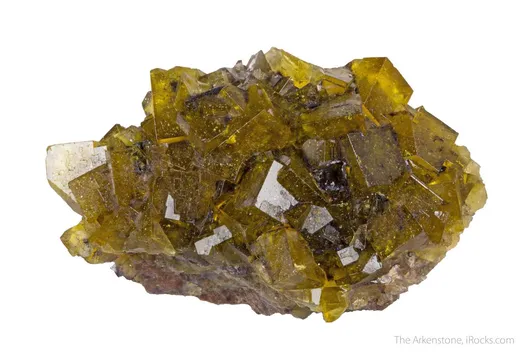
Notable specimen-producing areas include the Daniel, Weißer Hirsch, Rappold, Pucher, Wolfgangmaßen, Gesellschaft and other Neustädtel-Schneeberg mines for silver, cobalt-nickel arsenides, erythrite, walpurgite and bismuth minerals; the Annaberg-Frohnau district for annabergite and fluorite-bearing vein material; Johanngeorgenstadt for rare nickel arsenates, uraninite and bismuth-bearing secondary minerals; Ehrenfriedersdorf-Sauberg for apatite-group and tin-tungsten-related minerals; Pöhla-Tellerhäuser for skarn and fluorite-baryte associations; and Niederschlag for the best modern fluorite specimens from Erzgebirgskreis. The most desirable modern Niederschlag fluorites show sharp cubic crystals, often greenish yellow to olive-green or grey-green, with quartz, baryte or chalcopyrite; documented pieces include level-specific specimens from recent underground work and small-cabinet examples with cubes over 4 cm on edge.
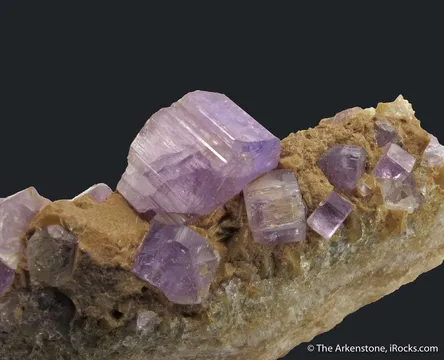
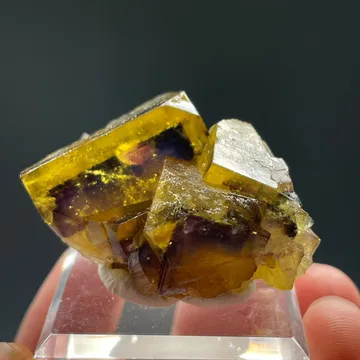
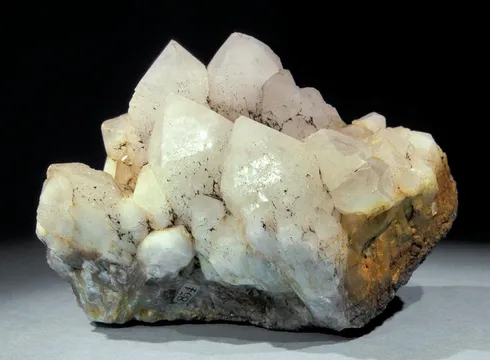
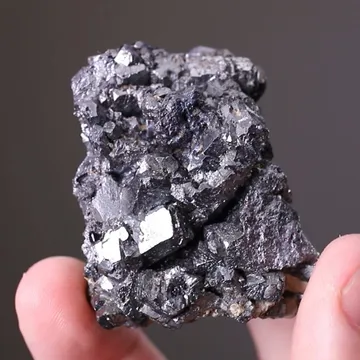
Fluorite from Erzgebirgskreis ranges from old, small vein occurrences at Schneeberg, Annaberg, Marienberg, Ehrenfriedersdorf and Pöhla to the modern Niederschlag mine, which has become the district’s most recognizable source for collector-quality fluorite. Niederschlag material is typically cubic, in greenish-grey, olive-green, yellow, greenish-golden, purple or banded colours, and is associated with quartz, baryte and chalcopyrite; the best pieces show sharp lustrous cubes, clean edges, attractive colour zoning or contrast with snowy quartz and brassy chalcopyrite, while ordinary pieces are more massive, cleaved, drusy or industrial-looking. Crystals from Niederschlag are usually small to small-cabinet scale, but fine examples with cubes several centimetres across are known, including reported cubes to about 4.3 cm on edge; level-labelled pieces from recent mine work, especially with intact cube faces and natural matrix, are much more desirable than anonymous “Erzgebirge fluorite” lumps.
Native silver from Erzgebirgskreis is a classic old-European collector mineral, especially from Schneeberg, Neustädtel, Annaberg, Marienberg and Johanngeorgenstadt. It occurs as wires, curls, dendritic growths, arborescent masses, plates, grains and rare crystallized forms, with Schneeberg records including small silver cubes to about 1.2 cm and historic wire specimens from mines such as Priester und Leviten and Daniel. Associations are the key to reading these pieces: dark acanthite, chlorargyrite, proustite or pyrargyrite, calcite, dolomite, quartz, baryte, native arsenic, bismuth, and cobalt-nickel arsenides often point to the five-element vein environment. Good pieces have three-dimensional sculptural silver, old patina rather than fresh abrasion, credible mine-level provenance, and a period label; ordinary pieces are small smears or flattened blebs in arsenide matrix, still historic but less visually compelling.
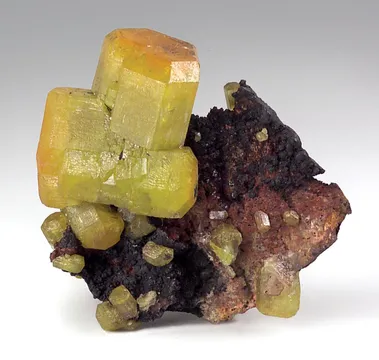
Beyond fluorite and silver, Erzgebirgskreis is exceptional for type-locality and rarity minerals. Annabergite, Ni3(AsO4)2 · 8H2O, is named from Annaberg material and remains one of the district’s signature green alteration minerals. Schneeberg and Neustädtel are tied to erythrite, köttigite, walpurgite, zeunerite, atelestite, bismutite, schneebergite, nickelschneebergite, trögerite, uranosphaerite, uranospinite, spherocobaltite and other rare bismuth, cobalt, nickel and uranium species. Johanngeorgenstadt is the type area for johanngeorgenstadtite and has produced paganoite, petewilliamsite, xanthiosite and other nickel arsenates or bismuth-bearing arsenates from highly unusual assemblages. Ehrenfriedersdorf’s Sauberg is central to fluorapatite and apatite history, with fluorapatite associated with quartz, muscovite, fluorite, pyrite and chalcopyrite. For the specialist, the district’s rarities are often microscopic, but their locality significance is large.
The most important buying issue for Erzgebirgskreis specimens is not a famous treatment problem but locality discipline. Old labels may read simply “Schneeberg,” “Annaberg,” “Sachsen,” “Erzgebirge,” “Johanngeorgenstadt,” “Neustädtel” or “Marienberg,” and those words may hide a very specific mine, vein, shaft or dump. For common species this may be acceptable; for type-locality minerals, silver, historic cobalt minerals and radioactive secondaries, it matters greatly. A specimen labelled only “Erzgebirge” should be priced accordingly unless its appearance and history support a more precise assignment.
There is no well-established Erzgebirgskreis-wide problem of dyed fluorite or assembled silver comparable to the better-known fakes from some other mineral markets. The recurring risk is misidentification and over-broad locality labelling. Old cobalt-nickel arsenides can be visually deceptive: nickeline, rammelsbergite, safflorite, skutterudite, nickelskutterudite, arsenic, acanthite and tarnished silver may all present as metallic grey masses or networks. Similarly, tiny yellow, orange or green secondary arsenates and uranyl minerals from Schneeberg and Johanngeorgenstadt often require analytical confirmation. For significant micro-rarities, a modern analysis or a trusted old collection pedigree is not an optional luxury.
Condition must be judged species by species. Native silver may be naturally tarnished, flattened by ore crushing, or embedded in friable carbonate/arsenide matrix; overcleaned silver loses much of the old-European character collectors want. Fluorite from Niederschlag commonly shows bruised cube edges, cleaves, contacts from vein walls, quartz caps, baryte coatings, or chalcopyrite perched on vulnerable faces; the premium is for sharp, unrepaired crystals with honest contacts. Erythrite and annabergite are soft and can be rubbed or smeared. Baryte is brittle. Many uranyl minerals are tiny, powdery, dehydrating or light-sensitive, and should be kept dry, boxed and away from unnecessary handling.
Radioactive and arsenic-bearing specimens deserve respect. Erzgebirgskreis has a long uranium history, and minerals such as uraninite, torbernite, zeunerite, walpurgite, nováčekite-group species and other uranyl arsenates or phosphates should be stored in labelled, closed containers, handled minimally, kept away from children and food areas, and never cut, ground, soaked or cleaned in ways that generate dust or contaminated liquid. The arsenide and arsenate suite also makes wet chemical cleaning risky. If a specimen is both radioactive and arsenic-bearing, its display value should be balanced against safe storage.
Availability is uneven. Niederschlag fluorite appears periodically because modern industrial mining and recent dealer circulation brought material to market, but fine sharp matrix pieces are not abundant. Good Schneeberg or Johanngeorgenstadt silver is much scarcer, especially with mine-level provenance and old labels. Type-locality walpurgite, erythrite, köttigite, schneebergite, nickelschneebergite or johanngeorgenstadtite is generally a specialist market, often traded as micromounts or small cabinet historical pieces. The district rewards collectors who buy fewer pieces with better labels.
In 1477, Schneeberg produced the kind of discovery that turns geology into legend. At the St. Georg Mine, miners broke into an enormous mass of rich silver ore. Later accounts describe it as a slab nearly a foot thick, about twelve feet long and six feet broad. Elector Ernest is said to have honoured the find by using it as a dining table—a piece of ore so rich and so large that princely ceremony could be staged upon it. When the mass was finally smelted, it was reported to have yielded roughly twenty tons of silver. Whether told in courtly language, mining history or museum catalogue prose, the story explains why Schneeberg specimens carry such weight: even a small fragment from the district belongs to a place where silver was once encountered not as a thread in the rock, but as a table-sized marvel.
Annaberg’s origin story begins with a man and a vein. On 28 October 1491, Caspar Nietzel found silver ore near the Frohnau Upper Mill on the Schreckenberg. The discovery was enough to redirect settlement. Within a few years, a new town rose across the Sehma, first called Neustadt am Schreckenberg and soon known as Sankt Annaberg. Mining courts were held in the mill gardens, the Frohnauer mill became tied to the machinery and administration of the young mining field, and in 1498 Annaberg gained minting rights. The Schreckenberger coin became a widely recognized piece of Saxon silver currency. A local saying captured the moment with the neat brutality of mining-town humour: if you were a rich Annaberger, you had a sack full of Schreckenbergers.
Marienberg’s story belongs to the planned city as much as to the vein. In 1519, Clemens Schiffel made the first important silver find near Wüstenschletta, at the entrance to the Hüttengrund. The rush that followed was so disorderly that Duke Heinrich the Pious founded a new mining town in 1521 to organize the influx. Ulrich Rülein von Calw, already associated with Annaberg, laid out Marienberg with a broad central market and a regular plan—an ideal Renaissance mining town north of the Alps. The contrast is unforgettable: above ground, geometric order and civic ambition; below ground, narrow veins, fault intersections and the uncertain geometry of ore.
The later history of Schneeberg changed colour. Silver built the town, but cobalt gave it a second life. Ores that had once seemed secondary became the basis for cobalt blue pigment, and the Schneeberg landscape, with its mines, water systems, processing sites and smalt works, became one of Europe’s great cobalt districts. The surviving mining landscape and Schindlers Werk smalt works show how mineral specimens, pigment chemistry and industrial organization converged. A small erythrite or cobalt arsenide from Schneeberg is not just a mineralogical object; it is a remnant of the supply chain that coloured glass, ceramics and decorative art far beyond Saxony.
The post-war uranium period was darker and more abrupt. From 1946 onward, Wismut uranium mining transformed old silver and cobalt districts into strategic mining zones. Johanngeorgenstadt, Annaberg, Schneeberg, Schlema-Alberoda and other Erzgebirge sites were worked with an urgency far removed from romantic mining folklore. Old veins were reinterpreted through the logic of uranium supply, and dumps, shafts and altered landscapes followed. Collectors encounter that history in the mineral suite itself: uraninite, torbernite, zeunerite, walpurgite, nováčekite-group species and a swarm of secondary uranium minerals that are beautiful, scientifically important and inseparable from a difficult chapter of 20th-century mining.