Bergmännisch Glück Mine, Germany - classic Erzgebirge locality famed for color-zoned fluorite, often with barite, chalcopyrite, and hematite staining, prized b…
Key facts
Bergmännisch Glück is one of the collector names that makes the Annaberg-Frohnau district instantly recognizable: a small, historically tangled Saxon vein locality whose modern fame rests not on ore tonnage, but on superb fluorite. The mine lies in the Frohnau sector of the Annaberg-Buchholz mining district in the Erzgebirge, where hydrothermal veins cut Proterozoic gneiss and where the long mining history moved through silver and cobalt, then uranium, before the locality became prized for specimens. The best-known collecting horizon is the Bergmännisch Glück Flacher vein, reached through the Frisch Glück adit and associated Wismut workings, a structure that yielded color-zoned fluorite with barite, chalcopyrite and galena in a compact but visually distinctive assemblage.
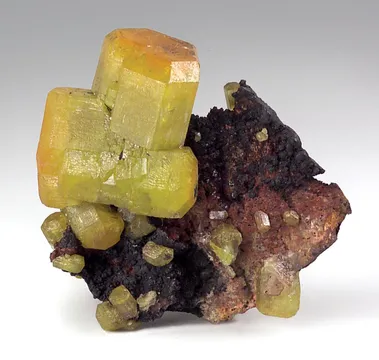
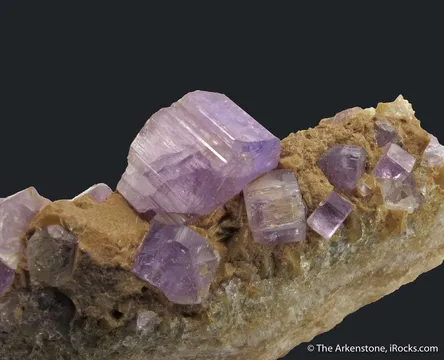
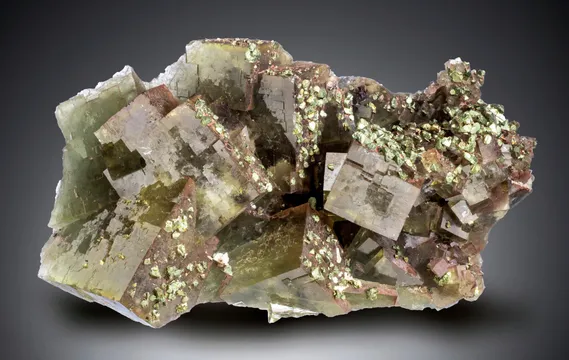
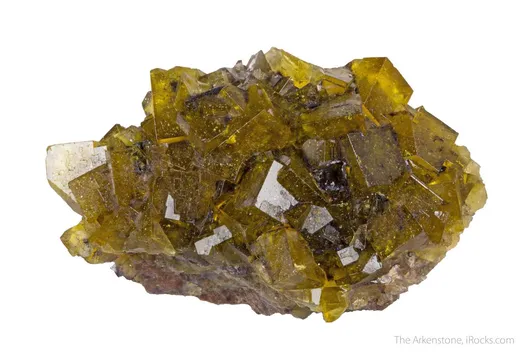
The classic specimens are not large in the global sense, but they have a look that is immediately local: cubic fluorite in honey-yellow, amber-orange, smoky purple, greenish yellow, blue-violet and dark “black” tones, commonly with crisp internal phantom lines parallel to cube faces. Some pieces show stepped or terraced cube growth; others are loose or matrix-supported clusters with a warm amber body and purple or bluish edge-zoning. A dusting or inclusion of brassy chalcopyrite can give the crystals depth, while white to pale barite plates or blades provide the contrasting architecture that makes the best examples feel unmistakably Erzgebirge rather than generic European fluorite. Hematite staining and coatings are part of the locality’s personality: they can enrich color dramatically, but they often trade away some transparency.
Regional View
Country View
For serious collectors, Bergmännisch Glück matters because it is both a classic and a modern-label problem. The Frohnau workings are closely spaced, historically interconnected, and variably labeled in the trade as Bergmännisch Glück, Bergmännisch Glück Flacher, Frisch Glück adit, Wismut Shaft 29b kleine Malwine, Malwine, Zehntausend Ritter, or simply Frohnau. That complexity is not a reason to avoid the locality; it is a reason to value precise old labels, dealer notes, and any documentation tying a specimen specifically to the Bergmännisch Glück Flacher vein. A fine, well-documented example belongs in any serious suite of German fluorite.
Search for specimens: View all specimens from Bergmännisch Glück Mine, Germany
Bergmännisch Glück Mine is situated at Frohnau, now part of Annaberg-Buchholz in Saxony’s Erzgebirgskreis, within the Annaberg mining district of the central Erzgebirge. The collector locality is best understood at three nested scales: the broader Annaberg five-element and fluorite-barite vein district; the Frohnau-Malwine mining area around Schreckenberg and the Frohnauer Hammer; and, most specifically, the Bergmännisch Glück Flacher vein reached through the Frisch Glück adit. The Frisch Glück adit, known as Adit 134, was driven in 1947 during the postwar uranium reworking of the district and gave access, among other structures, to the Bergmännisch Glück Flacher, which had already been worked in the early 19th century by the Bergmännisch Glück Mine.
Geologically the setting is the Annaberg-Buchholz system of polyphase hydrothermal veins hosted largely by Proterozoic paragneiss and related gneisses of the Erzgebirge. The district contains multiple vein styles: older Sn-quartz and polymetallic sulphide-quartz assemblages, uraninite-bearing stages, fluorite-barite-Pb-Zn mineralization, and the celebrated Ag-Bi-Co-Ni-As-U “five-element” assemblages of the Erzgebirge. In the Annaberg-Buchholz district, fluorite-barite-Pb-Zn mineralization is broadly distributed through the vertical profile, whereas uranium and five-element mineralization are concentrated in the upper few hundred metres where graphite-rich gneiss provided a strong redox control. For the specimen collector, the crucial point is that Bergmännisch Glück belongs to the low-temperature fluorite-barite-sulphide chapter of this long hydrothermal history, not to a simple single-stage fluorite vein.
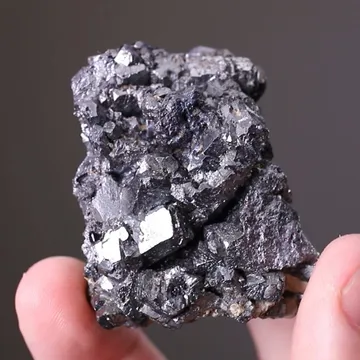
The principal collectible mineralization is the fluorite-barite assemblage of the Bergmännisch Glück Flacher vein. Documented species from the vein include fluorite, barite, chalcopyrite and galena; records for the mine level also include quartz and pyrite. The broader district mineralogy is far richer, but the Bergmännisch Glück collector suite is sharply focused: colorful fluorite cubes, white to yellowish barite, brassy chalcopyrite, and occasional galena or quartz. Inclusions and surface films are important. Chalcopyrite may occur as small metallic crystals on or in fluorite, and iron oxides or hematite can coat crystal faces, deepen the perceived colors, or form reddish-brown crusts on stepped areas.
Historically, the Frohnau area belongs to one of the oldest and most famous mining landscapes of the Erzgebirge. Mining in the Annaberg-Frohnau district began with late 15th-century silver discoveries and grew into a major silver and cobalt mining landscape. Bergmännisch Glück itself is tied to old silver and cobalt mining, with references to 18th-century activity and brief renewed working in the 1830s, while the Bergmännisch Glück Flacher was worked by the mine in the early 19th century. After World War II, SAG Wismut and later SDAG Wismut re-entered and investigated old workings throughout the Frohnau-Malwine area for uranium. Wismut work in the Frohnau district began in March 1947 and continued until 1958, with especially intensive shallow mining on the Bergmännisch Glück Flacher.
That uranium phase matters to specimen history because it created access, intersections, numbered shafts, and a later label vocabulary that still follows specimens today. Wismut Shaft 29b kleine Malwine appears in labels connected with the Bergmännisch Glück Flacher, and collectors will also see older or looser trade labels using Zehntausend Ritter or Malwine for closely related Frohnau material. In some cases those names may describe neighboring or connected workings rather than the exact mine, and the most conservative collector should treat “Frohnau” as the broader collecting field unless the label gives the vein or access point.
The specimen-making event most often associated with Bergmännisch Glück is the discovery of two vugs in 2005 on the Bergmännisch Glück Flacher. Those cavities yielded exceptionally color-zoned fluorite that collectors quickly began calling “Rainbow Fluorite.” The name is not a mineralogical variety in the strict sense; it is a trade and collector description for crystals showing stacked zones of yellow, orange, purple, blue, greenish and greyish color. Later material has continued to appear in dealer inventories and collection dispersals, including small-cabinet and cabinet examples, but the finest pieces from the 2005-style material are now treated as locality classics rather than ordinary recent-production fluorite.
Collecting access today should be approached cautiously and legally. The Frohnau-Malwine area includes old shallow workings, historic mine entrances, collapse-prone ground and Wismut-era uranium workings. Modern remediation has included the opening, securing and backfilling of old adits, raises and near-surface mine voids in the area above the Frohnauer Hammer. Such work underscores the condition of the ground: this is not a casual field-collecting locality, and any visit requires landowner permission, awareness of mining-law restrictions, and respect for closed or remediated workings. For most collectors, the practical route to Bergmännisch Glück specimens is the mineral market, old German collections, and documented dealer material.
Fluorite is the defining collector mineral of Bergmännisch Glück, especially from the Bergmännisch Glück Flacher vein. Typical specimens are cubic, often in loose clusters or druses, with sharp to slightly stepped faces and strong color zoning: honey-yellow and orange interiors, purple or bluish phantom lines near cube edges, smoky dark zones, and occasional greenish or greyish bands. Sizes range from thumbnails around 2–3 cm to small-cabinet and cabinet clusters near 8–14 cm, with individual cubes commonly in the millimetre-to-2 cm range and exceptional labeled pieces showing larger, visually dominant crystals. The most desirable examples are lustrous, translucent to transparent enough to reveal internal phantoms, and carry a good association of chalcopyrite or barite without being dulled by excessive hematite; more ordinary pieces may still be colorful but are blockier, stained, bruised on cube corners, or too opaque to show the “rainbow” zoning that made the locality famous.
Barite from Bergmännisch Glück is chiefly a companion mineral to fluorite rather than the locality’s headline species, but on good specimens it is essential to the architecture. It occurs as white, pale, yellowish to locally rosy lamellar plates, blades or tabular crystals, sometimes on the backs and margins of fluorite clusters, and in some newer descriptions as slender, rod-like crystals with a warm golden cast in the matrix. The finest barite-bearing pieces show undamaged, sharp barite contrasting against amber or zoned fluorite, with chalcopyrite adding a brassy accent; lesser pieces have barite hidden on the underside, broken into chalky remnants, or visually lost in iron staining. Because many Bergmännisch Glück specimens are marketed as fluorite first, a clean, well-displayed barite association can be a significant quality advantage.
Chalcopyrite at Bergmännisch Glück is usually present as small brassy crystals, inclusions, crusts or sparkling accents on fluorite, and it is one of the most diagnostic visual associations for the locality’s best-known fluorites. It may appear as golden specks enclosed in translucent cubes, scattered metallic crystals across crystal faces, or a lustrous crust at the edge of a fluorite group; dealer and occurrence records repeatedly pair it with fluorite and subordinate barite. Important pieces are not judged by chalcopyrite size alone, but by placement: bright, visible chalcopyrite that punctuates clear amber or color-zoned fluorite is far more desirable than dull granular sulphide hidden in the matrix. In well-balanced specimens, chalcopyrite supplies the metallic flash that ties the fluorite back to the district’s polymetallic vein heritage.
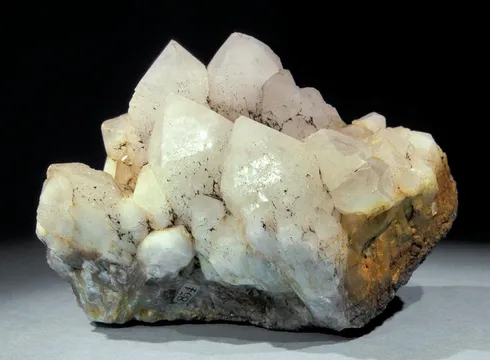
Other documented minerals from Bergmännisch Glück and the Bergmännisch Glück Flacher include galena, quartz and pyrite, with dolomite noted in some specimen associations from photo-based records and trade descriptions. Galena is not abundant as a display mineral here, but it is a meaningful part of the fluorite-barite-Pb-Zn vein signature and may appear with yellow-orange fluorite. Quartz and pyrite are better regarded as accessory species for matrix and paragenetic context than as the reason to buy the locality. No verified type-locality mineral is documented specifically from Bergmännisch Glück Mine in the records checked for this guide; collectors should not confuse this mine with the broader Annaberg-Frohnau district, where annabergite is historically important and was named for the Annaberg area but is not a Bergmännisch Glück type-locality claim.
The main authenticity issue is locality precision rather than outright fakery. The Frohnau mining area is crowded with historic mines, adits, shafts and connected workings, and labels in circulation may read Bergmännisch Glück, Bergmännisch Glück Flacher, Frisch Glück adit, Wismut 29b, kleine Malwine, Malwine, Zehntausend Ritter, Annaberg, or simply Frohnau. Some of those labels can be reasonable approximations for the same small mining field, but they are not always equivalent. The strongest labels specify Bergmännisch Glück Flacher vein, Frisch Glück adit, Bergmännisch Glück Mine, Frohnau, Annaberg-Buchholz, Saxony. A vague “Frohnau” label can still be a fine and honest label, but it should not automatically be upgraded to Bergmännisch Glück without supporting provenance.
Documented artificial treatments or widespread fakes specific to Bergmännisch Glück fluorite are not a standard concern in the literature and trade records checked for this guide. Still, condition and presentation deserve close inspection. Fluorite is relatively soft, cleaves easily, and cube corners on these specimens are often the first places to show impact. Look closely for bruising along cube edges, repaired clusters, reattached loose groups, and barite blades that have been broken and lost from the back or sides. Hematite and iron-oxide coatings are natural-looking and common on many examples, but heavy staining can mask bruises and reduce transparency; a piece with superb color in transmitted light may look much duller in normal cabinet lighting.
Fluorescence is not the main reason to acquire Bergmännisch Glück fluorite. Some fluorite from many localities responds under ultraviolet light, but for this locality the premium is overwhelmingly for daylight color zoning, transparency, phantom structure, luster and association. Strongly zoned cubes should be protected from heat shock and hard knocks, and cabinet specimens with projecting barite should be handled from the matrix or base rather than by crystal edges. Avoid prolonged direct sunlight as a general precaution for vividly colored fluorite, even where specific fading behavior has not been demonstrated for a given specimen.
Market availability is steady but selective. Small examples and single clusters appear regularly in European and American dealer stocks, and modern listings show prices ranging from modest two-figure or low three-figure sums for small or compromised pieces to several hundred dollars or euros for attractive miniatures and small-cabinet specimens. The best color-zoned “Rainbow Fluorite” examples, especially those with crisp phantoms, good transparency, sharp form and clean barite or chalcopyrite association, command a clear premium and are increasingly treated as modern German classics. A collector choosing between two pieces should usually favor documented provenance, undamaged cube edges, visible zoning in normal light, and a balanced fluorite-barite-chalcopyrite composition over sheer size.
The collector story of Bergmännisch Glück is really a story of two empty spaces. In 2005, two vugs on the Bergmännisch Glück Flacher opened and changed the way collectors spoke about Frohnau fluorite. The crystals were not merely yellow, nor simply purple, nor just dark Saxon fluorite of the older “black” tradition. They carried layered colors, with yellow, orange, violet, blue, greenish and greyish zones stacked through the cubes like a record of changing solutions in the vein. Collectors began calling them “Rainbow Fluorite,” a name that stuck because it described the emotional effect better than any technical label. The best examples are small enough to hold in one hand, but the interiors can look architectural: purple phantom lines running parallel to cube edges, transparent amber windows, and dark hematite-touched steps interrupting the light.
A second story is hidden in the labels. A collector trying to pin down one of these fluorites may find “Zehntausend Ritter” on one tag, “Wismut 29b” on another, “Malwine” on a third, and “Bergmännisch Glück Flacher” on a fourth. That is not just carelessness; it reflects the strange palimpsest of Frohnau mining. Old mine names, Wismut shaft numbers and vein names overlap in a compact field of old workings. German collectors have long cautioned that Zehntausend Ritter is a problematic all-purpose name for some Frohnau fluorites, because many colorful examples came from the Bergmännisch Glück Flacher or from neighboring connected workings. The practical lesson is memorable: with Bergmännisch Glück, a good specimen is only half the object; the label is the other half.
The modern ground above the old workings has had a more sobering story. Wismut’s postwar miners re-entered the Frohnau district in March 1947, working and investigating old structures for uranium until 1958, and they mined particularly intensively in the shallow Bergmännisch Glück Flacher area. Decades later, that shallow work still announced itself at the surface. Around the Frohnauer Hammer, collapses and sinkholes recurred, including a collapse in June 2018 near an allotment garden. Remediation planning that had begun in 2015 became urgent; in January 2019, work started in the central remediation area. Crews encountered the expected difficulty and then more: old and Wismut-era workings superimposed on one another, broken ground, near-surface voids, and blocky collapse masses in the headings.
By 2021 and 2022 the field notes read less like mineral collecting and more like underground surgery. The old Glück Auf Stolln was reopened, a walking excavator made access through the terrain, and workers secured headings with roof support. In the southern remediation area, the mining work began in July 2021 and, after weather interruptions, lasted 27 months. Wismut’s reports describe the opening and securing of the former Glück Auf Stolln, the excavation of raise 8/18, and work inside the Bergmännisch Glück Flacher. The photographs show exactly the sort of place collectors should imagine when they see a sparkling fluorite from Frohnau: not an open pocket in a quarry wall, but a layered historic mining landscape of old adits, raises, uranium-era workings, collapses, concrete plugs and reclaimed ground.