






A collector's guide to Frohnau, Germany: its geology, mining history and notable minerals, illustrated with the 44 specimens documented from this locality on EarthWonders.
Key facts
Frohnau is one of the most collector-relevant names in the Annaberg-Buchholz mining district of Saxony’s Erzgebirge, a compact but historically immense silver-cobalt-nickel-uranium vein field developed in and around the Schreckenberg above the Sehma valley. The locality matters because it joins two very different collecting worlds: the old European silver-cobalt arsenide tradition, with native silver, proustite, pyrargyrite, skutterudite, safflorite, nickeline, and the type-locality nickel arsenate annabergite; and the modern specimen market, where Frohnau is chiefly recognized for intensely colored fluorite from old mine workings and Wismut-era exposures.
The geological setting is classic middle Erzgebirge vein geology. At Markus Röhling, the workings lie in the northwestern part of the Annaberg grey-gneiss dome, where biotite to two-mica orthogneisses are cut by several generations of veins. Of particular importance are the younger NW to NNW striking “Flachen,” which carried fluorite-barite gangue and the Bi-Co-Ni-Ag-U assemblage. Ore shoots were not continuous blankets of mineralization; they were localized, especially near vein intersections and where the veins met the schistose, carbonaceous “Schwebenden” horizons. That structural control helps explain why Frohnau produced both rich ore pockets and sharply localized specimen finds.
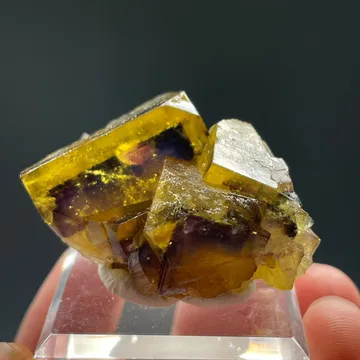
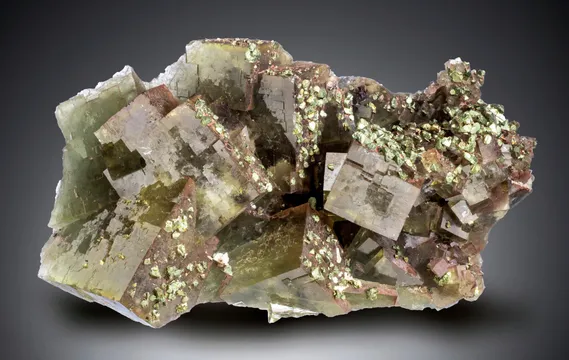
For collectors, the visual signature is fluorite. The best pieces are not merely yellow cubes; they show amber, honey-yellow, greenish, violet, blue-violet, brown, or nearly black zoning, commonly with sharp cubic phantoms, and in the finest specimens the colors become theatrical under transmitted light. Bergmännisch Glück material can show transparent to translucent yellow-orange cubes with blue-purple phantom lines parallel to the edges, while “black” Frohnau fluorite owes its appearance to deep purple coloration that can break into purple-yellow or purple-orange zoning when strongly backlit. Associations with baryte, quartz, chalcopyrite, galena, and dolomite give the best matrix specimens a distinctly Erzgebirge look: dense, architectural, metallic-edged, and old-mine in character rather than alpine-clean.
Regional View
Country View
Frohnau is also a heritage landscape. The Frohnauer Hammer, now a technical monument, stands near the scene of the late-medieval silver boom that made Annaberg one of Saxony’s great mining towns. The Markus-Röhling-Stolln visitor mine preserves a tangible part of the underground story: silver and cobalt mining from the early modern period, later Wismut uranium exploration, mine drainage adits, water-wheel technology, and the cultural memory of an ore district where mineral specimens are inseparable from mining history.
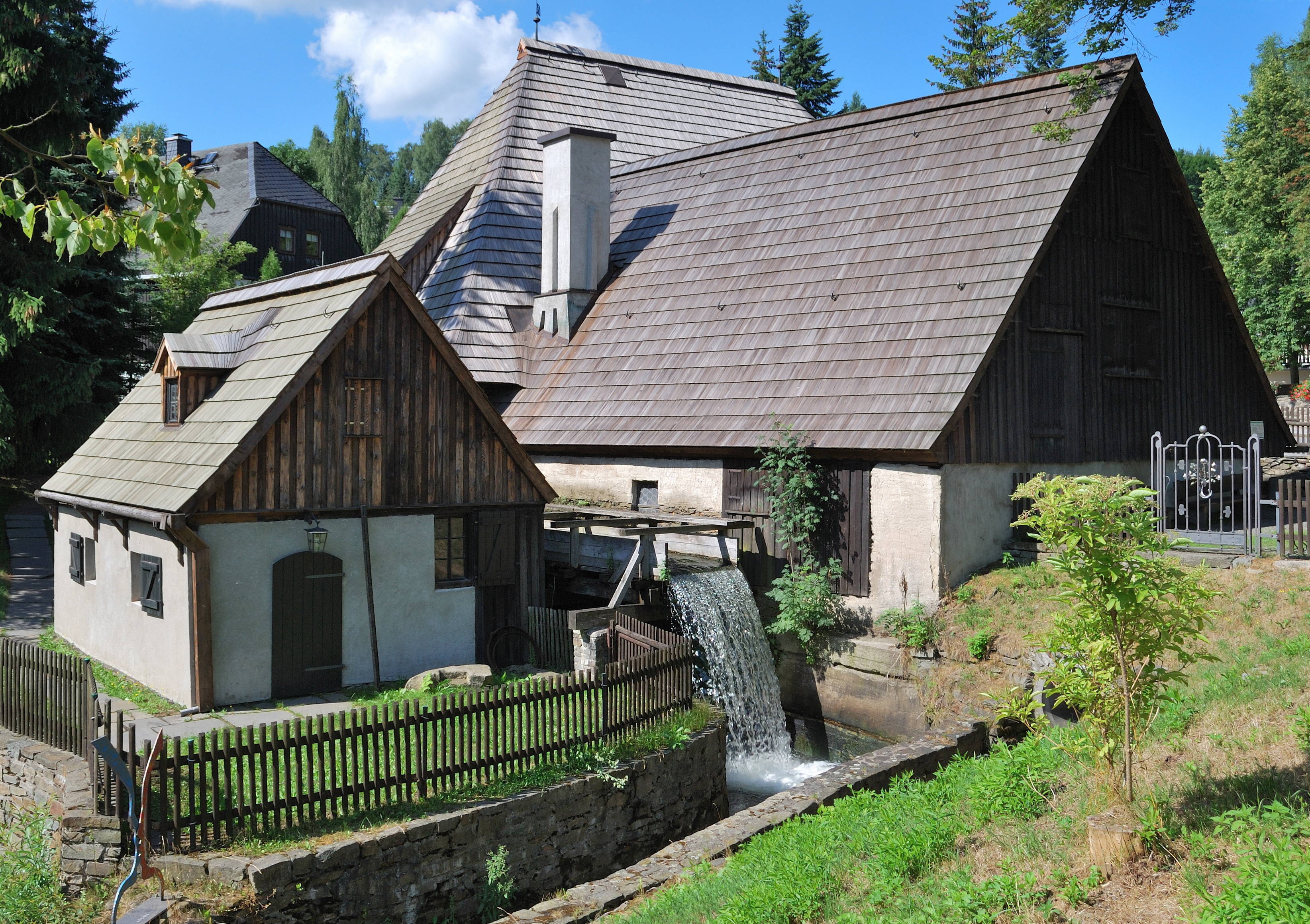
Photo: Harke, Wikimedia Commons
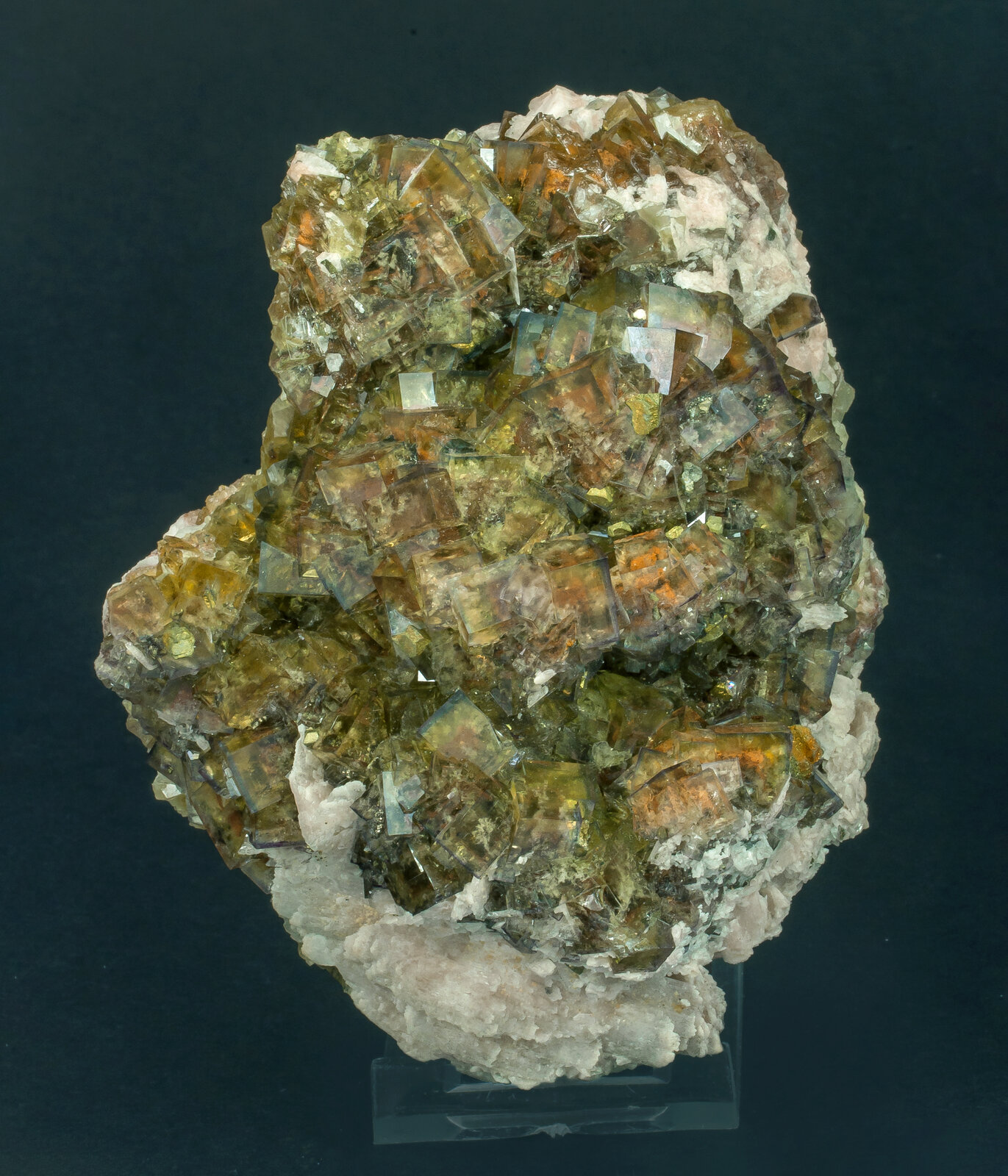
Photo: Fabre Minerals
Search for specimens: View all specimens from Frohnau, Germany
Frohnau is a suburb of Annaberg-Buchholz in the Erzgebirgskreis of Saxony, Germany, and forms part of the Annaberg mining district. The collector locality includes a web of named historic mines, shafts, adits, veins, and dumps around Schreckenberg and Schottenberg rather than a single hole in the ground. Important names attached to specimens include Bergmännisch Glück, Bergmännisch Glück Flacher, Frisch Glück adit or Adit 134, Malwine or Shaft 29, Zehntausend Ritter, Kippenhain, Teichgräber deep adit, Eisernes Schaf, Bäuerin, Markus Röhling, Krönung, Orgelstolln, König David, Galiläische Wirtschaft, and several smaller workings.
The deposit is a hydrothermal vein field in metamorphic basement rocks of the Erzgebirge. In the Markus Röhling workings, the host is part of the Annaberg Graugneiskuppel, a grey-gneiss dome of fibrous two-mica to biotite orthogneiss. Within the gneiss are schistosity-parallel metablack-shale horizons, locally called the “Schwebenden,” only about 0.1 to 0.5 m thick and dipping roughly 15 to 20° northwest. The district was underlain at depth by granite, with local granite rises exposed toward Buchholz. This combination of gneiss, black-shale horizons, granite influence, and repeated fracturing produced a dense vein network.
The Annaberg district contains several vein generations. Older, roughly east-west “Morgen” and “Spat” veins are tied to tin-tungsten and pyritic sphalerite-bearing mineralization; these were less important in the Markus Röhling mine history. The younger NW to NNW striking “Flachen” are the collector’s key, because they deposited the fluorite-barite gangue and the Bi-Co-Ni-Ag-U ore association. Ore shoots were strongly controlled by intersections and by the chemically reactive “Schwebenden.” The Markus Röhling mine is often cited as a particularly instructive example of metal deposition localized by those horizons.
Ore minerals documented from the Frohnau area include native silver, acanthite, proustite, pyrargyrite, stephanite, argentopyrite, nickeline, skutterudite, nickelskutterudite, safflorite, arsenopyrite, chalcopyrite, galena, sphalerite, uraninite variety pitchblende, and cassiterite. Gangue and later-stage minerals include fluorite, baryte, quartz, calcite, dolomite, siderite, gypsum, pyrite, marcasite, and chalcedony. The oxidation assemblage is especially significant because the hydrated nickel arsenate annabergite has its type locality here, at the Teichgräber Flacher vein in the Teichgräber deep adit of the Kippenhain mine.
Mining history begins with the famous silver discovery at Schreckenberg in 1491, traditionally associated with Caspar Nietzel. Within a few years, the Frohnau-Schreckenberg find helped trigger the foundation of Annaberg as a planned mining town. The Orgelstolln was driven around 1500 for drainage of the Schreckenberg and Schottenberg mines, and between about 1500 and 1505 the St. Annen Stollen was driven deeper; this later became the Markus-Röhling-Stolln. The system was not a short-lived medieval curiosity. Mining continued, with interruptions, for centuries.
The Markus Röhling mine became one of the most important operations in the Annaberg district. In 1733 the Erstneuglück-Flache-Gang was discovered; it became the main ore vein of the mine. From 1733 to 1857, the mine yielded about 15.4 tonnes of silver and 51,326 Zentner of cobalt ore, making it one of the district’s most productive mines. The ore value was given in contemporary accounts as 4,290,700 Mark. Silver carriers included proustite, pyrargyrite, argentite or acanthite, native silver, and chloanthite-group arsenides; cobalt was carried especially by skutterudite and safflorite.
Zehntausend Ritter is another name collectors encounter often, but it requires care. The old Zehntausend Ritter silver and cobalt mine began in 1528 and was worked intermittently until 1779, when it was incorporated into the Kippenhain mine. Kippenhain later also absorbed the Teichgräber deep adit in 1826. Modern fluorites sold as “10,000 Ritter” are frequently not from the old historical Zehntausend Ritter workings in a strict sense, but from later exposure along the Bergmännisch Glück Flacher vein produced during Wismut uranium work. That distinction matters for serious labeling.
The last major industrial mining episode came after World War II. From 1948 to 1953 the Markus Röhling mine was reworked by SAG Wismut for uranium exploration. A more than 1,000 m long access level was driven and a shaft was sunk; all encountered ore veins were investigated for uranium. The work ended in 1953 because no sufficiently workable uranium ore was found there. Other Frohnau and Annaberg workings also passed through the Wismut exploration era, and some of the exposures and dumps connected with that period later became important to collectors of fluorite.
Frohnau fluorite specimens come from several named sites. Bergmännisch Glück and the Bergmännisch Glück Flacher vein are central to the modern specimen trade, especially for color-zoned yellow to yellow-orange fluorite with blue, violet, or dark phantoms. Eisernes Schaf is known for bright yellow fluorite. Bäuerin has yielded zoned yellow-violet fluorite and is remembered locally even in the street name. The Zehntausend Ritter label is attached to black or yellow-black fluorite, but, as noted, the best-attributed specimen labels specify whether the material relates to the later Bergmännisch Glück Flacher exposure rather than the old 16th- to 18th-century mine.
A notable modern specimen episode concerns the Bergmännisch Glück Flacher, where two cavities found in 2005 are reported to have produced exceptional color-zoned “rainbow fluorite.” More recent underground material from the Bergmännisch-Glück-Flachen in the Malwine mine has reached institutional collections: the TU Bergakademie Freiberg recorded a large fluorite specimen with baryte from a current underground find and also illustrated a 32 cm-wide fluorite from Bergmännisch Glück Flacher, Shaft 29, Große Malwine, in Frohnau near Annaberg. Such records are important because they anchor a locality that is otherwise often represented in commerce by broad “Frohnau” labels.
Collecting access today should be treated as restricted. Many historic adits are gated, closed, privately owned, unstable, protected as monuments, or part of the UNESCO-listed Erzgebirge/Krušnohoří Mining Region. The Markus-Röhling-Stolln is accessible as a visitor mine, not as a collecting site. Visitors enter by mine railway and see preserved workings, including reconstructions and displays connected with silver-cobalt and Wismut uranium mining. Surface dumps and old mine features should not be assumed open simply because specimens are abundant in older collections or on the market.
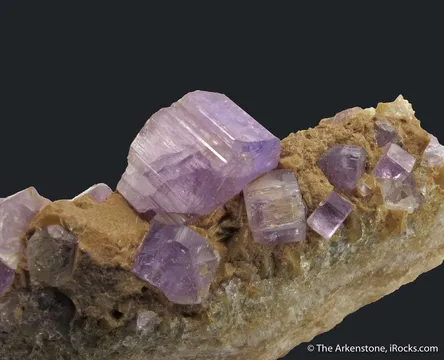
Frohnau fluorite is prized for cubic crystals in honey-yellow, amber, yellow-orange, greenish, violet, blue-violet, brown, and nearly black tones, often with strong internal zoning and sharp cubic phantoms. The most desirable pieces are transparent to translucent rather than merely massive, with crisp, lustrous cube faces and visible blue, purple, or dark phantom lines; some show a “rainbow” progression under changing light or when backlit. Crystal edges commonly reach the miniature to small-cabinet collector range, with individual cubes to about 2–3 cm documented in trade and regional accounts, while museum and modern underground pieces can be much larger as matrix specimens. Bergmännisch Glück and the Bergmännisch Glück Flacher vein are the key names for yellow-orange zoned material with baryte, quartz, chalcopyrite, galena, and dolomite; Eisernes Schaf is especially associated with bright yellow fluorite; Bäuerin with yellow-violet zoned pieces; and the Zehntausend Ritter label with black or yellow-black fluorite, though many such specimens are best understood as Wismut-era Bergmännisch Glück Flacher material rather than products of the historical Zehntausend Ritter mine proper. Good Frohnau fluorite separates itself from ordinary Erzgebirge fluorite by the combination of clarity, lustre, saturated warm color, dark edge or phantom zoning, and convincing mine-specific provenance.
Other minerals from Frohnau make the locality far more than a fluorite occurrence. Annabergite, Ni3(AsO4)2 · 8H2O, is the locality’s great mineralogical name: the Teichgräber Flacher vein in the Teichgräber deep adit of the Kippenhain mine is the type locality for the species, and old specimens occur as pale to apple-green coatings and blades derived from nickel arsenides. The silver suite includes acanthite, native silver, proustite, pyrargyrite, stephanite, and argentopyrite, while the cobalt-nickel arsenide assemblage includes nickeline, skutterudite, nickelskutterudite, and safflorite. Baryte is an important aesthetic associate of fluorite, especially as white to pale blades or tabular crystals, and quartz, dolomite, calcite, galena, sphalerite, chalcopyrite, pyrite, marcasite, cassiterite, uraninite variety pitchblende, zeunerite, johannite, lavendulan, cobaltkoritnigite, parasymplesite, phosphowalpurgite, and erythrite are among the documented species and rarities that give well-provenanced Frohnau suites their depth.
The main authenticity issue is not fake crystal growth; it is locality precision. Many labels simply say “Frohnau,” “Annaberg,” or “Saxony,” which may be acceptable for older pieces but is inadequate for top-tier specimens where Bergmännisch Glück, Bergmännisch Glück Flacher, Malwine, Bäuerin, Eisernes Schaf, Kippenhain, or Zehntausend Ritter have very different implications. The most important known mislabeling point concerns “10,000 Ritter” fluorites: many pieces so labeled are understood to come from the Wismut-era exposure of the Bergmännisch Glück Flacher vein rather than from the historical Zehntausend Ritter mine in the strict 16th- to 18th-century sense. Serious labels should preserve both the traditional trade name and the clarified geological or mining context when known.
Color is another source of confusion. Black Frohnau fluorite is generally very dark purple fluorite, and the apparent blackness may break into purple, yellow, or orange zoning in strong transmitted light. This is a natural color phenomenon associated with the uranium-bearing environment of the district; it should not be confused with artificial irradiation merely because radiation is part of the geologic story. Conversely, sellers often photograph honey to amber fluorite under warm light, which can exaggerate orange and copper tones. For expensive pieces, ask for daylight, backlit, and side-lit views, and evaluate whether the phantom zoning is truly internal rather than just surface reflection.
Condition is critical. Frohnau fluorite cubes can look spectacular in photographs yet have small edge bruises, contacted backs, cleaved corners, or dulled faces from extraction in tight old workings. Matrix specimens with baryte and chalcopyrite often have delicate attached blades or metallic crusts that abrade easily. The best pieces have sharp unrepaired cubes, bright lustre, clean phantoms, and no distracting bruises on the display face. Many legitimate specimens are not perfect; a small amount of edge wear is common, especially on older or dump-collected material, but the price should reflect it.
Be alert for repaired clusters and reconstructed matrix. Frohnau fluorite is valuable enough that broken clusters may be glued, mounted, or trimmed to improve display. A custom base is not a problem, but hidden repairs should be disclosed. Check for mismatched luster across fractures, glue lines between cubes, and unnatural contacts between fluorite and baryte. Because many specimens are loose clusters, lack of matrix alone is not suspicious, but locality-specific associations and old labels add value.
Fluorescence should not be overemphasized as an identifying feature. Fluorite may fluoresce, but Frohnau pieces are bought primarily for daylight color zoning, transparency, phantoms, and provenance rather than for UV response. Handle arsenate-bearing material such as annabergite, erythrite, cobaltkoritnigite, parasymplesite, and zeunerite with normal mineral-collector hygiene: do not lick specimens, avoid creating dust, wash hands after handling, and keep friable coatings boxed. Uraninite- or zeunerite-bearing specimens should be stored and displayed with sensible radioactive-mineral precautions; most fluorite specimens from the locality are not themselves a radiation hazard in ordinary collecting contexts, but mixed ore specimens deserve respect.
Market availability is better than most classic Saxon localities because modern finds and dealer inventories have kept Frohnau fluorite visible, especially in Europe and online. Still, the high end is not common. Ordinary yellow chunks or damaged cubes appear regularly; sharp, gemmy, strongly zoned cabinet pieces with reliable Bergmännisch Glück or Malwine provenance are much scarcer and command serious prices. Type-locality annabergite from Frohnau is far rarer in attractive display quality than fluorite, and old specimens with convincing labels are collector-grade historical objects even when the mineral is present only as green crusts.
The Frohnau story begins with the sort of event mining districts build legends around: a silver vein found on the Schreckenberg in October 1491, traditionally credited to Caspar Nietzel near the Frohnau mill. That discovery did more than open a few workings. It helped set off the Annaberg “Berggeschrey,” one of those rushes in which a mineral find becomes a town. Within the garden and rooms of the mill, mining courts were held and the decision was made in 1496 to found the “Neustadt am Schreckenberg,” the planned mining town that soon became St. Annaberg. In 1498 the young town received minting rights, and the name Schreckenberg passed from hillside to coinage in the form of the famous Schreckenberger silver groschen. For a collector holding a Frohnau specimen, the old label is not romantic decoration; it points back to one of the formative silver discoveries of the Saxon Erzgebirge.
Underground, the story tightened into adits, water, and vein intersections. Around 1500 miners began driving the Orgelstolln to drain the Schreckenberg and Schottenberg workings. Between 1500 and 1505, another level, 10 to 15 m deeper, was started as the St. Annen Stollen. That tunnel would later be known as the Markus-Röhling-Stolln. The names changed, but the logic remained: follow the water, reach the veins, and keep the workings alive. In 1733 miners struck the Erstneuglück-Flache-Gang, a vein whose very name—“first new luck”—sounds like a miner’s sigh of relief. It became the principal ore vein of the Markus Röhling mine.
The figures from Markus Röhling are unusually vivid. By the time the mine closed in 1857, it had produced about 15.4 tonnes of silver and 51,326 Zentner of cobalt ore. That output made it one of the most productive mines in the Annaberg district. The old accounts placed the value of those ores at 4,290,700 Mark. These are not abstract numbers for mineral collectors: the same vein system that yielded payable silver and cobalt also gave the arsenides, silver sulfosalts, fluorite-barite gangue, and later oxidation minerals that make Frohnau labels so desirable.
The 20th century added a colder chapter. From 1948 to 1953, SAG Wismut reopened and investigated the Markus Röhling mine for uranium. A more than 1,000 m long access level was driven, and a shaft was sunk. Every ore vein encountered was tested for uranium ore, but the operation was finally abandoned in 1953 because the mineralization was not workable enough. Some of the best-known modern fluorite labels owe their survival, directly or indirectly, to this Wismut-era disturbance of older ground. The collector irony is sharp: a uranium search that failed as an ore operation helped expose or preserve the conditions from which later collectors obtained some of the most beautiful fluorite in the district.
The modern fluorite story has its own pocket lore. At Bergmännisch Glück Flacher, two cavities found in 2005 are reported to have yielded the striking zoned material now celebrated as “rainbow fluorite.” These pieces are not rainbow in the souvenir-shop sense. The best crystals change personality with the light: yellow at the core or base, violet or blue along edges, and dark phantom lines locked inside like earlier versions of the same cube. A specimen may look warm amber in reflected light, then, when backlit, suddenly show the purple skeleton of its growth history.
The visitor mine keeps the underground atmosphere alive without turning it into a collecting site. Today, visitors to Markus-Röhling-Stolln travel roughly 600 m by mine railway before walking through preserved workings where the silver-cobalt period and Wismut uranium episode can both be read in the rock. The reconstructed 9 m water wheel is a reminder that these mines were engineered landscapes as much as ore bodies. Frohnau’s specimens belong to that larger system: gneiss, black shale, vein crossings, drainage adits, water wheels, silver coins, cobalt contracts, uranium surveys, and, finally, the colored cubes that made the locality famous in modern cabinets.
Brooke, H. J., and Miller, W. H. in Phillips, W. (1852), An Elementary Introduction to Mineralogy, new edition, London: Longman, Brown, Green, and Longmans, pp. 503–504 — The classic 1852 reference tied to the formal description of annabergite, the nickel arsenate named after Annaberg.
Annabergite mineral data, Mindat — Gives the modern species record for annabergite, including formula Ni3(AsO4)2 · 8H2O and the Frohnau-area type-locality entry at Teichgräber Flacher vein, Teichgräber deep adit, Kippenhain mine.
Frohnau locality record, Mindat — The main mineralogical locality record for Frohnau, including the mineral list, commodities, sublocalities, and the type-locality notation for annabergite.
Kippenhain Mine locality record, Mindat — Important for the Teichgräber-Kippenhain context of type-locality annabergite and for the old silver-cobalt mineral suite.
Bergmännisch Glück Mine fluorite occurrence, Mindat — Useful occurrence-level record for Frohnau fluorite, including associated minerals reported from photo data such as chalcopyrite, baryte, quartz, galena, and dolomite.
Nickerl, F., and Röthig, H. (2000), Verzeichnis der Berggebäude von Frohnau 1500–1900, Arbeitskreis Annaberg-Buchholzer Heimatforscher, 192 pp. — A key compiled reference for the named mine buildings, adits, and workings of Frohnau from 1500 to 1900.
Baumann, L., Kuschka, E., and Seifert, T. (2000), Lagerstätten des Erzgebirges, Enke Verlag, Stuttgart — Standard modern deposit reference for Erzgebirge ore geology, including the regional framework used to understand Annaberg-Frohnau vein mineralization.
TU Bergakademie Freiberg, Institut für Mineralogie, Jahresbericht 2018 — Documents a 32 cm-wide fluorite specimen from Bergmännisch Glück Flacher, Shaft 29, Große Malwine in Frohnau near Annaberg.
TU Bergakademie Freiberg, Institut für Mineralogie, Jahresbericht 2020 — Records acquisition of a larger fluorite specimen with baryte from a current underground find at Bergmännisch-Glück-Flachen in the Malwine mine, Frohnau.
Mineralogical Record, Tom Moore’s “What’s New in the Mineral World,” Online Report 43, March 18, 2011 — Notes a small new find of Frohnau fluorite seen at the 2015 Munich Show, with comments on yellow-orange and deep purple “black” material.
Mineralogical Record, Tom Moore’s “What’s New in the Mineral World,” Online Report 66, 2023 — Discusses early 21st-century collecting in old Frohnau mines and dumps, yellow to yellow-orange fluorite from Bergmännisch Glück, and market pricing for a group of specimens.
Mineralogische Sammlung Deutschland, Krügerhaus Freiberg — Exhibition brochure documenting fluorite with chalcopyrite from Frisch Glück Stolln, Frohnau bei Annaberg-Buchholz, Erzgebirge, Saxony.
Markus-Röhling-Stolln visitor mine: History — Official mine-history page with dates for the Orgelstolln, St. Annen Stollen, Erstneuglück-Flache-Gang, production totals, and Wismut reopening.
Markus-Röhling-Stolln visitor mine: Geology — Official geological summary of the Markus Röhling workings, including the Annaberg grey-gneiss dome, “Schwebenden” horizons, vein orientations, and ore-mineral assemblage.
Markus-Röhling-Stolln visitor mine: Tours — Practical access information for the preserved Frohnau mine workings; valuable for understanding what can be visited versus what is closed to collecting.
UNESCO World Heritage Centre: Erzgebirge/Krušnohoří Mining Region maps — Official UNESCO listing data for the Annaberg-Frohnau Mining Landscape, including coordinates and protected-property area.
Frohnau, Annaberg-Buchholz, Mindat — Core mineralogical database entry for the locality, with mineral list, sublocalities, photos, and type-locality information.
Bergmännisch Glück Mine, Mindat — Key sublocality for modern Frohnau fluorite, especially material from the Bergmännisch Glück Flacher vein.
Zehntausend Ritter Mine and Kippenhain Mine, Mindat — Essential for understanding the historic Zehntausend Ritter label and the caution that many “10,000 Ritter” fluorites relate to later Bergmännisch Glück Flacher exposure.
Annabergite, Mindat — Species page for Frohnau’s type-locality mineral, including formula, name history, type locality, and geological setting.
Mineralvorkommen im Bergbaurevier Annaberg, Seilnacht — A collector-friendly German overview of the Annaberg district, with specific notes on Frohnau fluorite from Eisernes Schaf, Bäuerin, Bergmännisch Glück, and Zehntausend Ritter.
Der Fluorit von Annaberg-Buchholz, Steine und Minerale — Accessible German article on Annaberg-Buchholz fluorite, color zoning, mining context, and collecting limitations.
Frohnauer Hammer, Wikimedia Commons photo page — Source page for the overview photograph of the Frohnauer Hammer, a key surface landmark of the Frohnau mining landscape.
Fluorite with Baryte and Chalcopyrite, Fabre Minerals — High-quality dealer photograph and specimen data for a Bergmännisch Glück fluorite with baryte and chalcopyrite.
.jpg)