A collector's guide to Italy: its geology, mining history and notable minerals, illustrated with the 88 specimens documented from this locality on EarthWonders.
Key facts
Italy is not one locality but a compact mineralogical continent: Alpine serpentinites and rodingites in the north, granitic miaroles at Baveno and Elba, skarn and iron-oxide systems in Tuscany, volcanic fumaroles around Vesuvius and Etna, and the great Pb-Zn-F-Ba mining districts of Sardinia and Lombardy. For collectors, the country’s strongest identity rests on specimens with a distinctly European, old-collection character: Val Malenco demantoid on serpentine and chrysotile, Bellecombe hessonite on clinochlore, Baveno quartz and feldspar combinations, Zogno fluorite, Elba hematite and pyrite, Monteponi lead carbonates and halides, Sicilian sulfur, and Vesuvius micro-rarities.
Regional View
Country View
The finest Italian specimens tend to reward close looking rather than brute size. Val Malenco demantoid is prized for sharp rhombic dodecahedra in yellowish green to emerald green, sometimes with chrysotile “horsetail” inclusions; Baveno pieces balance smoky quartz, orthoclase, albite, fluorite, and rare scandium minerals in small but elegant miarolitic groups; Zogno fluorite is best when the violet to purple cubes retain sharp stepped faces and sit cleanly against pale quartz; Elba hematite can show mirror-black, euhedral crystals divided by quartz seams, a look unlike the flatter “iron rose” style of the Alps.

Photo: Wikimedia Commons

Photo: Wikimedia Commons
Italy also matters scientifically. It has been one of the world’s great countries for type-locality minerals, with hundreds of species first described from Italian soil by the early twenty-first century. Campania alone, especially the Vesuvius-Somma system and its fumarolic and volcanic ejecta minerals, accounts for a remarkable historical suite of species. Tuscany gave the mineral world elbaite and ilvaite; Piedmont’s Baveno granite produced names such as bavenite, bazzite, and scandiobabingtonite; Sardinia’s mines supplied classic lead-zinc oxidation minerals; and the Western Alps remain a reference terrain for garnets, vesuvianite, diopside, and rodingite assemblages.

Photo: Wikimedia Commons
Search for specimens: View all specimens from Italy
Italy’s collectible minerals come from several very different deposit types. In the Alps, the key specimen-producing environments include serpentinite-hosted asbestos fissures, rodingites, Alpine clefts, and granitic or pegmatitic cavities. Val Malenco, in Lombardy’s Sondrio Province, is the classic example of the serpentinite setting: demantoid occurs in brittle chrysotile-filled fractures cutting foliated serpentinite in the Val Malenco ultramafic unit, generally associated with magnetite, Cr-bearing magnetite, calcite, hydromagnesite, brucite, clinochlore, and locally forsterite. Nearby and related Alpine rodingite bodies in Piedmont, Aosta Valley, and Liguria produce the country’s orange to wine-red hessonite, green to yellow andradite-topazolite, diopside, vesuvianite, clinochlore, and epidote.
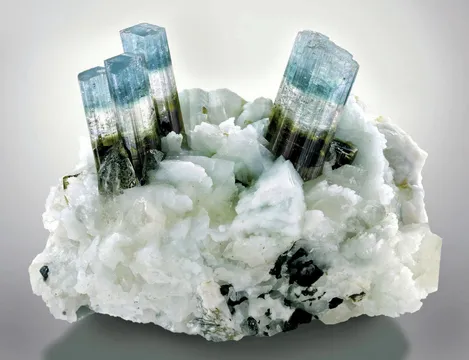
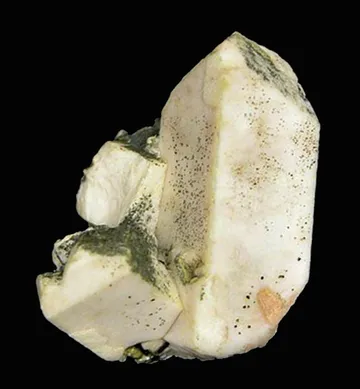
Baveno, on Lago Maggiore in Piedmont, represents a second northern Italian collecting style: miarolitic cavities in granite. The Baveno granite is famous to every feldspar collector because the “Baveno twin” is a textbook feldspar twin law, but the quarries are more than a feldspar locality. Their pockets contain orthoclase, albite, smoky quartz, fluorite, zinnwaldite, epidote, babingtonite, bavenite, bazzite, and a suite of rare scandium and REE minerals. The best specimens have crisp architecture: blocky feldspar, smoky quartz points, a cool white-to-pink matrix, and small accessories that reward magnification.
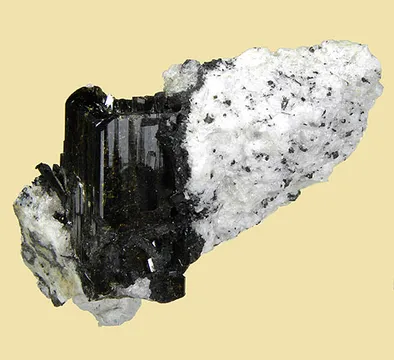
The Tuscan island of Elba contributes two different traditions. Eastern Elba, especially the Rio Marina and Capoliveri iron districts, produced hematite, pyrite, quartz, and magnetite specimens from iron ore bodies worked since antiquity. Western Elba, especially the Monte Capanne granitic area around San Piero in Campo and related pegmatites, is historically linked to elbaite, beryl, quartz, and feldspar. The Rio Marina material is the better-known display-specimen tradition: lustrous black hematite crystals, bright pyrite cubes and pyritohedra, and quartz-seamed ironstone matrix.
The Lombard and Bergamasque Prealps add hydrothermal carbonate-hosted fluorite, baryte, and Pb-Zn mineralization. Zogno, more precisely the Camissinone mine at Zogno in Bergamo Province, is the collector’s reference point: fluorite occurs in hydrothermal veins and cavities in Triassic dolostone, with the best pieces showing violet to purple crystals on pale quartz or carbonate. Other northern districts, including Dossena, Gorno, and the Valsassina mines, are important for Pb-Zn-F-Ba assemblages, though not all are equally represented by high-end display specimens.
Sardinia is the great Italian mining island. The Iglesiente and Sulcis-Iglesiente districts around Iglesias, Monteponi, Montevecchio, Nebida, Buggerru, and related camps are among the most important historic Pb-Zn-Ag districts in the Mediterranean. Monteponi is especially known to collectors for secondary lead minerals, including anglesite, cerussite, phosgenite, and associated oxidized-zone species. Southeast Sardinia, around Silius, contains the large Genna Tres Montis-Muscadroxiu fluorite-baryte vein system with Pb-Zn sulphides and REE-bearing carbonates in the gangue. Modern industrial interest there has centered on fluorspar and associated critical-mineral potential, while the specimen trade tends to favor older mine pieces and well-labeled material from specific shafts or levels.
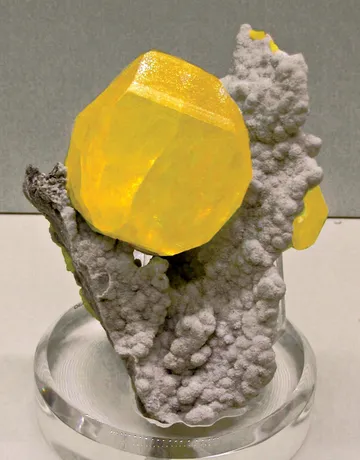
Southern Italy and the islands add volcanic and evaporitic mineralogy. The Somma-Vesuvius complex near Naples is one of the most mineralogically productive volcanic type-locality areas in the world, famous less for large cabinet specimens than for microminerals, fumarolic incrustations, ejecta minerals, and historically described species. Sicily is inseparable from sulfur: the island’s native sulfur specimens, often with celestine, aragonite, gypsum, calcite, or bitumen-rich matrix, are among the classic images of nineteenth- and twentieth-century European mining. The Etna and Vulcano systems add further volcanic sublimates and fumarolic species.
Mining history is equally varied. Elba iron ore was worked from the Etruscan and Roman periods into modern times; Rio Marina’s industrial open cuts and underground or semi-underground workings are now part of a mining-heritage landscape. Baveno’s granite quarries supplied building stone and, incidentally, pockets that made the locality famous to mineralogists. Val Malenco’s demantoid story is tied directly to asbestos mining, especially around Sferlùn, Dossi di Franscia, Cengiàsc, Coston d’Acquanegra, Valbrutta, and Al Ross; the finest known material came out while chrysotile was being quarried rather than through specimen mining. Zogno-Camissinone belonged to the fluorspar economy of Lombardy, including the later activity of Prealpi Mineraria, while Sardinia’s large districts passed through centuries of local, Pisan, Savoyard, private, regional, and industrial management.
Collecting access today is highly locality-specific and must not be assumed. Many Italian specimen localities are abandoned mines, active quarries, protected parks, private land, unstable Alpine slopes, or museum-managed heritage sites. The Val Malenco asbestos mines are closed, steep, and hazardous; the old Sferlùn access is not casual collecting ground. Baveno quarry access depends on permission and active quarry conditions. Rio Marina and other Elba mine areas are best approached through official park or museum visits. Sardinian mine sites may be fenced, protected as industrial archaeology, or under concession; underground collecting without authorization is unsafe and illegal. For serious collectors, the most practical route to classic Italian specimens remains the market, old European collections, museum deaccessions where legitimate, and carefully documented pieces from Italian dealers and shows.
The great pockets and finds that shaped the market are now largely historical. Sferlùn produced celebrated demantoid in 1947 and again in important finds during the second half of the 1960s and early 1970s before asbestos operations ended. Baveno’s quarry cavities have yielded specimen groups and rare minerals over a much longer span, from eighteenth- and nineteenth-century collectors to modern quarry-based research. Zogno fluorite had notable finds during its active mining period and later became familiar on the European market as violet cubes and etched or stepped crystals. Rio Marina’s most admired hematite and pyrite specimens are mostly old mine pieces, with some spectacular hematite cavities associated with the Bacino area and other Rio workings.
Italian andradite is collector-important chiefly in the Val Malenco serpentinites and Western Alpine rodingites, where it appears as yellow-green, emerald-green, brownish, or topazolite-like crystals rather than the black melanite style familiar from many skarns. In Val Malenco, andradite occurs in chrysotile-bearing fissures of serpentinite at localities such as Sferlùn, Dossi di Franscia, Cengiàsc, Valbrutta, and Coston d’Acquanegra, typically with magnetite, calcite, brucite, clinochlore, hydromagnesite, and serpentine minerals; individual crystals may reach about 2 cm, though many good specimens are aggregates of smaller dodecahedra. The finest pieces combine strong green color, glassy luster, sharp faces, separation on matrix, and credible old labels to a named mine or valley rather than a broad “Italy” attribution.
Italy’s demantoid is a Val Malenco classic: yellowish green to rich green Cr-bearing andradite in rhombic dodecahedra from asbestos mines and fractures in serpentinite, most famously Sferlùn, Dossi di Franscia, Cengiàsc, Coston d’Acquanegra, Valbrutta, and Al Ross. Good crystals are often millimetric to centimeter-scale, with exceptional examples approaching about 2 cm; the best are lustrous, transparent to translucent, sharply formed, and either perched on serpentine/chrysotile matrix or arranged in sparkling clusters with magnetite and carbonate. GIA work on Val Malenco material found nearly pure andradite compositions and common chrysotile “horsetail” inclusions, so fine Italian demantoid can carry both specimen and gemological interest, but top pieces are scarce because the asbestos mines closed in the 1970s and most market material is old production.
Italian fluorite has two collector personalities: the violet-to-purple hydrothermal cubes of Zogno-Camissinone in Lombardy, and the economically important fluorite-baryte vein material of Sardinia, especially around Silius. Zogno specimens are the most recognizable display fluorites, commonly as cubes or modified, stepped, etched, or rhombododecahedral-looking forms on white quartz or carbonate matrix, with color that may read dark purple in cool light and livelier violet in transmitted or warm light. Sardinian fluorite from Genna Tres Montis-Muscadroxiu and related localities is important for locality suites and mine history, often associated with baryte, galena, sphalerite, calcite, quartz, and carbonate gangue. Good Italian fluorite is sharply crystallized, clean, and accurately localized; ordinary pieces lose much of their appeal when dark, bruised, heavily cleaved, or labeled only as “Italy.”
Quartz from Italy is most valued when it anchors a classic assemblage rather than standing alone: smoky quartz with orthoclase and albite from Baveno, transparent “Lombardic diamond” Herkimer-style quartz from the Bergamo area, quartz with hematite from Elba, and Alpine-cleft quartz from northern mountain districts. Baveno pieces are especially collectible when smoky quartz crystals sit aesthetically on pinkish-white orthoclase-albite matrix with fluorite, zinnwaldite, or rare accessories; the crystals are not usually giant, but they have the poised geometry and old-European character that make Baveno combinations so recognizable. Good Italian quartz specimens have clarity, undamaged terminations, balanced matrix, and a specific locality story; ordinary loose crystals or broad “Italian Alps” labels are much less desirable.
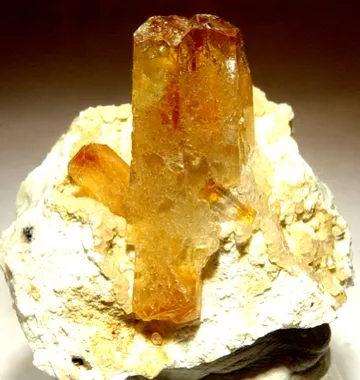
Italy’s garnet suite is dominated in collections by andradite-demantoid from Val Malenco and grossular-hessonite from Alpine rodingites, especially Bellecombe in Aosta Valley, Val d’Ala and Val di Susa in Piedmont, and Passo del Faiallo in Liguria. Bellecombe hessonite is the classic orange to reddish brown style: lustrous dodecahedra and trapezohedra, often gemmy and resinous, commonly on green clinochlore with diopside and vesuvianite; crystals are generally modest in size but can make exceptionally rich miniature and small-cabinet plates. Val d’Ala garnets bridge grossular-andradite chemistry and can show honey, yellow-green, topazolite, and grandite colors in rodingite assemblages. The best Italian garnets have saturated color, sharp complete crystals, attractive contrast against clinochlore or serpentinite matrix, and old labels to named valleys or villages rather than a vague Alpine attribution.
Beyond these headline species, Italy is essential for type-locality minerals and rarities. Vesuvius and the broader Campanian volcanic province supplied historically important species such as leucite, vesuvianite, humite-group minerals, cotunnite, euchlorine, and numerous fumarolic salts and oxides. Elba gave its name to elbaite and ilvaite, with the latter tied to the island’s old name, Ilva. Baveno is a reference locality for bavenite, bazzite, jervisite, cascandite, and scandiobabingtonite, and its miarolitic cavities remain important for scandium and REE mineralogy. Sardinia contributes classics such as phosgenite, anglesite, cerussite, monteponite, and mine-cave oxidation suites; Tuscany adds Larderello borates and geothermal minerals; Sicily is famous for sulfur, celestine, aragonite, gypsum, and the rare silica clathrate melanophlogite.
Italian specimens demand label discipline. “Italy” alone is rarely enough for value; the market distinguishes sharply between Sferlùn, Dossi di Franscia, and generic Val Malenco demantoid; between Camissinone/Zogno fluorite and other Italian fluorites; between Bellecombe hessonite and Val d’Ala or Ligurian hessonite; and between Baveno quarry material and generic Alpine feldspar-quartz combinations. Older labels may use historic province names, variant spellings, or broad trade localities, so serious pieces benefit from retained label chains and, where possible, comparison to known assemblages.
The most common authenticity issue is not elaborate fakery but imprecise or over-optimistic locality attribution. “Zogno” is often used as the trade name for Camissinone mine fluorite. “Silius” may refer to Genna Tres Montis, Muscadroxiu, Pozzo Centrale, or the broader vein system. “Val Malenco” demantoid may be assigned to Sferlùn without documentary support because Sferlùn is the premium name. “Herkimer” style quartz from Lombardy should not be confused with Herkimer County, New York material; the proper collector language is Herkimer-style or Lombardic diamond quartz.
Condition is critical. Demantoid and hessonite crystals are small, bright, and easily edge-nicked; magnification is essential. Val Malenco pieces may include chrysotile asbestos, so do not brush, grind, trim, or air-blast matrix; keep friable fibrous material boxed and handle minimally. Zogno fluorite cleaves readily and can show bruised corners, internal cleavage flashes, and acid-etched surfaces; attractive etching is a plus, but impact cleaves and dull recrystallized zones reduce value. Elba pyrite can oxidize in humid storage, especially if associated with reactive iron-rich matrix; stable humidity and avoidance of repeated wetting are prudent. Sulfur from Sicily is soft, brittle, heat-sensitive, and vulnerable to abrasion and greasy handling.
Fluorescence is locality-dependent. Val Malenco demantoid tested in the GIA study was inert to UV. Some Zogno fluorites are reported by collectors and specimen records to show a red response under longwave ultraviolet, sometimes described as a fading or “flash” effect, but this should be treated as a specimen-specific feature rather than assumed for all Zogno material. Sulfur, calcite, fluorite, and some volcanic sublimates from Italian localities can reward UV testing, but heat, humidity, and dust control matter more for preservation.
Rarity varies dramatically. Small Baveno quartz-feldspar pieces and common Italian fluorites appear regularly. Fine Sferlùn demantoid, clean Bellecombe hessonite plates, top Zogno fluorite, old Monteponi phosgenite, mirror-bright Rio Marina hematite, and well-documented Vesuvius type-locality rarities are much less available. The best Italian specimens often trade through European dealers, Italian regional shows, old private collections, and auction consignments rather than as steady mine production.
Val Malenco’s demantoid story has one of the sharper ironies in European collecting. The green garnet most collectors now chase was once an unwelcome passenger in asbestos. Chrysotile was the product; demantoid was a contaminant. Local accounts preserve the image of crystals hidden among the fibers or set on the fracture walls, and of miners breaking unwanted inclusions away because the fiber had to be clean before storage. The mineral and the asbestos share “genesis and destiny”: where there was demantoid there was asbestos, but not every asbestos fissure held demantoid.
The classic collecting moment came at Sferlùn in 1947, when L. Magistretti recovered what later literature describes as probably the most beautiful Italian demantoid crystals. Some went to the University of Milan; others entered the hands of jewelers and collectors. The place was never easy. The asbestos deposits lie high in the Alps, roughly 1800 to 2200 m above sea level, in a steep landscape above the Lanterna valley. Later important finds came in the second half of the 1960s, and Sferlùn’s best-known period effectively closed with the end of asbestos mining toward the 1970s. That is why a sharp green demantoid on original matrix, with an old Val Malenco or Sferlùn label, feels less like a routine garnet and more like a surviving fragment of an extinct industry.
Baveno’s story is quieter but just as collector-rich. The granite quarries above Lago Maggiore became mineral localities because working stone exposed cavities, and those cavities carried the small architectural combinations that Italian collectors learned to prize. Ermenegildo Pini, the Barnabite priest and mineralogist from Milan, was collecting there in the eighteenth century, and Baveno specimens entered the Milan museum tradition along with the Borromeo family collections and the work of nineteenth-century quarry collectors. Later, Ettore Artini, curator of the Milan museum from 1893, helped bring Baveno’s rare minerals into the scientific record, including bavenite and bazzite. A specimen from Baveno can be modest in size and still carry three stories at once: the stone trade of Lago Maggiore, the old Italian museum tradition, and the modern rare-element mineralogy of granitic pockets.
Elba’s mineral landscape is more theatrical. Around Rio Marina, the iron mines stained the hills red, black, and ocher, and the coast itself became part of the collecting mythology: hematite, pyrite, limonite, and quartz set against the blue Tyrrhenian Sea. The iron was worked from antiquity through the industrial era, and modern guided visits pass through a landscape of old washing plants, open cuts, terraces, and mining buildings. Collectors remember Elba not merely for “iron ore” but for the flash of mirror hematite and brassy pyrite on dark matrix. The most desirable old Rio Marina hematites look almost polished by nature, with black, faceted crystals divided by pale quartz seams.
Sardinia gives the guide a different kind of drama: not a single pocket but whole towns and valleys organized around ore. Monteponi, near Iglesias, appears in records as early as the fourteenth century and grew into one of Sardinia’s great lead-zinc mines. Its history includes fonderie, shafts, mechanized washing plants, and the persistent problem of underground water. The mineral collector’s eye sees the oxidized lead suite—anglesite, cerussite, phosgenite—but the place itself is an industrial landscape of shafts, laundries, calamine works, mine villages, and the long nineteenth- and twentieth-century effort to extract metal from the Iglesiente.
At Silius, the scale shifts again. The Genna Tres Montis-Muscadroxiu system began with interest in metallic minerals, then became a major fluorspar story. By the 1980s the mines employed hundreds of workers, and underground development connected the workings at depths on the order of hundreds of meters. Later, market changes tied to fluorochemical demand hit the mine hard. Today the name has returned in discussions of fluorspar, light rare earths, and associated minerals, but for collectors the lesson is older and simpler: a label reading “Silius” should be read as the beginning of a question, not the end of one.