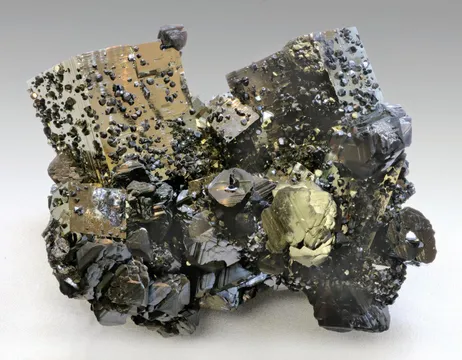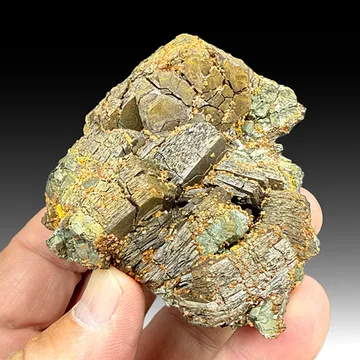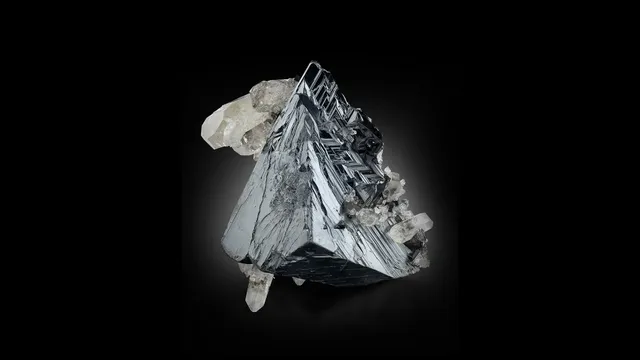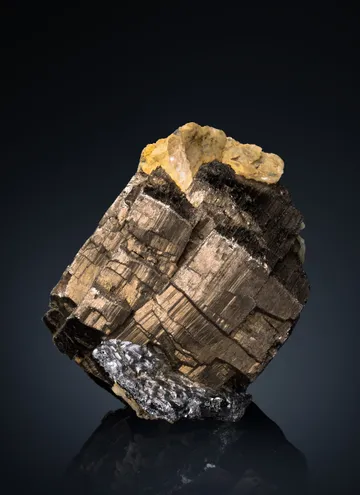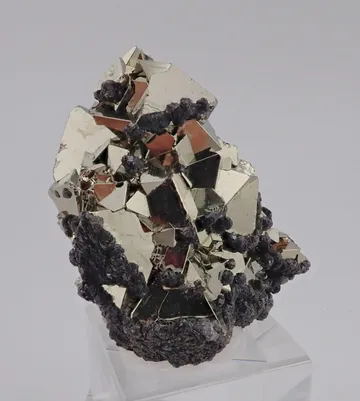
Huanzala Mine, Peru — a premier locality for pyrite, fluorite, sphalerite, galena, and quartz; pyrrhotite is rare, often preserved as pseudomorphs.
Key facts
Huanzala is one of the great modern Peruvian specimen mines, but its pyrrhotite is not the mine’s commonest calling card. Collectors know Huanzala first for brilliant pyrite, pink to green fluorite, black sphalerite, galena, quartz, and complex sulfide combinations. Pyrrhotite enters the story more selectively: as scarce crystallized material from the Reliquia workings and, more famously in collections, as the vanished form preserved by pyrite and arsenopyrite pseudomorphs. A good Huanzala “pyrrhotite” piece may therefore be less about fresh bronze pyrrhotite than about the ghost of pyrrhotite—sharp, pseudohexagonal blades and plates that record an earlier iron-sulfide stage even after the mineral itself has been partly or completely replaced.

Photo: Mineral Auctions
The best pieces are mineralogical narratives in three dimensions. Former pyrrhotite crystals can appear as compact, stacked, bladed, pseudohexagonal forms now composed of glittering pyrite, with arsenopyrite lying on the surfaces in oriented sprays or reticulated networks. These specimens are instantly different from ordinary Huanzala pyrite: they are flatter, more blade-like, more architectural, and often more delicate-looking, with a silvery-brassy shimmer rather than the bold octahedral geometry of the mine’s famous pyrite crystals.
Geologically, the setting is ideal for such transformations. Huanzala is a polymetallic replacement and skarn-related system in carbonate rocks of the Santa Formation, cut and influenced by quartz porphyry. The deposit produced abundant iron sulfides, lead-zinc ores, copper minerals, silver-tin-tungsten species, and later alteration assemblages. In that evolving chemical environment, pyrrhotite could form during reduced, hotter conditions and later be overprinted by pyrite or arsenopyrite as sulfur activity and fluid chemistry changed. For collectors, this makes Huanzala pyrrhotite especially attractive when the original pyrrhotite morphology is still sharp enough to read.
Historically, the mine’s specimen output is extraordinary. Huanzala has yielded pyrite by the ton and has long been regarded as one of Peru’s most prolific specimen localities. Within that abundance, crystallized pyrrhotite itself is a minority prize. Reliquia, a peripheral working on the northern side of the Huanzala mine complex, is the key name to remember: it is specifically tied to arsenopyrite after pyrrhotite, pyrite after pyrrhotite, and a small amount of crystallized pyrrhotite recovered in the mid-1980s.
Search for specimens: View all pyrrhotite specimens from Huanzala Mine, Peru
Huanzala Mine is in the Huanzala area of the Huallanca District, Bolognesi Province, Ancash Region, Peru. Older labels commonly place it in Dos de Mayo Province, Huánuco Department; those labels reflect earlier administrative usage and remain familiar in older collections. The mine lies in the high Andes, about 11 km by road from Huallanca and roughly 250 km north of Lima. Modern coordinates place it near 9° 52' S, 77° 00' W, at an Andean elevation around 4,000 meters.
The deposit is a zinc-lead-copper-silver polymetallic system developed in carbonate and clastic sedimentary rocks. The principal host is limestone of the Santa Formation, with Chimu Formation chert below and Carhuaz Formation sandstone and slate above. The mineralized zone follows the Santa Formation for more than 6 km along strike and is associated with skarn formation, hydrothermal replacement, and alteration on both sides of quartz-porphyry dikes. The mine’s ore and specimen assemblages reflect this hybrid character: skarn minerals and Fe-rich sphalerite belong to the earlier, hotter part of the system, while hydrothermal replacement and later alteration produced abundant pyrite, sphalerite, galena, chalcopyrite, fluorite, quartz, calcite, dolomite, sericite, and a suite of rarer Ag-Sn-W-Bi-Te minerals.
Mining history at Huanzala reaches back to the San José de Huanzala workings, reportedly discovered in 1721 and later abandoned. The modern era began in 1964, when Mitsui Mining & Smelting initiated exploration through Compañía Minera Santa Luisa S.A. Underground mining began in 1968. By the early 1980s the mine was producing hundreds of metric tons of ore per day, and it remains an operating Peruvian base-metal mine under Compañía Minera Santa Luisa of the Mitsui Kinzoku Group. Current production is centered on zinc, lead, and copper concentrates.
For specimen collectors, Huanzala is less a casual field-collecting destination than an active industrial mine. Access is controlled, underground workings are not open collecting ground, and specimen recovery has historically depended on miners, mine staff, Peruvian dealers, and export channels rather than public collecting. The locality’s specimen trade has always had a strong “mine-run” character: minerals appeared when pockets or productive zones were encountered during mining, then moved quickly through Huallanca, Lima, Tucson, European dealers, and large wholesale lots.
The Reliquia Mine area is especially important for pyrrhotite collectors. Reliquia lies on the northern periphery of the Huanzala complex and produced some of the mine’s more distinctive species and pseudomorphs, including arsenopyrite after pyrrhotite, pyrite after pyrrhotite, pale green to pastel pink and colorless fluorite, pearly gray curved dolomite on black sphalerite, and a small amount of crystallized pyrrhotite during the mid-1980s. Because most Huanzala pyrrhotite forms in the market are now replacements, Reliquia-attributed pieces with convincing old labels are particularly desirable.
Huanzala’s most spectacular specimen production involved pyrite rather than pyrrhotite, but those pyrite finds matter because they shaped the mine’s reputation and market history. The 1988 octahedral pyrite find produced enormous crystals, many averaging 8–10 cm, with larger crystals reported up to about 20–25 cm on edge. Several tons of specimens entered the market, including pieces too heavy to handle casually. Against that backdrop of abundance, true pyrrhotite and pyrrhotite pseudomorphs are much more selective, specialized, and mineralogically interesting.
Huanzala pyrrhotite is most admired in two related forms: crystallized pyrrhotite and pseudomorphs after pyrrhotite. Fresh pyrrhotite, where preserved, should be metallic bronze to brownish bronze, commonly darker and less yellow than pyrite. The crystal habit most associated with Huanzala is platy to bladed, with pseudohexagonal outlines. These forms can stack in parallel groups or compact clusters, giving the specimen a layered, architectural look.
The classic pseudomorph habit is especially distinctive. Pyrite after pyrrhotite may preserve platy pseudohexagonal crystals while replacing the original mineral with brilliant golden pyrite. Arsenopyrite can also replace pyrrhotite, sometimes leaving a reticulated network over a former hexagonal crystal. In the most attractive examples, arsenopyrite needles or short prismatic crystals lie in oriented patterns on the former pyrrhotite surfaces, giving the impression of metallic stitching or spiky horizons along the old blade edges.
Documented specimen sizes range from thumbnails and miniatures to small-cabinet pieces. Individual former pyrrhotite crystals in published and dealer-documented examples reach roughly 3 cm in some arsenopyrite pseudomorphs and up to about 5 cm in pyrite-after-pyrrhotite pieces. One modern miniature documented by a European dealer has a main pseudohexagonal crystal about 1.8 x 1.6 x 0.4 cm, while an older small-cabinet auction specimen measured 8.3 x 6.1 x 5.0 cm overall. These are not common bulk-market objects; the best examples are usually bought as pseudomorph specimens rather than as ordinary Huanzala pyrite.
Associations are a major part of the locality character. Pyrite, arsenopyrite, and quartz are the most consistent companions in documented pyrrhotite-related specimens. Fluorite, apatite, black sphalerite, dolomite, and other Huanzala sulfides may also appear. The quartz tends to be small, white, waxy to satiny, and prismatic; that fine drusy quartz is one of the visual clues that can help separate Huanzala matrix from superficially similar Peruvian sulfide localities. Black sphalerite gives strong contrast, especially when the specimen carries pale quartz or fluorite.
Quality depends first on the readability of the pyrrhotite form. The sharper the pseudohexagonal outline, the more convincing and collectible the piece. Flat, thick blades with undamaged edges are preferable to ragged masses. In pyrite replacements, bright luster and a complete replacement without crumbly surfaces are important. In arsenopyrite replacements, collectors look for complete reticulation, strong sparkle, and oriented arsenopyrite rather than random drusy coverage. Aesthetic matrix, quartz accents, fluorite, and good three-dimensional spacing can elevate a specimen considerably.
The finest Huanzala pyrrhotite-related pieces are not merely “pyrite with an interesting shape.” They preserve a sequence: pyrrhotite first, then replacement or overgrowth by pyrite and arsenopyrite, all within the broader Huanzala sulfide-fluorite-quartz environment. That paragenetic story is what gives the locality its appeal.
The main authenticity issue is terminology. Many specimens sold as “pyrrhotite from Huanzala” are actually pyrite after pyrrhotite, arsenopyrite after pyrrhotite, or mixed pseudomorphs preserving pyrrhotite’s original form. That is not a defect if accurately described; in fact, the pseudomorphs are among the locality’s most characteristic pyrrhotite-related specimens. But a label should be precise. “Pyrite ps. pyrrhotite” or “arsenopyrite after pyrrhotite” is different from fresh pyrrhotite.
Fresh pyrrhotite is much scarcer on the modern market than Huanzala pyrite. Older literature notes only a small amount of crystallized pyrrhotite from the Reliquia workings in the mid-1980s, and later dealer commentary on pseudomorphs repeatedly emphasizes how rarely unaltered pyrrhotite is seen. A sharp, bronze, unquestionably fresh pyrrhotite crystal from Huanzala with old provenance should be treated as a specialist specimen, not ordinary mine-run material.
Condition is critical. Former pyrrhotite blades are prone to edge chipping, and the replacement texture can create fragile surfaces. Arsenopyrite needles and reticulated coatings are easily bruised. Check the high points and blade margins under magnification. Broken pseudohexagonal plates can still be interesting study pieces, but collector-grade examples should preserve the original geometry clearly.
Stability deserves attention. Pyrrhotite is an iron sulfide that can oxidize more readily than many collectors expect, especially in humid storage. Keep specimens dry, avoid repeated washing, and do not store them in sealed damp environments. If a piece includes pyrite, watch for white, yellowish, or acidic-looking alteration products. If arsenopyrite is present, avoid unnecessary acid cleaning and handle dust or damaged surfaces carefully.
Huanzala pyrite has often been acid cleaned to remove carbonates and expose sulfide crystals. That treatment is historically common for Peruvian pyrite and not automatically disqualifying, but poor neutralization can leave residues in cracks and porous areas. On pyrrhotite-related pseudomorphs, excessive cleaning can dull galena, etch associated carbonates, loosen delicate coatings, or leave unnaturally bright but unstable surfaces. A specimen with old labels, natural-looking luster, and no chemical odor or powdery residues is preferable.
Mislabeling is another concern. Older Huanzala labels may say Huánuco or Dos de Mayo, while current references place the locality in Bolognesi Province, Ancash. That older wording alone is not suspicious. More important is whether the specimen matches the locality: black sphalerite, small white quartz, bright Huanzala-style pyrite, fluorite, arsenopyrite, and pale sericitic matrix all support a Huanzala attribution. Conversely, generic “Peru” pyrite, pyrite carvings, or pyrite from other districts should not be upgraded to Huanzala without evidence.
The market is uneven. Common Huanzala pyrite remains available, but good pyrrhotite pseudomorphs appear intermittently and are usually absorbed by collectors who specialize in pseudomorphs, Peruvian classics, or sulfide paragenesis. Miniatures with sharp former pyrrhotite blades are often more desirable than larger but damaged plates. Specimens combining sharp pseudohexagonal form, arsenopyrite orientation, quartz or fluorite accents, and old provenance are the ones to pursue.
Huanzala’s specimen trade has always had the flavor of a high-Andean mineral bazaar operating in the shadow of a serious industrial mine. When mineral buyers were known to be in residence, women would gather around them calling out the day’s offerings: “I have good Chispas today,” “I have cocos today,” “I have cuadros today,” and “I have triangulos today.” The vocabulary was a local market language for pyrite—sparkling chispas, pyritohedral cocos, cubic cuadros, and octahedral triangulos. One account compared the shouting to the sound of the stock market, each person announcing what her “stock” was doing that day.
The best specimens were not always sitting on tables. Miners living in dirt-floored houses sometimes buried their finest pyrites beneath the floor and dug them up only when a trusted buyer appeared. In 1991, one buyer arrived at about 2 a.m.—an hour that made sense because specimen selling at the mine was not permitted. The miner was drunk but able to work. He dug into the floor until the shovel went “ting” against the hidden pyrite. When the dirt was brushed away, the important crystal areas were still intact. Three large pieces emerged, the biggest about 30 kg. A deal was made quickly, before police could arrive, and then came the practical problem: how to move that much pyrite out of Huanzala in the middle of the night. A storekeeper with a three-wheeled bicycle was found. The pyrite went into the front basket, burlap went over the crystals, and the load was hand-wheeled up the road in the dark.
At shift changes during the height of chispas production, miners came out with specially sewn knapsacks packed with pyrite. Each could carry around 50 kg. The men were coated head to foot in black pyrite dust, looking more like coal miners than Andean base-metal miners. They were working in what one account called a totally pyritic environment. A single shift could bring out a ton or more of specimen pyrite, quickly sorted by size and price, and then swallowed by the world market. Since about 1989, that flood of chispas pyrite declined sharply.
The great 1988 pyrite find began almost deceptively. A buyer in Lima thought he had purchased the tail end of an outstanding pocket of octahedral pyrite clusters. Instead, those first specimens were only the beginning. The mine went on strike, and while normal ore work was interrupted, miners and local men had more time to collect. Material poured out until about mid-December. The crystals were huge: average octahedra of 8–10 cm, a largest measured edge of about 20 cm seen in Lima, and reports of a specimen around 150 kg that one dealer declined because the quality was not high enough. As many as 100 pieces may have weighed 50 kg or more. The find was too large-crystalled for thumbnails; even good small-cabinet pieces were scarce. Some pieces had lustrous angular growth pits, some carried drusy quartz, and some showed fractured and rehealed pyrite.
Those stories are mostly pyrite stories, but they are essential background for Huanzala pyrrhotite. They explain why ordinary Huanzala pyrite is abundant while pyrrhotite pseudomorphs are special. In a mine that could disgorge tons of pyrite, a sharp pseudohexagonal pyrrhotite form from Reliquia—especially one transformed into pyrite and stitched with arsenopyrite—belongs to a much narrower and more mineralogically subtle stream of production.