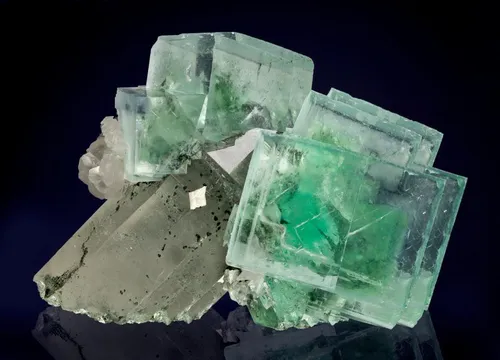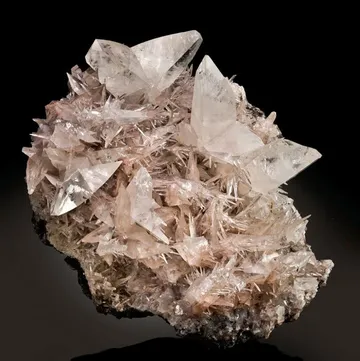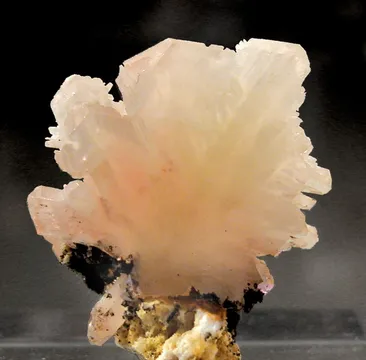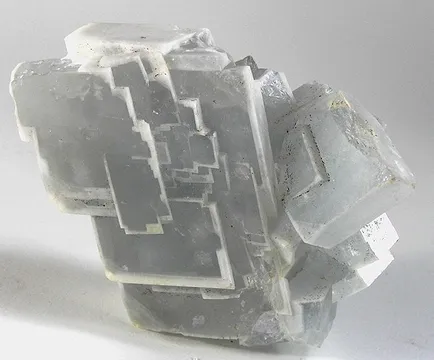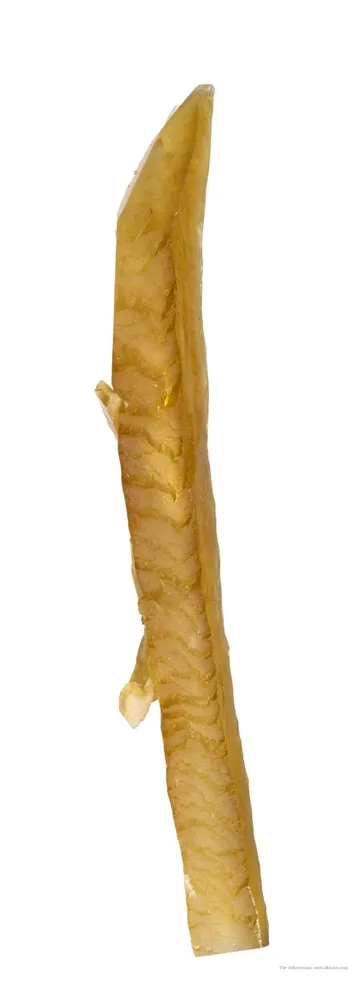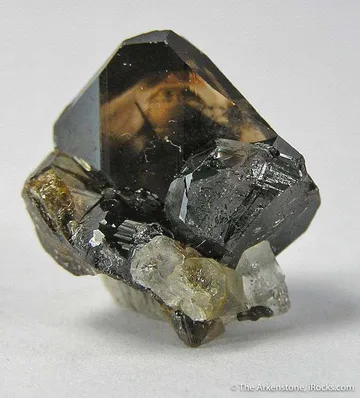
Huairou District, China — a key fluorite locality known as Beijing fluorite, producing honey-yellow to golden-amber cubes on white matrix, with blue phantoms.
Key facts
Huairou District, on the mountainous northern side of Beijing municipality, has become a small but memorable name in modern fluorite collecting because of a recent reappearance of specimens from old fluorspar workings around Lanying and Jiangjun Gou. The collecting locality sits in the Yanshan Fold Belt on the northern margin of the North China Craton, where Jurassic volcanic rocks and later hydrothermal systems provided open fractures for fluorite-bearing fluids. In industrial terms the deposit was a modest fluorspar mine; in collector terms it is important because its best pieces have the improbably urban-romantic label of “Beijing fluorite” and a distinctive look: honey-yellow to golden-amber cubes, sometimes with smoky, greenish, blue, or violet tones, perched on white barite or feldspathic matrix, with occasional blue phantoms and ultraviolet response.
Regional View
Country View
The locality’s wider mineralogical setting is not limited to fluorspar. Huairou also includes gold and molybdenum occurrences such as Detiangou, Beigangou, and Yangshudixia, where published work records quartz-vein and altered-rock gold mineralization with pyrite, pyrrhotite, chalcopyrite, galena, sphalerite, native gold, silver minerals, and tellurides. Those ore minerals are not what made Huairou visible in specimen cabinets; the collector identity of the district rests on the Lanying-Jiangjun Gou fluorite find, especially the glassier, more saturated yellow cubes and the blue-toned examples that circulated internationally after roughly 2022.
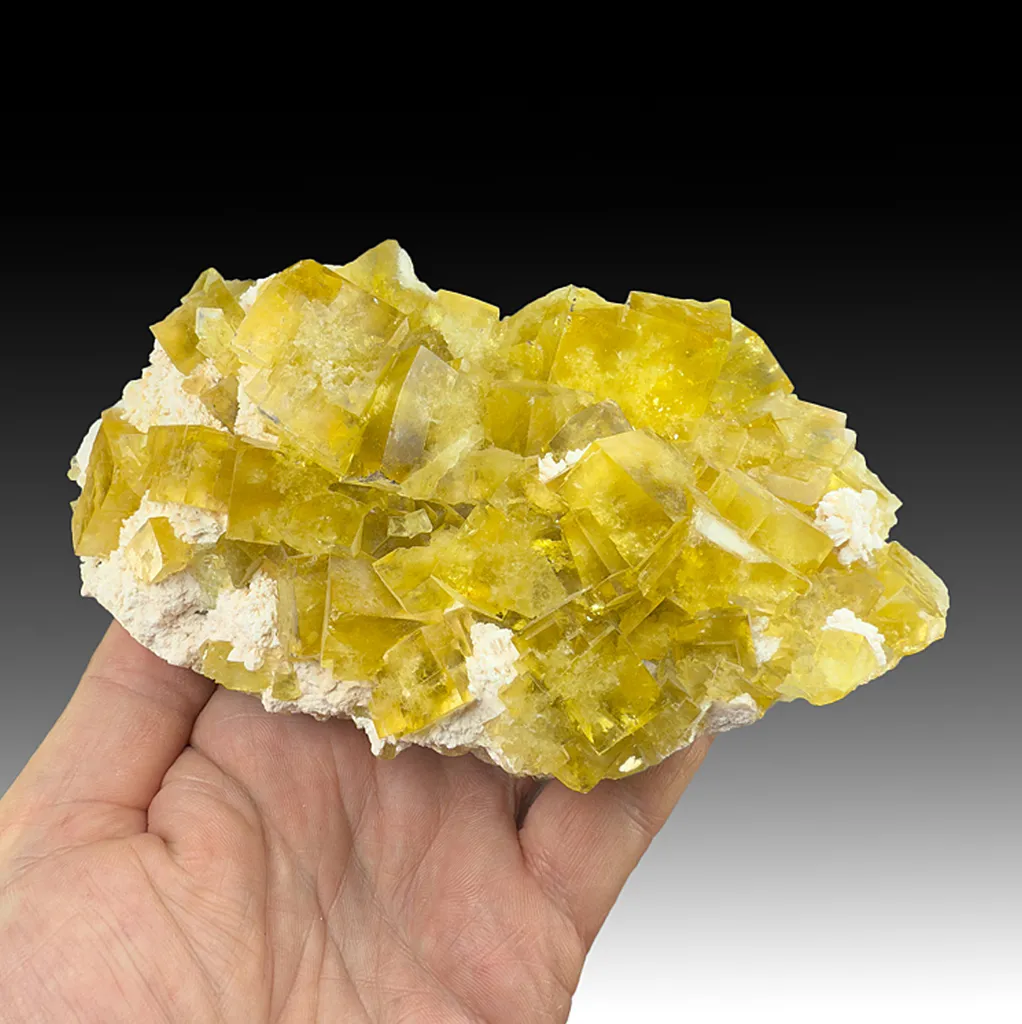
Photo: EarthWonders / Weinrich Minerals
Search for specimens: View all specimens from Huairou District, China
The collector material is tied chiefly to the Lanying fluorite mine and the nearby Jiangjun Gou workings in northern Huairou. Mindat records Lanying as a fluorspar mine at about 40°48′ N, 116°40′ E, within the North China Craton and Yanshan Fold Belt. A Chinese geochemical paper that sampled Lanying described the deposit as a hydrothermal fluorite vein hosted by Jurassic volcanic rocks, a compact description that fits the specimens: fluorite filling fractures and cavities rather than forming broad, sedimentary beds. Dealer and collector records for the recent material commonly use Lanying, Jiang Jun Gou, JiangJunGou Mine, or simply Huairou District, Beijing; the best interpretation is that the collector labels refer to closely related old fluorspar workings in the Lanying-Jiangjun Gou area rather than to a large, continuously documented specimen mine in the Western sense.
The industrial ore was fluorspar, but the specimen assemblage on the market is a fluorite-barite association. On collector pieces, yellow fluorite cubes are scattered across or partly embedded in a white, crystalline barite matrix; some specimens are nearly free-standing fluorite clusters with only subordinate barite or matrix remnants. Matrix pieces are especially attractive when the barite is fresh and white, because it gives the amber cubes the kind of contrast that makes a small Chinese fluorite suddenly read as a cabinet specimen rather than a mere locality example. Some Huairou fluorites are reported on feldspar-rich matrix as well, and collector photographs show cube clusters with stepped growth, interpenetrant cubes, and phantom-like internal zoning.
The mining history is unusually well preserved in local memory. A local account adapted from Peng Xingwen’s writing on the Lanying fluorspar mine says the deposit was discovered accidentally in the early 1940s near the villages of Lanying and Jiangjun Gou. The story begins with Wang Yong, an older villager who gathered firewood, cut grass, and grazed animals in the mountains. Around the autumn of Kangde 7, while the area was under the puppet Manchukuo-era administrative sphere, he noticed exposed stones in a gully that showed purple and green luster and brought several home as “gemstones.” A relative, Wang Xianting, later took one to the Luanping county office; a Japanese observer noticed it, asked where it came from, and the lead was followed back into the hills. By autumn 1942 Japanese personnel and the puppet local administration had organized investigation and mining.
From 1943 to 1945, the Japanese-directed operation reportedly extracted and shipped fluorite daily: two truckloads a day, five tons per truck, routed toward Shuangtashan at Chengde and then exported via Dalian to Japan. The same local account gives a total of more than 4,000 tons removed during that occupation-period episode. Work was harshly organized. After an initial group of more than thirty hired workers from Longhua, nearby villagers were conscripted; more than 150 people a day worked on drilling, blasting, carrying ore baskets, and moving fluorite from mine openings down to chutes on the mountainside. The names themselves were altered in that period: Laogoumen became Lanying, and Jiangjun Gou was renamed Pingshi, a pairing that played on the sound and branding of “Luanping fluorspar.”
After Japan’s surrender in 1945, the mining organization collapsed and the workings were abandoned. Mining restarted after 1949 in a very different context, partly as relief work after flooding in the Tanghe River area. Former mine workers and local cadres helped reopen the site, and villagers exchanged fluorite for grain at a rate described locally as one sheng of millet for each hundred jin of fluorspar. Production in that early recovery phase was still hand work and only about a thousand tons annually.
A third documented phase began in 1963, when the Beijing import-export authorities pursued fluorspar for trade with Japan. Changshaoying commune reopened and expanded production under local party leadership with outside trade officials advising on grading, sorting, inspection, and purchase. That export campaign lasted three years and reportedly ended in autumn 1966, with more than 3,000 tons shipped. A later, more informal phase followed in the reform-era 1980s and 1990s, when villagers were permitted to mine within designated limits. By the mid-1990s, local accounts describe two to three hundred people working more than thirty adits, selling fluorite mainly as metallurgical raw material. Mining gradually ceased in the twenty-first century as the richer material was exhausted and environmental pressure increased.
Collecting access today should be treated as restricted, uncertain, and unsafe. Modern field-trip accounts describe visible old adits, loose fluorite-bearing rubble, and fluorite still visible in walls and slopes, but they also warn strongly against entering the old workings. The underground openings are old, wet in places, unsupported, and subject to collapse, low oxygen, falling rock, and unstable backfill. Serious collectors should obtain local permission before any field visit and should not assume that because the locality is discussed online it is open for collecting. Dealers have also reported that the brief modern specimen recovery from an abandoned mine was closed by authorities after a short period, which explains why the locality appeared abruptly in the market and may not remain a steady source.
Huairou fluorite is best known for sharp cubic crystals in honey-yellow, golden-amber, lemon-yellow, smoky yellow, grey-blue, navy blue, and occasional greenish or violet-toned combinations, with the most desirable pieces showing transparent to gemmy interiors, glassy luster, blue phantoms or edge zoning, and clean cubes isolated enough to display their geometry. The common specimen size is thumbnail to cabinet, but the cubes themselves are typically in the centimeter range: published dealer examples include crystals to about 2.0 cm from Jiang Jun Gou, to 3.0 cm on a 17.0 cm barite-matrix cabinet, and to 3.5–3.7 cm on small-cabinet clusters. Good pieces here are not merely yellow; they have depth of color, crisp cube faces, minimal cleavage scars, and contrast against white barite or pale matrix. Ordinary examples can be duller, more opaque, bruised along cleavage, or massive-looking, and some are attractive primarily as rare Beijing-locality specimens rather than as top-level fluorite aesthetics.
Barite from Huairou is chiefly important as the visual and paragenetic partner of the fluorite rather than as the showy focal species. On the better collector specimens it forms a white crystalline matrix or bladed to granular barite base carrying golden fluorite cubes; the finest combinations succeed because the barite is bright, clean, and structurally supportive, allowing the transparent yellow cubes to sit above the matrix rather than disappear into it. Stand-alone barite groups from the district are not a major collecting category, but barite-bearing matrix is central to many of the most convincing Huairou pieces, especially the Jiang Jun Gou labels with lustrous yellow fluorite cubes across white barite. Condition matters: barite edges can be fragile, chalky, or bruised, and a fluorite specimen on a damaged white matrix loses much of the crisp contrast that makes the locality appealing.
Beyond fluorite and barite, Huairou’s documented mineral list is dominated by ore-mineral species from its gold and polymetallic prospects rather than by cabinet specimens. Detiangou is especially notable mineralogically, with records of acanthite, altaite, hessite, petzite, stützite, sylvanite, native tellurium, native silver, native gold, pyrite, pyrrhotite, chalcopyrite, galena, sphalerite, arsenopyrite, magnetite, calcite, quartz, actinolite, tremolite, chlorite, muscovite/sericite, feldspar, tourmaline, and an unnamed Bi telluride phase with formula Bi5Te6. Beigangou adds native gold, electrum, quartz, albite, epidote, hematite, muscovite, hornblende, and barite to the district record. These tellurides and precious-metal phases are important academically, but they should not be confused with the specimen-producing fluorite pockets; most are ore-microscope or analytical minerals, not freestanding display crystals. I found no verified valid type-locality mineral for Huairou District.
Huairou fluorite is a modern small-source locality, and provenance discipline matters. Labels may read Huairou District, Lanying fluorite mine, Jiang Jun Gou, JiangJunGou Mine, or “Beijing,” and not all of these labels have the same precision. A specimen simply sold as “China yellow fluorite” should not be upgraded to Huairou unless its chain of custody supports the attribution; conversely, some genuine early pieces reached the market with incomplete labels because the find was not widely understood when it first appeared.
The easiest mislabelling risk is confusion with other yellow fluorite localities. Huairou pieces can resemble yellow Moroccan fluorite at a glance, and some examples also invite comparison with pale yellow fluorites from other Chinese deposits. The combination of honey-yellow cubic fluorite, white barite or pale feldspathic matrix, blue phantoms or blue zoning, and a Beijing/Huairou/Lanying-Jiangjun Gou provenance is more persuasive than color alone. Rich marine-blue Huairou cubes are less common than yellow examples and should be approached with the same provenance caution.
No specific, widely documented fake or treatment scandal is attached to Huairou fluorite, but standard fluorite issues apply. Cleavage bruises, contacted backs, and edge nicks are common; even dealer descriptions of good examples often mention micro-damage or minimal cleaving. Examine cube edges under strong light, because yellow fluorite can hide small cleaves until viewed at an angle. Repairs are possible on any brittle fluorite cluster, so check for glue lines at crystal contacts, mismatched luster, and matrix joins. Acid cleaning can brighten matrix but may also leave etched, sugary barite or dulled fluorite faces if done carelessly.
Some Huairou fluorites are noted for unusual ultraviolet behavior, including violet longwave response and yellowish shortwave response, and some specimens show UV-reactive blue phantoms. UV reaction is a useful enjoyment feature, not a locality proof. Handle UV testing conservatively: avoid prolonged exposure of labels and boxes, and never shine shortwave lamps at skin or eyes. Fluorite itself is stable under normal display conditions, but barite matrix can chip, and many Huairou plates are thin enough that careless packing can shear crystals from the base.
Market availability has been episodic. The find became visible to collectors around 2022–2023, appeared in dealer offerings and show reports in 2023–2026, and remains available in small numbers rather than as a long-established bulk locality. Attractive cabinet pieces with lustrous, transparent yellow cubes on white barite command a premium because they combine rarity of locality, immediate color, and display contrast. More matte, opaque, massive, or damaged pieces are best treated as locality representatives.
The best Huairou story begins not in a specimen pocket but with a man in the hills. Wang Yong, an elderly villager near what became Lanying, was out cutting firewood when he noticed stones exposed along a gully. They were not the dull country rock he knew; they flashed purple and green and looked transparent enough to be “gemstones.” He carried a few home as curiosities. That casual act, a villager decorating his house with pretty stones, was the first step in turning a mountain gully into a wartime fluorspar mine.
The second turn in the story came through a desk ornament. Wang Xianting, a relative working in the puppet Luanping county office, saw the stones at home and took one back to the office. The piece was angular, bluish with purple and even reddish tones, and attractive enough that he kept it on his desk and handled it idly. A Japanese observer noticed the stone and asked where it came from. Wang answered plainly and even gave him the specimen. In 1942, a Japanese woman accompanied by several puppet-government investigators went into the valleys near Laogoumen to trace the source. After searching the mountain gullies, they found the fluorite.
Mining followed quickly and brutally. Three Japanese men named in the local account as Xiong Gu, Shan Sen, and Ju Chi arrived at the puppet police substation at Changshaoying and, with the puppet station head Tanaka, set up the mining organization. At first more than thirty workers were recruited from Longhua, but the work force soon expanded by coercion. More than 150 people a day were sent into the hills. The specialists drilled and blasted; the rest carried heavy baskets of fluorite from the mine openings to the mountainside, where prepared chutes sent the stone downward. The working day was often more than twelve hours, and the conscripted laborers were unpaid.
Even the place names were bent to the mine. Under the Japanese-puppet policy of concentrating villages for control, two settlements were built near Laogoumen and Jiangjun Gou to supply labor. Poor residents from Labagoumen, Qidaohe, Changshaoying, and nearby areas were forcibly moved there and housed in rough shelters built by corvée labor. The puppet Luanping county head Zhang Xianglian then renamed Laogoumen as Lanying and Jiangjun Gou as Pingshi. Together the names echoed “Luanping fluorspar,” turning local geography into an ore label.
By spring and summer 1943 the operation was shipping in rhythm: two trucks a day, five tons to a truck. Workers sorted fluorite by size and packed it in straw bags. The trucks carried it toward Shuangtashan at Chengde, and from there it was exported through Dalian to Japan. The local account gives more than 4,000 tons removed during the 1943–1945 occupation-period working. When Japan surrendered in 1945, the mining office dissolved, the forced settlements emptied, and the hills were left with ruined shelters and ragged adits.
The postwar reopening was tied to hunger. In autumn 1949, floods in the Tanghe River area damaged farmland badly enough to create a food crisis. The new local government looked for ways to combine disaster relief with production and revived the fluorite workings. Men who knew the old mine, including cadres Zhang Shu and Yuan Shunting, were sent to organize the effort. The relief arrangement was simple and earthy: one hundred jin of fluorite could be exchanged for one sheng of millet. For a time, the same mine that had fed wartime extraction became a way for mountain families to bridge a grain shortage.
A final human layer belongs to today’s collectors and weekend visitors. Modern field accounts describe old openings still visible from the road at Jiangjun Gou, fluorite-bearing rock scattered below, and fluorite visible in walls and slopes. They also carry the unmistakable warning of a place that looks inviting but is not safe: old wet adits, no drainage, no supports, loose stone overhead, and too much uncertainty underground. One geologically trained commenter on a field post summed it up sharply: “old adits—never enter.” It is a useful phrase for collectors to remember. Huairou specimens are best enjoyed in the cabinet; the old mine itself is not a playground.