Hotazel, South Africa — renowned Kalahari manganese locality known for deep-pink rhodochrosite on black manganite, rich paragenesis, and collector appeal.
Key facts
Hotazel sits on the northern Kalahari manganese country of South Africa’s Northern Cape, a district where a small, heat-baked mining settlement became shorthand for one of the great mineralogical provinces of the twentieth century. Collector labels that read simply “Hotazel” may refer to the historic Hotazel Mine itself, to the Hotazel town area, or more broadly to the mines of the Kalahari Manganese Field clustered around Hotazel, Wessels, Mamatwan, Black Rock, Gloria, and N’Chwaning. For serious collectors, that distinction matters: the original Hotazel rhodochrosites are a scarcer, older subset of the Kalahari classics, while the larger district produced an extraordinary hydrothermal and supergene mineral suite unmatched in manganese collecting.
The geological setting is the Paleoproterozoic Hotazel Formation of the Transvaal Supergroup, a rhythmic succession of banded iron formation, hematitic lutite, carbonates, and three manganese ore layers. Later faulting, hydrothermal alteration, and supergene overprinting transformed parts of the original sedimentary ore into the high-grade, coarse, vuggy manganese assemblages that collectors know so well. The best specimens are not merely “ore with crystals”; they are products of a complicated paragenesis in which manganese oxides, carbonates, silicates, sulfates, and late cavity minerals share the same small specimen.
Regional View
Country View
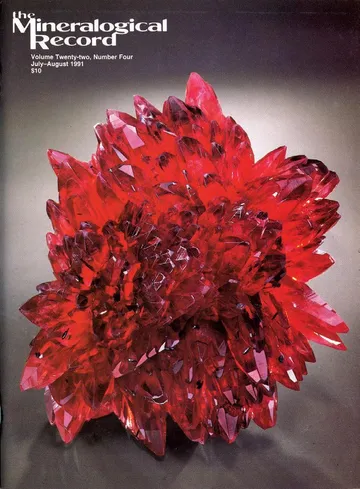
Hotazel’s most famous contribution to specimen mineralogy is rhodochrosite: deep pink to red, commonly on black manganite-rich manganese ore, and found in habits ranging from sparkling botryoidal crusts to gemmy scalenohedra, rounded “balls,” and wheat-sheaf or semi-spherical aggregates. The classic pieces have a visual tension that is instantly Kalahari: hot red carbonate against a heavy black manganese matrix, sometimes with earlier banded pink generations under later bright druse. Old Hotazel pieces tend to feel compact and intense rather than sprawling; a fine miniature can carry the same authority as a cabinet specimen if the color is saturated, the surfaces are fresh, and the association is unmistakable.

Photo: Wikimedia Commons
The wider Hotazel–Kalahari district is just as important for what it did beyond rhodochrosite. Wessels-type ore is the source of superb hausmannite, manganite, hematite, andradite, calcite, baryte, ettringite-group minerals, and a remarkable roster of rare species. Wessels Mine, near Hotazel, is a type locality for several species and a benchmark locality for the collector minerals that made the Kalahari Manganese Field a pilgrimage destination for both mineralogists and connoisseurs.
Search for specimens: View all specimens from Hotazel, South Africa
Hotazel lies in the Kalahari Manganese Field of the Northern Cape, the largest known land-based manganese deposit on Earth. The ore is hosted by the Hotazel Formation, part of the Transvaal Supergroup, and consists of three manganese ore beds interlayered with banded iron formation, hematitic lutite, and carbonate-rich rocks. In the original sedimentary system, manganese and iron accumulated in repeated chemical cycles; later diagenesis, deformation, hydrothermal fluid flow, and weathering produced the complex mineral zones now represented in both ore descriptions and collector specimens.
Two ore styles are especially important. Mamatwan-type ore is the lower-grade, primary sedimentary carbonate-rich manganese ore of the southern and central field, historically mined by large open-cast methods. Wessels-type ore is the later, higher-grade, hydrothermally altered ore concentrated in the northern part of the field. Wessels-type ore is typically richer, coarser, darker, more vuggy, and more specimen-friendly; its principal ore minerals include hausmannite, braunite II, bixbyite, and manganite, with gangue and cavity minerals such as calcite, andradite, baryte, hematite, rhodochrosite, ettringite-group minerals, and numerous rarities.
The historic Hotazel Mine was one of the names that introduced Kalahari rhodochrosite to the collector world. It was opened in the late 1950s after systematic postwar exploration confirmed major manganese mineralization on the farm Hotazel. The mine became famous when rhodochrosite specimens appeared in the 1960s and 1970s, before the later flood of spectacular N’Chwaning material reset the scale for South African rhodochrosite. The original Hotazel rhodochrosites are therefore both aesthetic specimens and historical documents: they represent the first phase of Kalahari rhodochrosite collecting, when locality labels were often less precise and much South African material circulated simply as “Hotazel.”
The broader mining history is woven through several operators and properties. Black Rock manganese was recognized earlier in the twentieth century, and by the 1950s S.A. Manganese and associated companies were investigating farms including Wessels, Mamatwan, Dibiaghomo, Dikgathlong, and Hotazel. Hotazel Mine was officially opened on 19 November 1959. Mamatwan began producing in November 1963 as a large open-cast operation. Wessels Mine was officially opened on 2 May 1973 and developed as an underground high-grade mine. In modern corporate terms, Hotazel Manganese Mines comprises the Mamatwan open-cut mine and the Wessels underground mine; South32 reports the operation as part of South Africa Manganese, with ownership held through Samancor Manganese and Broad-Based Black Economic Empowerment interests. The old Hotazel Mine itself is a separate historical locality: production there ceased in 1989, and later mining-rights information places the historical Hotazel void within the Tawana Hotazel Mine property.
Collectors should treat the word “Hotazel” on a label with care. It may mean Hotazel Mine proper, the town, the Hotazel manganese-mining area, or an imprecise older attribution for N’Chwaning or Wessels. During the 1970s and early 1980s, before modern locality discipline became standard, dealers and miners often used broad field names. A specimen accompanied by an old label, mine-run provenance, or documented chain of ownership is worth more interpretively than a modern relabeling based only on appearance.
The notable specimen pockets were not hobby digs but mining discoveries: cavities, ore faces, and broken manganese ore zones encountered during commercial extraction. The best old Hotazel rhodochrosites came from limited pockets, and their scarcity is partly a consequence of mining method, working conditions, and the fragility of the crystals. Heavy black ore, blasting, crushing, and rapid ore handling were not kind to delicate carbonate crystals. Surviving specimens with intact terminations, undulled luster, and no distracting bruising are therefore much more desirable than their nominal size alone would suggest.
Collecting access today should be considered closed. These are active, restricted, regulated, or privately controlled industrial manganese operations, not public collecting sites. The practical collector market consists of old collection material, historic dealer stock, mine-run pieces saved by workers, and specimens dispersed through established mineral dealers and auctions. Field collecting without permission is unsafe, illegal, and unrealistic.
Rhodochrosite from Hotazel is the locality’s signature specimen mineral, most valued as lustrous pink to red crystals and drusy botryoidal or semi-spherical aggregates on black manganite-rich manganese ore. The classic old material includes multiple growth generations: deep red to gemmy banded rhodochrosite, flatter intergrown scalenohedral crystals, and later sparkling pink coatings, with individual rounded groups commonly in the centimeter range and better specimens reaching fine-miniature to small-cabinet scale. The historic Hotazel Mine material tends to be scarcer than the later N’Chwaning scalenohedra and is prized for saturated red-orange to rose-red color, strong contrast with black matrix, silky to vitreous luster, and recognizable old-pocket habits such as “balls,” drusy crusts, wheat-sheaf aggregates, and compact scalenohedral clusters. Good pieces have fresh surfaces, visible translucency or backlit fire, crisp undamaged crystal crests, and balanced placement on manganese matrix; ordinary pieces are paler, heavily abraded, massive, or lack the dramatic black-and-red Kalahari contrast.
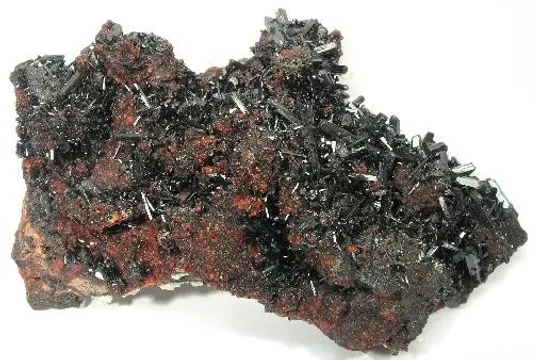
Manganite at Hotazel is most familiar to collectors as the black metallic to submetallic manganese oxide matrix beneath rhodochrosite, but it is far more than background: in Wessels-type and Hotazel-area ore it belongs to the high-grade altered manganese assemblage and appears as coarse black crystalline masses, laminar or bladed aggregates, fine crystalline seams, and dark botryoidal to vuggy surfaces. On specimen-grade rhodochrosite pieces it commonly forms the visual anchor, separating earlier pink carbonate from later red or drusy growth and giving the specimen its strong Kalahari identity. Fine manganite specimens from the broader Hotazel district are judged by metallic luster, sharp bladed or prismatic texture, freedom from powdery alteration, and contrast with rhodochrosite, calcite, hematite, or other late minerals; weak pieces are simply dull black ore with little crystal definition. Because many historic labels emphasize rhodochrosite, collectors should look closely at the black matrix: a crystalline manganite association can significantly improve both mineralogical interest and display quality.
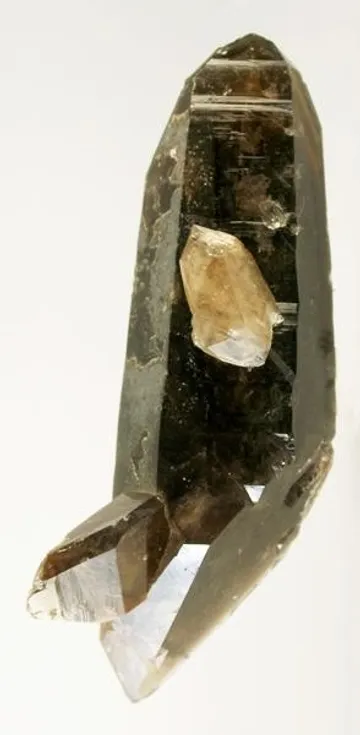
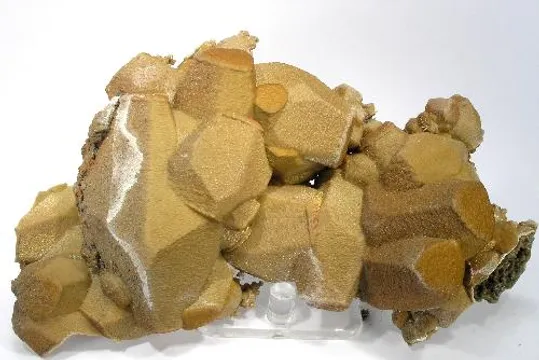
Other documented minerals from Hotazel and the surrounding Kalahari Manganese Field include hausmannite, bixbyite, braunite II, hematite, calcite, baryte, kutnohorite, andradite, quartz, ankerite, todorokite, manjiroite, nsutite, hollandite, pyrolusite, and a long list of rare manganese silicates, sulfates, and oxides. The nearby Wessels Mine is especially important for type-locality and near-unique species, including wesselsite, effenbergerite, poldervaartite, and vonbezingite, while the wider field is renowned for sturmanite, ettringite, thaumasite, mozartite, sugilite, gaudefroyite, inesite, jouravskite, and other collector rarities. For specimen buyers, the lesson is simple: “Hotazel” is not a one-mineral locality but a gateway label to one of the richest manganese mineral systems ever mined.
The chief authenticity issue is not widespread faking but locality precision. Many older South African rhodochrosites were sold under broad labels such as “Hotazel,” “Kalahari,” or “Kuruman,” and some specimens later proved more consistent with N’Chwaning I, N’Chwaning II, or Wessels. During the years when the famous finds were entering the market, the collecting world had not yet settled into the detailed locality distinctions now expected. A Hotazel label from the 1970s is therefore valuable evidence, but it should be read in context: old dealer label, acquisition date, mine name, collector history, and specimen habit all matter.
Real Hotazel rhodochrosite is generally not difficult to distinguish from common dyed carbonate or modern decorative material, but fine locality attribution can be difficult. The most convincing old Hotazel specimens are compact, richly colored, often on black manganite-rich ore, and may show rounded or drusy growth forms rather than the large, clean, classic scalenohedral clusters more strongly associated with N’Chwaning. That distinction is not absolute, so confident mine-level labeling should be reserved for specimens with provenance or close matches to documented old material.
Condition is a major value driver. Rhodochrosite has perfect rhombohedral cleavage and is vulnerable to bruising, broken tips, edge chips, and dulling from careless cleaning. Minute cleaves on old Hotazel crystals are common and should not automatically disqualify a specimen, but they must be disclosed honestly. The black manganese matrix is heavy and can undercut or crush crystals if the specimen is packed poorly; these pieces need firm support, no loose rattling in a box, and no pressure on the crystal face. Avoid acid cleaning unless performed by someone who understands manganese oxides and carbonate stability, because rhodochrosite reacts to acids and can lose luster.
Manganite and associated manganese oxides may soil fingers and packaging, and some specimens include friable black seams or powdery alteration. Stable, lustrous crystalline manganite is preferable to dull, crumbly wad-like material. For display, use inert mounts and avoid repeated handling. Fluorescence is not a normal buying criterion for classic Hotazel rhodochrosite or manganite specimens; value rests on color, luster, habit, association, historical provenance, and preservation.
Market availability is uneven. Small drusy Hotazel rhodochrosite on black matrix appears periodically, but fine, old, well-provenanced Hotazel Mine pieces are much scarcer than generic South African rhodochrosite. The best examples are often locked in older collections or trade through specialist dealers and auctions. Manganite-only specimens from Hotazel are less frequently highlighted, but manganite in strong association with rhodochrosite is a core part of the locality’s appeal.
The town name is one of the great mineral-locality jokes that actually belongs on a label. The farm name Hotazel is a phonetic contraction of “hot as hell,” a reference to the weather when the farm was surveyed. Later writers embroidered the scene with land surveyors in the red Kalahari sands, heat, and Cape brandy, but the sober place-name record gives the essential truth: the name came from the farm, and the farm name came from the heat. Few major mineral localities have a name that sounds like a warning and a punchline at the same time.
The modern mining story began not with a glittering specimen pocket but with the recognition that the black hills and buried rocks west of Kuruman held a manganese province of astonishing scale. Dr. A.W. Rogers had already noted in 1906 that Black Rock consisted largely of manganese ore, a major observation for what was then Cape Colony geology. Decades later, Dr. L.G. Boardman of the Government Geological Survey became central to the exploration story. After investigating the Black Rock deposits around 1940, he was excited enough by the scale of the manganese to publish his findings and to push further exploration when S.A. Manganese was approached again in 1950.
The prospecting sequence reads like the opening of a field camp novel. A.T. Fincham, convinced that the country around Black Rock must contain more manganese, took options on farms and tried to interest mining companies. S.A. Manganese first thought the area too isolated. Ammosal moved on some of the options, assessed the ground with geophysicist Oscar Weiss, and began mining Black Rock during the mid-1940s. When Boardman later persuaded S.A. Manganese to investigate again, the company surveyed farms including Wessels, Mamatwan, Dikgathlong, and Dibiaghomo. The first borehole on Wessels disappointed them. Then the drill moved to Dibiaghomo, and at 280 meters depth it cut high-percentage manganese ore. Other boreholes confirmed the discovery, information leaked, and the quiet farm-option strategy turned into a race between companies to lock up mineral-rich ground.
Hotazel itself entered the story soon after. Although work began in earnest elsewhere, S.A. Manganese was drawn to promising results on the farm Hotazel. A whole village was built on the farm, and the Hotazel Mine was officially opened on 19 November 1959. Mamatwan followed as a large open-cast mine, beginning production in November 1963 and exceeding one million tons per year during the 1970s. Wessels, whose mining rights had been acquired in 1952, took longer to develop; after renewed work in 1965 and twenty boreholes by January 1969, three manganese bands were identified, the top and bottom considered mineable. Wessels Mine opened officially on 2 May 1973 and was producing 750,000 tons per year by 1976.
For collectors, the decisive episode was the arrival of rhodochrosite. Kalahari rhodochrosite was discovered in the Hotazel opencast mine in 1963, and within the following years the Hotazel and then N’Chwaning finds changed the world’s expectations for manganese-carbonate specimens. Before the great N’Chwaning scalenohedra became the standard image of South African rhodochrosite, Hotazel had already supplied red and pink crystals, rounded aggregates, and drusy botryoidal pieces on black ore. That is why a true old Hotazel rhodochrosite feels different from a generic “South Africa” specimen: it comes from the opening chapter of the Kalahari rhodochrosite story, when a mining town named for impossible heat began producing some of the coolest manganese specimens ever seen.
Pierre Retief De Villiers, The mineralogy of the Kalahari Manganese-field north of Sishen, Cape Province, DSc thesis, University of Pretoria, 1965 — Early detailed treatment of the mines Hotazel, Devon, Langdon, Smartt, Adams, Mamatwan, and Black Rock, including mineralogy, geology, and geochemistry of the Kalahari Manganese Field.
A.S.E. Kleyenstüber, “The mineralogy of the manganese-bearing Hotazel Formation, of the Proterozoic Transvaal Sequence in Griqualand West, South Africa,” South African Journal of Geology, 87(3), 257–272, 1984 — A key cited paper on the mineralogy of the Hotazel Formation and its manganese-bearing rocks.
J. Gutzmer and N.J. Beukes, “Fault-controlled metasomatic alteration of early Proterozoic sedimentary manganese ores in the Kalahari manganese field, South Africa,” Economic Geology, 90(4), 823–844, 1995 — Foundational study of the hydrothermal and structural processes behind Wessels-type ore.
J. Gutzmer and N.J. Beukes, “Mineral paragenesis of the Kalahari manganese field, South Africa,” Ore Geology Reviews, 11(6), 405–428, 1996 — Important paragenetic framework for interpreting the succession of manganese ore and collector minerals.
H. Tsikos and J.M. Moore, “Petrography and Geochemistry of the Paleoproterozoic Hotazel Iron-Formation, Kalahari Manganese Field, South Africa: Implications for Precambrian Manganese Metallogenesis,” 1997 — Petrographic and geochemical discussion of the Hotazel banded iron formation and its associated manganese units.
H. Tsikos et al., “Deposition, Diagenesis, and Secondary Enrichment of Metals in the Paleoproterozoic Hotazel Iron Formation, Kalahari Manganese Field, South Africa,” Economic Geology, 98(7), 1449–1462, 2003 — Major paper on deposition and enrichment processes in the Hotazel Iron Formation.
Jens Gutzmer and Bruce Cairncross, “Spectacular Minerals from the Kalahari Manganese Field, South Africa,” Rocks & Minerals, 77(2), 94–107, 2002 — Collector-oriented classic on the specimens, including rhodochrosite, hematite, hausmannite, sturmanite, and other Kalahari minerals.
W.E. Wilson et al., “The N’Chwaning mines, Kalahari Manganese Field, Northern Cape Province, South Africa,” The Mineralogical Record, 2017 — Specialist Mineralogical Record treatment of the N’Chwaning mines within the same field, valuable for distinguishing N’Chwaning from Hotazel-attributed material.
Bruce Cairncross, “The Where of Mineral Names: Wesselsite, Wessels Mine, Kalahari Manganese Field, South Africa,” Rocks & Minerals, 95(3), 282–285, 2020 — Focused account of wesselsite, named for Wessels Mine near Hotazel.
GIA Gem Database, Edward J. Gübelin Collection no. 34679: Rhodochrosite, South Africa, Northern Cape Province, Hotazel — Museum/gemological record of a Hotazel rhodochrosite specimen, including optical and internal-growth observations.
The Kalahari Manganese Field — IUGS Geological Heritage Site — Concise authoritative overview of the field’s geology, mineral diversity, type-locality minerals, and collecting significance.
Kalahari Manganese Field — Mindat — Broad mineral database entry for the ore field around Hotazel, with mineral lists, locality hierarchy, and specimen photographs.
Hotazel Mine rhodochrosite specimen record — Mindat — Documented old-time Hotazel Mine rhodochrosite with detailed description of habit, color, matrix, and provenance.
Minerals of Hotazel — Wikimedia Commons — Open image category with Hotazel rhodochrosite, calcite, and kutnohorite photographs.
Hotazel — South African History Online — Historical place entry summarizing the town, the name origin, mining development, and the closure of the original Hotazel Mine.
Dictionary of Southern African Place Names — Raper, 1987 — Primary place-name reference for the “hot as hell” origin of Hotazel.
Mamatwan Mine Heritage Impact Assessment, 2021 — Useful historical summary of manganese exploration, Boardman, Fincham, mine openings, and regional mining development.
South32 Annual Report 2025 — Current corporate reporting on South Africa Manganese, including Mamatwan and Wessels.
Major Mines & Projects: Hotazel Complex — Operational and ownership summary for the Hotazel Manganese Mines complex.
Tawana Hotazel Mine — Operator page for the Tawana Hotazel Mine property incorporating the historical Hotazel Manganese Mine.