Aggeneys, South Africa — famed for Broken Hill-type base metals and hollow calcite casts of siderite-sphalerite, offering sculptural, metallic specimens for co…
Key facts
Aggeneys sits in the dry Bushmanland of South Africa’s Northern Cape, a mining town built around a cluster of extraordinary Mesoproterozoic base-metal deposits: Broken Hill/Deeps, Swartberg or Black Mountain, Big Syncline, and the great zinc body at Gamsberg. For ore geologists the district is one of the classic South African expressions of Broken Hill-type mineralization—lead, zinc, copper, silver and barium concentrated in a volcano-sedimentary succession, then folded, recrystallized and chemically reworked during Namaqua metamorphism. For collectors, however, Aggeneys is remembered above all for a far stranger thing: hollow, barrel- to scalenohedron-like casts after calcite, made of a shimmering mixture of siderite and sphalerite, many of them bronze-brown, gunmetal, greenish, reddish or subtly iridescent on the same crystal.
The best Aggeneys specimens do not look like ordinary ore-mine by-products. They have a sculptural, almost fossilized elegance: hollow carbonate-sulfide shells that preserve the geometry of vanished calcite, often with textured, glittering faces and enough metallic luster to make the species boundary feel deliberately mischievous. The district also produced sharp magnetite in chalcopyrite and galena, garnet-rich metamorphic pieces, rare barium- and manganese-bearing assemblages, and the type-locality brittle mica ferrokinoshitalite from the Broken Hill mine. It is a locality where the cabinet appeal comes directly from the geological complexity: high-grade metamorphism, base-metal sulfides, carbonate replacement, barium-rich rocks, iron formation, and localized oxidation all written into small, dense, memorable specimens.
Regional View
Country View
The name “Aggeneys” is used loosely in the specimen trade, and that looseness matters. Many of the famous siderite-sphalerite after calcite pieces were sold simply as “Aggeneys” or “Aggeneys mine,” while later documentation and collector discussion place the classic material at the Broken Hill mine within the Black Mountain complex. Good labels should therefore carry both the district and, where known, the mine: Broken Hill Mine, Aggeneys, Khâi-Ma Local Municipality, Namakwa District Municipality, Northern Cape, South Africa.

Photo: Rob Lavinsky, iRocks.com / Wikimedia Commons

Search for specimens: View all specimens from Aggeneys, South Africa
Aggeneys is best understood not as a single mine but as a district-sized base-metal system near the town of Aggeneys in the Khâi-Ma municipal area of Namakwa, Northern Cape. The modern Black Mountain Complex includes the Deeps and Swartberg underground mines west of the town and the Gamsberg open-pit zinc operation to the east. These deposits occupy the Mesoproterozoic Bushmanland Group within the Namaqua-Natal Metamorphic Province. The ore-bearing succession includes schists, quartzites, paragneiss, graphite-bearing sillimanite-mica schist, iron formation, barite-rich units, coticules, apatite-rich rocks, quartz-gahnite rocks and related metamorphic lithologies. In modern genetic language, the deposits are generally discussed as Broken Hill-type or highly metamorphosed SEDEX-related Pb-Zn-Cu-Ag-Ba systems, but recent work emphasizes a more complicated multistage history involving original seafloor or subseafloor mineralization, deformation, high-grade metamorphism, oxidation and later sulfidation.
The district’s principal orebodies form a west-to-east sequence of metal character. Broken Hill and Black Mountain/Swartberg are comparatively Cu-Pb-rich; Big Syncline is a lower-grade zinc-bearing body; and Gamsberg is the great zinc-dominant end member. At Gamsberg, published resources have been described at the scale of hundreds of millions of tonnes, and the deposit is repeatedly singled out as the most zinc-rich body in the district. Its ore lies in the Hotson Formation, with disseminated sphalerite and galena in schistose units, garnet-apatite ore, Fe-Mn-rich rocks, and barite- and magnetite-bearing associations. At Swartberg, the mineralized architecture includes a Lower Orebody, Barite Unit, Dark Quartzite, Upper Orebody and a discordant Garnet Quartzite; economic minerals include sphalerite, galena, chalcopyrite, pyrite, pyrrhotite and magnetite in strongly deformed and metamorphosed rocks.
Mining history at Aggeneys begins well before the town. Exploration started in 1929, when the first shaft was sunk on Swartberg—the “Black Mountain” that gave the company and mine their name. Work continued intermittently until the modern exploration push of the 1970s. Phelps Dodge began diamond drilling in 1970, intersected the Swartberg orebody in 1971, the Noeniespoort se Kop or Broken Hill orebody in 1972, and the Aggeneys Mountain or Big Syncline orebody in 1973. The Broken Hill orebody proved especially promising, and in 1974 an adit was driven to obtain bulk samples for metallurgical testing. A feasibility study for an underground mine followed in 1976. Gold Fields of South Africa took a 51% interest in the Black Mountain Mineral Development Company in 1977, and the underground operations began in the late 1970s. Anglo American later acquired Black Mountain and Gamsberg, and the assets were sold to Vedanta, with the Black Mountain Mining zinc interests transferring in 2011.
The Deeps orebody adds one of the district’s best modern exploration stories. As reserves were tightening in the late 1990s, chief geologist Pottie Potgieter obtained money for one final drill hole beyond the previously tested ground. That hole cut high-grade mineralization at a depth a little over 1,000 m, triggering renewed drilling, a feasibility study and the sinking of a 1,750 m shaft for the orebody that became Deeps. Today Deeps and Swartberg are mature underground operations, while Gamsberg is an open pit with its own concentrator.
For specimen collectors, the most important production episode was not the bulk mining of ore but the recovery of the unusual siderite-sphalerite epimorphs after calcite. The material appeared on the international market in connection with the 2006 Munich Show. Contemporary dealer and show reports describe a small find of hollow casts after calcite, with analyses in South Africa by Bruce Cairncross and others identifying the coating as a mixture of siderite and sphalerite rather than a single carbonate or sulfide. Dealer records and specimen labels describe examples from miniature to large cabinet size, with individual casts commonly several centimeters long and some plates reaching 25–30 cm. Later collector discussion has tightened the locality to the Broken Hill mine rather than the vague “Aggeneys mine” label under which many pieces first circulated.
Collecting access today should be regarded as closed unless explicitly arranged through the operator and land or mineral-rights holders. These are active industrial mine sites with regulated access, modern safety controls and no casual collecting. The specimens available to collectors are therefore principally older recovered pieces, dealer stock, estate collections, and occasional resales of the 2006-era epimorphs and older sulfide-magnetite-garnet suites.
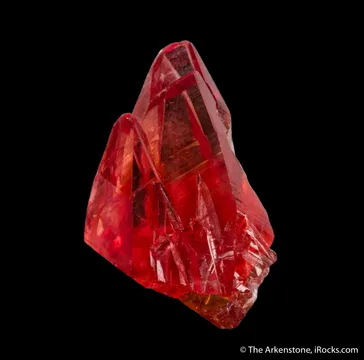
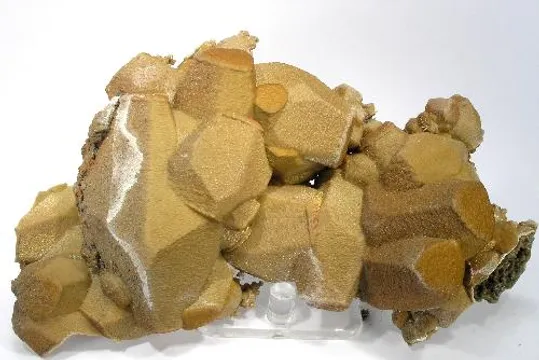
Aggeneys siderite is at its best in the famous Broken Hill Mine epimorphs after calcite: hollow, lightweight, barrel-shaped to scalenohedral shells in bronze-brown, tan, olive, reddish and gunmetal tones, commonly with a granular, sparkly, shimmering surface caused by the intimate mixture of siderite and sphalerite. Documented specimens range from miniatures around 5 cm across to cabinet and large-cabinet plates well over 10 cm, with individual casts reported around 4–5 cm and exceptional show pieces much larger. The classic associations are sphalerite, calcite, quartz, galena, chalcopyrite and locally rhodochrosite; the finest pieces show complete three-dimensional form, sharp preserved calcite morphology, attractive color zoning or iridescence, and little or no breakage, while ordinary examples are darker, incomplete, sawed, cracked, or display the hollow shell only through accidental damage rather than as a pleasing compositional feature.
Calcite is central to the collector story at Aggeneys even when little original calcite remains: the celebrated specimens are casts after calcite, with the vanished calcite crystals having supplied the barrel-like and scalenohedral architecture later coated or replaced by siderite and sphalerite. Surviving calcite may occur as associated remnants or as part of labels describing the pseudomorph process, but the value lies in how faithfully the later minerals preserve the calcite form—doubly terminated crystals, prominent flat rhombohedral terminations on some pieces, sharp edges and a complete all-around shell. The best Aggeneys “calcite” pieces for a calcite specialist are therefore pseudomorph or epimorph specimens with clear evidence of the original calcite habit, especially pieces that show the hollow interior cleanly without ruining the display face.
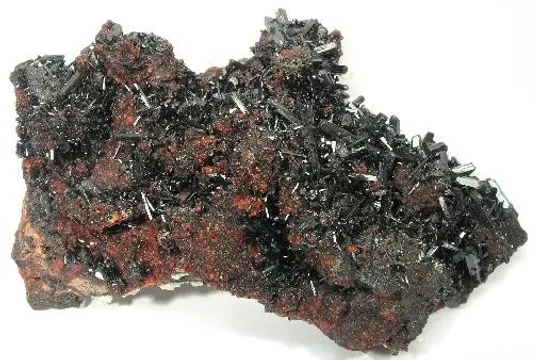
Sphalerite from Aggeneys occurs both as a major ore mineral in the district’s metamorphosed Pb-Zn-Cu-Ag deposits and, for collectors, as the dark to metallic component of the siderite-sphalerite epimorphs after calcite from the Broken Hill Mine. In the pseudomorphs it is not normally a separate cluster of bright tetrahedra but a textural and compositional partner to siderite, producing bronze, blackish, gunmetal and subtly iridescent surfaces on hollow shells; some pieces show more sphalerite-rich darker zones and others more sideritic brown tones. The best examples are those where sphalerite contributes luster and contrast without making the specimen visually muddy: sharp casts, good sparkle, evident hollow structure, attractive color variation and clean association on matrix outperform heavy, broken, overly dark or massive-looking pieces.
Beyond siderite, calcite and sphalerite, Aggeneys has a deep mineral list reflecting both primary ore and metamorphic overprint. Galena, chalcopyrite, pyrite, pyrrhotite, magnetite, barite, quartz, gahnite, garnet-group minerals including almandine and spessartine, rhodochrosite, rhodonite, pyroxmangite, grunerite, sillimanite, staurolite and amphiboles are all part of the broader district story. The locality is also important to species collectors because the Broken Hill Mine is the type locality for ferrokinoshitalite, a dark green, Ba- and Fe-rich brittle mica described from massive Pb-Zn-Cu-Ag sulfide orebodies in a quartz-magnetite-spessartine-apatite-sillimanite-gahnite-sulfide assemblage. Oxidized and supergene species reported from the district include cerussite, hemimorphite, smithsonite, linarite, caledonite, atacamite, paratacamite, corkite, plumbojarosite, plumbogummite and turquoise. At Black Mountain/Swartberg, rare sulfosalt work has documented paderaite with bismuthinite, emplectite, gladite and hodrušite—material of more interest to the microscope and polished-section collector than to cabinet-display buyers.
The main authenticity issue at Aggeneys is not widespread fakery but locality precision. Older labels often read simply “Aggeneys,” “Aggeneys Mine,” or sometimes “Black Mountain,” while the classic siderite-sphalerite casts after calcite are now generally attributed to the Broken Hill Mine within the Aggeneys/Black Mountain district. When buying an important specimen, prefer labels that preserve the old trade wording but add the corrected mine attribution rather than replacing provenance history with an overconfident simplified label.
The epimorphs are inherently vulnerable. They are hollow shells, light for their size, and may have thin walls beneath the sparkling surface. Broken terminations, cracks, sawed backs and small windows into the interior are common. Damage is not automatically fatal—one broken face can prove the hollow nature of the cast and make the specimen more instructive—but the premium pieces have complete major crystals, strong three-dimensional form, sharp edges, even surface shimmer and minimal distracting loss. Handle these specimens by the matrix or base, not by the casts, and avoid ultrasonic cleaning or aggressive chemical treatment. The mixture of carbonate and sulfide also makes acid testing a bad idea on finished specimens.
Color varies naturally. Some casts are warm brown and siderite-rich, others darker and more sphalerite-rich, and the best can show yellowish, greenish or reddish surface play under strong light. Be cautious with photographs that exaggerate metallic iridescence, but also recognize that flat lighting can undersell good pieces. In person, elite Aggeneys casts often have a subtle glitter that is difficult to capture in a single image.
Rarity is real. The famous material came from a small find that entered the market around 2006, and fresh mine production of comparable specimens is not something collectors should expect. Pieces appear today mostly through dealer inventories, auction archives, estate dispersals and resales from older collections. Miniatures and small cabinet specimens are the normal market format; large cabinet plates, especially complete ones with multiple sharp hollow casts, are much scarcer and are priced accordingly. Other Aggeneys minerals—magnetite in chalcopyrite and galena, garnet plates, unusual rhodochrosite and rare sulfosalts—are encountered far less often than the siderite-sphalerite pseudomorphs and should be judged with even more attention to provenance.
At the 2006 Munich Show, the Aggeneys table must have looked at first like a mistake: calcite forms that were not calcite, siderite that behaved like a pseudomorph, sphalerite sharing the same shell, and hollow crystals so light that a broken edge could reveal the trick immediately. Mike Keim’s Trinity Mineral Co. show report recorded Bruce Cairncross at the Kalahari Mineral Ventures booth with new South African material and “hollowed casts of calcite comprised of a mix of siderite and sphalerite.” The line that captured the room was simple: “Yes you heard me correctly - a carbonate and sulfide.” A 30 cm specimen was pictured from the find, and the report made clear that analyses were being shown to back up the claim. For a collecting world used to pseudomorphs that neatly replace one species with another, Aggeneys offered something untidier and more interesting: a mechanical-looking mixture that preserved the lost calcite crystals as shells.
The best of the early specimens were dramatic enough to travel quickly through major dealer networks. Auction descriptions from the years immediately after the find repeatedly call them barrel-shaped, hollow, lightweight and unusual, with microprobe work by Bruce Cairncross and others invoked to explain the siderite-sphalerite mixture. Individual crystals around 5 cm were considered large; complete all-around pieces were singled out as rare; and some large-cabinet plates carried multiple casts with broken windows exposing the hollow interiors. One 14.8 x 12.8 x 5.8 cm cabinet specimen was described with a 5.2 cm crystal, while another large-cabinet plate measured 16.0 x 9.6 x 4.7 cm and carried two prominent 4.2 cm crystals. The trade also slowly corrected itself: what had been sold broadly as “Aggeneys” became, in better modern cataloging, Broken Hill Mine, Aggeneys.
There is an older, less glamorous but equally consequential story beneath the specimen history. In the late 1990s, Black Mountain’s reserves were approaching exhaustion and the mine’s future was uncertain. Then chief geologist Pottie Potgieter asked for funds for one last drill hole, placed farther out than the previously tested ground. That hole cut high-grade mineralization at a depth just over 1,000 m. The result was not a pocket of showy crystals but a reprieve for a mining town: expanded drilling, a full feasibility study, and the decision to develop the orebody that became Deeps, with a shaft sunk to 1,750 m. For collectors, the episode is a reminder that the district’s most beautiful specimens came from the margins and accidents of a much larger industrial and geological enterprise.
Aggeneys also has a field story written in risk. On 17 November 2020, a geotechnical failure occurred on the western highwall slope of Gamsberg’s South Pit. Ten employees were trapped when failed material blocked the access and exit ramp. Eight were rescued; two were initially unaccounted for. Mine rescue teams later located one worker with the help of South African Police Service sniffer dogs, but he died of his injuries, and recovery efforts for the last missing worker continued. This episode belongs to the modern mining history rather than the specimen romance, but it is inseparable from how collectors should think about the locality today: Aggeneys is not a casual hill of collectible rubble but an active, high-risk industrial landscape.