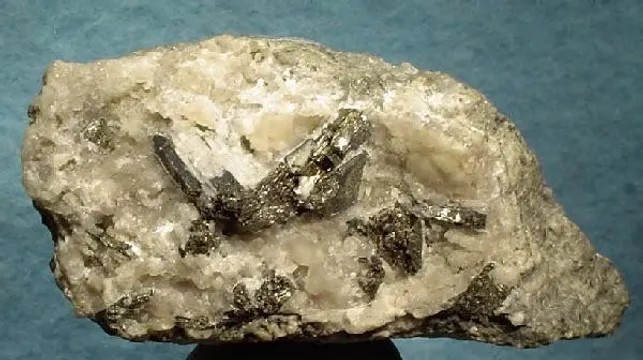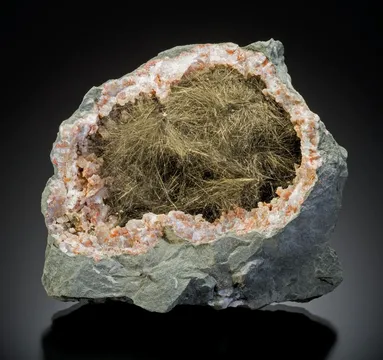
Halls Gap, USA - classic Kentucky locality renowned for millerite-in-geode specimens; metallic needles in pale quartz/chalcedony geodes prized by collectors.
Key facts
Halls Gap is the classic Kentucky locality for millerite-in-geode specimens: a roadside occurrence near Stanford in Lincoln County where Mississippian-age strata of the Borden Formation yield small quartz and chalcedony geodes carrying brassy nickel-sulfide needles. It is not a mine in the usual sense, and it never mattered as an ore producer; its importance is entirely specimen-based. Since the 1960s, collectors have prized it because the best geodes open like miniature cabinets: white to pinkish chalcedony and quartz druse forming the shell, with sprays, nests, rings, and wiry tangles of Millerite, NiS, suspended across the cavity or rooted among tiny sulfides.
The geological setting is deceptively plain: a highway cut through siltstone, shale, and related Borden Formation rocks in south-central Kentucky. Yet the geodes are chemically rich little systems. The assemblage documented from Halls Gap includes Millerite, Quartz, Chalcedony, Pyrite, Chalcopyrite, Calcite, Dolomite, Sphalerite, Galena, Marcasite, Honessite, Hydrohonessite, Jamborite-reported material, Violarite, and several sulfate or alteration species. To collectors, the locality’s signature look is unmistakable: metallic golden hair in a pale quartz geode, commonly with bronze to black sulfide specks, occasional pyrite cubes, and, in especially desirable pieces, springlike millerite coils or curved sprays rather than a simple loose fuzz.
Regional View
Country View
Halls Gap also has a place in the broader story of American Midwest geodes. Like the famous Keokuk and Indiana geode fields, its specimens are sedimentary geodes rather than hydrothermal vein pockets, but Halls Gap is far more strongly identified with nickel sulfides. Its reputation rests on the contrast between ordinary-looking broken shale and rubble at the roadcut and the improbable delicacy hidden inside some of the geodes: millerite needles so fine they can bend, twist, and bridge open space.

Photo: Wikimedia Commons
Search for specimens: View all specimens from Halls Gap, USA
The specimen locality is the Halls Gap occurrence in Lincoln County, Kentucky, most specifically the US Highway 27 roadcut near Halls Gap, south of Stanford. Halls Gap itself is a small named place at about 37°27′43″ N, 84°38′00″ W, and the collecting locality has long been associated with the roadcut rather than a formal mine, quarry, or named mineral claim. The productive exposures are part of the Mississippian Borden Formation succession mapped in the Halls Gap quadrangle, a package of siltstone, shale, silty limestone, dolomitic and cherty intervals, and related shallow-marine to delta-influenced sedimentary rocks.
The geologic nomenclature around the exact bed has been treated slightly differently in the literature. John C. Medici’s 1981 article placed the millerite geodes in the Muldraugh Member of the Mississippian Borden Formation, while Kentucky Geological Survey educational material has described millerite and honessite at Halls Gap as occurring in the Wildie Member of the Borden Formation. USGS stratigraphic work shows why collectors encounter this ambiguity: the Borden units in this part of Kentucky are laterally variable, with Halls Gap, Wildie, Nancy, and Muldraugh relationships changing across south-central Kentucky. For specimen purposes, the safe field label is “US Highway 27 roadcut, Halls Gap, Lincoln County, Kentucky, USA,” with the host described broadly as Borden Formation geode-bearing strata.
The deposit is best understood as a geode occurrence rather than an ore body. The quartz geodes are typically small, commonly reported in the 1–5 inch range, though Kentucky Geological Survey accounts note that some millerite geodes reach softball size. The geodes may be lined by chalcedony, crystalline quartz, or both. Their interiors can carry a surprisingly complex late-stage sulfide-carbonate-sulfate assemblage: millerite as hexagonal, slender, c-axis-elongate filaments; tiny chalcopyrite bisphenoids; sphalerite tetrahedra; galena; pyrite cubes and octahedra; marcasite; calcite rhombohedra; pink saddle-shaped dolomite; and nickel alteration products on or after millerite.
There was no mining company working Halls Gap for nickel, sulfide ore, or industrial quartz. The locality became available because road construction exposed the geode-bearing beds, and collectors then worked the roadcut, talus, and loose geode material. Publications describe production in collector terms: since about 1964, the roadcut produced thousands of quartz geodes, including exceptional millerite and unusual pyrite specimens. Kentucky Geological Survey material similarly notes that by the early 1960s Halls Gap millerite had already become a prized collector’s item, illustrated widely enough that the locality entered the standard visual vocabulary of American mineral collecting.
Collecting access today is a serious limitation. The classic productive roadcut is along a highway with traffic, steep ledges, loose rock, and right-of-way concerns. A 1999 central Kentucky geode-collecting paper stated that Halls Gap still produced occasional millerite-bearing geodes but warned that parts of the ledge had become extremely dangerous. Later collector accounts also emphasize that the old productive side had been heavily worked, partly filled, or considered difficult to collect. Any modern field visit should be approached as a roadside-safety and permission issue first, and a mineral trip second; the historic specimens now circulating through collections and dealers are far more important to the market than fresh collecting.
The notable “pockets” at Halls Gap are individual geodes rather than open cavities in a mine wall. The memorable finds are those in which the geode remained hollow enough for millerite to grow freely, rather than being completely filled by quartz, chalcedony, or calcite. The best recorded specimens include geodes with millerite hairs carrying attached pyrite or calcite microcrystals, geodes with curved or twisted millerite filaments several inches long, polycrystalline pyrite rings, and springlike coils. Such pieces explain the locality’s staying power: a Halls Gap specimen may be only thumbnail or miniature size, but under the lens it can show a level of structure and mineralogical choreography that rivals much larger cabinet specimens from conventional mines.
Millerite is the defining Halls Gap species, occurring inside quartz-chalcedony geodes as brassy to golden, metallic, hairlike acicular crystals, commonly in nests, radiating sprays, curved filaments, and wiry tangles rooted on quartz, chalcedony, chalcopyrite, pyrite, calcite, or dolomite. Published descriptions record slender hexagonal filaments, elongate along the c-axis, sometimes several inches long and often twisted; collector specimens more commonly show millerite needles from a few millimeters to a few centimeters in visible length, with the finest examples having undamaged, bright, free-standing hairs arranged in coherent sprays or dramatic coils rather than matted or broken fuzz. Associations with tiny pyrite cubes, chalcopyrite, sphalerite, galena, calcite rhombs, and greenish nickel alteration minerals are typical, and the most desirable Halls Gap pieces preserve the golden needles suspended cleanly in an open geode lined with white or pinkish chalcedony and quartz.
Quartz at Halls Gap is both the specimen matrix and, in many pieces, the visual stage for the millerite: geodes are lined by chalcedony and inward-pointing quartz crystals, with drusy, mosaic-textured, white, colorless, smoky, lavender, or locally pinkish tones documented from central Kentucky geode material and Halls Gap examples. As stand-alone quartz specimens these are usually modest, but in locality terms they matter greatly because the best millerite geodes need a clean, open quartz or chalcedony lining to expose the nickel sulfide without clutter; good quartz examples from Halls Gap therefore show sharp little crystals, attractive chalcedony color, and enough open cavity space to frame associated millerite, pyrite, chalcopyrite, calcite, or dolomite. Ordinary pieces are broken geode fragments or weathered chalcedony nodules; better collector pieces retain the geode form, a bright inner lining, and an undisturbed sulfide assemblage.
Beyond Millerite and Quartz, Halls Gap is unusually rich for a small roadcut geode locality. The documented list includes Calcite, Dolomite, Pyrite, Marcasite, Chalcopyrite, Sphalerite, Galena, Chalcocite, Violarite, Baryte, Celestine, Cerussite, Goethite, Hematite, Gypsum, Malachite, Paratacamite, Copiapite, Halotrichite, Metavoltine, Römerite, Voltaite, native sulphur, and several nickel alteration phases. The green to brown acicular material historically labeled Honessite or Jamborite is especially important but also problematic: later analytical work on specimens from Halls Gap and Hoopeston, Illinois identified such material as Hydrohonessite rather than Jamborite or Honessite, a reminder that visually similar nickel alteration products from this locality should be treated cautiously unless analyzed. The locality’s importance is not that it is a type locality for an accepted species, but that it produced textbook American specimens of Millerite and a suite of rare, delicate secondary nickel and iron minerals in sedimentary geodes.
Halls Gap specimens are highly locality-specific in appearance, but not immune to mislabeling. The most common label issue is geographic shorthand: specimens may be sold as “Halls Gap, Kentucky,” “Hall’s Gap,” “US 27 roadcut,” or simply “Kentucky millerite geode.” For a serious label, the best form is “US Highway 27 roadcut, Halls Gap, Lincoln County, Kentucky, USA.” A second, more mineralogical, problem is the naming of green secondary nickel minerals. Older labels may say Honessite or Jamborite based on color and habit alone; modern collectors should regard those identifications as tentative unless supported by XRD, Raman, EDS, or a trustworthy analytical pedigree, because analytical studies have shown that visually comparable Halls Gap material may be Hydrohonessite.
Condition is the central collecting issue. Millerite needles from Halls Gap are extremely delicate. They bend, mat, snap, and detach easily, especially if the geode has been repeatedly handled, trimmed, shaken in a flat, or cleaned too aggressively. Good specimens should have sharp, separate, lustrous wires with natural terminations or clean needle tips visible under magnification. Broken hairs tend to look like dull stubble, compressed wool, or flattened straw. A specimen with fewer but intact needles is often preferable to a dense nest that has been crushed into a brassy smear.
Preparation should be conservative. Halls Gap geodes may contain calcite, dolomite, pyrite, marcasite, chalcopyrite, sphalerite, and sensitive secondary sulfates or nickel alteration minerals; acid cleaning can improve quartz but may destroy carbonates, destabilize sulfides, or strip contextual associations. Mechanical trimming is also risky because a vibration through the geode shell can break the millerite hairs. Avoid ultrasonic cleaning entirely. Dust removal, if necessary, is best done with air bulbs or a very soft brush used away from the millerite itself.
Pyrite and marcasite associations deserve caution. Some Halls Gap pieces contain tiny sulfides and secondary sulfates, and specimens should be stored dry, ventilated, and away from high humidity. Any white, yellow, or green efflorescence should be monitored, not washed casually. If sulfide decomposition is suspected, isolate the specimen from other pieces and stabilize the storage environment before attempting treatment.
Authentic Halls Gap millerite remains available, but the market is finite. Fresh finds are occasional at best, the historic roadcut has been heavily collected, and the best old pieces tend to move through established collections. Most available specimens are thumbnails and miniatures; small-cabinet pieces exist but are far less common, especially if they preserve open geode architecture and undamaged needles. Premium pieces have a combination of strong locality aesthetics—golden sprays on clean quartz or pinkish chalcedony—plus documented old labels, unusual pyrite forms, or analytical confidence on associated nickel alteration minerals.
A good Halls Gap story begins with low expectations. In May 2012, collector Jake Slagle detoured from a New Orleans-to-Baltimore drive to see the old roadcut for himself. The locality’s online reputation by then had already become a chorus of warnings: cleaned out, filled in, hard to collect, off-limits. What he found was more ambiguous and, in a way, more typical of famous roadside localities late in their lives. Route 27 dropped down the hill; the cuts stood on both sides just north of the Halls Gap Motel; a pull-off at the end of the right-hand cut gave him a place to park. He stayed only about 90 minutes, collecting mostly from the parking area and nearby surface material rather than trying to pry fresh geodes from the ledge.
The results were humble but recognizable: geode fragments, nodular chalcedony, drusy surfaces, quartz crystals to about 5 mm, and several unopened geodes roughly 1–5 inches across. The unbroken geodes were hard enough to crack that the locality still had a little of its old resistance. Inside were weathered-looking chalcedony, cleaved calcite, and a few calcite rhombs rather than the hoped-for golden millerite. It is a telling modern Halls Gap episode: the famous chemistry was still there in the rubble and the memory of the place, but the easy roadcut miracles had mostly passed into older collections.
The comment left beneath that account reads like a small oral history from the productive years. Vince Cavanaugh wrote that in 1975, when he was a teenager, he and another collector, Charlie Kelly, worked the geodes directly out of the shale. Cavanaugh said he carved out “a couple of Geodes with Millerite,” while Kelly opened a larger geode that revealed a “large display of Honessite” with a yellowish-green color. He compared it to material in the T. Kennedy collection, giving the anecdote the flavor of the old collector network: teenagers at a highway cut, hand tools in shale, and a geode opening to a green nickel-mineral display memorable enough to be recalled nearly four decades later.
Another small story survives in a Wikimedia specimen caption by Rob Lavinsky. The pictured miniature—4.0 x 3.5 x 3.0 cm, ex Bill Pinch and Carlton Davis collections—was described as “the first millerite specimen I ever saw,” shown to him by Carl Davis in the mid-1980s. That is the quiet influence of Halls Gap specimens: many are not large, and most are not showy across a room, but under close light they teach a collector what acicular really means. A single geode half with a rich nest of millerite in quartz could become the first image by which someone learned the species.