Greystone Quarry, UK — renowned for dense, velvety dundasite on quartz and a micro-mineral suite from oxidised lead-zinc veins, highly prized by collectors.
Key facts
Greystone Quarry at Lezant, near Launceston in east Cornwall, is one of those British localities whose specimen interest is almost out of proportion to its industrial purpose. On the working side it is a roadstone quarry in hard, dark Lower Carboniferous dolerite—Cornish “blue elvan” in local usage—quarried for high-specification aggregate. To the collector, however, the quarry is important because its benches cut a mineralised lode system formerly worked by the small Greystone silver-lead, Wheal Sophia and North Tamar mines. Where those old lead-zinc-copper veins were exposed and oxidised, the quarry yielded a compact but remarkably varied suite of secondary lead, copper, zinc, vanadium, chromium and selenium minerals.
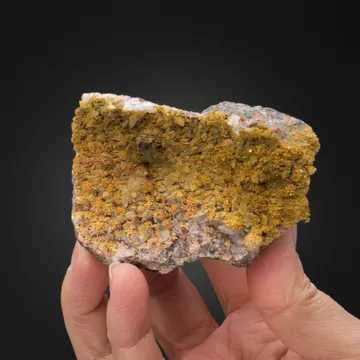
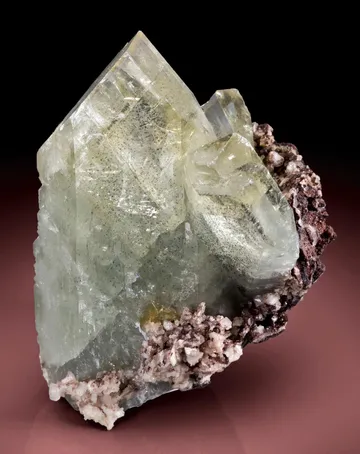
Its best-known collector mineral is dundasite. Greystone pieces typically show snow-white, silky, radial to felted micro-acicular dundasite on iron-stained quartz, goethite-rich cavities, cerussite, pyromorphite and other oxidised lead-zone associates. Good specimens are not large in crystal size—the beauty is in the dense, lustrous, velvety coverage and the contrast against rusty limonite and quartz—but they are highly characteristic of the locality. Around that signature species sits a richer micro-mineral story: aurichalcite and hemimorphite found in quartz vein matter, leadhillite confirmed as a first Cornish occurrence, rare vanadates and chromates such as vanadinite, descloizite, mottramite, vauquelinite, wulfenite and crocoite, and an unusual selenium-bearing thread represented by schmiederite.
Geologically, Greystone is not simply “a quarry with a vein.” The quarry exposes the Greystone Thrust Complex, with massive and pillowed metamorphosed alkali dolerites, radiolarian cherts, shales and imbricate thrust structures involved in the Greystone Nappe. That structural importance is why the quarry walls are protected as the Greystone Quarry SSSI. For collectors, the same hard-rock exposure that made the site valuable for aggregate also cut through veins and gossans that the nineteenth-century miners pursued from the Tamar valley.
Regional View
Country View

Photo: Ashley Dace / Geograph Britain and Ireland, via Wikimedia Commons
Seen from the rim, Greystone’s scale explains why specimen production was episodic rather than continuous: collectors depended on fresh quarry faces, blast rubble and short-lived exposures in the right vein material. The quarry is an active industrial site, so the specimen record is a patchwork of named finds, analysed micro-minerals, old collector labels and material recovered when access was possible under permission.
Search for specimens: View all specimens from Greystone Quarry, UK
Greystone Quarry lies in the parish of Lezant, Cornwall, close to Greystone Bridge and a little south-east of Launceston. The active quarry works a Devonian–Carboniferous microgabbro/dolerite body for crushed-rock aggregate and coated roadstone. In the quarry faces the dolerite is associated with Lower Carboniferous basinal sedimentary rocks, including black siltstones, slates, radiolarian cherts and shales. The succession is structurally complex: the Greystone Thrust carries Upper Devonian Lezant Slate over Lower Carboniferous rocks, and the quarry exposes a set of thrusts, ramps and duplex structures in three dimensions. This is the geological reason the site is nationally protected as an earth-science SSSI.
The collector mineralisation belongs to cross-cutting vein and lode material rather than to the quarry rock as aggregate. Quartz-carbonate veins, some iron- and manganese-oxide stained, cut the dolerite and enclosing sediments. Primary sulphides recorded from the system include galena, sphalerite, chalcopyrite, pyrite, pyrrhotite, marcasite and tetrahedrite-group material, with native silver and native copper also documented. Oxidation of these veins produced the locality’s better specimen suite: cerussite, anglesite, hydrocerussite, dundasite, leadhillite, linarite, caledonite, pyromorphite, mimetite, vanadinite, descloizite, mottramite, wulfenite, vauquelinite, crocoite, aurichalcite, rosasite, smithsonite, hemimorphite, malachite, brochantite and related iron and manganese oxides.
The old mines are inseparable from the locality. Greystone, also recorded historically as Greston or “Gresson,” was worked as a silver-lead and base-metal prospect in the nineteenth century; North Tamar and Wheal Sophia occupied adjoining or nearby ground on the same general lode system. Records describe an early lead lode intersected at 11 fathoms and a copper-bearing lode at 20 fathoms, with De la Beche noting unusually pure yellowish sphalerite associated with galena and chalcopyrite. Wheal Sophia was developed from river-level adits and shafts, and by the late 1840s had driven substantial adit levels on copper-bearing ground showing yellow copper ore, malachite and pyrite. Later nineteenth-century attempts included proposals for steam pumping, a 40-inch pumping engine, pitwork and renewed development under the Greystone Silver-Lead name.
Modern quarrying post-dates those small mines but cut across their mineralised ground. Greystone appears on late nineteenth-century Ordnance Survey mapping and has long been worked for road metal. It was formerly associated with English China Clay and later Aggregate Industries; the site is now listed by Holcim UK as its Greystone Aggregate Plant at Launceston, PL15 9PF. Because it remains an operating quarry and parts of the faces are protected as SSSI exposures, collecting is not a casual-access proposition. Specimens in collections generally come from earlier visits with permission, quarry blast material, dealer stock, and old British collections.
The best documented specimen finds cluster around exposed quartz vein material. In 1981, loose quartz vein blocks in the south-eastern corner of the quarry yielded blue aurichalcite associated with colourless hemimorphite; the vein was described as nearly vertical, 50 to 150 mm wide, and cutting the late Viséan dolerite on a quarry bench. Subsequent material showed crystal sprays in cavities with chalcopyrite. Leadhillite from a 1986 find was confirmed by the British Museum (Natural History) and represents the first recorded occurrence of that species in Cornwall. Notable later collector pieces include divergent acicular millerite on dolomite, rhodonite and bustamite vein material cutting metasediments, rich malachite crusts, and dundasite-rich quartz/goethite cavities, some associated with cerussite or pyromorphite and probably collected during the stronger period of access in the late twentieth century.
Dundasite from Greystone Quarry is the locality’s signature collector species: white to snow-white, silky, radial and felted micro-acicular aggregates coating iron-stained quartz, goethite-lined cavities, cerussite and, on some specimens, pyromorphite-bearing matrix. Individual sprays are microscopic, commonly best appreciated in fields of view of only a few millimetres; documented examples include 0.5 mm radial crystals on cerussite, 2 to 4 mm photographic fields of dundasite, and hand specimens in which the mineral forms a continuous bright white crystalline skin over much of the matrix. The most attractive pieces show dense, clean, lustrous dundasite rather than sparse powdery patches, ideally with contrasting rusty limonite, quartz points, acicular cerussite to several millimetres, or yellow-green pyromorphite for colour contrast. Material labelled “Greystones Quarry” is normal in the British trade and refers to this same Lezant locality.
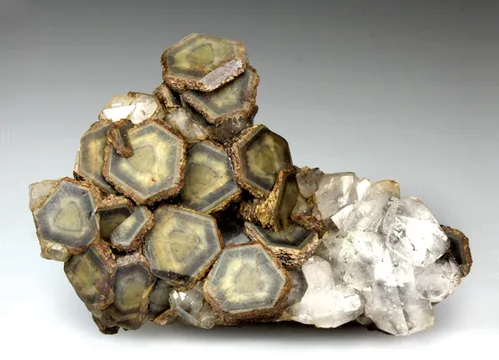
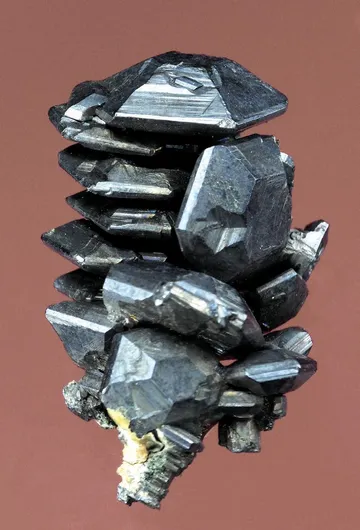
Greystone’s wider mineral list is exceptional for a modest quarry locality. The locality is not celebrated as a mineral type locality, but it is a type locality in the structural-geology sense for the Greystone Nappe/Greystone Thrust Complex, and mineralogically it has produced several important Cornish records. Leadhillite crystals to about 6 mm with linarite were confirmed as the first Cornish occurrence. Aurichalcite with hemimorphite was considered among the best Cornish material of both species when described. Rare lead-zone species reported or analysed from the quarry include caledonite, hydrocerussite, linarite, mimetite, pyromorphite, vanadinite, descloizite, mottramite, wulfenite, vauquelinite and crocoite. Selenium-bearing schmiederite occurs as very rare pale blue to white-tipped laths below 1 mm, and the metallic suite includes galena, sphalerite, chalcopyrite, pyrite, marcasite, pyrrhotite, millerite, native silver and native copper. Rhodonite and bustamite add an unusual manganese-silicate note to a locality otherwise dominated, in collector memory, by lead and copper secondary minerals.
Greystone Quarry material needs to be read with a collector’s eye. Labels may say Greystone Quarry, Greystones Quarry, Lezant, Callington District, Launceston, North Tamar Mine, Greystone Mine or Wheal Sophia, depending on whether the specimen was labelled by modern locality, old mine association or dealer convention. “Greystones” is a common trade spelling and should not automatically be treated as a different place. Conversely, “Greystone Quarry” without Cornwall or Lezant can be ambiguous, because there are other Greystone/Graystone quarries elsewhere; a good label should anchor the piece to Lezant, Cornwall, England.
No published pattern of artificial Greystone dundasite, repaired dundasite coatings or locality-specific faking is known, but micro-mineral identities from this quarry can be deceptively difficult. Several species require analytical support to separate with confidence: linarite versus selenium-rich schmiederite, vanadinite versus mimetite/pyromorphite microcrystals in poor colour, and some blue-green copper-zinc crusts that may be aurichalcite, rosasite, brochantite, chrysocolla or mixtures. Specimens carrying rare names such as crocoite, vauquelinite, wulfenite, descloizite, schmiederite, native silver or acanthite should be treated as analytical or provenance-dependent unless the label traces to a reliable collection or published determination.
Condition issues are typical of oxidised lead-zone micros. Dundasite is soft, fibrous and easily dulled by handling, brushing or aggressive cleaning; the best surfaces should be left untouched. Cerussite needles and leadhillite blades are brittle, pyromorphite and vanadinite microcrystals can be hidden among iron oxides, and goethite/limonite matrix can shed. Do not wash porous pieces unless you know exactly what is present; many Greystone specimens are best cleaned only with air, a very soft brush well away from the display surface, or not at all. Because the suite includes lead minerals and, rarely, chromates such as crocoite and vanadates such as vanadinite, avoid creating dust, keep specimens away from children, and wash hands after handling.
Rarity varies sharply by species. Dundasite is the one mineral most likely to appear in British dealer stock, but even it is not abundant compared with classic UK localities for common species. Recent dealer offerings show the market range well: small to cabinet dundasite pieces on quartz/goethite or with cerussite and pyromorphite have appeared, and rich malachite or chalcopyrite-on-calcite pieces from the quarry are occasional rather than routine. For a serious locality suite, the difficult slots are not just the obvious rarities—crocoite, schmiederite, vauquelinite, wulfenite and native silver—but also good, well-provenanced examples of the 1981 aurichalcite-hemimorphite material and the 1986 leadhillite.
The most extraordinary Greystone-area story is not a pocket story but a technology story. Wheal Sophia, the little mine immediately tied to the lode ground later cut by the quarry, became part of Cornish mining history in the early 1850s when engineer C. S. Richardson supervised what was reported as the first detonation of a blasting charge by electricity in a Cornish mine. The procedure sounds startlingly modern against the setting of river adits, horse whims and waterwheels: a galvanic battery was placed in the count-house, a “rock shot at grass” was fired with 300 feet of wire, powder was exploded two feet underwater, and finally a charged hole about 40 fathoms up the adit was connected back to the surface battery. For a mine struggling with water, calls and uncertain ore, it was a flash of technical bravado.
The same mine’s ordinary difficulties were much less glamorous. Wheal Sophia’s adit was driven from river level on a south-underlaying copper lode six to nine feet wide, but the shallow hilltop shaft met fast water and work repeatedly stalled. In 1852, a waterwheel was being erected to drain the mine to 60 fathoms below adit and to power crushing and winding gear. Then the Tamar rose eleven feet above its ordinary level, delaying the wheel-pit at exactly the moment when the company needed momentum. That mixture of ambition and obstruction is typical of the small east Cornwall lead-copper ventures: promising lodes, practical ingenuity, and just enough water, cost and geology to defeat the shareholders.
Greystone Wood, close by, adds another physical image to the landscape. Manganese ore there occurred in detached pockets near a hillfort site and was worked in the late 1870s for about 150 tons of pyrolusite-rich ore. Later recollections described ore being lowered down the hillside by tramway to the road; remnants of the winding drum and steel cable were still visible in the early 1960s. From the bottom of the incline the material was carted to Launceston at 2 shillings and 6 pence per ton. A former Greystone Farm worker remembered the ore as so heavy that wagon axles were not infrequently broken by the loads.
Even the ground around the modern quarry has a habit of surrendering old stories. A stone row in Lezant parish, recorded in the Historic Environment Record as destroyed in 1981 and thought lost when Greystone Quarry expanded in the 1980s, was later rediscovered. RAF reconnaissance photographs from the 1940s showed three aligned stones in a field beside what was then a much smaller quarry, and older residents remembered them standing there. By 2023, parish records describe discussions with the quarry estate manager, a planned relocation, an information panel and even the possibility of a Trekenner School time capsule to accompany the stones. For mineral collectors, it is a reminder that Greystone is not merely a hole in dolerite: it is a changing industrial landscape laid over mine workings, old field boundaries, archaeology and the River Tamar crossing.