Greenlaws Mine, UK — Weardale, Pennine Orefield; renowned for color-zoned fluorite cubes from vuggy flats, with historic lead context and modern access.
Key facts
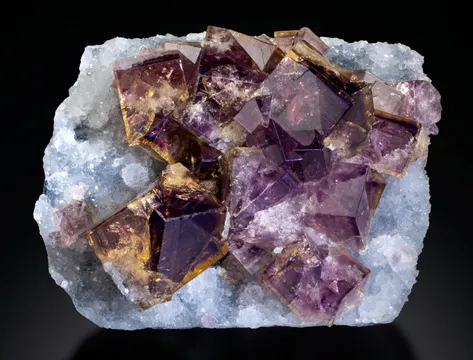
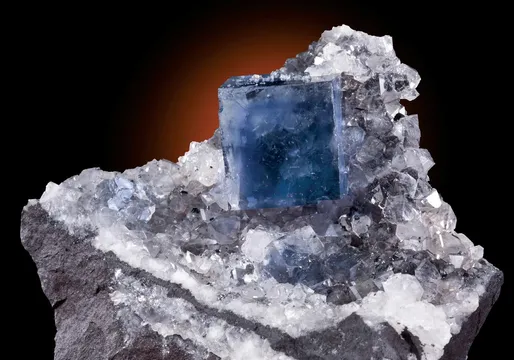
Greenlaws Mine sits on the hillside south of Daddry Shield in Weardale, County Durham, within the Northern Pennine Orefield: one of Britain’s classic Mississippi Valley Type lead-zinc-fluorite provinces. For collectors, Greenlaws matters because it is not merely another Weardale fluorite name. Its best specimens come from vuggy replacement “flats” where the Greenlaws East Vein cut favourable Carboniferous limestone, especially the Great Limestone, and from related lower-level material thought to involve the Scar Limestone. Those flats preserved cavities lined with yellow, amber, purple, cranberry and colour-zoned fluorite, often in lustrous cubic crystals, sometimes twinned, and in modern finds sometimes as overgrowths on broken earlier fluorite fragments.
The old mine was worked principally for lead, with galena as the economic ore, but its modern reputation rests on fluorite. Greenlaws pieces can look very different from the better-known green daylight-fluorescent fluorites of Rogerley and Diana Maria. The classic Greenlaws look is purple to grape-purple, amber-purple zoned, or rich lemon yellow; the better crystals are sharp, glassy to translucent, and frequently show edge zoning, cloudy interiors, frosted-growth surfaces, siderite staining or matrix of massive fluorite and altered limestone. The most desirable cabinet pieces carry strong colour zoning, clean cubic form, minimal bruising on exposed corners, and enough transparency for internal phantoms or colour boundaries to show under backlighting.
Historically, Greenlaws also bridges two collecting eras. Late 19th- and early 20th-century pieces entered major British collections through dealers and collectors associated with the old lead-mining period, while the 21st-century Greenlaws Mine Project reopened access to parts of the mine for controlled specimen recovery and research. That modern work has made Greenlaws one of the few British classic localities where serious collectors can compare old-time museum material with fresh, documented pocket material from named workings.
Regional View
Country View
The mine’s importance is sharpened by the unusual survival of underground context. Reports from modern access describe fluorite still visible in situ, artifacts left where possible, and original wooden mine rails in the workings. Unlike heavily stripped commercial specimen operations, Greenlaws has been handled as a managed private project, with selective recovery, mapping and geological observation. That makes a well-labelled Greenlaws specimen especially attractive: the label can connect a mineral object to a named cross-cut, flat, or modern recovery episode rather than merely to a famous valley.
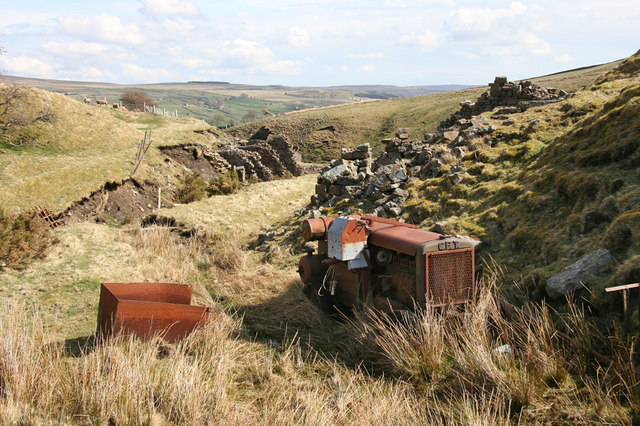
Photo: Helen Wilkinson / Geograph
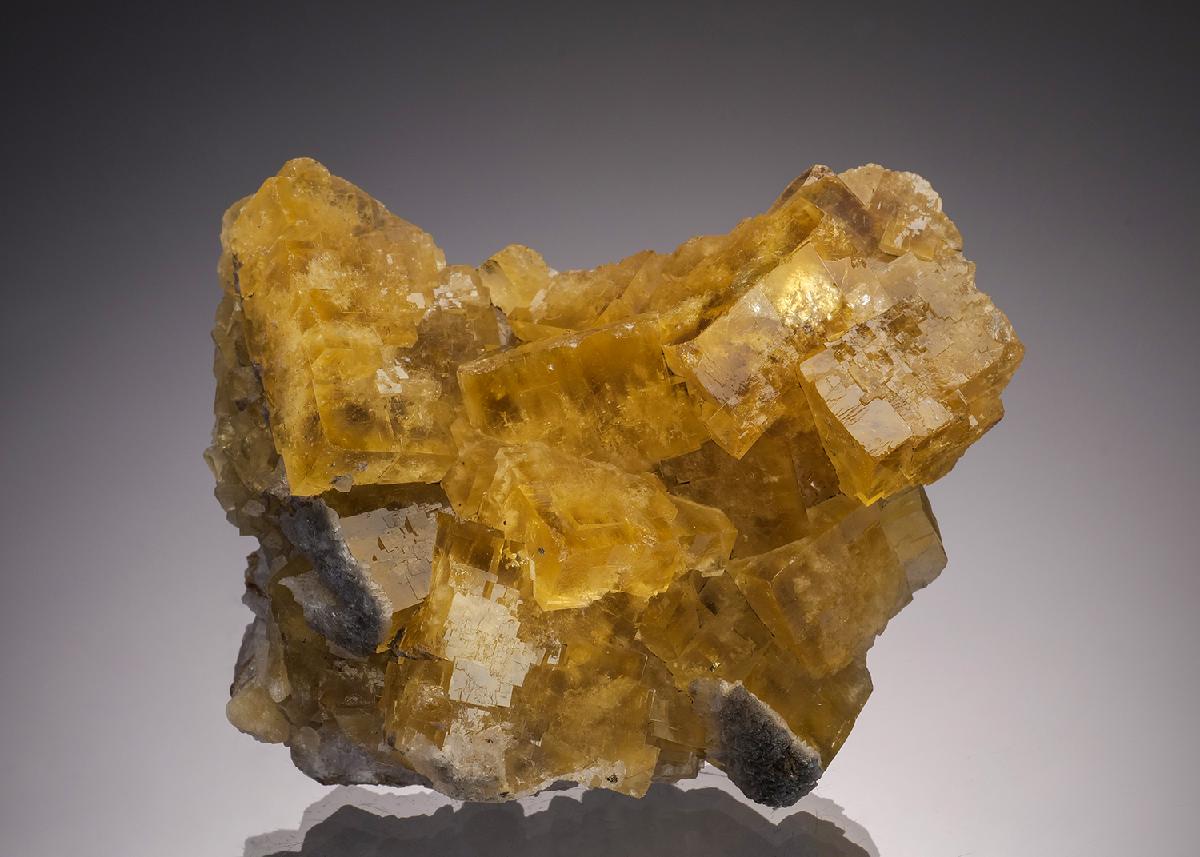
Photo: Crystal Classics
Search for specimens: View all specimens from Greenlaws Mine, UK
Greenlaws Mine is recorded at Daddry Shield, Stanhope parish, County Durham, about 1 km south of St John’s Chapel. The mindat locality is the Greenlaws Mine, Daddry Shield, Stanhope, County Durham, England, UK, with UK National Grid Reference NY885364 and coordinates close to 54° 43' 19" N, 2° 10' 41" W. The surface remains associated with Middle Greenlaws Level lie in a shallow valley on the north-facing slopes of High Pike, around Daddryshield Burn, where spoil heaps, level portals, a horse level, bouse teams, a wheelpit, washing-floor remains and other ore-work structures preserve part of the 19th-century lead-mining landscape.
Geologically, Greenlaws belongs to the Northern Pennine Orefield, where mineralization occurs both as steep fissure veins and as flat-lying replacement bodies in limestone. In the broader orefield, hydrothermal fluids moved through faults and reacted with favourable limestone beds, replacing the wall rock with ankerite, siderite, quartz, fluorite and baryte assemblages and depositing galena and sphalerite in veins, pockets and flats. Greenlaws lies in the fluorite-rich central zone of the orefield, the same broad Weardale–Rookhope region that made British fluorite famous, but its collectible character is particularly tied to the flats adjacent to the Greenlaws East Vein.
The mine worked two principal parallel veins, the Greenlaws West Vein and the Greenlaws East Vein. The west vein is described as weak and relatively modest in output; the east vein was far more productive and carried the principal workings. Later development also encountered the Swinhope Cross Vein and Westernhope Cross Vein. Where the Greenlaws East Vein intersected the Great Limestone, it generated vuggy replacement flats at the High Flats horizon near the top of the limestone. Dunham’s work also records cavity-bearing flats in the upper parts of the Scar Limestone, and lemon yellow fluorites in the Natural History Museum, London, have been interpreted as probably coming from Scar Limestone flats in the lower levels.
Underground observations reported in the Journal of the Russell Society describe a flat drift connecting several named and unnamed workings. Heading inward from the Hydraulic shaft, the accessible sequence included Britannia Flat on the east side, an unnamed flat on the west side, Victoria Flat on the east side, Joseph Brown’s Cross Cut on the west side, and G. Ritson’s Cross Cut on the east side. The first two were smaller and had already yielded few cavities before the later study; Victoria Flat, Joseph Brown’s Cross Cut and G. Ritson’s Cross Cut were larger and, when reached around November 1999 and the following years, still contained numerous pristine cavities suitable for in situ observation.
The mineralization in those Greenlaws flats is unusually informative for collectors because the fluorite did not simply form as perfect wall linings in clean open space. Moreton’s study emphasized mud-filled vugs, gravitational growth effects and later wall-rock breakdown. Upward-facing crystals were observed to be duller and more opaque than downward-facing crystals, while oxidation and alteration fractured the wall rock and filled cavities with clay and sand derived from overlying strata. This helps explain why many authentic Greenlaws pieces show a mixture of attractive luster and earthy cavity residue, and why some crystals display frosted faces, stained zones, broken-overgrown fragments or surfaces that seem to record more than one crystallization episode.
Mining began early in the post-medieval lead-mining era. Published history for the project gives an opening around 1700 by the Beaumont family, with activity recorded on the site from 1725. The Greenlaws East Vein was worked for lead by the Beaumont Company from 1850 to 1884, then briefly by the Weardale Lead Company. Other sources extend the productive east-vein working at the broader site to 1907, and the modern project history preserves reminders of an abandonment survey dated 1866 in the main Great Limestone flats. The mine closed as a lead mine when it became uneconomic, and later attempts to reopen or rework it for fluorspar, including efforts in the 1940s and from the 1960s onward, were unsuccessful or limited until modern specimen work gained more reliable access.
Greenlaws was never an important commercial fluorspar producer, despite the richness of some fluorite-bearing ground. Modern project notes state that Greenlaws spar is low in silica, and it remains a historical puzzle why it was not developed as a fluorspar source on a larger scale. The significance for collectors is the opposite: because it was not stripped for industrial spar in the way many later fluorspar mines were, parts of the flats retained specimen cavities and wall material of exceptional mineralogical interest.
The recent collecting story begins with difficult access. A group of collectors and mine explorers worked on the Hydraulic shaft in the 1990s, allowing study of the flats for the first time in nearly a century. A later and more sustained Greenlaws Mine Project dates from 2009–2010, under a private lease, with Pete Ward and the project team clearing collapsed access and working down to the Great Limestone flats. Accounts differ slightly in emphasis, but the modern project is consistently described as non-commercial in spirit: a not-for-profit exploration, collecting and research venture rather than a public collecting site or industrial mine.
Access today is strictly controlled. The mine and dumps are on private land, and published accounts make clear that visitors cannot simply arrive to collect. The site includes hazardous underground workings, deep shafts, collapsed ground, historic structures, spoil and water-management remains. Historic England lists Middle Greenlaws Level lead mine and ore works as a Scheduled Monument and records the site as being in very bad condition, with extensive flood damage and erosion. The OREsome North Pennines survey also notes that a 1995 flood washed spoil downstream and buried parts of the mid-19th-century ore works. In practical collector terms, Greenlaws should be treated as a specimen locality reached through documented purchases and established project material, not as a destination for casual field collecting.
Notable specimen-producing areas include Joseph Brown’s Cross Cut, G. Ritson’s Cross Cut, Victoria Flat and the lower or quarry-level workings. Documented specimens include amber cubes up to about 4 cm from G. Ritson’s Cross Cut; amber crystals with a purple outer zone from Joseph Brown’s Cross Cut; amber-and-purple zoned cubes with the largest crystal recorded at 54 mm from Joseph Brown’s Cross Cut, collected in 2002; purple fluorite cubes up to about 23 mm with oxidised siderite from Victoria Flat; and a 65 x 55 x 40 mm deep purple partial crystal from Joseph Brown’s Cross Cut. Dealer and gallery records also show later pieces with cubes to about 4.2 cm, cabinet-sized groups around 10–11 cm across, smaller twinned crystals with sphalerite, and occasional lemon yellow specimens with galena inclusions or massive off-white fluorite matrix.
Greenlaws fluorite is overwhelmingly cubic, but within that simple habit the mine offers a striking range: dark grape-purple cubes from Joseph Brown’s Cross Cut, amber crystals with purple rims, lemon yellow specimens thought to come from lower Scar Limestone flats, smaller purple crystals with sphalerite from lower-level workings, and unusual floaters and multi-faced “funkies” from clay-rich collapse cavities. Crystal sizes on documented specimens range from small 6 mm crystals associated with sphalerite to cubes of 4–5.4 cm and large cabinet plates around 24 cm across; the best pieces combine glassy luster, sharp cubic outlines, strong colour zoning, attractive translucency and minimal bruising on cube edges. Ordinary Greenlaws pieces may be massive, muddy, iron-stained or partially frosted; superior examples show internal amber-purple architecture, clean display faces, twinning or second-generation overgrowths on earlier fragments, and enough daylight or backlighting response to make the colour come alive without confusing them with the green Rogerley-style Weardale material.
The recorded Greenlaws mineral suite is compact: galena, sphalerite, quartz, calcite, siderite, smithsonite and cerussite accompany fluorite. Galena is historically the ore mineral and appears as ribs in massive fluorite, altered crystals on fluorite, and heavy metallic crystals in some modern cavities; sphalerite occurs with smaller lustrous fluorite, especially in lower-level material; siderite may partly coat fluorite cubes or occur with quartz and sphalerite; and cerussite is documented as acicular white crystals in altered lead-bearing ground. Smithsonite is a more unusual locality entry, with a recorded specimen collected from a shallow opencut on Greenlaws West in 1983. Greenlaws is not known as a type locality for any mineral species, and one older rarity deserves caution: strontianite was historically reported from Low Greenlaws Level, but later work traced the only known labelled specimen in the Geological Museum collection, registration MI 16362, and found by X-ray diffraction that it was calcite, probably inverted from aragonite, not strontianite.
The chief authenticity issue with Greenlaws is locality precision. A purple or amber Weardale fluorite is not automatically Greenlaws; many mines in the dale produced purple fluorite, and Greenlaws material is easily confused in the marketplace with Blackdene, Heights, West Pastures, Boltsburn, Frazer’s Hush, Rogerley-related operations or generic “Weardale” labels. Stronger labels name Greenlaws Mine plus a working or pocket area such as Joseph Brown’s Cross Cut, G. Ritson’s Cross Cut, Victoria Flat, Quarry Level, Greenlaws East Vein or the Greenlaws Mining Project. Old labels associated with Arthur Russell, John Hill, John Graves, Butler of Brompton or the Natural History Museum collecting trail are particularly desirable but require normal provenance scrutiny.
There are no well-documented widespread treatments or manufactured fakes specific to Greenlaws fluorite in the sources consulted, but there are two practical mislabelling traps. First, the mine’s yellow fluorite is much rarer than purple and may be casually assigned to “Weardale” or confused with other British yellow fluorites unless the piece has a credible old or project label. Second, daylight fluorescence and colour-change language is often used broadly for Weardale fluorite; Greenlaws specimens can fluoresce, and some are striking under daylight or long-wave UV, but not every Greenlaws piece behaves like the classic green Rogerley or Diana Maria material. A specimen sold mainly on fluorescence should be checked under consistent 365 nm long-wave lighting and ordinary daylight rather than judged from edited photographs.
Condition is a serious collecting point. Greenlaws fluorite often came from clay-filled, collapse-affected or alteration-fractured cavities, and many otherwise impressive pieces have edge bruises, contacted sides, healed fractures, clay residues, iron staining or cleaved corners. Damage is especially common on exposed cube vertices and on large matrix plates. This should not automatically disqualify a specimen—some of the most characterful Greenlaws pieces show natural frosting, oxidised siderite, broken-and-overgrown earlier fluorite, or wall-rock residue—but price should track the quality of the main display faces. Clean, glassy, zoned crystals with no obvious modern chipping are much scarcer than muddy but colourful groups.
Handle Greenlaws fluorite as you would any fine fluorite: avoid thermal shock, ultrasonic cleaning, acids, and strong mechanical scrubbing. Clay-filled material can look tempting to clean aggressively, but cavities may hide loosened crystals, old fractures or crumbly silicified limestone. Gentle soaking in clean water, soft brushes and patient drying are safer than attempts to remove every trace of mud or iron stain. Fluorite is relatively soft at Mohs 4, cleaves perfectly, and cube corners chip easily in storage; keep display pieces isolated from harder minerals and avoid pressure on protruding crystals.
On the market, Greenlaws is available but not common in the sense that Rogerley-type modern Weardale fluorite is common. Small purple pieces, matrix fragments and less perfect groups appear periodically; fine amber-purple zoned pieces, lemon yellow examples, documented Joseph Brown’s Cross Cut pieces and large undamaged cabinet specimens are much scarcer. Recent dealer listings show prices ranging from modest sums for small or damaged examples to four-figure prices for strong yellow or especially aesthetic Greenlaws fluorite. Provenance, working name, colour rarity and condition matter more here than simple size.
The best modern Greenlaws story is not a single pocket; it is the strange experience of entering a mine where the old men seem to have walked away yesterday, leaving both artifacts and fluorite behind. When Jolyon Ralph visited with Katya and Roman, the day began not at a public car park or visitor centre, but at the bottom of the valley. Everyone had to transfer into Pete Ward’s Land Rover for the rough ride up to the private mine entrance. Roman could not go underground, so Katya and Jolyon took turns descending; while one went below, the other stayed above with Roman, who still found fluorite pieces in the dump and roadway.
At the entrance, Pete unlocked the gate beside an old mine cart found in the workings. The wooden rails nearby were not modern replacements but original 19th-century wooden mine rails, described in the visit report as probably the longest surviving original wooden mine rail section in Europe. From there the route dropped to the shaft, where winding gear handled equipment and ladders handled people. The descent was followed by a crawl, then easier walking, then the revelation that collectors dream of and almost never see: fluorite still in place. Ralph’s caption captured the moment with the memorable phrase, “Fluorite, and I cannot stress this enough, everywhere.”
What made the visit unusual was restraint. Much of the fluorite remained in situ, not because it lacked value, but because the project was not run as a strip-out operation. Some specimens were being recovered, but many pockets were left for observation. Artifacts were treated the same way; where possible they remained where found, taped off, preserving the mine as a historical space as well as a specimen source. Smaller items found during digging were gathered together, but the dominant impression was not of a emptied mine. It was of a place still crowded with evidence—cavities, rails, deads, old workings, clay, timber, tools and purple crystals.
The word “deads” becomes wonderfully literal underground at Greenlaws. In old mining usage, deads are stacks of waste rock placed in unused workings so the miners did not have to haul barren material all the way out. At Greenlaws, the waste stacks sometimes include nice fluorite crystal groups deliberately tucked into them by the old miners. To a collector, that is almost comic: pieces we would now trim, label and put in a case were used as convenient waste-rock blocks.
The same visit also preserves a cautionary story. Pete showed the remains of a pocket that had been destroyed by a group of foreign collectors who had previously been allowed into the mine. They were told they could dig only in a certain area, went elsewhere, and ruined a pocket Pete had been proud of. After that, collectors were no longer allowed to come to Greenlaws to collect. It is a small story with a large lesson: one act of bad faith at a private locality can close access for everyone.
One of the liveliest moments from the visit involved Lucy, who does much of the collecting at the mine. While Katya was underground, Lucy was working a large piece from a cavity. An hour later Pete helped move the block, turn it over and wash it. The recovered material was not just a trophy for sale; the account ends that sequence with the cleaned result and a small gift for Katya. Nearby were zoned pieces, yellow fluorite, galena with fluorite, clay-coated specimens and the odd floating forms Pete especially liked—the “funkies,” three of which had been found that morning. These are the Greenlaws pieces collectors talk about: floaters from clay pockets with distorted, multi-faced or rule-breaking geometries that look as if normal cubic fluorite briefly forgot its manners.
Older Greenlaws history has its own paper trail. Modern project work in the Natural History Museum collections found that many Greenlaws specimens entered the museum world in the late 1800s or early 1900s, handled by the West Cumbrian dealer John Graves and passed through Butler of Brompton in London. Others came through Sir Arthur Russell, whose labels connect material to the collection of John Hill, manager of Greenlaws and Stanhope Burn mine. Russell’s labels record purchase from “A Hill, 1931,” identified by the project history as Alvin Hill, a mine manager active at several Escarpment baryte mines in the 1930s and 1940s. The Hill family lived at Mine House beside Quarry Level, the mine’s main drainage adit, so a Greenlaws label can sometimes carry not just a locality but a family connection to the mine’s working life.