






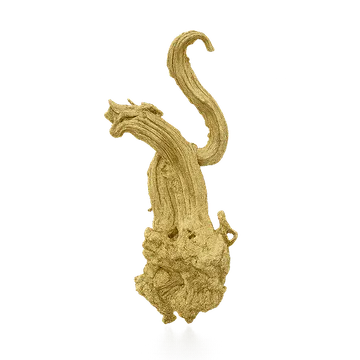
Gold from Morro Velho Mine, Minas Gerais, Brazil — historic Archean orogenic deposit; scarce native gold in quartz-carbonate-sulfide matrix with siderite and s…
Key facts
Gold from the Morro Velho Mine is collectible less because it is abundant on the specimen market than because it comes from one of the great historic gold mines of the Americas: a deep, long-lived, Archean orogenic gold deposit at Nova Lima, in the Quadrilátero Ferrífero of Minas Gerais. The mine is famous to mining historians for its depth, longevity, British-Cornish industrial story, and enormous gold production; to mineral collectors it is also a classic locality for siderite, dolomite, pyrrhotite, scheelite, cubanite, and associated ore-suite minerals. Native gold specimens from the mine are scarce survivors from an operation built for production, not specimen preservation.

Photo: Wikimedia Commons
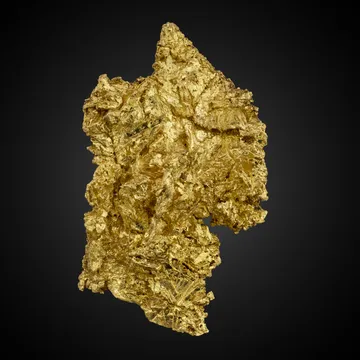
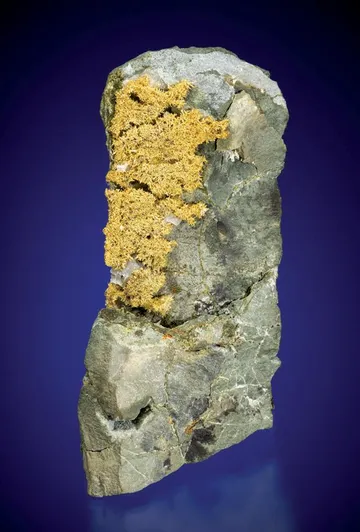
Visually, Morro Velho gold most often enters collections as small, bright yellow native gold in quartz-carbonate-sulfide matrix rather than as large showy leaves. Mindat’s occurrence entry records native gold as yellow plates and notes that few specimens survive, while also acknowledging the potential for spectacular crystallized pieces. That tension defines the locality for collectors: Morro Velho produced extraordinary quantities of gold, but very little of it escaped the mill as intact mineral specimens.
The geological setting is a classic collector’s clue. Morro Velho sits in the Archean Rio das Velhas greenstone belt, at the base of the Nova Lima Group, where mineralization is hosted in the mine-rock assemblage long known by miners as “Lapa Seca.” In the ore, gold belongs to a quartz-carbonate-sulfide system dominated by pyrrhotite, arsenopyrite, pyrite, and minor chalcopyrite, with associated dolomite, ankerite, quartz, siderite, albite, scheelite, cubanite, and other minerals. The best gold specimens are therefore not anonymous “Brazilian gold”; they should make sense in this specific matrix environment.
A Morro Velho gold specimen with convincing provenance, visible native gold, and the right suite—quartz, siderite or dolomite, pyrrhotite, arsenopyrite, and locally scheelite—is a serious locality piece. The locality’s cabinet appeal often lies in context: a fleck, plate, or small crystal of gold attached to the same mineralogical world that made Morro Velho one of Brazil’s defining mines.
Search for specimens: View all gold specimens from Morro Velho Mine, Minas Gerais, Brazil
Morro Velho is located at Nova Lima, near Belo Horizonte, in Minas Gerais, Brazil. The mine belongs to the northern part of the Quadrilátero Ferrífero, a district whose Archean greenstone belts and iron-rich stratigraphy have supplied much of Brazil’s most important historic gold production. Coordinates commonly given for the Mina Grande workings are about 19° 58′ 6″ S, 43° 49′ 14″ W.
The deposit is best described as an Archean orogenic gold deposit. The ore occurs in a thick carbonaceous phyllite package with intercalated felsic to intermediate volcaniclastic rocks and dolomites. Two principal ore styles are documented: dark gray quartz veins, and sulfide-rich gold orebodies ranging from disseminated sulfides to massive sulfide bodies. The sulfide assemblage is dominated by pyrrhotite, with arsenopyrite, pyrite, and minor chalcopyrite as the principal accompanying ore minerals.
The mine term “Lapa Seca” is essential to understanding Morro Velho. Local miners used it for quartz-carbonate rocks, literally “dry stone,” and later geological work interpreted the Lapa Seca assemblages as hydrothermally altered rocks divided into carbonatic, micaceous, and quartzose types. In collector language, that means gold specimens should not be expected only in white quartz; the most characteristic Morro Velho environment is a carbonate-sulfide-quartz system, often visually darkened by pyrrhotite, arsenopyrite, and pyrite, and enlivened in classic pieces by siderite, dolomite, scheelite, albite, cubanite, or quartz.
Historically, gold was recovered in the Morro Velho area in the colonial period, with the mine commonly cited as discovered or first worked in the early 1700s. The English Saint John d’El Rey Mining Company acquired Morro Velho in 1834 and transformed it into an industrial underground mine. Morro Velho later became celebrated as one of the deepest mines in the Americas, with Mina Grande reaching level 27 at about 2,453 m below surface before that part of the workings was abandoned in 1997. Britannica gives the main period of operation as 1834 to 2003 and notes an air-cooled shaft reaching about 8,500 feet, or 2,590 m.
The mine includes the Mina Velha and Mina Grande workings. One Unicamp thesis abstract divides the mine into Mina Velha from 0 to 518 m and Mina Grande from 518 to 2,453 m. Mindat records Mina Grande as abandoned in 1997 and Mina Velha as still producing at 518 m at that time. Later public summaries describe closure of Mina Velha and Engenho d’Água in the early 2000s, with the broader AngloGold Ashanti operations in the district continuing under modern corporate mining rather than collector access.
For collectors, access is effectively historical and market-based. Morro Velho was a major industrial mine, not a casual collecting locality. Specimens on the market are generally old-time pieces, mine-saved pieces, dealer-held classics, or material that surfaced through former collections. The most famous collectible Morro Velho minerals are not gold itself but the broader ore and gangue suite: lustrous greenish-yellow to honey siderite, colorless dolomite, pyrrhotite, scheelite, cubanite, albite, quartz, and occasional native gold.
Morro Velho gold is recorded as native gold, Au, yellow in color, with a platy habit. Known photographed examples include small gold crystals and small nuggets, and at least one dealer-documented miniature shows a very small sharp native gold crystal about 0.2 cm across on a quartz-siderite-pyrrhotite specimen. Mindat’s occurrence page associates photographed gold with dolomite, arsenopyrite, quartz, scheelite, siderite, and pyrrhotite.
The best gold specimens from this locality are judged first by locality confidence. Because the visible gold may be only millimetric, the matrix and associations matter greatly. A convincing Morro Velho specimen should harmonize with the documented ore environment: quartz-carbonate matrix, siderite or dolomite, bladed or tabular pyrrhotite, arsenopyrite, pyrite, and locally scheelite or cubanite. A loose rounded nugget may still be authentic, but matrix pieces with old labels are easier to place mineralogically.
The color should be a natural rich yellow to buttery yellow, not the brassy, greenish, or iridescent tones of pyrite, chalcopyrite, or pyrrhotite. This distinction is especially important at Morro Velho because its sulfide suite is visually dominant and can be deceptive in low light. Pyrrhotite can appear bronze to brownish; chalcopyrite can flash brassy yellow; arsenopyrite can be silvery-white to steel-gray; pyrite can be bright brass-yellow. True gold should show the dense, warm, malleable look that does not break into brittle sulfide cleavage.
Typical display size is small. A Morro Velho gold specimen with visible, unaided-eye gold on matrix is already desirable; a sharp crystal or plate several millimeters across is significantly better. Larger gold masses from the mine exist in the record of production, of course, but not commonly as preserved collector specimens. In the present market, the locality’s classic display specimens are much more often siderite, dolomite, pyrrhotite, scheelite, cubanite, or albite than native gold.
Quality factors include visible gold placement, old provenance, undisturbed matrix, and association. A tiny gold crystal on a well-composed quartz-siderite-pyrrhotite miniature can be a better locality specimen than a larger but contextless loose bit. Scheelite association is especially attractive because Morro Velho scheelites are themselves classic, recorded as orange-red bipyramids up to 3 cm with blue-white shortwave fluorescence. Siderite association is also prized, since Morro Velho produced fine yellow-brown to greenish-yellow siderite rhombs on dolomite and quartz.
Condition issues differ from those of delicate leaf gold localities. The visible gold itself is usually resilient, but the surrounding matrix can be more vulnerable: siderite has perfect rhombohedral cleavage and can chip; dolomite edges can bruise; pyrrhotite may tarnish or alter; sulfide-rich matrix can soil labels and packaging if stored damp. Avoid aggressive cleaning. Brightening a sulfide-carbonate-gold matrix can remove precisely the patina and textural evidence that make an old Morro Velho specimen believable.
Morro Velho gold is rare on the collector market relative to the mine’s fame and total production. Serious collectors should expect far fewer choices than they would for Minas Gerais quartz, Brazilian tourmaline, or even Morro Velho siderite. Mindat’s native gold entry states plainly that few specimens survive, and recent dealer records support that view: Morro Velho gold appears sporadically, while non-gold Morro Velho classics—especially siderite, dolomite, pyrrhotite, scheelite, cubanite, and albite—surface more often.
The principal authenticity concern is misattribution. A small gold-in-quartz specimen labeled only “Minas Gerais” or “Brazil” should not be promoted to Morro Velho without older documentation or matrix evidence. The label should ideally include Morro Velho Mine, Nova Lima, Minas Gerais, Brazil, and older labels from established collections add real value. Matrix consistent with the locality—quartz-carbonate-sulfide, especially siderite or dolomite with pyrrhotite and arsenopyrite—strengthens the case.
No well-established, locality-specific tradition of fabricated Morro Velho gold fakes is documented in the sources listed below. The broader risks are the standard ones for gold specimens: attached gold, artificially inserted gold in quartz cracks, misidentified pyrite or chalcopyrite, and attractive but poorly provenanced loose nuggets. Because Morro Velho is a famous name and true gold specimens are scarce, a specimen that is both showy and inexpensive deserves extra skepticism.
For testing, use the least destructive path. Visual examination under magnification should come first: gold should show a warm yellow color, malleable-looking rounded edges or natural crystal faces, and no brittle fracture surfaces like sulfides. A magnet can help identify magnetic pyrrhotite-rich matrix but will not prove gold. Specific gravity or XRF can be useful for loose pieces, but acid tests and scratch tests are inappropriate for fine mineral specimens. On matrix pieces, the safest authentication is a combination of provenance, association, microscopy, and, if warranted, non-destructive analytical testing by a qualified lab or institution.
Market availability is thin. A documented Weinrich Minerals example was a sold 4.0 x 3.0 x 2.0 cm miniature with quartz, pyrrhotite, siderite, and a 0.2 cm native gold crystal from the Stan Woollams collection. Mindat’s gallery records only a small number of native gold photos from the locality. By contrast, Minfind and dealer archives show that Morro Velho siderite, dolomite, pyrrhotite, albite, and other associated minerals are more readily encountered, sometimes in good cabinet quality. For a gold collector, Morro Velho is therefore a locality to buy deliberately when a convincing piece appears, not one to expect from routine Brazilian gold searches.
Morro Velho’s specimen story begins in a valley that was never built for romantic collecting. In the nineteenth century the mine was an industrial organism of waterwheels, stamps, arsenical mud, mule roads, powder houses, adits, and guarded gold shipments. The mine lay on the western slope above the Ribeirão do Morro Velho, and the old workings were grouped into three contiguous sections called Bahu, Cachoeira, and Gamba. The lode dipped at about 46 degrees, so the main haulage and pumping shaft followed an inclined plane rather than a neat vertical descent.
By 1849, the company was employing about 1,200 people and stamping about 6,000 tons of ore. Six waterwheels drove 96 heads of stamps, their pounding echoing through the valley. The crushed ore slurry passed through copper grates and onto hides laid over inclined strakes, where gold and heavy sand lodged while lighter material washed away. Every two hours the hides were lifted and washed. In the amalgamation house, gold-bearing sand went into barrels with mercury and was revolved by waterpower for 20 to 30 hours. Every ten days, the amalgam was squeezed through chamois leather, the mercury recovered, and the residue burned to yield gold. The dust went into leather bags and traveled under armed guard to Rio de Janeiro.
For Cornish miners, reaching Morro Velho was itself a field expedition. In the early to mid-nineteenth century many left Cornwall from Falmouth aboard packet ships bound for Rio de Janeiro, a sea journey that could take up to two months. After customs in Rio, they faced roughly another month inland. One route crossed Guanabara Bay, crept up the swampy Rio Estrela to Porto da Estrela, and then continued by mule. The ascent of the Serra da Estrela followed a zig-zag road paved at great expense under Emperor Dom Pedro I and took two or three days. The travelers crossed the Paraíba by ferry, pushed on through Barbacena, Ouro Branco, Ouro Preto, Mariana, Gongo Soco, Caeté, and Sabará, and finally covered the bad hilly country to Morro Velho. The river route from Rio was disliked: small boats carrying four people, luggage, and three or four mules could capsize, and yellow fever haunted the swampy lowlands.
The Cornish community that grew around the mine became the largest and longest-lived of its kind in Brazil. In the 1860s, Cornish people at Morro Velho numbered about 350. Brazilians tended to group the British together as “o inglês,” but observers noted that the Cornish element was unmistakable: the men kept their accent, customs, and mining culture. Their settlement, the Colônia Inglêsa, stood above the industrial works near the Casa Grande and company stores. Houses were whitewashed and local in construction, yet the gardens, railings, lawns, and imported plants gave the place a transplanted British air.
The valley could be beautiful, but it was not gentle. Morro Velho sat at about 600 m elevation in a low valley with poor air circulation. People said the four seasons of Europe could pass in a single day. Dawn could bring fog and drizzle; midmorning burned it off; the rainy season announced itself with thunderstorms of hail and rain in November; and at the end of January or beginning of February came the veranico, a little summer of fierce heat, strong sunlight, and low humidity. The mine’s river could be little more than an industrial drain thick with mud and arsenical slime in the dry months, then a furious torrent in the rainy season.
The mine’s first great catastrophe came on the night of 21 November 1867, when fire broke out in the lower levels and set the timberwork alight. The men fought it for days. When that failed, the superintendent ordered the shafts sealed to starve the fire of oxygen. The flames died, but only after consuming the timber stulls holding the cavernous stopes. The workings caved. Cornish employees were laid off, and the company spent seven years raising capital and sinking two new vertical shafts with improved haulage, at a cost of about £50,000. During the lean years Morro Velho survived by working upper levels, reworking dumps, and exploiting a small nearby venture.
Relief after the 1870 reopening was spoiled by scandal. Superintendent James Gordon, who had run the operation for two decades, was accused of diverting mine resources to his own ventures and of “picking the eyes” out of the mine—working only the richest parts and leaving the long-term structure and future of the operation compromised. Cornish mining captains raised the alarm. Gordon was dismissed in 1875.
The second disaster announced itself with a detail only miners would understand. On the night of 10 November 1886, Cornish timbermen noticed that a timber cut specially to fit into the stull-work was suddenly too large. The ground had moved. Before remedial work could be done, the ground gave way and buried ten men. Subsidence continued for weeks, the mine closed, and the company went into liquidation. Most of the Cornish workforce returned to Cornwall or moved on, while a skeletal crew remained.
From that collapse came the modern deep mine. George Chalmers, a young Cornishman appointed superintendent in December 1884, treated the disaster as a chance to rebuild Morro Velho from first principles. He argued for sinking new vertical shafts on the same lode to unheard-of depths—about 700 m from surface—and building a new mill. The board balked, then relented. Chalmers returned to Brazil in 1887, reconstruction began in the 1890s, and within three years production exceeded the 200,000 metric tonnes of raw ore occasionally achieved in the mid-nineteenth century. By 1910 that figure had doubled. Chalmers later electrified the works with hydroelectricity, installed plant to deliver cool air into the deep workings, and opened an electric tramway in 1913 connecting the mine with the Raposos station. He remained associated with the company for 40 years, leaving the superintendent’s post in 1924 and serving as consulting engineer until his death in 1928.
The social history of Morro Velho is darker than its mineral cases suggest. The English-owned Saint John d’El Rey Mining Company became a major slaveholder in Minas Gerais. Historical work on the mine records ritualized Sunday ceremonies in which enslaved workers were assembled before the Casa Grande, inspected, rewarded, disciplined, and placed—sometimes—on long paths toward manumission. Every other Sunday, more than a thousand enslaved people could gather in assigned clothing before overseers and the superintendent. Twice a year, on St John’s Day in June and at Christmas, five to ten people of exemplary behavior were placed on a manumission list; after seven to ten additional years, further good behavior could bring freedom. The system was meant as control, but enslaved people learned to press it as a right the company had to respect.
Morro Velho also left cultural traces beyond mining. St John the Baptist’s Day, a midsummer festival familiar in Cornwall, became an annual miners’ festival by the late 1850s. It included tar barrels, a bonfire, wrestling, gymnastic games, athletic races, brass bands, fireworks, and a feast. Slaves were included in the day off. Crowds of 2,000 to 3,000 could gather; toasts were made under British and Brazilian flags, and “God Save the Queen” closed the proceedings. By 1913 the sports field had teams named “Cornwall” and “Morro Velho,” and football introduced by young Cornish miners helped take root in nearby Nova Lima. The company later donated ground for the Vila Nova Athletic Club stadium, whose lions gave the club the nickname Leão do Bonfim.
_-_View_of_the_Old_Gold_Works_at_Morro_Velho,_Brazil_-_MN79_-_Marianne_North_Gallery.jpg)