






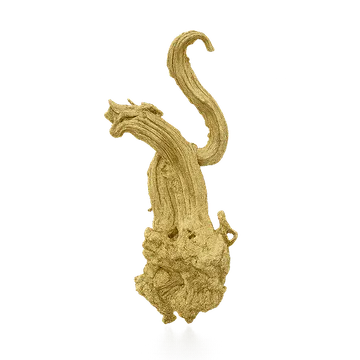
Gold from Round Mountain Mine, Nevada — collectible native gold with crystal leaf-and-plate forms, herringbone leaves, and hoppery cubes in quartz-rich rock.
Key facts
Round Mountain is one of the great modern specimen-gold localities of the United States: a giant Nevada gold mine that, unusually for a bulk-tonnage operation, has also yielded elegant, visibly crystallized native gold for collectors. Much of Nevada’s gold fame rests on invisible or submicroscopic gold in Carlin-type ores; Round Mountain is different. Here, a low-sulfidation epithermal gold-silver system in volcanic rocks produced not only disseminated ore but also coarse, collectible gold in pockets, veinlets, fractures, and placer concentrations.
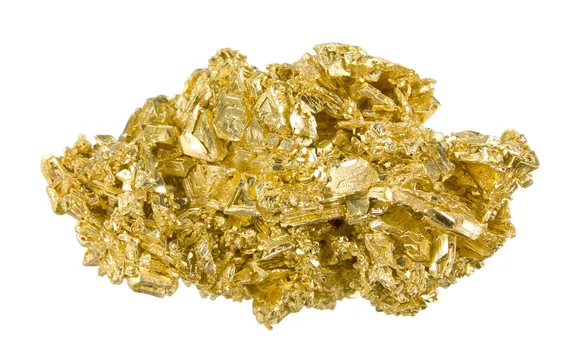
The collector appeal is immediate. The best Round Mountain pieces show bright to light golden metal in flattened spinel-law twins, herringbone leaves, fan-shaped plates, parallel-growth ribbons, hoppery cubes, crude octahedra, and sculptural “leaf” forms. Many examples are airy, delicate, and two-sided; others are thick, brilliantly lustrous masses of intergrown crystals. The most diagnostic pieces are not rounded placer nuggets but sharply crystalline leaf-and-plate aggregates, often with a pale, electrum-like cast and, on matrix pieces, associations with quartz, adularia-bearing volcanic rock, clay, or altered tuff.

Photo: Wikimedia Commons
The geological setting explains the look. Round Mountain is a volcanic-hosted, adularia-sericite, low-sulfidation epithermal deposit on the western flank of the Toquima Range, in the Big Smoky Valley of Nye County. The principal host rocks are Oligocene rhyolitic ash-flow tuffs, with mineralization also cutting older Paleozoic metasedimentary rocks and locally influenced by structures related to a buried caldera-margin setting. Gold occurs as native gold and electrum with quartz, adularia, pyrite, iron oxides, manganese oxides, clay minerals, and a suite of minor epithermal accessory minerals.

Photo: Wikimedia Commons
Historically, Round Mountain mattered before it became a modern open pit. Rich free gold was discovered in 1906, and early miners worked high-grade veins and productive placers around the mountain. Modern bulk mining began in the late 1970s, turning what had been a selective underground and placer district into one of the world’s major low-sulfidation epithermal gold operations. For mineral collectors, the late twentieth and early twenty-first century specimen production gave the locality its modern reputation: thumbnail to cabinet-size crystalline native gold, much of it saved opportunistically from an industrial mine whose principal business was never specimens.

Photo: Wikimedia Commons
Search for specimens: View all gold specimens from Round Mountain Mine, Nevada, USA
Round Mountain Mine is in the Round Mountain mining district of the Toquima Range, Nye County, Nevada, roughly north of Tonopah and west of the Toquima highlands. The modern mine occupies the old Round Mountain/Sunnyside area and has also been associated in records with names such as Round Mountain Gold Mine, Sphinx glory hole, Great Western tunnel, Rattlesnake, Keane vein, and Los Gazabo vein.
The deposit is best described as a giant volcanic-hosted, low-sulfidation epithermal gold-silver system. The ore system is hosted largely by Oligocene rhyolitic ash-flow tuffs near the margin of a buried caldera structure, with important mineralization in permeable tuffs, fracture-controlled zones, and older Paleozoic metasedimentary rocks beneath the volcanic package. In collector terms, this is why the locality can produce several visually different styles of gold: disseminated electrum in altered tuff, coarser fracture and vein gold, gold with quartz and adularia, and placer gold derived from the erosion of nearby lodes.
Early mining began after rich, visible gold was found in 1906. The first phase was selective and intimate: hand work on small, high-grade veins, dry washing of rich surface material, hydraulic working of placers once water could be brought in, and underground mining on veins such as Los Gazabo and Keane. The historical district produced for decades before the modern open-pit era. Commercial modern production began in 1977 under the Smoky Valley Common Operation, and the mine became a large open-pit and heap-leach/mill complex. Kinross acquired its initial interest in 2003 and later acquired the remaining interest from Barrick affiliates in early 2016; today the mine is owned and operated by Kinross through Round Mountain Gold Corporation.
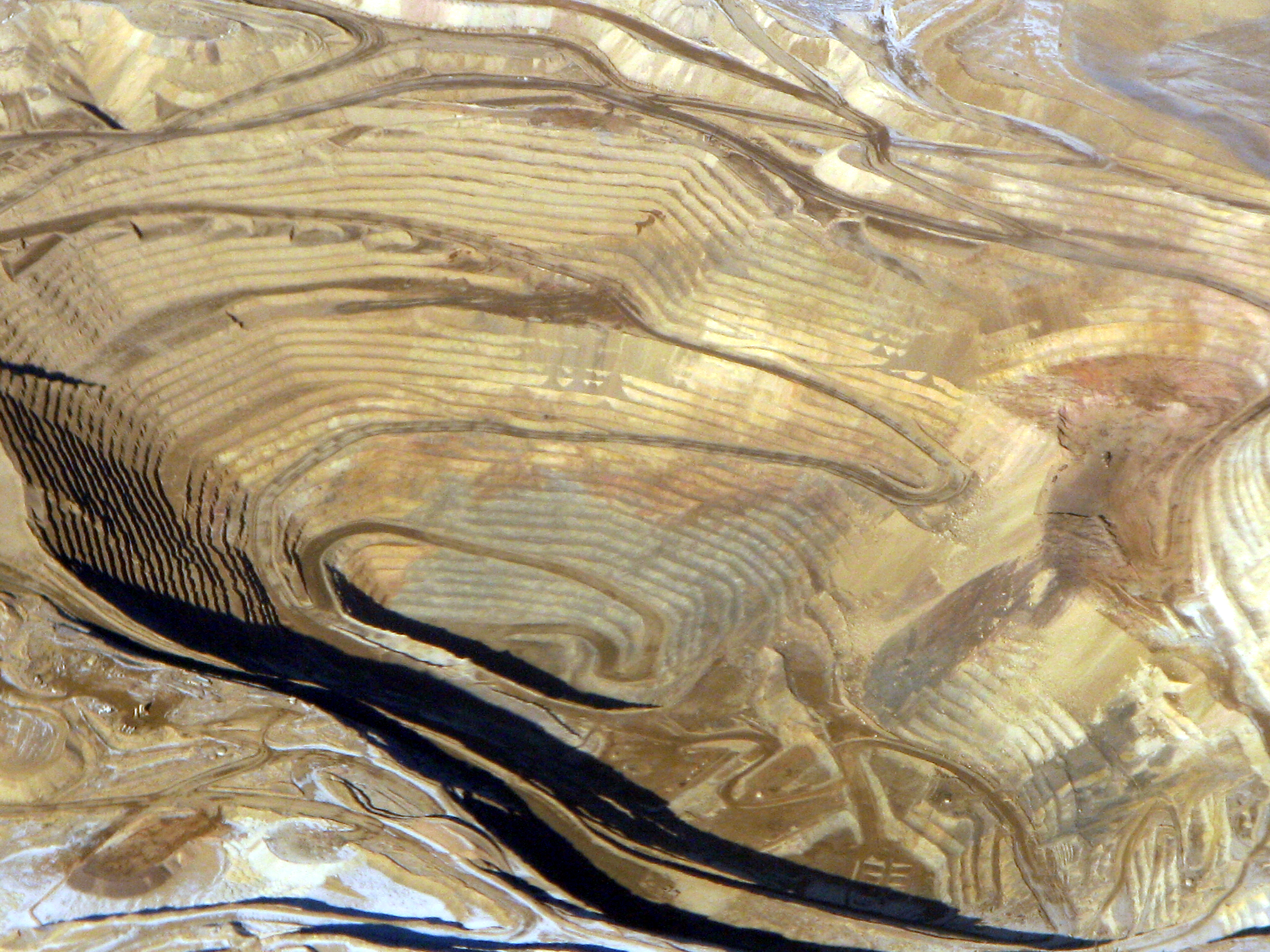
Photo: Wikimedia Commons
Modern Round Mountain is not a public collecting site. It is an active industrial mine with controlled access, active claims, surface and mineral rights, heavy equipment, heap-leach facilities, pits, haul roads, and safety restrictions. Collectible gold entered the market through mine-related recovery, authorized handling, miners, old collections, and dealers rather than through open public collecting. Provenance matters because specimens from the mine have been dispersed through many hands since the late 1980s and early 2000s, and because “Round Mountain” is a valuable label.
Notable specimen production is especially associated with the late 1980s through about 2006, when crystalline gold from the operation appeared in the collector market in meaningful numbers. The mine has also produced macrocrystalline gold from later mining, but nearly all gold at Round Mountain is an ore commodity rather than specimen material, and most gold-bearing rock is processed. Good specimens therefore represent a tiny saved fraction of a very large gold system.
Round Mountain gold is famous for crystallinity. The most characteristic specimens are flattened and elongated spinel-law twins, leaf-like and herringbone plates, parallel wires or ribbons, and combinations of cubic, octahedral, and hopper-growth forms. Some pieces show stepped, shelf-like octahedral growth; others are jagged fans of thin plates, feather-shaped sheets, or bright plates richly covering rhyolitic tuff. Well-crystallized examples can have a scaly, reptilian texture where overlapping spinel twins march across a leaf surface.
The color ranges from rich yellow gold to a lighter, slightly greenish or pale yellow tone where silver-rich electrum is involved. Historical descriptions from the district noted greenish-tinged gold in some quartz vein material, contrasting with yellower gold associated with limonite. Modern collector specimens often have a pale, brilliant, high-luster look rather than the warm buttery color typical of some California golds.
Size ranges are unusually favorable for an American gold locality. Thumbnails and miniatures are the most commonly encountered collector sizes, but small cabinet specimens and occasional cabinet-size pieces are known. Mindat records flattened and elongated spinel twins to about 6 cm, and published and photographed examples show individual specimens from under 2 cm to more than 5 cm across. The finest pieces balance size with sharpness: an airy 5 cm fan may be more desirable than a heavier but shapeless mass, while a thick crystalline cluster with sharp leaves and undamaged points can command strong interest.
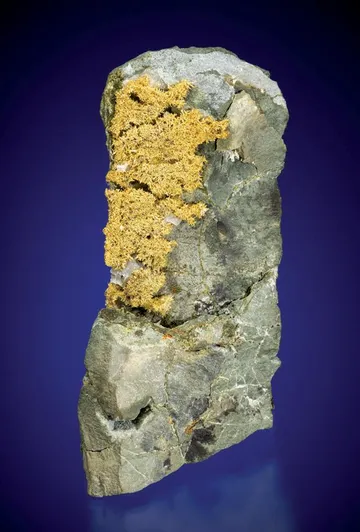
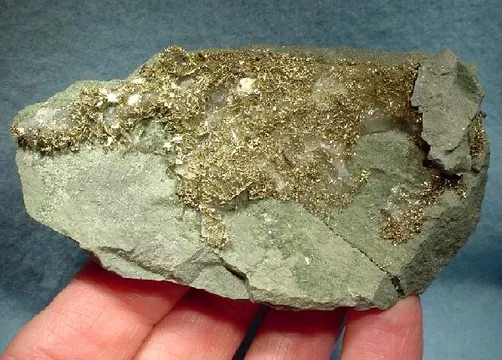
Matrix is less common and can be important. Many Round Mountain specimens are essentially all gold, liberated from the host, but matrix pieces may show gold on quartz, altered rhyolitic ash-flow tuff, clayey material, or adularia-bearing epithermal vein material. Quartz-associated examples have particular geological charm because they tie the collector specimen directly to the epithermal vein environment rather than presenting only the freed gold.
Associated minerals documented from the locality include quartz, adularia, pyrite, goethite, hematite, limonite, clay/sericite minerals, alunite, fluorite, calcite, realgar, scorodite, pyrolusite, and aguilarite. In specimen photographs, the most common visual associations are quartz and pale clayey or altered volcanic matrix. Aguilarite is a microscopic association in gold/electrum, not normally a collector-visible accessory.
Quality factors are locality-specific. Look for crisp spinel-law twin blades, strongly reflective luster, undistorted leaf edges, intact points, attractive negative space, two-sided crystallization, and a recognizable Round Mountain growth style. The best pieces are not merely “gold by weight”; they are crystallographic objects. A light but sharp and sculptural herringbone leaf can be more collectible than a heavier, rounded, bent, or abraded piece. Conversely, unusually robust masses of fully crystalline Round Mountain gold are coveted because much of the locality’s material is naturally thin and delicate.
Round Mountain gold is actively traded and remains available, but the better material is finite and increasingly old-collection. Small crystalline pieces still appear from specialist gold dealers, mineral auctions, and older collector holdings; cabinet-level examples, fine leaf forms, and high-weight crystalline pieces are much less frequent. Auction records and dealer offerings show strong demand for sizable crystallized leaves and thick twinned clusters, particularly when the specimen has clear provenance to a known collection or early 2000s production.
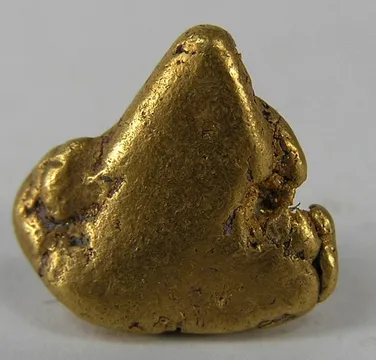
The first authenticity concern is locality. Many gold specimens are sold generically as “Nevada,” “Round Mountain,” or “crystallized gold,” and the label can add value. Round Mountain pieces should show habits consistent with the locality: flattened spinel twins, herringbone leaves, bright pale gold to electrum-like tones, stepped plates, hoppery cubes, and, where present, epithermal quartz or altered tuff matrix. Rounded placer nuggets, waterworn masses, or generic melted-looking gold should not be accepted as Round Mountain mine specimens without strong documentation.
No widely established Round Mountain-specific fake tradition is comparable to the famous manufactured gold-on-quartz and glued gold specimens known in the broader gold market, but general gold-specimen cautions apply. Watch for gold mechanically attached to quartz, repaired leaf edges, acid-cleaned matrix, exaggerated locality claims, and specimens whose matrix and gold do not make geological sense together. Because gold is soft, mounted specimens should be inspected for glue, wax, solder, pressure marks, or bends hidden by the display base.
Condition is critical. Round Mountain leaves and wires can be thin, flexible, and easy to bend. The most common condition issues are bent tips, compressed leaf edges, rubbed high points, detached or missing crystals, and loss of matrix on matrix specimens. Some pieces have been chemically cleaned to remove clay or iron oxides; cleaning is not automatically a problem, but over-cleaning can reduce geological context, leave residues in crevices, or produce an unnaturally bright appearance. Handle with tweezers only when necessary, avoid repeated remounting, and store thin leaves in a box that prevents any pressure on the high points.
For valuation, separate gold value from specimen value. A Round Mountain crystal weighing only a few grams may be worth many multiples of melt value if the form is sharp and aesthetic. A heavier piece can be less desirable if it is bent, dull, granular, or shapeless. The strongest examples have three things at once: a convincing old provenance, recognizable Round Mountain crystallography, and undamaged sculptural form.
The Round Mountain story begins with a paradox that only a prospector could love: rich free gold at the surface, but so little obvious vein quartz that the camp was first viewed with suspicion. In February 1906, ore deposits were discovered on and around the bold hill called Round Mountain, rising from the edge of Big Smoky Valley. The early ore showed visible metallic gold, yet the lack of classic quartz veining made some observers doubt the district. That hesitation did not last. During 1906, two companies were already developing lodes, and the first recorded production came not from deep mining but from dry washing the rich surface material.
The early camp boomed, relapsed, and then settled into work. The U.S. Geological Survey’s old description is wonderfully blunt: Round Mountain suffered “the usual boom and relapse,” though it was not promoted as wildly as nearby Manhattan. Most production came from the hill itself. As underground development advanced, apex litigation followed the veins and claims, and by 1913 several companies had consolidated into the Round Mountain Mining Co., which became the district’s dominant producer.
The veins that made the early high-grade reputation could be astonishingly small. Much of the best ore from the top of Round Mountain came from veins scarcely more than an inch wide. In drusy cavities, gold rested on projecting quartz crystals, often as distinctly crystalline octahedrons and more complex forms. Some of the rich quartz ore held thick plates of gold in graphic texture, while other pieces showed gold with a greenish tinge. The old geologists noticed something collectors still appreciate: the finest “specimen ore” from the small veins on top of Round Mountain could be almost free of iron staining, allowing the gold itself to dominate the visual field.
The placers made a different kind of drama. At first, dry washers worked the slopes of Round Mountain. Then water was brought from Shoshone and Jefferson creeks so the gravels could be hydraulicked. That was not enough. In 1915, the Round Mountain Co. completed a 9-mile pipeline to bring water from Jett Canyon in the Toiyabe Range, yet even that ambitious line could not provide enough water for year-round hydraulic work. The placers were not a thin skin of uniform gravel. Prospecting south of the main tailrace showed gold values increasing with depth: roughly $0.20 per cubic yard in the upper 10 feet, rising through deeper intervals to $3.55 per cubic yard at 50 to 60 feet. In a desert valley where water itself had to be engineered into place, the richest ground lay downward.
One small episode from the Monte Cristo prospect captures the strangeness of Round Mountain district gold. About a mile east of Round Mountain, a fault zone in granite contained a clayey gouge streak just 1 to 3 inches wide. In that gouge was coarse, “very feathery” gold, apparently deposited after the fault movement that made the gouge. The gold was light in color and was said to be worth $12.55 per ounce, a low value for pure gold and a strong hint of silver-rich composition. By the time of the 1915 visit, 20 tons of ore from the prospect had been milled and had yielded about $2,000. It was not the main mine, but it reads like a miniature of the district’s personality: narrow structures, pale gold, fault movement, and surprisingly rich pockets in unassuming material.
The modern open pit changed the scale beyond recognition. The original knob that gave Round Mountain its name has been largely removed by mining, and the contemporary pit is measured not in inches of vein width but in thousands of feet of benches and haul roads. Yet the collector specimens preserve the small-scale story: delicate plates that grew in open spaces, herringbone leaves from epithermal fluids, and crystalline gold saved from a mine designed to make doré bars rather than display pieces.


_4.jpg)

