Goboboseb Mountains, Namibia — premier quartz locality famed for phantom-growth and color-rich crystals, with rare basalt-pocket specimens prized by collectors.
Key facts
The Goboboseb Mountains are one of the great modern quartz localities: the true home of much of the material long traded simply as “Brandberg.” For collectors, the distinction matters. Brandberg Mountain is the celebrated granite massif to the east; Goboboseb is the volcanic, pocket-bearing ground west and northwest of it, especially around Tafelkop and nearby claims. The specimens are not pegmatite quartz in the classic granitic sense, but cavity minerals from Early Cretaceous Etendeka volcanic rocks—basalts and quartz latites tied to the Messum volcanic center and the Paraná–Etendeka flood-basalt province.
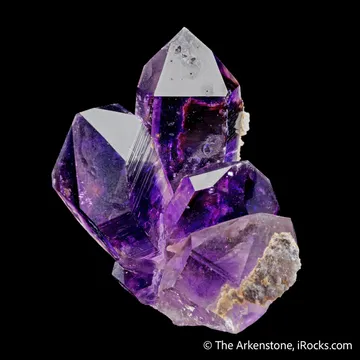
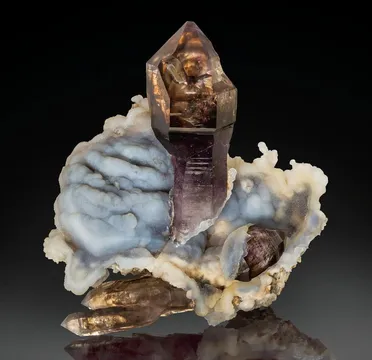
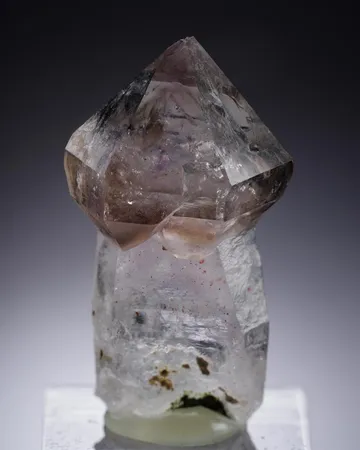
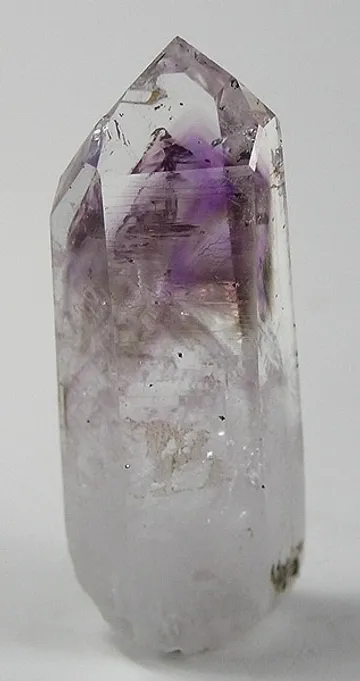
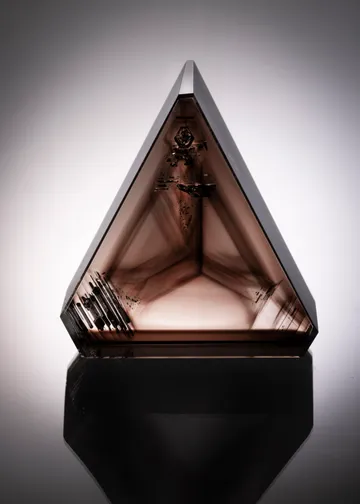
What made Goboboseb famous is not one color of quartz, but the way the quartz records repeated growth. Fine crystals may combine rock crystal, smoky quartz, and amethyst in the same individual, with purple caps, smoky stems, clear windows, phantoms, skeletal or “fenster” growth, reverse scepters, hematite dusting, clay veils, and liquid-vapor inclusions large enough to see without magnification. The best crystals are glassy and internally alive: turned in the hand, they show ghost crystals nested within ghost crystals, color floating under the rhombohedral faces, and, in rare examples, a mobile bubble moving through a trapped pocket of ancient fluid.
Regional View
Country View
The locality also matters because it is a specimen-mining landscape rather than a large industrial ore field. Its finest pieces have been won from hard basalt pockets by small-scale miners and claim holders working in harsh desert country, often with simple tools and long supply lines to Uis, Henties Bay, and Swakopmund. That human reality explains the look of many specimens on the market: single crystals and small groups are abundant, while intact basalt-matrix geodes are much less common because the host rock is exceptionally unforgiving.

Photo: Wikimedia Commons

Photo: Wikimedia Commons

Photo: Wikimedia Commons
Search for specimens: View all specimens from Goboboseb Mountains, Namibia
The Goboboseb Mountains lie in the Brandberg area of the Dâures Constituency, Erongo Region, northwestern Namibia. The productive collecting district includes Tafelkop, the Ras Greef claim area, the Violet Crown Mine, the Copper Valley prospect, and a spread of small workings in the surrounding volcanic hills. In modern mineral labeling, “Goboboseb Mountains, Brandberg Area, Erongo Region, Namibia” is the most useful locality name for specimens, with Tafelkop or a named claim added when known.
Geologically, the range belongs to the Awahab Formation of the Etendeka Group, an Early Cretaceous volcanic succession of interbedded basalt and quartz latite. The volcanic pile is roughly 600 m thick in the Goboboseb–Messum area. The lower part, the Tafelkop Basalt Member, is about 250 m thick and consists of multiple basalt flows commonly 5–30 m thick. The amethyst, smoky quartz, rock crystal, prehnite, calcite, analcime, and related minerals occur in cavities, amygdules, vugs, and geodes developed mainly in the upper, rubbly, or amygdaloidal parts of basalt flows.
Above the Tafelkop basalt sits the Goboboseb Quartz Latite Member, a 100–150 m package of quartz-latite units interpreted in the geological literature as high-temperature welded ash-flow deposits, or rheoignimbrites, rather than simple lava flows. The wider volcanic story is enormous: the Goboboseb–Messum volcanic center is tied to silicic eruptions of the Awahab magma system, with the Messum igneous complex recognized as the eruptive center for major quartz-latite units. For collectors, that deep-time context matters because it places these delicate, transparent quartz specimens in one of the largest continental flood-volcanic provinces on Earth.
The mineralization is best understood as low-temperature to moderate-temperature hydrothermal filling of pre-existing volcanic cavities. Published fluid-inclusion data on Goboboseb quartz describe aqueous liquid-vapor inclusions, modest salinity of about 5 weight percent NaCl equivalent, and homogenization around 201 °C. In collector language, those trapped fluids help explain why so many Goboboseb crystals are valued as internal objects: phantoms, veils, bubbles, and healed fractures are not flaws in the usual sense, but part of the locality’s signature.
Historically, amethyst from the Brandberg region was already noted in the older Namibian mineral literature by 1942, and the locality became better known to collectors through late twentieth-century German and international publications. Focused specimen recovery around Tafelkop expanded in the modern collecting era; Gert Bachran is documented as having mined specimens at Tafelkop in 1990, and later names attached to the collecting landscape include Johann Cotze, Andreas Palfi, and Ras Greeff. The Ras Greef claim is especially familiar from collector reports and Mindat photo documentation, while Violet Crown Mine—formerly known as Buks Claim—has become a named source for large, well-formed, richly colored amethyst associated with calcite, dolomite, and pyrite.
Copper Valley is a different but important part of the Goboboseb mineral picture. The Copper Valley basalt flow occupies a north-south paleovalley west of Tafelkop, and the Copper Valley prospect has produced native copper with chrysocolla, cuprite, tenorite, and quartz. It is not the source of the classic purple quartz, but it broadens the locality from a quartz-only story into a volcanic district with both cavity minerals and small copper mineralization.
Modern activity is small-scale and claim-based. Official environmental assessments for Farm Goboboseb describe artisanal and semi-mechanized mining for amethyst, smoky quartz, rock crystal, topaz, and related gemstones. Around the time of the assessment, approximately 64 mining claims were registered or under application in the Goboboseb area. The same documents describe several artisanal groups and semi-mechanized groups, with roughly 80 small-scale miners working at the site, plus indirect livelihoods in sorting, polishing, and selling stones along routes such as the Henties Bay–Uis road.
Production is irregular because the pockets are irregular. A miner may work for weeks with little more than ordinary smoky or broken quartz, then open a cavity containing a concentration of high-quality crystals. The best pockets yield sharp, lustrous crystals with intact terminations, complex color zoning, and minimal bruising. Matrix pieces are much less common than loose singles because the basalt is hard, pockets are difficult to extract intact, and blasting or heavy breaking can destroy the very surfaces collectors prize.
Collecting access today should be treated as controlled, not casual. Claims, mining rights, safety risks, remoteness, and the protected status of nearby Brandberg Mountain all argue against unsanctioned collecting. The ethical route is to buy from miners, claim holders, established Namibian dealers, or reputable international dealers who can provide precise locality information. Specimens labeled only “Brandberg” should be read carefully: many are genuinely from the Brandberg area in the broad trade sense, but the famous quartz, amethyst, smoky quartz, prehnite, and zeolite specimens usually trace to Goboboseb rather than the protected Brandberg massif itself.
Quartz is the defining mineral of Goboboseb, and its value here lies in complexity rather than mere size: crystals range from tiny thumbnails to cabinet specimens and, in exceptional documented cases, much larger individuals, with water-clear rock crystal, smoky quartz, and amethyst appearing as successive growth zones in single crystals or groups. The classic habits are sharp hexagonal prisms, doubly terminated crystals, scepters, reverse scepters, skeletal or fenster forms, and stacked growths with internal phantoms; the most prized pieces combine glassy luster, clean terminations, vivid zoning, and visible inclusions without distracting bruising. The productive zones around Tafelkop and surrounding basalt outcrops yield many loose crystals and small groups, while intact matrix specimens are more prized because the crystals grow in hard basalt cavities that are difficult to remove cleanly.
Amethyst from Goboboseb is famous for purple that seems suspended within the crystal rather than evenly poured through it: lilac, grape, reddish violet, and deep purple zones commonly form caps, phantoms, scepter heads, or rhombohedral color patches on otherwise clear or smoky quartz. Fine pieces may show amethyst over rock crystal, amethyst over smoky quartz, smoky over amethyst, or repeated alternations of all three, and Goboboseb amethyst is notably prone to unusual faces, steep rhombohedra, scepters, skeletal textures, and internal fluid inclusions. Ordinary pieces are simply pale or contacted purple quartz; outstanding examples are glassy, sharply terminated, strongly zoned, and internally dramatic, especially from the Tafelkop area and named workings such as Violet Crown Mine, where large, richly colored crystals are documented.
Smoky quartz at Goboboseb is best appreciated as part of the same growth system as the amethyst: tea-brown to deeper smoky zones often form stems, cores, phantoms, or earlier generations later capped by amethyst or clear quartz. Many of the finest smoky pieces are not dark black crystals but transparent to translucent crystals with a warm smoky body, high luster, amethyst flashes, and visible growth zoning; scepters, double terminations, skeletal faces, and fluid inclusions are especially desirable. More common smoky crystals can be attractive but modest, while top collector examples show clean form, good transparency, undamaged terminations, and balanced contrast between smoky, clear, and purple zones.
Prehnite is the great companion species of Goboboseb, especially from Tafelkop, where it occurs as pale apple-green to mint-green, translucent radial aggregates, rosettes, whorls, botryoidal clusters, and semicircular “wheel” forms, sometimes reaching several centimeters and in notable reported aggregates up to about 10 cm across. It is commonly associated with quartz, amethyst, calcite, analcime, and other zeolite-suite minerals in basalt cavities, and the finest pieces have a fresh wet luster, pleasing green color, crisp radial structure, and balanced placement on contrasting white or clear associated minerals. Lesser pieces are dull, massive, or bruised; good Goboboseb prehnite is sculptural and architectural, often giving a specimen a soft, rounded counterpoint to the sharp quartz crystals.
Calcite from Goboboseb is usually a supporting actor, but an important one: it lines cavities, forms pale to white crystalline matrix, and hosts or accompanies quartz, amethyst, analcime, and prehnite in classic combination pieces. The best calcite-bearing specimens use calcite as contrast—white or cream calcite beneath green prehnite, purple amethyst, or clear analcime—rather than as a dominant show species, and well-crystallized calcite matrix can make a loose-looking quartz association into a complete specimen. Because calcite is softer and more reactive than quartz, collectors should inspect these pieces carefully for bruising, acid damage from cleaning, and broken attachment points around the quartz or prehnite.
Analcime occurs in Goboboseb’s zeolite-bearing cavity assemblage as white to colorless, typically sharp trapezohedral crystals, most valued when perched cleanly with green prehnite, calcite, and quartz. It is far less abundant in the collector market than quartz or prehnite, but it gives combination pieces a distinctly volcanic-cavity character and helps separate Goboboseb suites from simple amethyst-only specimens. The best analcime specimens show isolated, undamaged crystals with crisp faces and good contrast; mediocre examples are small, chalky, buried in calcite, or difficult to distinguish without magnification from other pale cavity minerals.
Hematite from Goboboseb is most familiar to collectors as an inclusion mineral in quartz rather than as large freestanding metallic crystals: red flakes, dustings, veils, and sparkling internal sprays can create “firework” effects inside otherwise clear, smoky, or amethystine quartz. These inclusions are part of the locality’s visual language, especially when they follow phantom boundaries or collect beneath amethyst caps, adding red warmth to purple and smoky zoning. Fine hematite-included quartz must still be judged first as quartz—clarity, luster, termination quality, and absence of damage matter—but a vivid, well-positioned hematite veil can elevate a small Goboboseb crystal from ordinary to memorable.
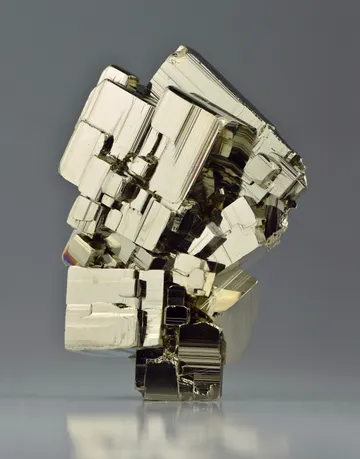
Other documented Goboboseb minerals include baryte, brookite, celadonite, chlorite-group minerals, chrysocolla, cuprite, dolomite, epidote, goethite, gypsum, heulandite-subgroup minerals, laumontite, magnetite, manganese oxides, native copper, pumpellyite-(Mg), pyrite, scolecite, siderite, stilbite-subgroup minerals, and tenorite, along with rock-forming feldspars, pyroxenes, amphiboles, and alteration minerals. The locality is not chiefly a type-locality district; its rarities are notable because they occur in a world-class quartz-prehnite-zeolite volcanic cavity environment, with Copper Valley adding native copper and copper oxides to the broader Goboboseb mineral suite.
The main authenticity issue is locality labeling. “Brandberg amethyst” remains deeply entrenched in the trade, but many such specimens are more accurately labeled Goboboseb Mountains, often Tafelkop or a nearby claim when precise information is available. Brandberg Mountain itself is culturally, legally, and geologically distinct, and digging there is prohibited; a seller who presents vague “Brandberg” material as if it came from the protected massif should be questioned. Conversely, older “Brandberg” labels are not automatically wrong in trade usage—they may simply predate the modern preference for naming Goboboseb more precisely.
Fakes are not the central problem with Goboboseb material. The crystals have a look that is difficult to counterfeit convincingly: complex internal zoning, natural phantoms, healed surfaces, inclusions, and basalt-cavity associations. The more common concerns are repairs, recemented crystals, glued scepters, glued matrix, polished or oiled faces, and overenthusiastic “enhydro” claims. A true mobile fluid inclusion should be demonstrable under good light by gently rotating the specimen; many Goboboseb crystals contain fluid inclusions, but not all contain a visible moving bubble.
Condition is critical. The locality’s quartz is hard, but it is recovered from hard basalt, transported from remote camps, and often sold after several stages of handling. Check tips, prism edges, scepter junctions, rehealed-looking breaks, and bruised high points. Doubly terminated crystals and scepters are especially vulnerable at both ends. Matrix pieces should be examined for fresh attachment breaks where crystals may have been knocked from a cavity wall.
Prehnite demands different scrutiny. Its radial aggregates can bruise or crumble at exposed edges, and pale green color can look dull if the surface is abraded. Analcime and calcite combinations should be inspected for chipped analcime corners and etched calcite. If a calcite-bearing piece has been acid-cleaned, the quartz may survive beautifully while the calcite loses sharpness.
Rarity is strongly style-dependent. Small single quartz and amethyst crystals from Goboboseb are widely available, while top-tier examples with intense zoning, high transparency, sharp undamaged form, moving fluid inclusions, hematite phantoms, or balanced scepter architecture are much scarcer. Good prehnite combinations are available but increasingly selective in quality; fine analcime associations and intact matrix pieces are appreciably less common than loose quartz singles. The current market is active, with new material still emerging from small-scale miners and claim-based operations, but supply fluctuates sharply because pockets are unpredictable and mining conditions are difficult.
A field visit to Goboboseb in August 2005 captured the locality at a scale collectors rarely see when handling a polished mineral-show label. After Uis, the approach toward Brandberg West gave way to rougher tracks and open volcanic country. Tafelkop stood as the landmark ahead, and the slopes around it already showed the marks of years of digging. In that bare desert setting, even a small camp was conspicuous: makeshift shelters, mining debris, and the stark contrast between brilliant glassy crystals and the dark volcanic rock that held them.
The human side of Goboboseb is inseparable from the specimens. The small-scale miners’ dwellings documented in the literature were basic structures of plastic sheeting and simple frames, with water and food brought in from Uis. A dry wash with Welwitschia plants appears in field accounts of the route, but at the diggings themselves the dominant impression is harder: heat, basalt rubble, little shade, and long distances between practical necessities. The locality’s elegance in a display case begins in a working landscape where every liter of water and every kilogram of rock has to be managed.
The 2005 account also records a visit to Gert Bachran’s camp at the foothills of Tafelkop. Bachran had first mined specimens there in 1990, and the camp served during later, sporadic visits. The party then visited the workings of Andreas Palfi and Ras Greeff, where a more permanent camp sat low on the hill. Palfi and Greeff were working for amethyst, but the same recurring problem remained: matrix pieces were difficult to save because the geodes were locked in hard basalt. The normal result was single crystals, small groups, or slabs pried from vugs rather than complete geodes.
One practical idea from that account says almost everything about Goboboseb specimen mining. Palfi was considering portable diamond saws as a way to cut geodes from the basalt instead of smashing around them. The thought is mundane and brilliant at once: bring a cutting tool into remote desert basalt so the pocket can be removed with its architecture intact. Collectors who wonder why a small matrix cluster can cost many times more than a loose crystal should picture that problem—the beautiful object exists inside rock tough enough to defeat ordinary patience.
Mindat field photographs and captions add smaller, memorable details. Ras Greeff appears not only as a name on a claim but as a person collectors met at his home, with a mineral display outside for specimens offered for sale. One visitor photographed a “find of the trip” in a small basalt boulder: a pocket about 6 x 10 cm holding three clear quartz crystals and small calcites, the largest quartz crystal about 3 cm. Another caption, beside a scorpion photographed on basalt near Tafelkop, reduces the geology to a collector’s blunt field note: “This basalt is HARD.”
Recent accounts from visiting buyers show how uneven the modern supply can be. One traveler returning to Goboboseb after years away described high demand, fewer active artisanal miners because some had shifted to salaried lithium work, and a disappointing buying trip in which the available production was mostly smoky quartz. That is the other side of a famous locality: every spectacular pocket that reaches a show case is balanced by long dry spells, remote work, flies, heat, bargaining, and boxes of ordinary material.