Brandberg quartz from Namibia features glassy luster, transparent trigonal crystals, and dramatic color zoning; prized for locality and collector appeal.
Key facts
Quartz from the Brandberg Area of Namibia occupies one of those rare positions in the mineral market where a commercial name, a collector tradition, and a real geological district overlap but are not perfectly identical. “Brandberg quartz” is the familiar dealer’s phrase, yet much of the classic amethystine quartz, smoky quartz, colorless quartz, scepters, reverse scepters, and fenster quartz attributed to Brandberg is more precisely from the Goboboseb Mountains west of the Brandberg massif, especially the Tafelkop area. That distinction matters to serious collectors: Brandberg Mountain itself is a protected national monument, and the celebrated specimens seen in collections and at shows are principally from basalt-hosted amygdules and geodes in the surrounding Brandberg–Goboboseb district rather than from the granite massif proper.
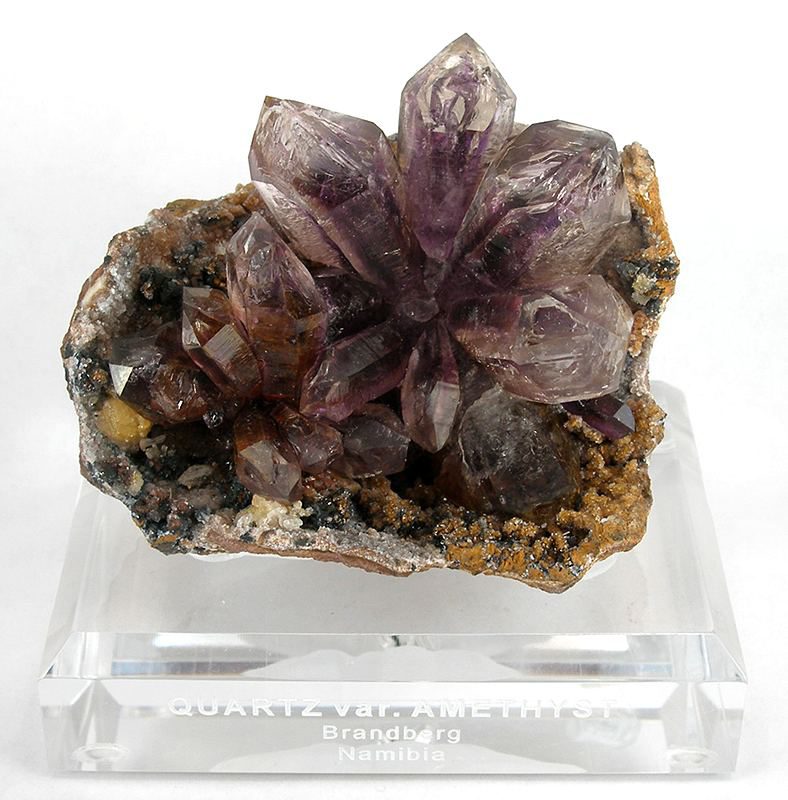
Photo: Wikimedia Commons
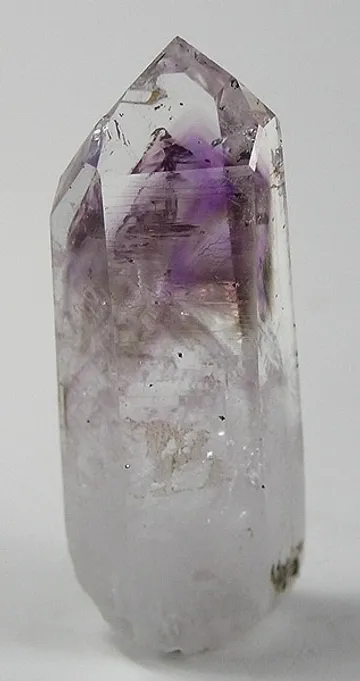
The visual signature is unmistakable when the material is good: glassy luster, sharp trigonal habit, high transparency, and internal color zoning that can place amethyst, smoky quartz, rock crystal, hematite veils, and pale milky zones within a single crystal. Fine crystals may carry purple phantoms suspended in colorless quartz, smoky caps over amethyst interiors, or amethyst tips on otherwise clear or smoky prisms. The best pieces have the slightly dreamlike depth that makes the crystal look less like a colored object than a transparent chamber in which successive growth episodes have been preserved.
The geological engine behind the locality is equally dramatic. The Brandberg massif is a large granitic complex rising above the Namib Desert, while the Goboboseb Mountains expose Early Cretaceous Etendeka Group volcanics: interbedded basalts and quartz latites of the Awahab Formation. The productive specimen pockets occur chiefly in amygdaloidal basalt flow tops and geodes in the Tafelkop Basalt Member. These vesicles, from millimeter-scale cavities to geodes more than a meter across, acted as open spaces for later silica-rich fluids to deposit quartz, amethyst, smoky quartz, prehnite, calcite, analcime, epidote, hematite, and related low-temperature secondary minerals.

Photo: Wikimedia Commons
Historically, the locality entered the literature before it became a staple of the international specimen trade. Amethyst from the Brandberg area was described in 1936 by G. Menzer after he received crystals through Idar-Oberstein. Those early crystals already showed the traits collectors prize today: dark purple color, zoning, and visible fluid inclusions. A more sustained collecting history developed much later, with small-scale work surfacing before broader legal claiming and production increased around the 1980s and early 1990s.
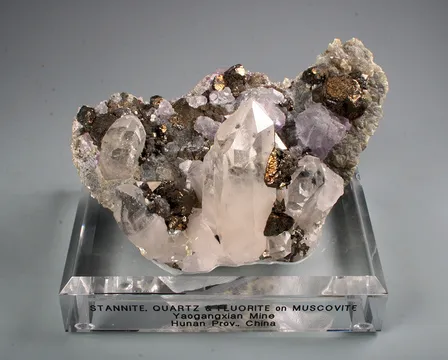
Collectors look first for the locality’s internal architecture. A simple purple point may be attractive, but a serious Brandberg-area quartz should be judged through the crystal: phantoms, veils, vapor tubes, mobile bubbles, smoky-amethyst interplay, scepter growth, reverse sceptering, doubly terminated form, fenster development, and hematite inclusions all add importance. The highest-end specimens combine these features with freedom from bruising, good display orientation, and, unusually for the district, matrix.
Search for specimens: View all quartz specimens from Brandberg Area, Namibia
The collector locality is best understood as the Brandberg–Goboboseb specimen district of northwestern Namibia, in the present Dâures Constituency of the Erongo Region. The famous Brandberg massif lies to the east; the Goboboseb Mountains, including Tafelkop, lie to the west. The road approach described in the literature runs from Uis toward Henties Bay, then northwest on the road toward the old Brandberg West mine, with tracks turning toward Tafelkop and the surrounding basalt hills.
The deposit type is a volcanic amygdule-and-geode occurrence in basalt. The productive cavities are in the Tafelkop Basalt Member, a multiple-flow basalt unit forming the base of Tafelkop. Some basalt flows have amygdaloidal tops; cavities range from small vesicles to large geodes. The host rock is hard, dark basalt, and specimen extraction is labor-intensive because quartz is commonly attached tenaciously to cavity walls. Where basalt is weathered or chemically altered, portions of matrix can sometimes be removed with crystals intact, but most production consists of single crystals, floaters, small groups, or slabs pried from vugs.
The broader geology belongs to the Etendeka Group, one of the volcanic records associated with the opening of the South Atlantic during the breakup of Gondwana. The Goboboseb Mountains cover roughly 1,100 square kilometers and are assigned to the Awahab Formation, composed of interbedded basalts and quartz latites about 132–135 million years old. The nearby Messum Igneous Complex is considered the likely eruptive source for much of the Goboboseb volcanic pile, and the basalt-quartz-latite succession has been interpreted as part of a large volcanic system rather than a small isolated lava field.
Mining history is a mixture of early recognition, long quiet periods, claim staking, informal digging, and periodic organized work. Menzer’s 1936 report shows that Brandberg-area amethyst had reached Europe before World War II. The original discovery west of Brandberg has also been attributed in later accounts to Gawie Cloete in the 1950s, although sustained collecting did not become important until much later. From the late 1930s through the 1980s, no large, continuous production is recorded, but scattered pieces surfaced. By the late twentieth century, legally pegged claims and mineral entrepreneurs were working parts of the area, while local Damara diggers also recovered crystals from surrounding outcrops.
Collecting access should be treated with caution and respect. The actual Brandberg Mountain is a national monument; collecting there is illegal, and some quartz and amethyst reportedly taken from the mountain itself should not be confused with legitimately produced Goboboseb material. The classic specimen area around Tafelkop has been worked by local diggers and claim holders; it is remote desert terrain where water, vehicle condition, heat, and permission are practical and ethical concerns. Historical field accounts describe summer temperatures exceeding 40°C, boulder-strewn tracks, flat-tire hazards, and basic camps where food and water had to be brought in from Uis.
Notable finds include large doubly terminated crystals over 30 cm, a single 35 cm crystal recorded in the Desmond Sacco collection, Herkimer-like quartz on drusy white quartz reported in 2005, sceptered and reverse-sceptered amethyst and smoky quartz, fenster quartz groups, and quartz with unusually large fluid inclusions. The most collectible pieces are not merely purple: they show multiple growth generations, internal phantoms, visible vapor tubes, hematite veils, and clean geometry.
Brandberg-area quartz is quartz, SiO2, but its collector identity depends on variety and structure. The district produces amethyst, smoky quartz, rock crystal, amethystine smoky quartz, clay-included fenster quartz, scepter quartz, reverse scepter quartz, faden-like distorted crystals, and doubly terminated floaters. Individual crystals commonly combine more than one visual type, which is why the locality has become so prized: color and growth habit are not separate categories but often superimposed in the same specimen.
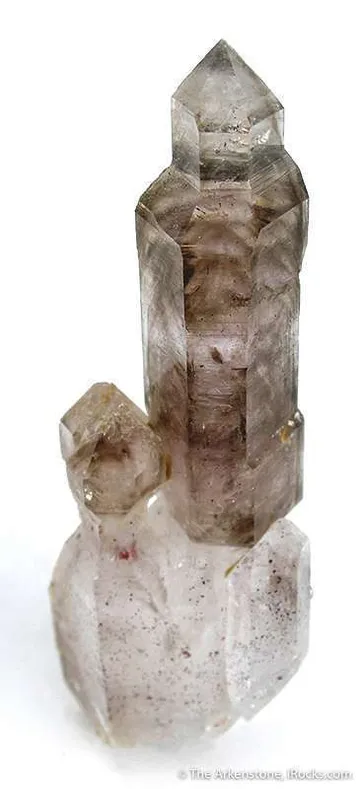
Crystal habit ranges from simple prismatic points to elegant doubly terminated floaters, Japan-law twins, scepters, reverse scepters, and complex skeletal or fenster forms. The best scepters may show a smoky lower prism and an amethyst cap, or an amethyst phantom from the underlying prism projecting into the scepter head. Some doubly terminated crystals carry scepters at one or both ends. Fenster quartz from the district can be brownish or clay-included, with recessed “window” faces and skeletal growth giving a hollowed, architectural appearance.
Color is one of the locality’s great strengths. Amethyst ranges from pale lilac to saturated grape purple; smoky quartz ranges from warm brown-gray to dark smoky; rock crystal may be water-clear or slightly milky at the base. Many specimens show amethyst phantoms within clear quartz, smoky outer zones surrounding purple interiors, or dark amethyst concentrated at terminations and edges. Hematite can occur as tiny platelets, veils, red inclusions, black or silvery internal films, or phantom-defining dustings inside transparent quartz. In the finest examples, these inclusions add depth without muddying the crystal.
Fluid inclusions are a defining feature. The Goboboseb quartz studied in the Rocks & Minerals article contains abundant aqueous liquid-vapor inclusions, many microscopic but some with visible bubbles. Larger gas-bubble inclusions are commonly discussed by collectors as “enhydros,” though the more precise mineralogical term is fluid inclusion. Reported inclusions may be elongated, rounded, or shaped like negative quartz crystals, and some contain unidentified solid phases. Fluid-inclusion work found salinity of about 5 weight percent NaCl and homogenization temperature of approximately 201°C, indicating low-temperature hydrothermal growth after cavity formation in the basalt.
Typical specimen sizes vary widely. Small crystals under 3 cm are common; miniatures and small cabinets dominate the market. Cabinet specimens occur, but matrix pieces are much less common than loose crystals because extraction from basalt is difficult. Literature records crystals exceeding 30 cm and a 35 cm single crystal in a private collection, but these are exceptional and should not be treated as normal market size.
Associated minerals are important for locality confirmation and specimen interest. Calcite occurs in some amethyst geodes as drusy linings and in prehnite vugs, commonly as stubby scalenohedra. Prehnite is a premier associated species from the broader Goboboseb district, usually as pale to apple-green spherical or subspherical aggregates, though large quartz-prehnite combination pieces are uncommon. Analcime, epidote, hematite, goethite, baryte, babingtonite, chrysocolla, celadonite or chlorite-like crusts, pumpellyite, gypsum, laumontite, heulandite, pyrite, chalcedony, and siderite have all been reported from the district, though not all are common on quartz specimens.
Quality is judged by a balance of surface and interior. A top Brandberg-area quartz should have glassy luster, sharp terminations, attractive three-dimensional form, undamaged edges, and internal features that are easy to read without turning the specimen endlessly under a light. Strong but natural zoning, visible phantoms, clean smoky-amethyst transitions, and a well-placed fluid inclusion can elevate a crystal dramatically. Matrix adds rarity when it is stable, aesthetic, and not merely a broken basalt scar. Damage is especially important because the locality’s crystals often have exposed, transparent terminations that reveal even tiny bruises.
The first authenticity issue is labeling. “Brandberg” is entrenched in commerce, but the most accurate label for many classic specimens is “Goboboseb Mountains, west of Brandberg Mountain, Damaraland/Erongo Region, Namibia,” or more specifically Tafelkop where known. A specimen labeled only “Brandberg” is not automatically wrong in market language, but it is incomplete. For a serious collection, preserve any old labels while adding a more precise modern locality note when documentation supports it.
The second issue is locality stretching. The name “Brandberg quartz” is sometimes used loosely for amethystine phantom quartz, smoky-amethyst quartz, or enhydro quartz from Namibia in general. True Goboboseb/Brandberg-area material typically shows a recognizable combination of habits: elongated or doubly terminated crystals, amethyst and smoky zoning in the same crystal, internal phantoms, hematite veils, fluid inclusions, and occasional fenster or scepter form. None of these features alone proves the locality, but the total pattern is distinctive.
There is no need to assume that every attractive Brandberg quartz has been treated, but collectors should still examine high-value specimens carefully. Look for repaired terminations, reattached matrix, stabilized cracks, filled chips, or polished windows cut to reveal inclusions. Restoration is not hypothetical: current high-end dealer descriptions sometimes disclose repaired or restored areas on Brandberg-area amethyst specimens. Polished slices and tumbled pieces from Brandberg-area crystals also exist; these can be interesting study pieces but should not be confused with undamaged natural crystals.
Fluid inclusions deserve special caution. Genuine Brandberg-area quartz can contain visible mobile bubbles, but “enhydro” has become a premium market word and is used loosely. A genuine inclusion should be enclosed within natural crystal growth, commonly following internal planes, negative-crystal shapes, or growth features. Suspiciously large, round, isolated cavities; drilled-looking openings; resinous surfaces; or bubbles in obviously polished or fabricated pieces should be treated skeptically. For expensive enhydro specimens, buy from sellers who can show the moving bubble clearly and disclose whether any polishing, cutting, or repair has been done.
Condition problems are common because much of the production comes from hard basalt cavities opened with hand tools. Broken attachment points, chipped terminations, bruised prism edges, contact marks, iron or goethite coatings, and extraction scars are all normal market issues. Some iron staining is natural and can be attractive, especially where hematite creates red internal veils; dull exterior coatings may be less desirable unless they contribute to the specimen’s character.
Rarity is feature-specific. Small loose crystals, pale amethyst points, and modest smoky-amethyst crystals are regularly available. Fine doubly terminated crystals with strong color zoning, clean scepters, undamaged fenster quartz, aesthetic matrix clusters, large crystals over 10 cm, and specimens with prominent visible fluid inclusions are much scarcer. Large matrix pieces with well-displayed amethyst or smoky quartz are particularly desirable because matrix extraction from the basalt is difficult.
Market availability remains good but uneven. Brandberg-area quartz appears regularly through specialist mineral dealers, auctions, online marketplaces, and collector resales, but the best older pieces often carry collection provenance and are priced accordingly. Expect modest thumbnails and miniatures to be obtainable; expect strong premiums for saturated amethyst phantoms, scepter habit, doubly terminated floaters, visible mobile inclusions, and clean matrix presentation.
In 1936, long before “Brandberg” became a familiar show-table name, G. Menzer at the University of Berlin received amethyst crystals through “Herrn” Brusius of Idar-Oberstein. The material was dark purple and attractive enough for jewelry, but it already carried the collector clues that would later define the locality: color zoning and visible fluid inclusions. Menzer donated Brandberg crystals to the Museum of Natural History in Berlin. Later authors could not locate them there; they may have been lost during the Allied bombing of World War II, or their labels may simply have disappeared into the confusion of a museum collection.
The modern field picture is more austere. A 2005 visit described the approach from Uis toward the Brandberg West mine, then onto slow, rough tracks leading toward Tafelkop. The landmark was a flat-topped koppie visible in the distance, with evidence of digging on scree slopes around the hills. The landscape made even small human structures conspicuous: makeshift houses of Damara diggers, a newer camp associated with Johann Cotze, and the house of Ras Greeff about a kilometer from the informal diggers’ village. The ground itself was described as nearly vegetationless, a rubble-strewn surface weathered from ancient lavas.
Heat shaped the working day. The visitors arrived just before midday, when the temperature was already in the mid-30s Celsius, and at first the settlement seemed deserted. People emerged slowly from their shelters. Smashing hard basalt in that heat was impractical, so digging took place mainly in the early morning and late afternoon. The diggers came forward with cardboard beer flats holding crystals for sale. The scene was orderly: rather than crowding the visitors, each person waited to be approached.
Those flats held the real grammar of the locality: smoky quartz in one box, pale amethyst in another, plus colorless quartz, darker amethyst, color-zoned crystals, and oddities with scepters and reverse scepters. Among the newer finds were Herkimer-like quartz crystals on drusy white quartz, a style the authors had not previously seen from the area. The largest crystal offered on that visit was about 20 cm, though most pieces were miniature to cabinet size.
Later that day the visitors drove to Gert Bachran’s camp at the foothills of Tafelkop. Bachran had first mined specimens there in 1990 and used the camp during sporadic visits. They then went to the workings of Andreas Palfi and Ras Greeff, who had a permanent camp on the lower slopes where they were excavating amethyst. The problem was not finding cavities in principle; it was removing them intact. Matrix specimens were scarce because geodes were almost impossible to liberate from the host basalt. Palfi was considering portable diamond saws as a way to cut geodes out of the rock rather than sacrifice the matrix to hammer and chisel.