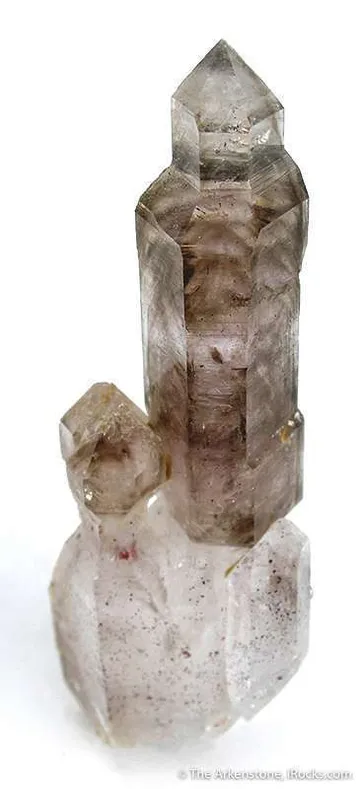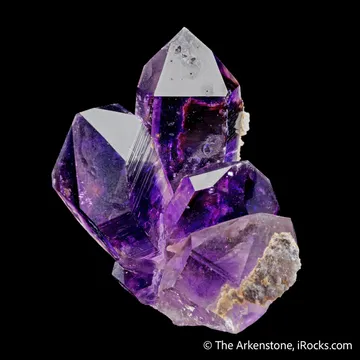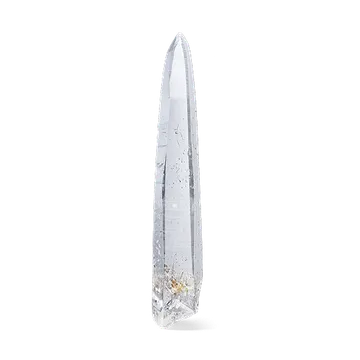
Quartz from Goboboseb Mountains, Namibia — glassy color-zoned crystals with amethyst and smoky zones, plus phantoms and fluid inclusions prized by collectors.
Key facts
Quartz from the Goboboseb Mountains is the classic “Brandberg” quartz of the specimen market: glassy, internally theatrical crystals in which clear quartz, smoky quartz, and amethyst often occupy the same prism as stacked phantoms, smoky veils, purple caps, hematite sparks, and moving two-phase fluid inclusions. The best pieces are not merely purple quartz; they are miniature records of repeated growth in basalt cavities, with color suspended inside the crystal rather than painted evenly through it.

Photo: Wikimedia Commons
The locality is often mislabeled in the trade as Brandberg, but the famous specimen-producing ground is not the Brandberg granite massif itself. The productive area lies in the Goboboseb Mountains west of Brandberg Mountain, especially around Tafelkop, where amygdaloidal basalt flows of the Etendeka volcanic province supplied the cavities that later received silica-rich fluids. Brandberg Mountain is culturally and legally distinct, and digging there is prohibited; the bulk of the quartz, amethyst, smoky quartz, prehnite, and associated zeolites sold under the “Brandberg” name comes instead from Goboboseb.
The visual signature is hard to confuse when it is seen in hand. Many crystals are transparent enough to read their growth history: a clear base turns smoky, then purple, then clear again at the termination; or a milky lower zone opens into a sharply bounded amethyst phantom; or a small amethyst reverse scepter sprouts from the tip of an otherwise colorless crystal. Hematite inclusions may appear as red dust, metallic platelets, or phantom-defining veils. Fluid inclusions, some large enough to see unaided, are a prized feature and are responsible for the “enhydro” appeal that has made many Goboboseb pieces favorites among quartz specialists.

Photo: Wikimedia Commons
For collectors, the highest-level specimens combine sharp form, bright luster, transparency, internal color architecture, and freedom from mining damage. Doubly terminated floaters, scepters, reverse scepters, purple-tipped groups, crystals with moving bubbles, and pieces retaining basalt or quartz matrix are especially desirable. Matrix specimens are much scarcer than loose crystals because the host basalt is hard and pockets are difficult to remove intact.

Photo: Wikimedia Commons
Search for specimens: View all quartz specimens from Goboboseb Mountains, Namibia
The Goboboseb Mountains are in the Brandberg area of the Dâures Constituency, Erongo Region, northwestern Namibia. The mineral-producing district includes Tafelkop, the Ras Greef claim area, the Violet Crown Mine, and surrounding basalt outcrops. The collecting landscape is a harsh, open desert of rubble-strewn lava, dry washes, and sparse vegetation, reached from Uis by the D2342 route toward the former Brandberg West mine and then by rough tracks toward Tafelkop.
Geologically, the specimens are products of volcanic cavities, not granite pegmatites. The Goboboseb Mountains are assigned to the Awahab Formation of the Etendeka Group, a Cretaceous volcanic succession of basalts and quartz latites related to the Messum igneous complex. The Tafelkop Basalt Member is the key specimen host: a roughly 250-meter-thick stack of basalt flows, many 5 to 30 meters thick, with amygdaloidal flow tops. Cavities range from tiny amygdules to geodes more than a meter across. Those cavities are the natural pocket system for quartz, amethyst, smoky quartz, prehnite, calcite, analcime, and other late-stage minerals.
The fluids that made the quartz were warm, saline, and cavity-filling. Published fluid-inclusion work on Goboboseb quartz found aqueous liquid-vapor inclusions with about 5 weight percent NaCl equivalent salinity and homogenization around 201 °C. In collector terms, that explains both the abundance of internal veils and the occasional large visible bubble: these crystals grew in open spaces where liquid and vapor could be trapped during successive growth episodes.
Mining has always been small-scale and specimen-oriented. The rock is too hard for easy pocket removal, so much production consists of single crystals, small groups, and slabs pried from vugs rather than complete basalt geodes. Informal Damara miners, claim holders, and visiting mineral people have all shaped the district’s specimen history. Gert Bachran is documented as having mined specimens at Tafelkop in 1990, and later claims and camps associated with Johann Cotze, Andreas Palfi, and Ras Greeff became part of the modern collecting landscape. By the early 2000s, Goboboseb quartz had become firmly established on the international mineral-show circuit, even though many labels still defaulted to “Brandberg.”
Modern activity continues under the realities of Namibian small-scale mining. Official environmental documents for Farm Goboboseb describe artisanal and semi-mechanized extraction of amethyst, smoky quartz, rock crystal, topaz, and other gemstones, with dozens of small-scale miners and registered or pending mining claims. The same documents describe hand sorting, local and export sales, difficult market access, harsh weather, falling-rock hazards, and the practical dependence of miners on towns such as Uis, Henties Bay, and Swakopmund for services and buyers.
Collecting access should be treated as claim-controlled, not as casual open ground. The safe and ethical route is to buy from miners, claim holders, established Namibian dealers, or reputable international dealers with clear locality information. Brandberg Mountain itself is not the legal source for these specimens; digging there is prohibited, and specimens labeled simply “Brandberg” should be understood as trade shorthand unless accompanied by more precise Goboboseb or Tafelkop data.
Goboboseb quartz occurs as clear rock crystal, smoky quartz, amethyst, clay-included fenster quartz, hematite-included quartz, and mixtures of these in a single crystal. The most admired examples show clear-to-smoky-to-amethyst zoning, purple phantoms, smoky phantoms, red hematite phantoms, and sharp internal boundaries that give the crystal depth when turned under light.
The classic habit is a lustrous, elongated hexagonal prism with bright pyramidal terminations. Doubly terminated crystals are common enough to be a locality hallmark, and complete or nearly complete floaters occur because crystals can grow freely in basalt cavities. Scepter and reverse-scepter habits are especially important at Goboboseb. Some crystals carry a smoky or clear prism with an amethyst head; others show the reverse, with small purple growths emerging from an older termination. Doubly terminated crystals may be sceptered at one or both ends. Fenster, skeletal, and “window” quartz forms also occur, commonly with clay or other inclusions accentuating the internal architecture.
Color varies from nearly water-clear rock crystal through tea-smoky brown to lilac, grape purple, and reddish amethyst. The purple is commonly concentrated near terminations, in central phantoms, or in isolated internal zones rather than evenly distributed through the whole crystal. Hematite inclusions add another dimension: metallic black or silver platelets, reddish dust, and bright red specks can define phantoms or float in otherwise transparent quartz.

Photo: Wikimedia Commons
Fluid inclusions are one of the locality’s great attractions. Microscopic inclusions are abundant, and larger visible bubbles occur in some specimens. Collector descriptions often use “enhydro” for these two-phase inclusions, especially when a vapor bubble moves through a liquid-filled channel. In good examples, the bubble is not an added novelty but an integral part of the quartz’s growth history.
Typical loose crystals under 3 cm are common. Miniatures and small-cabinet crystals are regularly encountered, while clean cabinet-sized crystals with strong color zoning are much harder to obtain. Crystals over 30 cm have been documented but are exceptional; one published private-collection crystal measured 35 cm. Matrix examples are significantly scarcer than single crystals because removing intact portions of basalt pocket wall is difficult. Where the basalt is weathered or altered, pieces on matrix are more likely to survive extraction.
Common associated minerals include calcite, prehnite, analcime, epidote, goethite, hematite, chalcedony, and locally zeolites such as heulandite-subgroup minerals and stilbite-subgroup minerals. Calcite may form drusy linings in some amethyst geodes. Prehnite is a premier associated species from the same district, commonly as green spherical aggregates, but large quartz-prehnite combinations are not as common as the fame of both species might suggest. Some quartz crystals carry small prehnite balls or partial prehnite coatings, and the best combinations are far more desirable than ordinary loose crystals.
Quality is judged first by luster and transparency, then by the internal composition of color. A merely purple crystal is less important than one with a sharp amethyst phantom, a smoky core, a red hematite veil, or a moving bubble positioned where it can be seen. For advanced collectors, the ideal Goboboseb specimen has the locality’s full vocabulary in one piece: crisp habit, bright glassy faces, complex zoning, a scepter or doubly terminated form, natural inclusions, and minimal bruising.
The greatest authenticity issue is locality precision. “Brandberg quartz” is entrenched in the trade, but for most modern specimen-market quartz, the accurate locality is the Goboboseb Mountains, commonly Tafelkop or nearby claims west of Brandberg Mountain. A label that reads “Brandberg, Namibia” is not automatically wrong as trade shorthand, but serious collections should preserve the more accurate Goboboseb designation when known.
There is no widely documented, locality-specific epidemic of dyed or manufactured Goboboseb quartz in the serious mineral trade. The more realistic concerns are mislabeling, undisclosed repair, over-enthusiastic metaphysical marketing, and damage hidden by lighting or photography. High-value scepters, moving-bubble crystals, and matrix pieces deserve close inspection under magnification. Look for glue lines at terminations or reattached scepter heads, suspiciously polished contact areas, and breaks disguised as natural etching. A reputable seller should disclose restoration; at least one recent high-end dealer listing for Goboboseb amethyst explicitly noted minor restoration at the top of a crystal, which is exactly the kind of transparency collectors should expect.
Condition problems are common because the host is hard basalt and the pockets are laborious to open. Edge nicks, bruised terminations, contacted bases, detached crystals, and small repairs are all seen. Matrix specimens often show rough extraction scars, while loose crystals may have one side that was attached to the pocket wall or incompletely crystallized. Drusy quartz overgrowths, etched faces, clay inclusions, goethite films, and hematite veils should not automatically be considered damage; in many cases they are part of the locality’s natural character.
The market remains active. Small loose crystals, pale amethyst, smoky-amethyst points, and modest enhydro pieces appear regularly from Namibian and international dealers. Fine doubly terminated floaters, rich purple phantom crystals, large clean scepters, reverse-scepter groups, and matrix specimens with strong composition are much less common and can command strong competition. The best pieces are not simply bought as “amethyst”; they are bought as locality-defining quartz specimens with architecture, transparency, and provenance.
A field visit to Goboboseb in August 2005 captured the locality at a human scale. After Uis, the road toward Brandberg West gave way to a slow approach over rough ground. Tafelkop stood ahead as the landmark, and the slopes around it already showed the physical evidence of digging. In that bare volcanic country, even a small camp stood out immediately: the familiar makeshift houses of local Damara diggers, a newer camp associated with Johann Cotze, and the house of Ras Greeff about a kilometer from the informal miners’ village.
The landscape described by the visitors was almost stripped to geology. Human habitation and mining were conspicuous because the surface was essentially without vegetation, a field of rubble from weathered lava. Earlier on the route, the track crossed a dry wash with Welwitschia mirabilis plants, but at the diggings the dominant visual impression was basalt, heat, and improvised shelter. The local dwellings were basic: plastic sheeting stretched over rudimentary wooden frames, with food and water brought in from Uis many tens of kilometers away.
At midday the temperature was already in the mid-30s Celsius, and at first the settlement seemed deserted. Then people began to emerge from the shade. The timing made practical sense: smashing hard basalt in the heat of the day was poor strategy, so most work happened in the early morning and late afternoon. When specimens came out for sale, they appeared in one of the most memorable details from the field report—cardboard beer flats, each holding crystals. The scene was not a scrum. Each person waited to be approached rather than overwhelming the visitors.
The material on offer showed the locality’s range in miniature: pale amethyst, colorless quartz, darker amethyst, color-zoned amethyst, smoky crystals, scepters, reverse scepters, and a newer style of Herkimer-like quartz on drusy white quartz that the authors had not previously seen from the area. The largest crystal offered that day was about 20 cm; most pieces were miniature to cabinet size. The published account also pushed back against a persistent assumption among foreign buyers: the diggers were not simply demanding impossible prices, and good specimens could still be bought fairly at the site.
The visit continued to Gert Bachran’s camp at the foothills of Tafelkop. Bachran had first mined specimens there in 1990 and used the camp during sporadic visits. The party then went to the workings of Andreas Palfi and Ras Greeff, where a more permanent camp sat low on the hill. They were excavating for amethyst, but the same old problem remained: matrix specimens were scarce because whole geodes were almost impossible to liberate from the host rock. Their typical production was single crystals, small groups, or crystals on slabs pried from vugs. Palfi was considering portable diamond saws as a way to cut geodes from the basalt rather than breaking them apart by force.
That single practical idea says much about the locality. Goboboseb is famous for crystals that look delicate and luminous, yet they come from one of the most unforgiving specimen environments imaginable: hard basalt, desert heat, remote camps, hand tools, rough tracks, and pockets that often yield their best crystals only by sacrificing the matrix around them.