A collector's guide to Brandberg Area, Namibia: its geology, mining history and notable minerals, illustrated with the 301 specimens documented from this locality on EarthWonders.
Key facts
Brandberg Area is one of those locality names that serious collectors learn to read with a little geological caution and a great deal of admiration. In the specimen trade, “Brandberg” usually evokes water-clear quartz, amethyst, smoky quartz, color zoning, phantoms, scepters, reverse scepters, fenster faces, hematite sparks, and moving two-phase fluid inclusions. Geologically, however, the classic specimens are overwhelmingly not from the protected Brandberg granite massif itself, but from the Goboboseb Mountains west of Brandberg, especially around Tafelkop and adjacent basalt outcrops. There, amygdules and geodes in Early Cretaceous Etendeka volcanic rocks supplied open cavities in which quartz, amethyst, smoky quartz, calcite, prehnite, analcime, epidote, hematite, and rarer species crystallized.
The setting is inseparable from the broader volcanic architecture of northwestern Namibia. Brandberg itself is a great granitic ring complex, an erosional remnant of Jurassic–Cretaceous magmatism associated with the Damaraland alkaline province and the breakup of Gondwana. The collectible quartz–prehnite assemblage, by contrast, belongs mainly to the Goboboseb volcanic succession: interbedded basalts and quartz latites related to the Etendeka flood-basalt province and the Messum igneous system. For collectors, the result is a basalt-vug locality of unusual refinement rather than a conventional pegmatite or alpine-cleft field.
Regional View
Country View
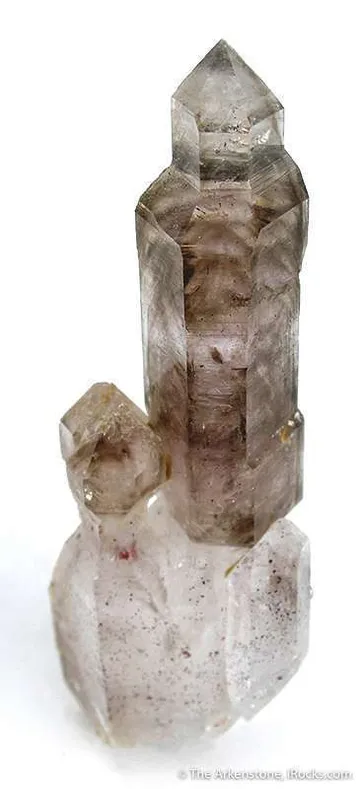
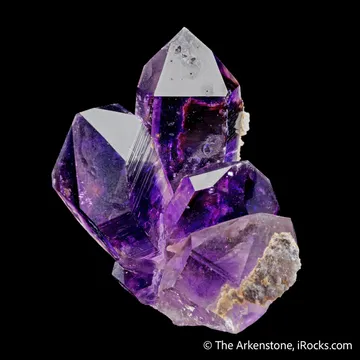
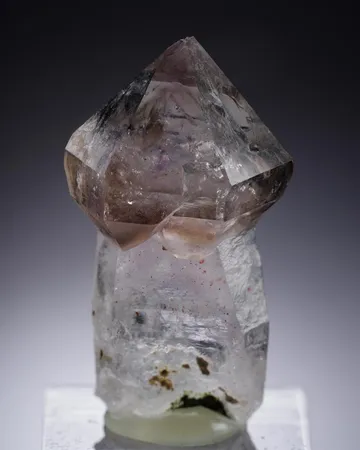
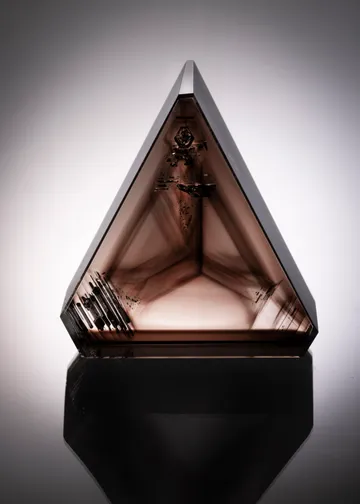
The finest “Brandberg” quartz specimens have a look that is difficult to confuse with ordinary amethyst. Color is commonly suspended inside the crystal as zones or phantoms rather than spread evenly from surface to core. A single crystal may pass from colorless rock crystal to smoky gray-brown, to violet amethyst, and back again, while thin red or black hematite veils mark earlier growth surfaces. Good specimens are bright, transparent, sharply terminated, and internally animated; great specimens combine that clarity with a clean moving bubble, an elegant scepter habit, a doubly terminated floater form, or a rare aesthetic matrix attachment.

Photo: Wikimedia Commons
Brandberg Area also has a more technical mineralogical side. The umbrella locality includes not only Goboboseb and Tafelkop, but also Brandberg West, the Messum igneous complex, the Brandberg Complex itself, and the Amis Complex on the southwestern periphery of Brandberg. Those sublocalities bring in tin–tungsten vein mineralization, peralkaline granite and pegmatite assemblages enriched in Zr, Nb, Y, Sn, Zn, and rare-earth elements, and a suite of less showy but scientifically important minerals. Yet for the collector’s cabinet, the signature remains the same: glassy quartz from basalt cavities, often so clear that the real show is inside the crystal.
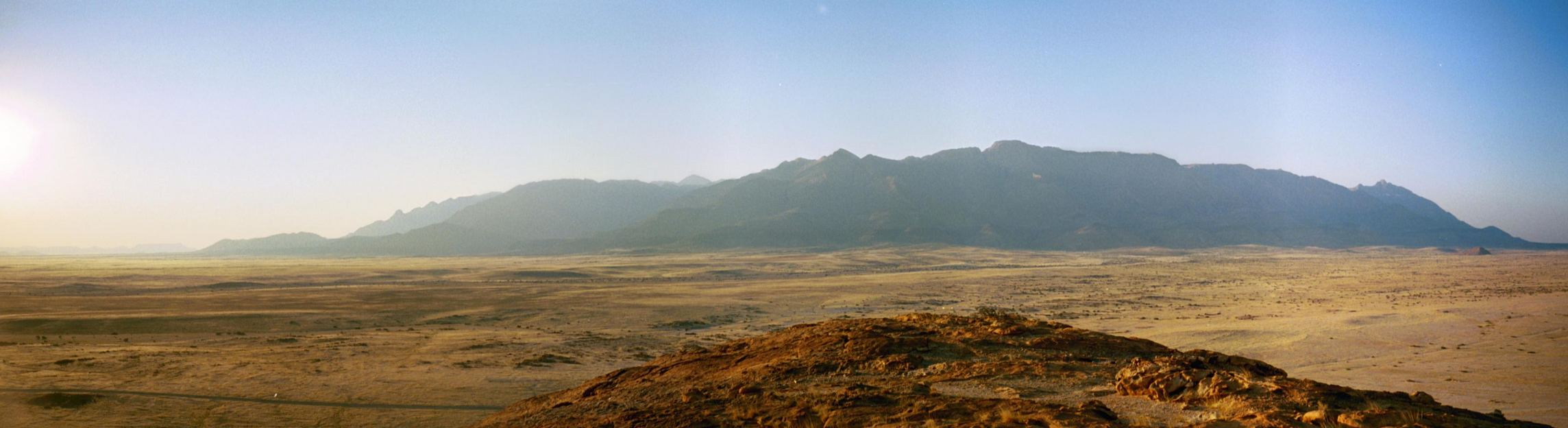
Photo: Wikimedia Commons
Search for specimens: View all specimens from Brandberg Area, Namibia
Brandberg Area, as used by collectors and databases, is best understood as a regional umbrella rather than a single mine face. It encompasses the Brandberg granite massif and nearby mineral-producing districts, including the Goboboseb Mountains, Tafelkop, Copper Valley, Brandberg West, the Messum igneous complex, and the Amis Complex. The collectible quartz, amethyst, smoky quartz, and prehnite that made the name famous come mainly from the Goboboseb Mountains west of the Brandberg massif, not from the main protected mountain.
The specimen deposit is a volcanic-cavity deposit. The productive host is chiefly the basal Tafelkop Basalt Member of the Awahab Formation, part of the Etendeka Group. The basalt consists of stacked flows, and some flow tops are amygdaloidal. Those amygdules range from millimetric cavities to geodes more than a meter across. The lower basalt at and around Tafelkop yielded most of the quartz and prehnite specimens, with quartz latite units, the Messum Mountain Basalt Member, and Springbok Quartz Latite forming part of the broader volcanic pile. Messum lies to the south of the Goboboseb Mountains and is regarded as closely related to, and likely the volcanic source region for, the Goboboseb volcanic rocks.
Mineralization in the Goboboseb specimen zone is cavity filling rather than ore mining in the usual sense. Silica-rich, low-temperature to moderate-temperature fluids entered vesicles and fractures in the basalt after the lavas had formed, depositing successive generations of quartz, amethyst, smoky quartz, chalcedony, calcite, prehnite, zeolites, epidote-group minerals, iron oxides, and rarer species. The repeated growth episodes are visible in the best quartz crystals as internal phantoms and abrupt color boundaries. Fluid-inclusion work on Goboboseb quartz documented abundant aqueous liquid-vapor inclusions, with some bubbles large enough to see easily without magnification; more recent work on amethyst-hosted inclusions has tied the fluids to magmatic-hydrothermal systems in the Paraná–Etendeka continental flood-basalt province.
Prehnite is concentrated in somewhat different parts of the same volcanic terrain. The better-known prehnite workings are on and west of Tafelkop, toward Copper Valley, rather than exactly coincident with the main quartz diggings. This helps explain why large, top-quality amethyst and large, top-quality prehnite together on the same specimen are much less common than either species separately. Quartz crystals with attached small prehnite balls do occur, as do prehnite-lined geodes with later quartz overgrowths, but the best single-species pieces tend to come from pockets optimized for one habit or the other.
The broader Brandberg Area includes ore deposits and rare-metal mineralization distinct from the Goboboseb collector pockets. Brandberg West is a tin–tungsten mine about 45 km west-northwest of Brandberg and roughly 90 km from Uis. There, quartz–sulfide–cassiterite–wolframite veins are hosted by metasedimentary rocks of the Swakop Group, and ore was extracted by open-cast mining from 1946 to 1980. The Amis Complex, a late intrusive center on the southwestern periphery of the Brandberg Complex, contains peralkaline arfvedsonite–aegirine granite and associated pegmatitic and aplitic rocks enriched in Zr, Nb, rare-earth elements, Sn, Zn, and related high-field-strength elements.
The historical record of “Brandberg” amethyst is older than the modern flood of specimens might suggest. Amethyst from the Brandberg area was described in 1936 by Gerhard Menzer, who had received dark purple, jewelry-suitable crystals from Brusius of Idar-Oberstein. Those early crystals reportedly showed the now-familiar color zoning and visible fluid inclusions. A later discovery tradition credits Gawie Cloete with finding amethyst west of Brandberg in the 1950s, though systematic collecting and commercial production did not become important until decades later.
Modern specimen production gathered force in the 1980s and early 1990s. Claims were pegged and worked by Cloete, Hartman, Raath, Greeff, Bachran, and others, while local Damara diggers also worked the area. Prehnite made a strong international impression in the early 1990s, when apple-green, lustrous globular specimens began appearing at shows. By 2005, more coordinated workings under figures such as Andreas Palfi and Ras Greeff were using jackhammers and drilling into claimed basalt outcrops; at the same time, informal diggers continued to offer crystals from camps near Tafelkop.
Today the locality remains a small-scale mining and collecting district rather than a large industrial specimen mine. A 2020 environmental scoping document described the Goboboseb small-scale mining hotspot as a set of claims operated by individuals and groups using artisanal to semi-mechanized methods, extracting amethyst, rock crystal, smoky quartz, prehnite, beryl, tourmaline, and related semiprecious stones. The same document described roughly 80 small-scale miners in the Xoboxobos/Goboboseb area, many living at the mining area in tents and corrugated-iron structures, with gemstones sold to local dealers and foreign collectors.
Access must be approached carefully. Brandberg Mountain itself is a national monument and a culturally important rock-art landscape; specimen digging there has been repeatedly distinguished from the legal and practical reality of mining at Goboboseb. The well-known commercial specimens should be labeled Goboboseb Mountains, Brandberg Area, Erongo Region, Namibia, where appropriate. Visitors should not assume that a famous trade name grants permission to collect. The productive ground is a patchwork of claims, communal land, conservancy interests, and environmental requirements, and collecting or purchasing at the source should be done only through legitimate local miners, claim holders, and guides.
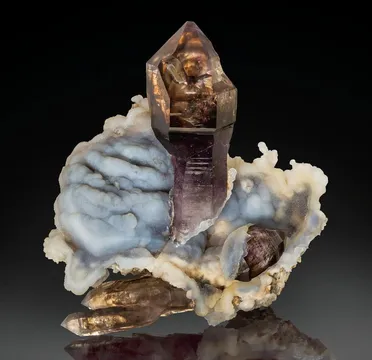
The best-known pocket characteristics are highly specific. Small loose crystals are common, especially under 3 cm. Larger crystals over 20 cm are much scarcer, and crystals exceeding 30 cm are exceptional. Doubly terminated floaters are common enough to be part of the locality’s identity, but undamaged, lustrous, transparent floaters with strong amethyst or smoky zoning command far more attention. Matrix specimens are comparatively rare because geodes are difficult to remove intact from hard basalt; many crystals were historically broken free from cavity walls rather than extracted with host rock. Where basalt is weathered or chemically altered, partial geodes and matrix plates can be recovered, but complete, aesthetic matrix pieces are still special.
Quartz from Brandberg Area is essentially the collector’s shorthand for Goboboseb quartz: lustrous, transparent to translucent crystals from basalt geodes around Tafelkop, commonly as loose floaters, doubly terminated crystals, scepters, reverse scepters, fenster forms, and small clusters, with matrix pieces scarcer because the hard basalt seldom releases geodes cleanly. Colorless rock crystal, amethyst, smoky quartz, brown clay-included window quartz, and hematite-included quartz intergrade on the same specimens, so the best pieces are judged less by bulk size alone than by internal architecture: sharp phantom boundaries, centered scepter heads, moving fluid inclusions, bright luster, minimal bruising, and the clean optical contrast that lets violet, smoky, red, black, or clay zones appear suspended inside the crystal. Small crystals under 3 cm are abundant; cabinet-sized crystals are collectible; crystals over 20 cm are notable; and the exceptional large single crystals reported from major collections, including examples around 35 cm, represent the high end of the locality.
Amethyst from the Brandberg Area is prized for delicacy and depth rather than the massive saturated geode linings familiar from Brazil or Uruguay: crystals commonly show violet caps, phantom layers, internal ribbons, sceptered growth, reverse scepters, and transitions into colorless or smoky quartz, with hematite specks and fluid inclusions adding much of the character. Dark purple material was documented as early as the 1930s, while the modern collector supply comes mainly from Goboboseb and Tafelkop workings active from the 1980s onward; most pieces are thumbnails, miniatures, or small cabinet specimens, though larger matrix and floater crystals occur. Ordinary examples are pale, contacted, internally fractured, or merely purple, while the superior pieces are transparent, glassy, sharply terminated, color-zoned in a way that reveals multiple growth episodes, and ideally enhanced by a moving bubble, a clean amethyst phantom, an elegant scepter, or natural association with calcite, prehnite, analcime, or hematite inclusions.
Smoky quartz from Brandberg Area is rarely just a brown crystal; the most desirable Goboboseb pieces are smoky-amethyst or smoky-clear combinations, often doubly terminated, with smoky zones forming phantoms, basal clouds, scepter stems, or caps against amethyst and rock-crystal growth. The smoky color may appear gray, brown, or tea-colored, sometimes in the same specimen as violet amethyst and red or black hematite veils, and the best examples retain high transparency so the smoke reads as internal zoning rather than murkiness. Good smoky quartz here is sharply formed, bright, and undamaged; better pieces carry balanced scepter or reverse-scepter habit; and the top collector grade combines smoky zoning with amethyst, visible vapor tubes or negative-crystal inclusions, a mobile bubble, and enough clarity that the entire sequence of growth can be read through the prism.
Prehnite from Brandberg Area, chiefly the Goboboseb–Tafelkop/Copper Valley sector, ranks among the locality’s great companion specialties: it forms spherical to subspherical whorls and clustered balls, typically 1–10 cm across, in pale to medium apple-green and occasional aquamarine blue-green shades, with the best specimens showing a satiny to highly lustrous surface rather than chalky or bleached skin. The productive prehnite pockets are not exactly the same as the main amethyst pockets, which is why large prehnite balls with equally important amethyst crystals are uncommon; more typical associations include calcite, colorless quartz, epidote, analcime, and rarely babingtonite. Fresh color is critical, because exposed prehnite can fade toward pale green or colorless, and some acid-cleaned pieces acquire dull luster or yellow iron staining, so superior examples combine lively green color, intact globular form, crisp sparkling crystal faces, clean association, and no evidence of overcleaning.
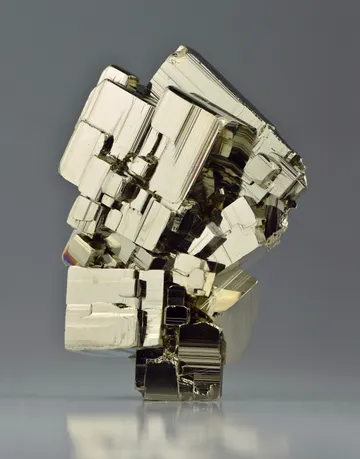
Other minerals documented from Brandberg Area broaden the locality far beyond the four market species. In the Goboboseb basalt cavities, analcime occurs as white trapezohedra with prehnite, quartz, calcite, and heulandite; calcite forms drusy scalenohedral coatings and cavity linings; chalcedony lines some geodes; epidote appears as dark green to black small crystals or radiating aggregates; hematite is especially important as red, black, or metallic inclusions and phantom-defining platelets in quartz; siderite occurs as chocolate-brown rhombs; and rare or unusual accessories include babingtonite, barite, gypsum, heulandite, laumontite, pumpellyite-subgroup material, pyrite, chrysocolla, and native copper from the Copper Valley area. The larger Brandberg umbrella also includes rare-metal minerals from the Amis Complex, including aegirine, arfvedsonite, bastnäsite-group and pyrochlore-supergroup material, dalyite, yttrofluorite, zirconium-niobium-rare-earth assemblages, and Mindat’s first-recorded-locality entry for the unapproved pyrochlore-supergroup name fluorkenopyrochlore; these are scientifically interesting but generally not the aesthetic cabinet pieces that made “Brandberg” famous.
The central authenticity issue is locality precision. Many labels still say simply “Brandberg,” “Brandberg amethyst,” or “Brandberg quartz.” That wording is historically entrenched but incomplete. For most classic quartz, amethyst, smoky quartz, and prehnite specimens on the market, the more precise label is Goboboseb Mountains, Brandberg Area, Dâures Constituency, Erongo Region, Namibia. Older labels should be preserved because they document collecting history, but a modern collection should add the Goboboseb clarification when supported by specimen habit, dealer record, or provenance.
The second issue is confusion between Brandberg Mountain proper and the surrounding Brandberg Area. Brandberg Mountain is a national monument and cultural landscape famous for rock art; published mineral-locality work explicitly separates that protected massif from the Goboboseb specimen fields west of it. A claim that a recent commercial specimen was dug from Brandberg Mountain itself should be treated with caution unless supported by unusually strong documentation.
There is no need to assume that smoky-amethyst zoning, red inclusions, or bubbles are artificial. Those are defining traits of the locality. Natural combinations of amethyst, smoky quartz, colorless quartz, clay-included fenster quartz, hematite inclusions, vapor tubes, and fluid inclusions are well documented from Goboboseb. The collector’s task is not to reject complexity, but to distinguish natural internal features from repairs, glued breaks, buffed faces, and exaggerated metaphysical marketing.
Treatment concerns are mostly practical rather than epidemic. Quartz can be heated or irradiated in the general mineral trade, and amethyst and smoky quartz are both color-sensitive under enough heat, but the documented Brandberg/Goboboseb assemblage is naturally zoned. Be skeptical of unnaturally uniform, inky, or oddly surface-concentrated color, but remember that genuine pieces often have very sharp internal zoning. Strong magnification and backlighting are useful: natural phantoms and inclusions continue through growth zones, while dye, coatings, or resin repairs tend to sit in cracks or along surfaces.
Repairs and restorations do occur, especially on fine scepters, large crystals, and matrix pieces. The locality’s crystals can be slender, doubly terminated, and internally fractured, and matrix specimens are difficult to extract from hard basalt. A clean, centered scepter head on matrix is worth close inspection at the stem, attachment point, and termination. Use shortwave and longwave UV cautiously as a repair-checking tool rather than expecting diagnostic fluorescence from the quartz itself; adhesives may fluoresce even when the mineral does not.
Condition is a major value factor. Typical problems include bruised terminations, broken side crystals, rehealed-looking but actually damaged contact areas, iron staining, overetched surfaces, and prehnite dulled by cleaning. On quartz, minor internal veils are part of the locality’s appeal and should not be confused with damage. On prehnite, however, chalky luster, bleached color, or yellow redeposited iron can sharply reduce desirability. Calcite associated with prehnite may have been dissolved during cleaning, so matrix context and paragenesis can be lost on otherwise attractive specimens.
Market availability remains good for small to medium quartz and amethyst crystals, including floaters and pale smoky-amethyst combinations. Better pieces are far more selective: large undamaged crystals, strongly colored amethyst, elegant scepters, moving enhydros, transparent smoky-amethyst combinations, and attractive matrix examples are all increasingly competitive. Prehnite is available but the best apple-green, lustrous, undamaged balls or geodes are much less common than modest pale pieces. The locality is not exhausted, but the easy supply of superb, inexpensive “Brandberg” quartz is long gone.
In the field, Brandberg is a place where the name itself plays tricks. The mountain dominates the desert visually and culturally, glowing red enough at sunrise and sunset to earn its “fire mountain” associations, but the collector’s road leads westward, toward the flatter-topped Goboboseb hills. Tafelkop comes into view as a landmark on the horizon. The route from Uis follows the C35 toward Henties Bay, then the D2342 toward the old Brandberg West mine, before minor tracks branch off toward the diggings. Older field notes describe local miners using improvised signposts marked with crystal drawings, a charmingly practical solution in a harsh landscape of gravel, basalt boulders, and dry washes.
The classic approach to the diggings passes Welwitschia mirabilis plants in a dry wash, then climbs into the dark volcanic terrain at Tafelkop. The geology is not hidden beneath soil; it is exposed in broken, sun-struck stone. In one 2005 field visit, the authors found the human traces of mining as conspicuous as the geology: informal Damara diggers’ shelters, a newer camp connected with Johann Cotze, and Ras Greeff’s house about a kilometer from the diggers’ village. In such a barren landscape, any habitation stands out. The surface was described as virtually vegetation-free rubble weathered out of the lavas over immense time.
The same visit recorded a rhythm of desert labor that collectors should remember when handling a polished show label in an air-conditioned room. The party arrived just before midday, with the temperature already in the mid-30s Celsius. At first the settlement looked deserted. Then people emerged gradually from their shelters. Breaking hard basalt in that heat was not sensible, so digging happened mainly early in the morning and late in the afternoon. Specimens for sale appeared not in velvet trays but in cardboard beer flats: one box might hold smoky quartz, another pale amethyst. The scene was orderly, with miners waiting their turn rather than overwhelming the visitors.
The crystals themselves carried the day. In 2005, new material included Herkimer-like quartz on drusy white quartz, a style the authors had not seen there before, along with pale amethyst, colorless quartz, darker amethyst, color-zoned amethyst, smoky crystals, scepters, and reverse scepters. The largest crystal offered to them was about 20 cm, while most available pieces were miniatures to cabinet-sized. The field report is also a useful corrective to one persistent myth: the diggers were not uniformly asking impossible prices. Bargaining was part of the exchange, but very nice specimens could still be bought fairly at the source.
The history of the locality has its own lost chapter. Menzer’s 1936 amethysts, received from Brusius of Idar-Oberstein, were reportedly dark purple, suitable for jewelry, zoned, and visibly included with fluid. Menzer donated Brandberg crystals to the Museum of Natural History in Berlin, but later workers could no longer locate them. They may have been lost during the Allied bombing of World War II, or their labels may have disappeared. For collectors, that is a sobering reminder that a specimen without its label can be almost as lost as a specimen destroyed.
Another practical story explains why Brandberg matrix is rarer than the quantity of loose crystals might suggest. In the Palfi–Greeff workings visited in 2005, the miners were drilling and jackhammering into basalt. Once the weathered skin and crystals had been removed, fresh basalt was extremely hard and resistant. Crystals were commonly recovered as singles, small groups, or pieces pried from vugs on slabs. Andreas Palfi was considering portable diamond saws to cut geodes from the rock, an idea that any collector of matrix quartz can appreciate: the prize was not simply finding crystals, but finding a way to remove them without destroying their geological stage.
Prehnite has its own field rule: the good green must be found fresh. At the prehnite workings west of Tafelkop, older excavation scars marked where pockets had already been opened. Published field observations noted that newly opened cavities were needed for good green prehnite because sun-exposed material soon became bleached and pale. That small fact explains much about the market. A vivid apple-green ball is not merely a pretty object; it is a specimen rescued before the desert light could drain its color.
Bruce Cairncross and Uli Bahmann, “Minerals from the Goboboseb Mountains: Brandberg Region, Namibia,” Rocks & Minerals, 81(6), 442–457, 2006 — The essential collector-oriented paper for Goboboseb quartz, amethyst, prehnite, associated minerals, field access, and production history.
Marta Sośnicka, Samuel Niedermann, Rudolph Erasmus, and Sharad Master, “Fluid systems captured by giant amethyst-hosted fluid inclusions from continental flood basalts,” Geochimica et Cosmochimica Acta, 399, 171–190, 2025 — Modern fluid-inclusion study of Goboboseb amethyst and quartz, including noble-gas evidence and links to Paraná–Etendeka flood-basalt magmatic-hydrothermal systems.
Marta Sosnicka, Samuel Niedermann, Rudolph Erasmus, and Sharad Master, research dataset for “Fluid systems captured by giant amethyst-hosted fluid inclusions from continental flood basalts,” Mendeley Data, Version 1, 2025 — Supporting data for fluid inclusions, gas compositions, salinities, homogenization temperatures, and related basalt geochemistry.
Michael Diehl, “Geology, mineralogy, geochemistry and hydrothermal alteration of the Brandberg Alkaline Complex, Namibia,” 1989 — Foundational study of the Brandberg Complex, hydrothermal alteration, and Zn, Sn, Nb, Y, and REE mineralization, with special relevance to the Amis Complex.
Axel K. Schmitt, Robert B. Trumbull, Peter Dulski, and Rolf Emmermann, “Zr-Nb-REE Mineralization in Peralkaline Granites from the Amis Complex, Brandberg (Namibia): Evidence for Magmatic Pre-enrichment from Melt Inclusions,” Economic Geology, 97(2), 399–413, 2002 — Key paper on rare-metal enrichment in the Amis peralkaline granites and pegmatitic/aplitic rocks.
Yi Sun, Gengxin Deng, Dingsheng Jiang, Ewa Krymarys, and Olivier Bachmann, “Igneous, hydrothermal, or both? Exploring the origin of pegmatites and aplites at the Amis intrusion, Namibia,” Geosphere, 2025 — Recent study of the late-stage Amis center associated with the Early Cretaceous Brandberg pluton.
Namibia Geological Survey / Ministry of Mines and Energy, “Brandberg,” Roadside Geology of Namibia leaflet — Concise official geological summary of Brandberg, Messum, Goboboseb, and the regional Gondwana-breakup setting.
“Gondwanaland Geopark,” Geological Survey / EIS PDF — Regional mineral-resource guide noting Goboboseb amethyst, smoky quartz, Etendeka volcanic cavities, and visible fluid inclusions.
Green Gain Consultants cc, “Environmental Impact Assessment Study and Environmental Management Plans for Goboboseb Small-Scale Mining Hotspot in Erongo Region,” Background Information Document, 2020 — Useful contemporary source on small-scale mining, land tenure, environmental context, and artisanal to semi-mechanized extraction at Goboboseb.
Robert B. Cook, “Connoisseur’s Choice: Prehnite, Brandberg, Namibia,” Rocks & Minerals, 74(3), 178–180, 1999 — Frequently cited short treatment of the locality’s prehnite significance.
J. Henn, “Amethyst von Brandberg, Namibia,” Lapis, 10, 44–48, 1993 — German collector reference on Brandberg/Goboboseb amethyst.
G. Menzer, “Über Amethyste von Brandberg in Deutsch-Südwestafrika,” Zentralblatt für Mineralogie, Geologie und Paläontologie, Abt. A, 289–290, 1936 — Early published notice of Brandberg-area amethyst.
S. C. Milner and A. Ewart, “The geology of the Goboboseb Mountain volcanics and their relationship to the Messum Complex, Namibia,” Communications of the Geological Survey of Namibia, 5, 31–40, 1989 — Geological basis for the Goboboseb volcanic succession and its relation to Messum.
A. Ewart, S. G. Milner, R. A. Armstrong, and A. R. Duncan, “Etendeka volcanism of the Goboboseb Mountains and the Messum Igneous Complex, Namibia. Part 1: Geochemical evidence of Early Cretaceous Tristan plume melts and the role of crustal contamination in the Paraná–Etendeka CFB,” Journal of Petrology, 39, 191–225, 1998 — Major geochemical paper on the regional volcanic system.
A. Ewart, S. G. Milner, R. A. Armstrong, and A. R. Duncan, “Etendeka volcanism of the Goboboseb Mountains and the Messum Igneous Complex, Namibia. Part 2: Voluminous quartz latite volcanism of the Awahab magma system,” Journal of Petrology, 39, 227–253, 1998 — Companion study on the quartz-latite volcanism surrounding the collector locality.
“Inside Goboboseb: Amethyst mining in Namibia's remote mountains.” — Riaan and Silke Fraser — Field video centered on amethyst mining in the Goboboseb Mountains.
“Small Scale Miners - Geopark Brandberg” — YouTube — Short media piece on Goboboseb small miners and the proposed visitor-oriented mining initiative in the Brandberg West/Tsiseb conservancy area.
“Amethyst with Prehnite - Goboboseb Mountains, Brandberg Area,, Erongo Region, Namibia” — Vimeo — Specimen video showing the amethyst–prehnite association from the locality.
Mindat: Brandberg Area, Dâures Constituency, Erongo Region, Namibia — Broad locality umbrella for Brandberg Area, including sublocalities, mineral list, commodities, and the important label note separating Brandberg proper from Goboboseb production.
Mindat: Goboboseb Mountains, Brandberg Area, Namibia — Core locality page for the classic quartz, amethyst, smoky quartz, and prehnite-producing Goboboseb Mountains.
Mindat: Amethyst from Goboboseb Mountains — Species occurrence page with associated minerals and photo links for Goboboseb amethyst.
Mindat: Prehnite from Goboboseb Mountains — Species occurrence page focused on prehnite and its quartz–amethyst associations.
Mindat: Brandberg West Mine — Reference page for the Brandberg Area tin–tungsten mine and its quartz–sulfide–cassiterite–wolframite vein mineralization.
Mindat: Amis Complex — Useful entry for the peralkaline rare-metal side of the Brandberg Area, including Zr–Nb–REE mineralization.
UNESCO World Heritage Centre: Brandberg National Monument Area — Cultural and natural context for Brandberg Mountain, including its national monument status, rock art, biodiversity, and geological setting.
Wikimedia Commons: Quartz-174616.jpg — Freely licensed image and data page for a 5.0 cm Goboboseb amethyst quartz crystal photographed by Rob Lavinsky.
Wikimedia Commons: Brandberg Mountain Panorama.jpg — Freely licensed panoramic view of the Brandberg Massif by Joel Holdsworth.
Minerals from the Goboboseb Mountains: Brandberg Region, Namibia — Full PDF of the key Rocks & Minerals locality article by Bruce Cairncross and Uli Bahmann.
Goboboseb Small-Scale Mining Hotspot EIA Background Information Document — Contemporary environmental and social context for small-scale mining at Goboboseb.
Fluid systems captured by giant amethyst-hosted fluid inclusions from continental flood basalts — Scientific article page for the 2025 fluid-inclusion study of Goboboseb amethyst and quartz.
Zr-Nb-REE mineralization in peralkaline granites from the Amis Complex, Brandberg — GFZ record for the Schmitt, Trumbull, Dulski, and Emmermann paper on Amis rare-metal mineralization.