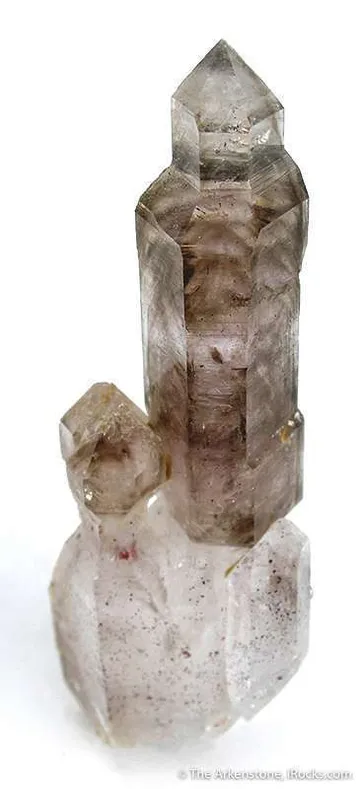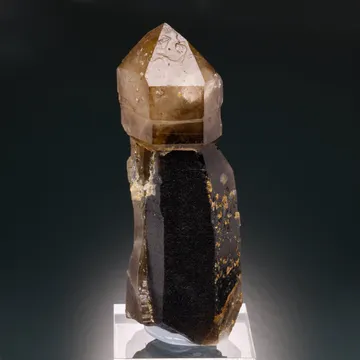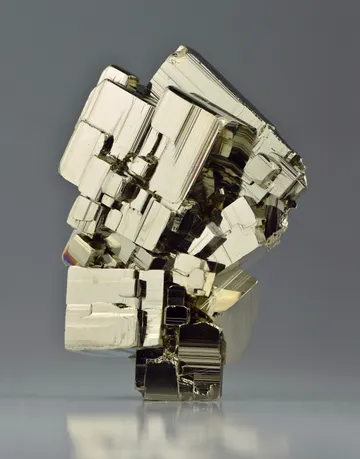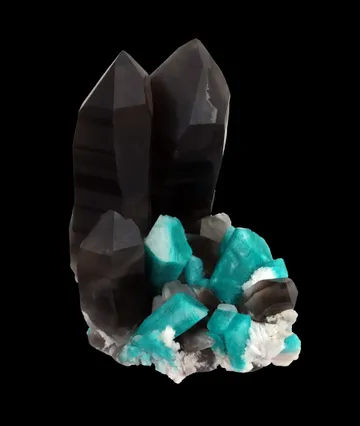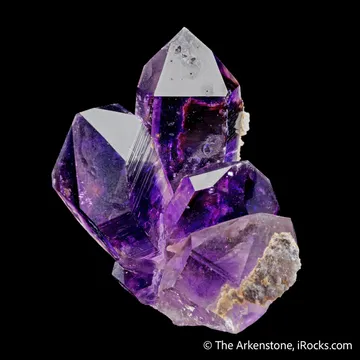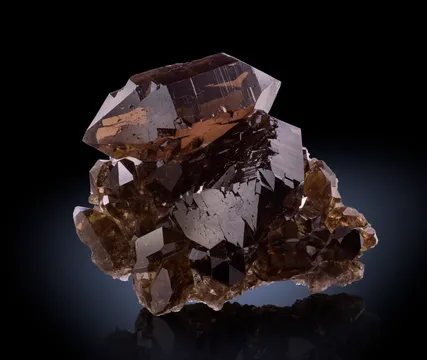
Goboboseb Mountains, Namibia — smoky quartz with glassy luster, zoning, amethyst phantoms, and floater crystals from basalt cavities; prized by collectors.
Key facts
Smoky-quartz from the Goboboseb Mountains is best understood as part of the famous “Brandberg” quartz tradition, but the collector’s label needs care: the major production of show-quality smoky, amethyst, rock-crystal, scepter, and fenster quartz comes not from the protected Brandberg Mountain itself, but from the Goboboseb Mountains west of Brandberg, especially Tafelkop and surrounding basalt outcrops. The trade name Brandberg persists because it is old, convenient, and widely recognized; a precise modern label should read Goboboseb Mountains, Brandberg Area, Erongo Region, Namibia.
What makes the material distinctive is not simply a brown smoky color. The best crystals combine glassy luster, high transparency, pale-to-medium smoky zoning, amethyst phantoms, hematite veils, clay inclusions, vapor tubes, and moving or stationary liquid-vapor inclusions. Many pieces have the visual depth of a small optical instrument: a clear outer crystal enclosing wisps, windows, scepters, reverse scepters, and smoky-amethyst growth stages that seem to float in three dimensions. A good Goboboseb smoky-quartz crystal is often more about architecture and internal history than mass or darkness.

Photo: Wikimedia Commons
Geologically, these crystals belong to a volcanic setting rather than the alpine fissures or pegmatites that produce many of the world’s classic smoky quartz. The Goboboseb Mountains are a southern remnant of the Etendeka volcanic province, with basalt and quartz-latite units related to the Messum Complex. The collector-quality quartz occurs in amygdules and geodes in the basalts, from small vesicles to cavities more than a meter across. That origin explains the frequent loose “floater” crystals, the scarcity of matrix specimens, and the recurring association with calcite, prehnite, hematite, chalcedony, epidote, and other low-temperature cavity minerals.
Historically, the locality gained broader collector importance during the late twentieth century, though amethyst from the Brandberg area had been described much earlier. By the 1980s and 1990s, quartz from the Goboboseb Mountains had become a regular presence in international mineral commerce. Today, serious collectors pursue specimens with a precise locality, sharp terminations, undamaged scepters, strong glassy luster, visible smoky-amethyst phantoms, true three-dimensional internal zoning, and, when present, large mobile bubbles or well-defined negative-crystal fluid inclusions.
Search for specimens: View all smoky-quartz specimens from Goboboseb Mountains, Namibia
The smoky-quartz locality lies in the Goboboseb Mountains west of the main Brandberg massif, in the broader Brandberg Area of Namibia’s Erongo Region. Tafelkop, the flat-topped hill whose name means “Table Mountain,” is the key landmark in the specimen-producing district, and many of the best-known quartz and prehnite diggings lie on or near the basalt hills around it. The landscape is dry, open, stony, and exposed; any settlement, track, or working is immediately conspicuous against the rubble-strewn volcanic ground.
The deposit type is volcanic cavity mineralization in amygdaloidal basalt. The productive host is the Tafelkop Basalt Member, a roughly 250-meter-thick succession of superimposed basalt flows. Some flow tops are amygdaloidal, and the amygdules range from millimeters to geodes over one meter across. These cavities furnished the open space in which quartz, amethyst, smoky quartz, calcite, prehnite, hematite, chalcedony, and related species crystallized. Above the Tafelkop basalts are quartz-latite flows of the Goboboseb Quartz Latite Member, with the overall volcanic pile belonging to the Early Cretaceous Etendeka Group.
The regional geology is larger than the individual pockets suggest. The Goboboseb volcanic sequence includes basalts and quartz latites associated with the Messum Complex, a major igneous center to the south. Geological work has interpreted the Goboboseb volcanics as part of the Messum volcanic system, with the quartz latites representing high-temperature rheoignimbrites and proximal eruptive products. For the collector, the practical consequence is that the quartz pockets are not random vein occurrences: they are tied to vesicular volcanic flow tops and later low-temperature mineralizing fluids moving through the basalt.
Access has traditionally been by dirt roads from Uis toward the old Brandberg West mine, then by narrower tracks toward Tafelkop. The country is rough enough that high ground clearance is strongly preferable, and the old locality literature stresses water, tire care, and heat. Summer temperatures can exceed 40°C, and the 70-kilometer supply connection to Uis has shaped the way local diggers live and work at the site. The actual digging has been, and largely remains, small-scale: hand tools, sledgehammers, chisels, crowbars, and at times jackhammers supplied by dealers or claim operators.
The history of discovery has several layers. Amethyst west of Brandberg has been attributed to Gawie Cloete in the 1950s, although substantial collecting is reported later. Even earlier, German mineralogist G. Menzer described amethyst from the Brandberg area in 1936, after receiving crystals through Idar-Oberstein connections; those crystals were said to have dark purple color, zoning, and fluid inclusions. Specimens were donated to the Museum of Natural History in Berlin, but later workers were unable to locate them, perhaps because of wartime loss or lost labels. Between the late 1930s and the 1980s only occasional specimens reached collectors, then legal claims and more systematic working by Cloete, Hartman, Raath, Greeff, Bachran, and others brought the locality into broader commerce.
Production has never been a neat industrial story. Some ground was legally pegged; some areas were claim-jumped; some legal holders left; some local Damara diggers continued independently; and some later operations coordinated local labor under claim holders. By 2005, named workers and organizers included Andreas Palfi and Ras Greeff, who were systematically excavating and drilling into claimed outcrop. Gert Bachran was also documented at a camp in the Tafelkop foothills and had first mined specimens there in 1990. The mode of production explains why many specimens are singles, floaters, and small clusters rather than broad plates: the basalt is hard, matrix is stubborn, and liberating a full geode intact is difficult.
Notable finds include doubly terminated crystals, scepters, reverse scepters, double-ended scepters, Japan-law twins, faden-like forms, fenster crystals with clay inclusions, and crystals with dramatic smoky-amethyst zoning. Large crystals over 30 cm are occasional rather than routine; the literature records a single crystal in the Desmond Sacco collection measuring 35 cm. Most specimens offered to visiting collectors were cabinet to miniature size, and one documented 2005 buying visit saw a largest offered crystal of about 20 cm. That range remains important for market expectations: Goboboseb can produce substantial smoky quartz, but the locality’s finest value is often in form, clarity, zoning, and internal detail rather than sheer bulk.
Goboboseb smoky-quartz is typically SiO2 in crystals ranging from colorless through pale gray-brown to deeper smoky brown, often sharing a single crystal with amethyst zones. The smoky color may appear as edge shading, phantom planes, cloudy wisps, basal zones, or a darker scepter head over a clearer or amethystine stem. Many crystals are not uniformly smoky; the most recognizable specimens show separate growth episodes, with smoky quartz, rock crystal, amethyst, and hematite-included quartz stacked or nested inside one another.
The classic habits are unusually varied. Simple prismatic crystals occur, but collectors prize doubly terminated crystals, scepters, reverse scepters, skeletal and fenster crystals, flattened or tabular forms, and complex multiple-generation growth. Some crystals have etched or corroded faces; some have window-like skeletal recesses; some show parallel vapor tubes or internal veils. A particularly desirable look is a transparent smoky scepter on an amethyst or milky quartz stalk, especially where the scepter head preserves a visible amethyst phantom or smoky zoning at the base.
Crystal size spans a broad range. Crystals under 3 cm are common and generally more available. Fine small-cabinet crystals around 5–10 cm are a mainstay of the market and often show the best balance of clarity, form, and affordability. Crystals over 20 cm are much less common; examples over 30 cm are exceptional, and the recorded 35 cm Sacco-collection crystal is a benchmark for size. Matrix pieces are scarcer than loose crystals because the basalt matrix holds tenaciously and is difficult to remove without damaging the quartz.
Fluid inclusions are one of the great Goboboseb signatures. The quartz may contain abundant liquid-vapor inclusions, from microscopic inclusions to bubbles visible to the naked eye. Published fluid-inclusion work on Goboboseb quartz found aqueous inclusions with vapor bubbles, some in negative quartz-crystal shapes, with salinity around 5 weight percent NaCl and homogenization near 201°C. For collectors, this translates into the practical fascination of mobile “water bubbles,” milky basal zones made by countless inclusions, and interior textures that give the crystal life under a loupe.
Hematite is another key inclusion mineral. It does not usually occur as large independent crystals at Goboboseb; rather, it appears as minute platelets, veils, phantoms, red flecks, black or silver inclusions, and streamers inside quartz. Red hematite in water-clear quartz is especially attractive, and smoky-amethyst crystals with red specks can be very locality-characteristic. Clay inclusions are also common in fenster and skeletal examples, giving warm golden-brown internal stains that contrast with glassy smoky faces.
Associated minerals documented from the broader Goboboseb/Tafelkop system include amethyst, rock crystal, chalcedony, calcite, prehnite, hematite, epidote, analcime, celadonite or chlorite-like green crusts, barite, gypsum, siderite, native copper, goethite, and rarer babingtonite and pumpellyite. Prehnite is a premier Goboboseb mineral in its own right, but large, showy quartz-prehnite combinations are not common; small prehnite balls or partial coatings on quartz are more realistic expectations. Calcite may occur as drusy linings in amethyst geodes, though it is often absent from cleaned quartz specimens.
Quality is judged by the same broad criteria used for great quartz, but with locality-specific emphasis. Look first for undamaged terminations, sharp edges, high vitreous luster, and transparency. Then evaluate the internal picture: crisp smoky or amethyst phantoms, visible zoning, well-placed hematite, uncluttered vapor veils, and any moving bubble. Good fenster pieces should have intentional-looking skeletal architecture rather than random breakage or heavily abraded etching. A top specimen should reward rotation: the form, color, and inclusions should change as the crystal turns, not disappear after one display angle.
The most important authenticity issue is locality precision. Many specimens are still sold as “Brandberg quartz,” “Brandberg amethyst,” or “Brandberg smoky quartz,” but most show specimens in the trade are properly Goboboseb Mountains material from west of the Brandberg Mountain, especially around Tafelkop. True collecting on Brandberg Mountain itself is a different matter because the mountain is a national monument, and published locality work explicitly notes that clandestine collecting there is illegal. A careful collector should preserve older Brandberg labels but, where evidence supports it, add a modern clarification: Goboboseb Mountains, Brandberg Area, Erongo Region, Namibia.
There is no need to be suspicious of every smoky-amethyst combination from this locality; mixed smoky, clear, amethyst, and hematite-included zones are one of the defining Goboboseb traits. Similarly, bubbles, vapor tubes, negative crystals, clay inclusions, and internal veils are not automatic signs of damage or manufacturing. They are common natural features in the locality’s quartz and are among the reasons these specimens are desirable.
Condition, however, needs close inspection. Loose crystals may have been snapped from matrix, so basal contacts, broken attachment points, and small bruises near the base are common. Termination chips can hide against smoky zoning or internal veils. Fenster crystals require special care: what looks like skeletal growth should be distinguished from damaged faces, bruised windows, and cleaved-looking breaks. On matrix specimens, check whether quartz has been glued back to basalt or whether a crystal is merely sitting in a reconstructed pocket.
Treatments are less a Goboboseb-specific scandal than a general smoky-quartz concern. Artificial irradiation can darken quartz worldwide, and heating can alter smoky color, but the verified Goboboseb literature emphasizes natural zoning, fluid inclusions, and cavity growth rather than treatment. For this locality, a credible specimen should have a coherent paragenesis: glassy to slightly etched faces, natural smoky-amethyst zoning, plausible clay or hematite inclusions, and a trustworthy chain of labels from a known dealer, collection, or field source. Be cautious with oddly uniform, very dark material lacking the clarity, zoning, or habit expected from Goboboseb.
Market availability is steady but uneven. Small loose smoky or smoky-amethyst crystals remain available, while high-end scepters, complete floaters, large mobile-bubble specimens, sharp fenster forms, and matrix pieces are much more selective. Recent market examples show small-cabinet and cabinet specimens appearing through specialist dealers and auctions, from modest single crystals to multi-thousand-dollar smoky-amethyst clusters with strong zoning or unusual inclusions. The best buying opportunities are often not the darkest crystals, but the most legible ones: pieces where the smoky zones, amethyst phantoms, hematite, and fluid inclusions can be read cleanly without excessive fractures.
The drive into the Goboboseb diggings reads like a field guide to mineral collecting in desert volcanic country. From Uis, the road toward the old Brandberg West mine passes between the Brandberg massif to the east and the Goboboseb Mountains to the west. Tafelkop rises ahead as a flat-topped landmark. Somewhere along the route, the formal road gives way to narrower tracks, and at times the directions were marked not by signs of the usual sort but by “ingenious crystal drawings” placed by local diggers to guide visitors toward the pockets.
Near Tafelkop, the field changes from landscape to workings. The diggers’ dwellings were described as basic shelters of plastic sheeting over wooden frames, scattered along the foothills and surrounding hills. Food and water had to come from Uis, 70 kilometers away. The cavities were in hard basalt, and the tools were direct and physical: sledgehammers, chisels, crowbars, and whatever else could break a pocket open. Compressors and jackhammers had been used at times, usually when dealers supplied them, but the essential reality of the locality was hand work in heat and stone.
A 2005 visit by Bruce Cairncross and Uli Bahmann captured the rhythm of specimen production in a way that still feels immediate. They arrived just before midday, when the temperature was already in the mid-30s Celsius. At first the settlement looked deserted. Then people began emerging from their shelters. The reason was simple: the middle of the day was no time to smash hard basalt. Digging happened in the early morning and late afternoon, when the heat eased enough to work.
The buying scene was orderly rather than chaotic. Diggers approached with “cardboard beer flats” holding crystals for sale: smoky quartz in one box, pale amethyst in another. Cairncross and Bahmann noted that each seller waited his turn instead of overwhelming the visitors. The stock on that visit gives a valuable snapshot of production: pale amethyst, colorless quartz, relatively dark amethyst, color-zoned amethyst, smoky crystals, and a few oddities with scepters and reverse scepters. The largest crystal offered was about 20 cm, but most were miniature to cabinet size.
The same visit also records the more organized side of the locality. Gert Bachran had a camp at the foothills of Tafelkop and had first mined specimens there in 1990. Andreas Palfi and Ras Greeff had a camp on the lower slopes of a hill where they were excavating for amethyst. Matrix specimens remained scarce because removing whole geodes from the basalt was nearly impossible with ordinary methods. Their finds were more often single crystals, small groups, or slabs pried from vugs. Palfi was considering portable diamond saws to cut geodes out of the rock — a telling detail, because it shows exactly why broad, undamaged matrix plates from Goboboseb are the exception rather than the rule.
The older history has its own lost-and-found romance. Menzer’s 1936 amethyst crystals, received through Herrn Brusius of Idar-Oberstein, were described as dark purple and jewelry-suitable, with typical zoning and visible fluid inclusions. Menzer donated Brandberg-area crystals to the Museum of Natural History in Berlin, but later researchers could not locate them. They may have been destroyed during Allied bombing in World War II, or they may simply have lost their labels. Either way, the absence is part of the locality’s story: a prewar glimpse of what later collectors would come to prize, now represented only by literature and memory.
Bruce Cairncross & Uli Bahmann, “Minerals from the Goboboseb Mountains: Brandberg Region, Namibia,” Rocks & Minerals 81:6, 442–457, 2006. DOI: 10.3200/RMIN.81.6.442-457 — The essential locality article for collectors, covering geology, access, production history, habits, inclusions, associated minerals, and the 2005 collecting update.
S. C. Milner & A. Ewart, “The geology of the Goboboseb Mountain volcanics and their relationship to the Messum Complex, Namibia,” Communications of the Geological Survey of Namibia 5, 33–42, 1989 — Primary geological treatment of the Goboboseb volcanic succession and its relationship to the Messum Complex.
Mindat occurrence record: Smoky Quartz from Goboboseb Mountains, Brandberg Area, Dâures Constituency, Erongo Region, Namibia — Species-level occurrence page with associated-mineral data and photo references.
Mindat locality page: Tafelkop, Goboboseb Mountains, Brandberg Area, Dâures Constituency, Erongo Region, Namibia — Useful for the Tafelkop sublocality and its mineral list.
Wikimedia Commons file: Quartz-274998.jpg — Rob Lavinsky photograph of a 7.4 x 5.4 x 3.7 cm smoky/amethyst quartz crystal from Goboboseb, licensed CC BY-SA 3.0.
EarthWonders specimen record: Quartz (Var: Smoky Quartz), Quartz (Var: Amethyst), Goboboseb Mountains — A documented market example with dimensions, provenance, and descriptive notes matching the Wikimedia image.
Documented private-collection records in Cairncross & Bahmann include a 35 cm quartz crystal in the Desmond Sacco collection, large and unusual sceptered forms in the Uli Bahmann and Herbert Haug collections, and published examples of doubly terminated, doubly sceptered, fenster, hematite-included, and fluid-inclusion-rich Goboboseb quartz.
Cairncross & Bahmann also note a public display specimen from the broader Goboboseb/Copper Valley area: an arborescent native copper specimen with drusy quartz in the Geological Survey of Namibia Museum, Windhoek.
Quartz / Amethyst (doubly-terminated with water bubble!) — MineralAuctions / iRocks — Video linked from a MineralAuctions listing to show a moving bubble in a Goboboseb quartz-amethyst crystal.
スモーキークォーツ〖Smoky Quartz〗ナミビア産 — PEANUTS MINERALS — Dealer video linked from a Japanese listing for a 61 x 34 x 23 mm smoky-quartz specimen from the Goboboseb Mountains.
Quartz / Amethyst (doubly-terminated with water bubble!) listing — MineralAuctions — Listing page documenting the specimen, locality, Paul Zerfass provenance, and the associated bubble video.
Quartz, Amethyst, Smoky Quartz and water bubble — MineralAuctions — Auction record describing stacked smoky and amethyst phantoms plus fluid and gas bubbles in a Goboboseb crystal.
Minerals from the Goboboseb Mountains: Brandberg Region, Namibia — The best single collector-oriented reference for Goboboseb quartz, prehnite, locality history, and field conditions.
The geology of the Goboboseb Mountain volcanics and their relationship to the Messum Complex, Namibia — Technical geological foundation for the volcanic setting of the locality.
Mindat: Smoky Quartz from Goboboseb Mountains — Quick reference for occurrence validation, associated minerals, and photo data.
Mindat: Tafelkop, Goboboseb Mountains — Sublocality page for the key Tafelkop producing area.
Mindat photo gallery: Goboboseb Mountains — A broad visual survey of quartz, amethyst, smoky quartz, prehnite, and associated species from the district.
Wikimedia Commons: Quartz-274998.jpg — Open-license image page for a representative smoky/amethyst Goboboseb quartz crystal.
EarthWonders specimen: Quartz (Var: Smoky Quartz), Quartz (Var: Amethyst) — Documented specimen entry showing the market description, size, and provenance of a representative Goboboseb crystal.
MineralAuctions: Smoky Quartz on Quartz, Goboboseb Mountains — Recent auction record illustrating small-cabinet market availability and pricing.
MineralAuctions: Smoky Quartz scepter, Goboboseb Mountains — Auction record for a cabinet-size sceptered smoky-quartz cluster with fenster faces and clay inclusions.
EarthWonders Goboboseb smoky-quartz search — Current marketplace search for smoky-quartz specimens from the locality.