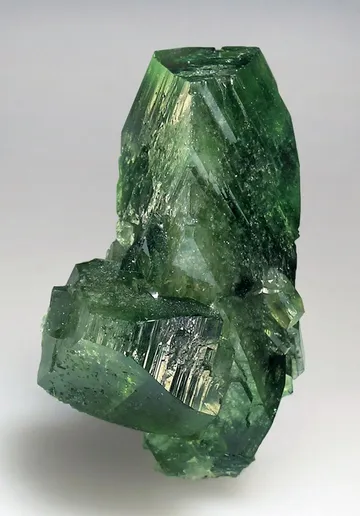
Petersen Mountain, Nevada — Foster Hallman claims pockets yield smoky, amethyst, and citrine-toned sceptered crystals prized by collectors.
Key facts
The Foster Hallman claims are one of the named Nevada sources behind the famous “Hallelujah Junction” quartz reputation: smoky quartz, amethyst, citrine-toned quartz, and compound scepter crystals from pocket-bearing quartz veins on Petersen Mountain near the California–Nevada line north of Reno. For collectors, the claims matter because they produced the kind of quartz that is unmistakably architectural rather than merely pretty—hexagonal smoky stems carrying broader caps, doubly terminated floaters, smoky-amethyst zoning, healed bases, skeletal windows, milky scepter heads, and occasional “candlestick” growth on rare twinned crystals.
The locality’s importance is inseparable from Foster Hallman himself, the Reno fireman and mineral collector whose name became attached to some of the best northern-side claim material. In the broader Petersen Mountain system, quartz occurs in pockets and cavities associated with milky quartz veins cutting granodioritic rock. Those pockets are the whole story: not ore stopes in the usual mining sense, but isolated chambers where changing growth conditions repeatedly overgrew earlier quartz, leaving stalks, caps, phantoms, smoky zones, purple tips, and cloudy internal veils. The best Foster Hallman specimens read like crystallized sequences of events—first a stalk, then a cap, then later color, healing, etching, or a second generation of quartz.
Regional View
Country View
The finest pieces from this claim group are usually judged first by silhouette: a strong scepter profile, an undamaged cap, and enough transparency for smoky gray, violet amethyst, or milky internal zoning to glow when backlit. Some crystals are elegant single scepters; others are heavier, almost weapon-like forms with offset caps, recrystallized backs, and textured or skeletal surfaces. Compared with ordinary loose smoky points, the real claim classics have presence—tall, balanced, and unmistakably American West pocket quartz.

Photo: Wikimedia Commons
Search for specimens: View all specimens from Foster Hallman claims, USA
The Foster Hallman claims are recorded in the Stateline Peak Mining District, Fort Sage Mountains, Washoe County, Nevada, and belong to the broader Petersen Mountain / Hallelujah Junction quartz-collecting field. Older and dealer labels may use “Peterson Mountain,” “Petersen Mountain,” “Hallelujah Junction,” “Foster Hallman Claim,” “Crystal Tips,” “Royal Scepter,” or simply “Nevada,” so precise claim-level labels are especially valuable. “Hallelujah Junction” is the collecting name that stuck, even though the highway junction itself lies down off the mountain in California; the specimen localities are the quartz-producing claims higher on and around Petersen Mountain.
Geologically, this is a quartz-pocket system in granodioritic country rock. The collectible specimens formed in cavities, pockets, and brecciated openings along quartz veins rather than in a conventional metallic ore body. Milky quartz veins are the principal host, and the productive ground is recognized by pockety quartz, alteration selvages, broken vein zones, and decomposed granitic material. In good pockets, later quartz generations overgrew earlier crystals, producing the locality’s signature scepter habit: a narrower stem supporting a larger termination or cap, often with color contrast between the generations.
The ore-body language used for metal mines fits poorly here. The “ore” is specimen quartz, and production depends on intersecting isolated pockets. A small cavity may yield only loose points; a larger one may contain scepters projecting from walls, detached crystals in clay-rich pocket mud, plates of smoky crystals, amethyst-tipped crystals, and mixed smoky-amethyst-citrine pieces. Modern field descriptions from the broader Hallelujah Junction claims emphasize that pockets can be tiny or many feet across, and that once a cavity is exposed, heavy equipment gives way to delicate hand work.
The mineral assemblage documented from the Foster Hallman claims is quartz-centered: quartz, amethyst, and smoky quartz are the core collector species, with citrine reported for the Foster Hallman / Petersen Mountain material in Nevada gemstone references. In the immediately related Petersen Mountain claim system, ametrine, citrine, muscovite, pyrite, and chlorite-group minerals are also recorded from named pits such as Crystal Tips No. 2, while broader Petersen Mountain records include species such as epidote, piemontite, and meta-autunite. For Foster Hallman labels, however, the market and the literature are overwhelmingly about quartz morphology and color zoning.
Mining history here is specimen-mining history. The quartz occurrences on Petersen Mountain were known to collectors by the mid-20th century, and by the early 1980s Jon Johnson and Foster Hallman had staked official claims in the area, with Hallman associated in later accounts with the northern side of the claim block. Hallman worked the mountain for decades and became one of the defining personalities of the locality. The production was never steady industrial output; it came in episodes—claim work, backhoe-assisted digs, club or fee visits, and later partner-operated production whenever the right pocket-bearing ground was opened.
The claim story continued after Hallman’s best-known years. Field accounts and market records document continuing finds into the 2000s and 2010s, including significant smoky-amethyst scepters, doubly terminated crystals, and the 2019 Glass Ceiling Pocket, which produced a 13.1 cm smoky quartz crystal with a 3.2 cm milky scepter from the Foster Hallman claims. Nevada active-mine listings for Petersen Mountain in Washoe County under Hallelujah Partners show that the broader quartz-producing locality remained part of the state’s active mine-reporting landscape into the mid-2020s.
Access should be treated as controlled and permission-based. The productive mountain is covered by multiple claims, and collecting on an active or staked claim without permission is not acceptable. Paid digs and club trips have been offered at times in the broader Hallelujah Junction area, but availability changes with ownership, season, claim work, insurance, road conditions, and safety concerns. The approach roads, especially Greasy Hill Road in field accounts, are steep and can become treacherous when wet; the country is exposed, windy, hot in summer, and short on shade. Serious collectors should regard the locality as private-claim country first and a collecting destination only when permission is explicit.
Quartz from the Foster Hallman claims is prized less for simple clear points than for complex pocket growth: scepters, smoky and amethyst-tipped scepters, doubly terminated floaters, “dumbbell” habits, healed bases, skeletal windows, and rare twinned or candlestick forms. Published specimen records from the claim include crystals reported to 35 cm, a 9.2 cm rare 3032 quartz twin with candlestick growth, and a 10.9 cm smoky-amethyst scepter forming a 3032 candlestick twin. Good Foster Hallman quartz has sharp form, clean luster, visible growth contrast between stem and cap, and minimal repair; ordinary pieces are more likely to be loose points, broken scepter parts, or cloudy crystals without a strong silhouette.
Amethyst from the Foster Hallman claims usually appears as purple zoning within quartz rather than as simple geode-style crystals: violet caps, amethyst-tinted ends, smoky-amethyst scepters, and crystals whose purple is strongest when viewed in transmitted light. The best examples combine saturated but transparent violet with smoky gray zoning and a well-defined scepter habit; a backlit crystal can show smoky, colorless, and amethyst zones in the same specimen. Fine Foster Hallman amethyst is scarcer than ordinary smoky quartz from the mountain, and collectors prize pieces where the purple is naturally integrated into a sharp cap or doubly terminated crystal rather than appearing as a weak wash in a damaged point.
Smoky quartz is the most recognizable Foster Hallman style: tapered hexagonal stems in gray to dark brown, often gemmy in the body, with milky, pale smoky, clear, or amethyst-bearing scepter caps. A documented 2019 Glass Ceiling Pocket specimen from the Foster Hallman claims measured 13.1 cm and carried a 3.2 cm milky scepter; other small-cabinet market examples show dark gray caps, purple accents visible when backlit, skeletal pockets, etched or frosted prism faces, and healed areas. The best smoky quartz from here has depth of color without becoming dead-black and opaque, a complete cap, sharp terminations, and enough translucency to show phantoms or internal growth zones.
Other minerals tied to the Foster Hallman / Petersen Mountain quartz system are subordinate but useful for context. Citrine is reported with amethyst and smoky quartz from the Foster Hallman claims in Nevada gemstone references, and related Petersen Mountain pits document ametrine, muscovite, pyrite, and chlorite-group minerals. Mica and chloritic inclusions or coatings can create phantoms, mossy veils, and pocket-mud textures on quartz; pyrite is a minor accessory rather than a major collectible species here. No type-locality mineral has defined the Foster Hallman claims in the way quartz morphology has; the locality’s scientific and market identity rests on exceptional multi-generation SiO2 growth.
The first collector problem is locality precision. “Hallelujah Junction” is a useful old collector name but not a claim name, and many labels blur Nevada, California, Petersen Mountain, Peterson Mountain, Crystal Tips, Royal Scepter, and Foster Hallman material. For a serious collection, a label reading “Foster Hallman claims” or “Foster Hallman Claim” is more desirable than a broad Hallelujah Junction label, especially if it is supported by an older collection tag, a dealer record, a publication reference, or a known pocket name such as Glass Ceiling Pocket.
The second issue is repair. Large scepters from this locality can be naturally vulnerable: caps protrude into cavities, stems are narrower than heads, pockets collapse, and extraction often takes place in broken quartz and decomposed granitic material. Repaired scepters are not automatically undesirable, but repairs must be disclosed. A clean, unrepaired floater or intact scepter commands a premium over an otherwise comparable glued example. Check the stem-cap junction, the base of the scepter, rehealed-looking breaks, and any abrupt change in luster or texture.
Condition standards should be realistic but strict. Minor peripheral nicks are common, especially on sharp terminations and exposed cap edges, but a bruised main face or chipped scepter head hurts value. Etching, frosting, skeletal recesses, and recrystallized surfaces can be natural features here and should not be mistaken automatically for damage. Conversely, a naturally healed base should not be confused with a modern repair; use magnification and transmitted light to distinguish old quartz overgrowth from glue.
Color should be judged under neutral light and, when possible, by backlighting. Foster Hallman smoky-amethyst pieces often reveal their best zoning only in transmitted light, where gray, colorless, violet, milky, and citrine-toned growth generations separate clearly. Be cautious with any quartz whose smoky or amethyst color appears unnaturally uniform, especially if the label history is weak; irradiation and heat treatment are common in the wider quartz market, even though specific widespread treatment problems are not documented as a defining issue for this locality. Provenance matters more than romance.
Fluorescence is not a major buying point for Foster Hallman quartz. Handling considerations are simple: avoid ultrasonic cleaning for repaired or included pieces, keep fragile scepters out of crowded flats, and do not soak specimens aggressively if pocket clay or iron staining contributes to their natural look. For display, the locality rewards lighting from behind or below; many dark smoky pieces look far better with transmitted light than under flat overhead illumination.
Rarity is tiered. Loose smoky points, modest crystals, and damaged scepter fragments appear periodically. Good miniatures and small-cabinet scepters are available but competitive. Large unrepaired smoky-amethyst scepters, dramatic doubly terminated floaters, rare twin or candlestick forms, matrix pieces, and pieces with documented pocket or publication provenance are genuinely scarce. Recent public sales show modest small-cabinet Foster Hallman scepters trading in the low hundreds, while stronger Petersen Mountain / Hallelujah Junction quartz with size, sculptural form, and condition can move much higher.
Petersen Mountain has the sort of field history that quartz localities acquire only after years of dust, machines, private claims, strong personalities, and sudden pocket luck. The place is high, exposed, and deceptive: from a distance it can look like another dry granitic Nevada ridge, with sagebrush, bitterbrush, wind, and a long road up from the Reno side. Then a vein opens and the tone changes completely. The machine stops, the hand tools come out, and everyone leans toward a dark seam hoping the next glint is a scepter cap rather than broken milky quartz.
Modern diggers describe the work as a partnership between machine and eye. An excavator may peel back overburden or scrape a wall, but the moment a vein, alteration zone, or pocket sign appears, the operator must stop. Ian Merkel, who has worked the locality for years, described the need for that instant communication: once the right sign appears, less than a second can matter. A good pocket might be only three inches across; another might open to fifteen feet. Inside could be loose points, amethyst, smoky quartz, citrine-toned crystals, or scepters pointing from several directions like a mineralized crown.
The cautionary detail every collector should remember is the hand work. Merkel’s warning about people scraping pockets with screwdrivers is not fussy perfectionism; it is the difference between a lustrous crystal face and a permanent scratch across a specimen that took geologic time to grow. Experienced diggers prefer gentler tools—small pries, fingers, chopsticks, and patient mud removal—because the crystals often lie in clayey pocket fill, healed cracks, and decomposed granitic grit. The drama of the locality is not simply finding quartz; it is extracting a fragile object from a collapsing space without turning it into fragments.
Foster Hallman himself sits at the center of the old claim folklore. He was remembered as a Reno fireman, a large physical presence, and a man who worked Petersen Mountain for smoky-amethyst scepters and museum-style quartz for decades. One field account describes him in Paul Bunyan terms, the sort of claim owner who became part of the mountain’s identity. In the old digging arrangements, visitors could keep much of what they found, but the better pieces belonged to Foster under the rules of the day. That produced exactly the tension one would expect: every digger hoped for a great crystal, and every great crystal raised the question of whether it was too great to keep.
One story from a Foster-era dig captures the mixture perfectly. After a frustrating day, the diggers kept scratching at the wall with picks and screwdrivers after Foster left. At around three in the morning, five or six nighttime intruders came over the rim of the pit and began rummaging through the same ground. One of them reached into a pocket the earlier digger believed he had already checked in daylight and pulled out a large doubly terminated elestial. The moment had all the cruelty of field collecting: either the crystal had been missed in plain reach, or the intruder had staged the discovery for effect. Years later the writer preferred the second explanation. It was easier than believing he had overlooked a “drop dead big old smoky” in his own pocket.
The best Foster story from that same account begins with real production. Early in the morning, the backhoe tore out rock and exposed a good-sized opening. The work shifted to careful digging, and a ten-inch smoky crystal came out near the mouth of the pocket. Under the collecting agreement, Foster kept it. After another half hour, a ten-by-ten-inch plate of smokies with a fat central scepter came free. Foster kept that too. Through the afternoon the pocket produced thumb-sized points and another large scepter, perhaps six inches, and again the best pieces passed through the digger’s hands to the claim owner.
Then the day swerved. A boy, about nine or ten, fell down the hill, bleeding and in shock, and Foster took him down the mountain to the hospital. After the commotion, the digger returned to what seemed an emptied pocket. He scraped almost absently at dirt in the bottom, still in that peculiar zone between disappointment and habit that every field collector knows. At dusk, a crystal face appeared. A fallen scepter had been hidden in a crack in the cavity floor, sealed under dirt and decomposed granite. What came out was a large “turkey headed” scepter with a second scepter bridging into its base, a piece big enough to fill the collector’s hand. After a day of surrendering the pocket’s showpieces, he kept that one—and wrote years later with both guilt and gratitude, as if the mountain had finally handed him a private answer.
Another tale turns Foster into pure desert legend. In the early days, after going down toward Hallelujah Junction for beer, he was said to have reappeared in the sagebrush half a mile away wearing only boots and carrying the case. It is the kind of story that survives because it feels inseparable from the locality: remote, hot, informal, half ridiculous, and utterly human. Foster laughed when reminded of it and did not deny it. For collectors, such stories do not make a smoky-amethyst scepter sharper or more transparent, but they do explain why a Foster Hallman label carries more than coordinates. It carries a vanished field culture of rough roads, backhoes, pocket mud, hand tools, and personalities as memorable as the crystals.