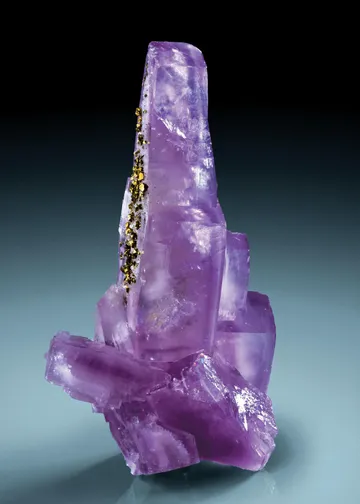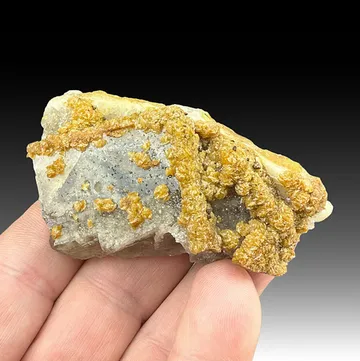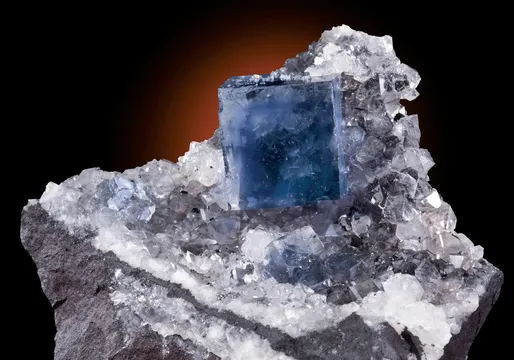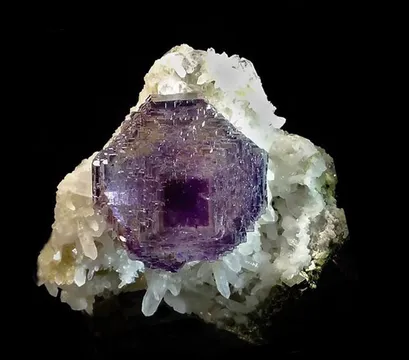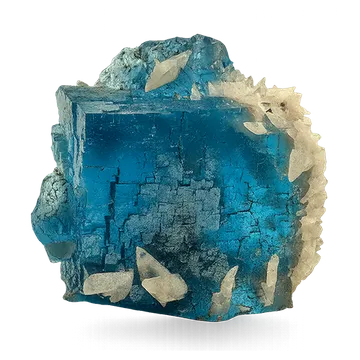
Fluorite from Blackdene Mine, UK - purple to lavender cubes with glassy faces, color zoning, and UV fluorescence; a classic Weardale specimen for collectors.
Key facts
Blackdene Mine is one of the classic purple-fluorite names of Weardale: a closed Upper Weardale fluorspar and lead mine remembered for translucent to semi-transparent violet cubes, pale lavender twins, stepped “tower” floaters, glittering quartz coatings, bright cubo-octahedral galena, and the occasional dusting of brassy chalcopyrite. Its best specimens have a distinctly northern English balance: not merely fluorite crystals on a matrix, but fluorite integrated with the metallic architecture of the orebody that produced them.

Photo: Steetley Minerals
The mine sits near Ireshopeburn and St John’s Chapel, just north of the River Wear, in the central fluorite-galena zone of the Northern Pennine Orefield. In geological terms, Blackdene belongs to the great family of North Pennine hydrothermal vein deposits: fissure veins and related ore shoots cutting Carboniferous limestones, sandstones, shales, and locally the Whin Sill, with fluorite, quartz, galena, sphalerite, siderite, ankerite, calcite, pyrite, and chalcopyrite forming the collector-relevant assemblage. In hand specimens, that geology expresses itself as purple CaF2 crystals over quartz or massive fluorite, galena set directly on fluorite, and late calcite or quartz that can either enliven the piece or partly mask the fluorite below.
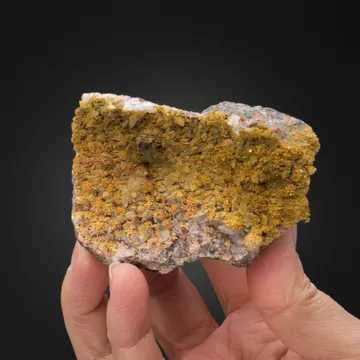
Blackdene fluorite is not a single look. The familiar material is pale lavender to deep purple, often translucent rather than fully gemmy, and commonly twinned or grown as offset, stacked cubes. Better examples show glassy faces, color zoning, frosted or cloudy centers, and a strong violet-blue fluorescence under ultraviolet light. A less common Blackdene expression comes from the Silverdykes/Slitt vein system: straw-yellow to pale amber fluorite, sometimes with green cores or blue zoning, and much less frequently encountered than the purple material.

Photo: Steetley Minerals
Historically, Blackdene bridges two eras of Weardale mining. The old workings were lead workings associated with the Beaumont period, while the twentieth-century mine became an important fluorspar producer for the steel industry. That dual history matters to collectors because many of the best specimens came out during active commercial mining, especially when modern development exposed fresh cavities, ore shoots, and crosscuts. Today the mine is closed, flooded in its more recent workings, and no longer a specimen source in any practical collecting sense. The market is therefore supplied almost entirely by old stock, miners’ pieces, and collection dispersals.
Collectors prize Blackdene fluorite for three things above all: locality character, association, and form. The most recognizable pieces combine purple fluorite cubes with bright modified galena, sometimes with chalcopyrite sprinkled across the fluorite or galena like brass filings. Matrix-free stepped floaters and elongated purple “tower” crystals are a second major collecting target. A third, quieter category is fluorite on quartz or with calcite, where the appeal lies in delicate contrast rather than metallic drama.
Search for specimens: View all fluorite specimens from Blackdene Mine, UK
Blackdene Mine is located at Ireshopeburn, near Stanhope in County Durham, England, within the North Pennines Orefield. The workings lie north of the River Wear between St John’s Chapel and Ireshopeburn. Mindat gives the locality as Blackdene Mine, Ireshopeburn, Stanhope, County Durham, England, UK, with a UK National Grid Reference of NY868390 and coordinates around 54°44′44″N, 2°12′18″W.
Geologically, the mine worked the Blackdene Vein and related parts of the Slitt and Silverdykes vein system. The Blackdene Vein trends roughly northeast, recorded in the BGS memoir as N60–65°E, and the Silverdykes vein lies on approximately the same line north of the Slitt intersection but dips in the opposite direction. This is not a trivial mapping detail: older interpretations treated Silverdykes as a continuation of Blackdene, while later underground evidence showed a more complicated structural relationship.
The deposit is a hydrothermal vein and ore-shoot system of the Northern Pennine Orefield, a fluoritic subtype of Mississippi Valley–style mineralization. In the Blackdene area, productive ground was controlled by the intersection of open fractures with competent beds such as limestone and sandstone, while weaker shale intervals tended to pinch or close the veins. That alternating Carboniferous stratigraphy explains the mine’s ribbon-like ore shoots: strong beds held open workable vein widths, while softer beds could reduce the vein to gouge or narrow stringers.
The old lead-mining phase is long. The Blackdene workings were developed by the Beaumont Company in the early nineteenth century, but the broader area has evidence of lead mining dating back to at least the early fifteenth century. During the Beaumont period, from 1818 to 1861, Blackdene was credited with 14,198 tons of lead concentrates, including some production from Elmford in 1824–1832. The British Geological Survey memoir notes that producing that concentrate may have involved mining roughly 200,000 tons of ore, much of it from upper levels where miners would have discarded as much barren and gangue material underground as possible.
Fluorspar became important later. Between 1906 and 1939, Messrs Hinchcliff worked some fluorspar from the Blackdene Vein in connection with Elmford operations. J. V. Peart also worked good-quality fluorspar from old workings via Allercleugh Level in 1936–1939, producing 3,754 tons before a collapse to surface ended that effort. United Steel Companies acquired the disused mine in 1949 and launched a major exploration and development campaign. By 1951, two sumps below Blackdene Level had been pumped out; by 1954, much of the old ground above Blackdene Level had been investigated.
The modern fluorspar workings were developed below Blackdene Level at 40, 95, 145, and 190 feet, equivalent to 12, 29, 44, and 58 meters below the old level. These levels were served by vertical shafts and four main inclines. The stratigraphic range extended from the Three Yard Limestone down to the Alternating Beds beneath the Scar Limestone. The BGS memoir records that this section contained less shale and more hard strata than usual, allowing a more continuous ore shoot than many in the district: about 2,800 feet, or 853 meters, long.
By 1973 the main Blackdene oreshoot was considered essentially stoped out, apart from ground left for support. The mine then shifted emphasis to the Slitt Vein. In 1962, as development approached the Slitt Vein, low-angle boreholes from Ridley’s Crosscut encountered promising fluorite widths. A crosscut from the 95-foot level and later a connection from the 195-foot level opened what British Steel records called the “North Slitt” oreshoot. That body reached about 1,000 by 170 feet, or 304 by 52 meters, with widths up to 14 feet, or 4.2 meters, averaging about 5.5 feet, or 1.7 meters. It had largely been extracted by 1972.
Total recorded output from Blackdene Mine, including Blackdene Vein and substantial Slitt Vein ore shoots, was 364,406 tons, or 370,237 tonnes, of crude fluorspar and about 4,500 tons of lead concentrates in the later fluorspar-mining period. The mine ultimately passed through British Steel and then Weardale Mining and Processing, closing finally in 1987. The more recent workings off the incline are now flooded, and accessible areas are described as badly understoped. The remaining dumps are overgrown and are not a meaningful specimen source; collecting there should be treated as a closed-site, permission-only matter, with attention to private land, unstable ground, flooding, and the legal restrictions of mine access.
The defining Blackdene fluorite habit is cubic, often twinned, and frequently stepped or elongated. Collectors use phrases such as “tower,” “floater,” and “stepped face” for the best three-dimensional groups. These are not random descriptive flourishes: Blackdene is genuinely known for elongated purple fluorite crystals built from stacked cube growth, and for matrix-free or near-floater groups that have a sculptural, architectural look.
Color is usually in the purple family: pale lavender, lilac, violet, smoky purple, and deeper blackberry-purple tones. The most typical crystals are translucent to semi-transparent rather than water-clear. Some show frosted white or grey interiors, cloudy cores, or mosaic surface textures; others have glassy faces and transparent zones around the edges. High-grade examples may have transparent windows, visible color zoning, and strong contrast between a darker purple outer zone and a paler or massive fluorite core.
Purple cubes from Blackdene commonly range from millimetric druse to several centimeters on edge. Many collector pieces show fluorite crystals around 0.5–3.5 cm, while documented larger crystals reach 6 cm and exceptional opaque purple-and-white crystals around 15 cm. Large Blackdene fluorites tend to lose transparency as they gain size, so the most gemmy crystals are often smaller. A specimen with 2–4 cm purple cubes that remain lustrous and translucent, especially if well placed on galena or quartz, is already a strong example.
Slitt Vein and Silverdykes-related material adds variety. Yellow to straw-colored fluorite is known, including twinned crystals around 2–3 cm with faint green cores. Amber twins with green centers and light blue zoning are rare, and reported from a single cavity encountered while driving the incline. Pale green fluorite with purple zoning is also documented from Blackdene/Slitt material, though it is not the standard Blackdene look in the way that purple cubes and galena combinations are.
Associated minerals are central to the locality’s appeal. Galena is the great partner mineral: bright, lead-grey, metallic, commonly cubo-octahedral or modified cubic, and in the best pieces sitting directly on purple fluorite. Blackdene produced fine galena in its own right, and some collectors pursue the locality as much for galena-on-fluorite as for fluorite alone. Chalcopyrite occurs as small brassy crystals scattered on fluorite, galena, or quartz; a dusting of chalcopyrite can add tremendous sparkle without overwhelming the composition. Quartz commonly coats or underlies the fluorite, ranging from druzy, bright, white quartz to clear crusts over fluorite faces. Calcite appears in several forms, sometimes as creamy or nail-head crystals, and may coat earlier fluorite. Sphalerite, pyrite, siderite, ankerite, and rare aragonite round out the collector assemblage.
The best Blackdene pieces have a combination of recognizable locality character and clean display. On a top specimen, the fluorite should have sharp cubic geometry, pleasing lavender-to-purple color, and enough translucency to show depth. Galena should be bright and three-dimensional rather than dull or massive. Chalcopyrite should be fresh and brassy, not tarnished to anonymity. Quartz should sparkle, not simply smother. Calcite is most desirable when it forms a crisp accent; thick calcite crusts can obscure the fluorite, though they may still be attractive when arranged well.
Fluorescence is another quality marker. Blackdene fluorite is strongly fluorescent under ultraviolet light, usually in violet-blue to bluish tones, and some pieces show a perceptible daylight response. The effect is not the same collecting category as the famous green daylight-fluorescent Rogerley or Diana Maria material, but a Blackdene specimen that shifts under natural light or glows vividly under longwave ultraviolet has added interest and is easier to recognize as classic Weardale material.
Blackdene is a closed classic locality, so old labels, provenance, and collection history carry real weight. Labels naming Blackdene Mine, Ireshopeburn, Weardale, County Durham, or Blackdene Mine, Stanhope, are all commonly encountered. Better labels may specify Slitt Vein, Silverdykes Vein, Blackdene Vein, a collection name, or a 1970s recovery date. These details matter because Blackdene specimens overlap visually with fluorite from Frazer’s Hush, Cambokeels, Heights, Boltsburn, and other Weardale mines.
The most common authenticity issue is not synthetic fluorite or artificial coloring, but misattribution. Purple Weardale fluorites with quartz, galena, calcite, or chalcopyrite can be visually similar across mines. Blackdene attribution is strongest when several indicators agree: purple or lavender cubic fluorite; modified bright galena; chalcopyrite dusting; quartz matrix or coating; stepped elongated growth; and an old label or credible dealer provenance. Straw-yellow or amber Slitt/Silverdykes pieces require especially careful provenance because they are less immediately recognizable to collectors who know only the purple Blackdene style.
There is no well-established, locality-specific treatment tradition for Blackdene fluorite comparable to the dyeing or irradiation problems seen in some other mineral markets. Still, fluorite is soft, brittle, and cleaves perfectly in four directions, so undisclosed repairs are always possible on old cabinet specimens. Large fluorite plates with heavy galena are especially vulnerable to shock. Check for glue lines along cube contacts, reattached galena crystals, repaired matrix breaks, and cleverly hidden contacts under quartz or calcite. A shortwave and longwave UV lamp can sometimes reveal glue, but a careful loupe examination under white light remains essential.
Condition is the great discriminator. Edge bruising, corner cleaves, scuffed cube faces, and broken galena corners are common. Some Blackdene specimens are naturally incomplete where they detached from a cavity wall; that is not the same as post-collection damage, but it should be reflected in price and display quality. Minor edge rubs on an old Weardale specimen may be acceptable, especially if the piece has strong form or provenance. Fresh cleaves on a main crystal, dull galena faces, or unstable pyrite/chalcopyrite coatings are more serious.
The best display pieces tend to fall into a few categories: purple fluorite with bright galena; elongated stepped purple fluorite floaters; purple fluorite with chalcopyrite sparkle; fluorite with crisp quartz or calcite accents; and rarer Slitt/Silverdykes yellow or amber twins. Small thumbnails and miniatures still appear, but significant Blackdene specimens with strong aesthetics are increasingly collection-to-collection material. In recent public dealer and auction listings, modest small pieces have sold or been offered at accessible prices, while large cabinet plates with sharp galena, strong fluorite coverage, and old provenance can reach several thousand dollars.
For storage and display, treat Blackdene fluorite as a classic rather than a decorative stone. Keep it out of prolonged direct sunlight, avoid vibration, and never clean aggressively. Water and a soft brush may be adequate for stable quartz-fluorite pieces, but galena, chalcopyrite, pyrite, calcite, and old repairs complicate cleaning. Avoid acids: calcite is easily attacked, galena and sulphides can be compromised, and any old glue repair may be exposed or weakened. If a specimen has an old label, preserve it separately and photograph it with the piece; for Blackdene, provenance is part of the specimen.
Blackdene has one of the more vivid modern collecting stories in Weardale lore, preserved by Pete Ward on the Campylite locality page. It belongs to the era when the mine was still alive with belts, a crusher, an underground loco on charge, working shifts, and the awkward gap between commercial ore extraction and the collector’s eye for a cavity wall lined with crystals.
The first sign was not purple fluorite, but sparkle on the belts feeding the crusher. Ward recalled driving past and seeing white quartz crystals flashing where ordinary ore should have been moving. The response was practical, if very much of its time: a few beers for the night watchman, then a night descent through the old workings into the stopes. Coming back out was surreal: after the darkness of the old ground, the bottom of the decline was bright, with the locomotive sitting on charge like a prop in an industrial theatre.
On one particular day, the belt was again alive with quartz and calcite. That evening, as the afternoon shift came out of the decline, Ward and his companions slipped into the workings. They found an exploratory drive following a quartz stringer, and that stringer had opened into a run of cavities. The main cavity was not a little pocket. It was about 4 feet high and as much as 3 feet wide, and its walls were lined with fluorite crystals up to a foot on edge, coated in quartz.
The loose material in the middle of the cavity was even more remarkable. Ward described it as breccia, but not the sort of waste a collector ignores. The broken material was itself specimen-grade: fluorite, calcite stacked in pagoda-like groups, and occasional glittering pyrite. Four companions supported the effort while Ward worked the cavity, wrapping and carrying specimens through the mine and up to the surface. They worked through the night without stopping.
By morning the price of the find was visible on his body. His hands and fingers were numb; deep cuts from sharp calcite had opened across his hands and arms, and blood was running from his elbows. The group had packed thousands of specimens, from pieces an inch across to specimens more than a foot wide. By the time they stopped, Ward had tunnelled nearly 15 yards along the cavity, and the pocket still had not ended.
Then the mine clock caught up with them. The morning shift was arriving. They loaded a final set of bags and dragged them up the decline, only to meet the miners coming down. The escape was pure collecting folklore: hats tipped forward, keep walking, no fuss. The miners barely looked at them. Minutes later the collectors were across the car park, into the Land Rovers, and gone.
It is easy to romanticize such a night now, but the important mineralogical point is more concrete: Blackdene was capable of producing specimen cavities on a scale that transformed commercial fluorspar ground into one of the great English fluorite localities. The story explains why so many Blackdene specimens entered collections during the working years and why old Blackdene pieces can appear in so many sizes and combinations. It also explains the character of the best material: fluorite crystals large enough to be architectural, quartz bright enough to reveal the pocket from the crusher belt, calcite sharp enough to cut skin, and pyrite glittering in the rubble.