Hematite from Fibbia, Switzerland - Alpine iron-rose rosettes with mirror luster, a premier Swiss locality prized by collectors for its sculptural habit.
Key facts
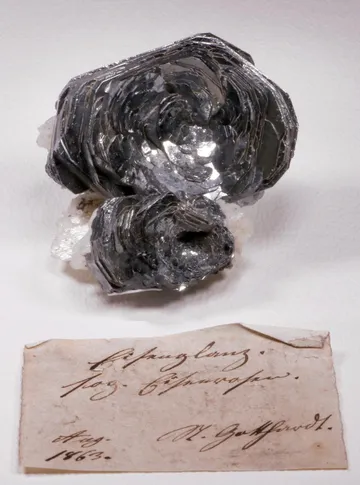
Fibbia hematite is one of the great Alpine expressions of Fe2O3: bright, steel-gray to black, mirror-lustrous plates gathered into rosettes that collectors know as “iron roses” or, in the local collecting language, Eisenrosen. The best pieces have the severe elegance of the high Alps—dark metallic petals rising from pale adularia or quartz, sometimes with golden rutile needles, stilbite, or minute accessory minerals tucked into the cleft assemblage. The appeal is not just species rarity; hematite is common worldwide. What makes Fibbia important is the combination of classic locality, sculptural rosette habit, high luster, and unmistakably Alpine matrix.

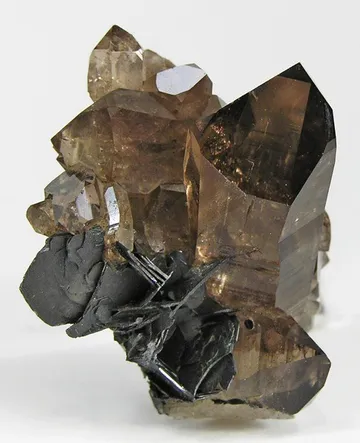
Photo: Rob Lavinsky, iRocks.com / Wikimedia Commons
The locality lies in the St. Gotthard region of Ticino, within the broader Gotthard-Fibbia mineral zone around Airolo, Fibbia, Pizzo Lucendro, Monte Prosa, and the San Gottardo area. This is alpine-cleft country: fractures in crystalline rocks opened and healed during Alpine tectonism, allowing hot metamorphic fluids and later cooler fluids to deposit quartz, adularia, hematite, rutile, feldspars, zeolites, and a suite of rarer species. Fibbia is especially associated with granitic and gneissic rocks of the Gotthard massif, and its mineralization belongs to the historic Alpine fissure tradition rather than to an ore mine in the industrial sense.
For collectors, Fibbia sits in the first rank of Swiss hematite localities because it produces true “rose” morphology: tabular crystals stacked and radiating like petals, usually compact rather than sprawling, and often perched aesthetically on a pale cleft matrix. The finest examples show sharp individual plates, black-to-silver metallic luster, a coherent rosette outline, and little damage along the fragile edges. A small, immaculate Fibbia iron rose can be more desirable than a larger, bruised example, because the locality’s charm is precision.
Historically, the Gotthard-Fibbia mineral zone has been famous for centuries. Modern geotope documentation describes the area as internationally known since the 1600s and notes the celebrated “rose di ferro” of Fibbia among its rare and spectacular mineralizations. The locality’s reputation was strengthened by generations of Swiss Strahler—Alpine crystal hunters—whose work turned scattered fissures, road cuts, and tunnel-related exposures into some of Europe’s most enduring cabinet specimens.
Search for specimens: View all hematite specimens from Fibbia, Switzerland
Fibbia is recorded mineralogically as Fibbia, Fontana, Airolo, Leventina, Ticino, Switzerland, and is often labeled in older collections as La Fibbia, Fibbia Mt., St. Gotthard, San Gottardo, or Gotthard-Fibbia. Those broader labels are historically understandable but should be read carefully: “St. Gotthard” can cover a wider mineral district, while “Fibbia” is a more specific locality within the Airolo-Leventina part of Ticino.
The deposit type is Alpine fissure or cleft mineralization. The host terrain belongs to the crystalline Gotthard massif, where Variscan granitoids, aplites, gneisses, and hornblende-bearing schists are cut by mineralized fractures. Scientific work on the Fibbia area distinguishes several vein generations; the Alpine retrograde fissure stages formed roughly between 20 and 13 million years ago under cooling metamorphic conditions, with temperatures falling from about 420 °C to 200 °C or lower. Hematite belongs particularly to later fissure development, after major quartz and feldspar growth, in an oxidized cleft environment favorable to brilliant tabular Fe2O3.
This is not a hematite mine. Production has come from Alpine collecting, construction exposures, and the work of professional or highly experienced Strahler. The Gotthard region’s road and tunnel works had a profound effect on specimen recovery. Blasting and excavation between Fibbia, Val Tremola, Monte Prosa, and the Gotthard road-tunnel approaches opened clefts that would otherwise have remained sealed. Some of those fissures yielded hematite roses, rutile, fluorapatite, titanite, stilbite, phenakite, bazzite, pink fluorite, and other classic Alpine minerals.
Collecting access should be treated as regulated and sensitive. The Gotthard-Fibbia mineral zone is recognized as a Swiss geotope of national importance and is explicitly described as subject to medium-to-strong tourist and mineral-collecting pressure. Ticino has rules for the search and collection of minerals, rocks, and fossils, and exceptional scientifically important finds may have reporting or surrender obligations. Anyone considering fieldwork must verify current cantonal requirements, land ownership, seasonal hazards, and protected-site restrictions before entering or disturbing a cleft.
Notable finds range from small thumbnail roses to major cabinet specimens. Historic accounts describe sharp hematite roses to several centimeters from road and tunnel-related exposures, a celebrated 9 cm cluster collected in 1979 by Bruno Schaub-Gottschalk at Alpe di Fieud in the Fibbia/Gotthard area, and museum-quality iron roses reaching approximately 10 cm across. Such pieces are exceptional; most Fibbia material encountered on the market is thumbnail to miniature size.
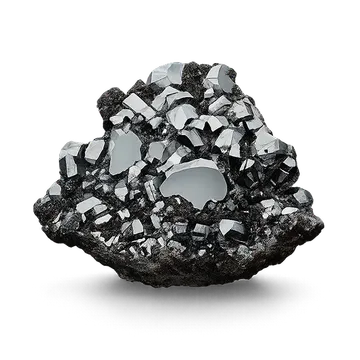
Fibbia hematite is most prized in the “iron rose” habit: flattened tabular crystals, commonly hexagonal to subhexagonal in outline, overlapping in rosette aggregates. The best rosettes look like layered metallic flowers rather than simple stacks of plates. Individual blades may be thick and robust or thin and petal-like; both can be excellent if the crystal edges are sharp and the faces remain lustrous.
Color is typically steel-gray, silver-gray, gunmetal, or black with a highly reflective metallic sheen. Fresh faces can flash almost mirror-bright under direct light. Minor surface iridescence occurs on some Alpine hematites, but for Fibbia the classic look is dark, bright, and architectural rather than rainbow-colored.
Matrix is a major quality factor. Pale adularia provides the most desirable contrast, especially when the hematite rises cleanly above a white or translucent feldspar base. Quartz is also common in the broader paragenesis, including clear and smoky varieties; some Fibbia specimens combine hematite with quartz, adularia, rutile, and zeolite-group minerals. Rutile, when present as golden to reddish acicular crystals, gives a specimen extra Alpine character. Bazzite, phenakite, xenotime-(Y), fluorapatite, chabazite, stilbite subgroup minerals, albite, muscovite, chlorite, anatase, and rare Ti-Nb-REE oxides are all part of the documented Fibbia mineral suite, though not all occur on hematite specimens.
Typical collector specimens are small. Toenail and thumbnail roses around 1–3 cm are common in commerce; fine miniatures may show one or several rosettes on adularia or quartz. Documented examples include rosettes around 1.2 cm on a miniature matrix, individual hematite crystals to about 1.4 cm in a 4.6 cm miniature, and larger rosette groups around 3–4 cm. Cabinet-size pieces exist, but they are scarce and expensive, especially when undamaged and visually balanced.
Quality hinges on five things: coherent rose form, metallic luster, sharp edges, attractive matrix contrast, and condition. A Fibbia hematite with several small but perfect roses on white adularia is often more collectible than a larger cluster with broken petals. Rutile decoration, old provenance, and a precise Fibbia or La Fibbia label add value, provided the label is credible.
The main authenticity issue with Fibbia hematite is locality precision. Older labels may say “St. Gotthard,” “San Gottardo,” “Gotthard,” “La Fibbia,” or simply “Switzerland.” Some of those may indeed refer to Fibbia-area material, but the Gotthard region contains multiple hematite-producing localities, including nearby Lucendro and Monte Prosa. A serious collector should keep old labels, compare associations, and avoid upgrading a broad Gotthard label to “Fibbia” without supporting evidence.
Condition is critical. Iron roses are vulnerable along plate edges; small chips show as bright interruptions on otherwise dark metallic faces. Look closely at the rim of each petal, the junction between rose and matrix, and the underside of prominent plates. Repairs are possible on Alpine cleft specimens, especially where a rosette has detached from matrix, so inspect for glue lines, unnatural contact points, and mismatched luster. Dealer disclosures such as “no recorded repairs” are valuable but should not replace examination.
No special treatment is normally needed to make Fibbia hematite attractive; the value is in natural luster and form. Cleaning, however, is part of the Alpine-mineral tradition. Clay, iron staining, and zeolite coatings may be removed from some specimens by skilled preparators. Over-cleaning can leave a harsh look, expose old damage, or weaken delicate associations such as stilbite or rutile. A specimen with natural, clean metallic faces and undisturbed accessory minerals is preferable.
Rarity is relative. Small Fibbia roses are available often enough that a patient collector can obtain an example, but excellent, matrixed, damage-free specimens are not common. Current and recent market records show the spread clearly: small sold examples appear as toenails and thumbnails; fine miniatures and small cabinets with adularia, rutile, or important provenance can sell in the low to mid thousands of dollars; a large 120 mm hematite-on-adularia specimen was listed at $12,000 in June 2026, while a Jack Halpern collection small-cabinet Fibbia iron rose with adularia and rutile closed at $1,560 in December 2024. A Rock H. Currier/George Vaux provenance specimen sold through Heritage in 2019 for $3,500. These prices reflect both aesthetics and the premium attached to old Swiss Alpine provenance.
The most compelling Fibbia story belongs to Bruno Schaub-Gottschalk, a veteran Strahler whose name is tied to the Alpe di Fieud/Fibbia iron-rose tradition. By the time his finds were being discussed in the mineral literature, he had worked the locality for more than 30 years, recovering iron roses, adularia, stilbite, bazzite, xenotime, apatite, smoky quartz, and, on one occasion, pink fluorite and phenakite. The scale of the work was not romantic in the easy sense. One account records that he spent three years clearing overlying debris before he could even begin collecting from the productive site.
That persistence culminated in 1979 with a specimen later described as one of the finest Swiss hematite iron roses ever recovered: a 9 cm cluster of intergrown roses on matrix from Mt. Fieud in the St. Gotthard–Fibbia area. The piece became notable enough to be illustrated in Swiss collecting literature and then retold in the broader mineral press as a “find of the century” episode. Its importance lies not merely in size, but in what it represents: a cleft opened by labor, memory, and patience in a district where the best pockets are seldom obvious.
Construction changed the district as much as hand collecting did. Between 1962 and 1964, road work from Fibbia through Val Tremola toward the future south portal of the Gotthard road tunnel exposed numerous mineralized clefts between Fibbia and Monte Prosa. Blasting revealed a suite of about 15 species, including fluorapatite, rutile, titanite, stilbite, phenakite, pink fluorite, and hematite. One cleft opened in 1962 produced hematite roses sprinkled with sheaf-shaped stilbite clusters, a combination that perfectly expresses the Alpine fissure aesthetic: hard, black metallic flowers set against pale, delicate zeolite sprays.
The broader area had been productive before the road-building years. In 1943, C. Taddei found large, lustrous hematite roses with unusually thick crystals on the eastern flank of Monte Prosa. Then, in the early 1970s, work near the future southern portal of the Gotthard road tunnel reignited excitement, with extremely sharp hematite roses reported to 4 cm from the many clefts encountered beneath the pass. These finds help explain why older labels may be vague. A collector might write “Fibbia” or “La Fibbia” for material from a broader working area that, to the Strahler, belonged to the same mountain story.
There is also a quieter cabinet-history thread. A 7.5 cm Fibbia hematite-and-adularia specimen, mainly two slightly intergrown roses with crystallized adularia on the back, entered the George Vaux collection in 1896. It later passed through Bryn Mawr College and the Rock H. Currier collection before appearing at auction in 2019. That single specimen bridges three worlds: 19th-century American collecting, institutional mineral stewardship, and the modern market for classic Alpine iron roses.