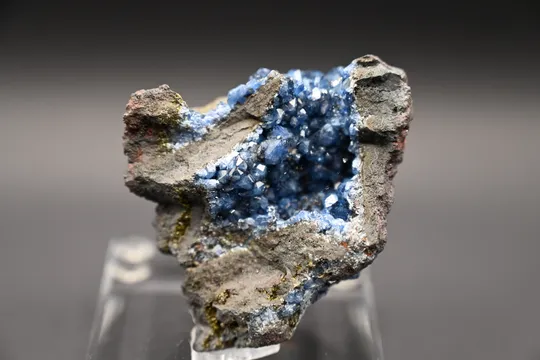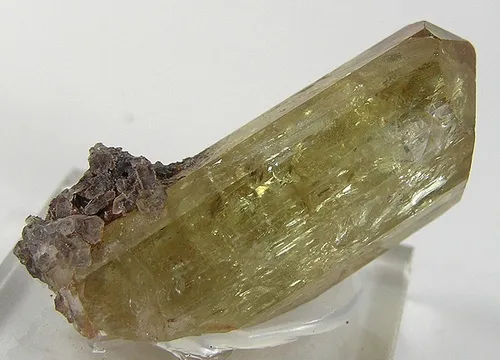
Durango, Mexico — a diverse mineral province with Ojuela, Cerro de Mercado, and Navidad; famed for creedite, fluorapatite, fluorite, arsenates.
Key facts
Durango is not a single-species locality in the way collectors sometimes use the name on old labels; it is a mineral province whose reputation rests on several very different deposits. In the north, the Ojuela Mine at Mapimí is one of Mexico’s great oxidized polymetallic replacement deposits, a limonitic labyrinth that made museum pieces of adamite, legrandite, wulfenite, mimetite, hemimorphite, rosasite, calcite, and purple fluorite. Near the city of Durango, Cerro de Mercado is an iron oxide–apatite deposit famous for transparent lemon-yellow fluorapatite crystals, so widely distributed and so chemically useful that “Durango apatite” became a standard material in thermochronology laboratories. Farther northwest in Indé Municipality, the Navidad fluorite mine produced the orange, radiating creedite groups that now define the modern collector image of Durango.
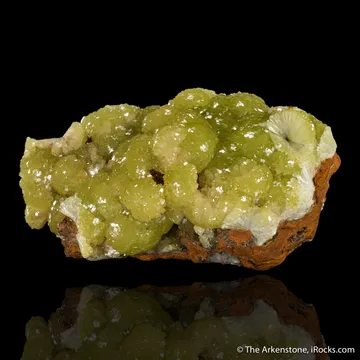
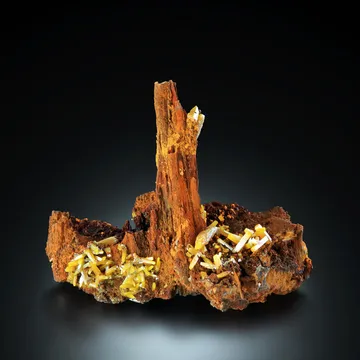
The state’s best specimens are instantly recognizable. Navidad creedite forms glossy orange to colorless sprays and balls, sometimes draped over purple, green, or pinkish fluorite. Cerro de Mercado fluorapatite is typically yellow-green, hexagonal, and glassy, whether as loose prismatic crystals or crystals perched in quartz, chalcedony, opal, calcite, and iron-oxide matrix. Ojuela’s cabinet pieces are a different aesthetic altogether: rusty gossan matrices carrying bright arsenates and carbonates, with calcite and fluorite serving both as display minerals and as gangue records of the ore-forming system.
Regional View
Country View
For serious collectors, Durango’s importance lies in that breadth: one label can mean a world-class Mexican arsenate suite, a classic iron-apatite standard locality, a fluorite-creedite vein, or one of the old rhyolite-associated tin-topaz-arsenate occurrences that gave the state its name mineral, durangite. Precision matters. “Durango, Mexico” is often only the first step; the specimen’s real value and scientific meaning usually depend on whether it is from Navidad, Ojuela, Cerro de Mercado, Barranca, Filo, Velardeña, or another named Durango locality.

Photo: Wikimedia Commons

Photo: Wikimedia Commons
Search for specimens: View all specimens from Durango, Mexico
Durango’s specimen geology is best understood as a set of overlapping mining traditions rather than a single deposit type. Ojuela, in the Mapimí district, is a carbonate-hosted polymetallic replacement system where silver-lead-zinc ores were localized by favorable limestone beds, folding, fissuring, mantos, and chimneys. Primary sulfides and gangue minerals were overprinted by deep and prolonged oxidation, producing the spectacular secondary suite for which the mine is famous. The classic specimen matrix is porous brown to black gossan, often carrying calcite, quartz, fluorite, limonite, and a wide range of Zn-Pb-Cu arsenates, carbonates, molybdates, and vanadates.
The Ojuela deposit was discovered in the Spanish colonial period, with 1598 appearing consistently in modern locality histories. Mining continued over centuries, interrupted and reshaped by war, exhaustion of bonanza ore, foreign investment, and later local small-scale work. Peñoles took possession of the Ojuela mines in the late nineteenth century, and the celebrated suspension bridge was built to move ore across the canyon between the mining camp and the workings. Today the bridge and mine complex are a public heritage and tourism site, but that should not be confused with open collecting access. Any underground entry, dump work, or specimen recovery requires current permission from the responsible operators or landholders, and old workings in this district are extensive, unstable, and locally arsenic-rich.
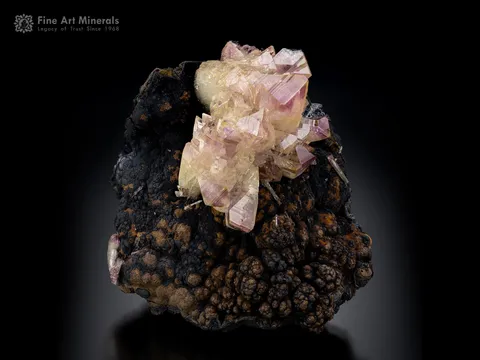
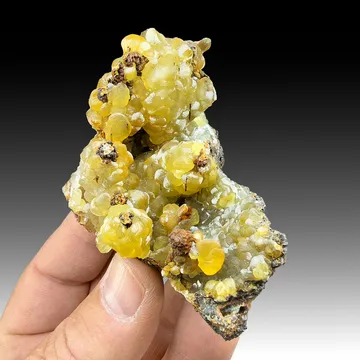
Ojuela came into mineralogical view later than its mining history suggests. The deposit was known to miners for centuries, but the great collector era began in earnest when significant specimen pockets entered the trade in the twentieth century. The 1946 discovery of a large adamite grotto by Dan Mayers and Francis Wise is the turning point most often cited in collector literature. Later specimen mining and selective recovery yielded the mine’s definitive cabinet material: green, purple, yellow, and color-zoned adamite; yellow legrandite; wulfenite on mimetite; rosasite and aurichalcite sprays; hemimorphite; calcite; and saturated purple fluorite. Named sublocalities and orebodies such as Cumbres, San Juan Poniente, Palomas Oriente, and the San Judas Chimney matter on labels because they can correspond to distinct mineral associations and important type-mineral occurrences.
Cerro de Mercado sits at the northern edge of the city of Durango and is an entirely different geological system: an iron oxide–apatite deposit associated with Oligocene felsic volcanism of the Sierra Madre Occidental and the Chupaderos caldera complex. The mine is famous commercially as an iron deposit and mineralogically for its yellow to yellow-green fluorapatite. Published work describes the iron mineralization as magnetite-hematite-rich, with fluorapatite intergrown with iron oxides and also lining cavities, fractures, and bedding-plane openings in the ore. Crystals occur in veins and vugs cutting the hematite-rich mass, commonly with quartz, chalcedony, opal-AN, calcite, magnetite, martite, limonite, and locally pyroxene-group minerals.
Cerro de Mercado was opened in the nineteenth century and remained a major iron operation into the modern industrial period. Collector-quality fluorapatite was recovered as a by-product of mining, not as the principal commodity. The best pieces are sharp, glassy, lemon-yellow hexagonal prisms with pyramidal terminations; matrix pieces can show the yellow crystals dramatically set against dark iron oxide and pale silica. Loose crystals were common in older collections and commercial parcels, but fine, undamaged, lustrous crystals—especially matrix pieces and larger examples—are markedly less casual in today’s market than the abundance of old stock might imply.
The Navidad Mine in Indé Municipality is a brecciated fluorite vein mined primarily for industrial fluorspar. The mine has been worked for many decades and is associated in specimen literature with the names Navidad, Clarines Navidad, Clarines de Navidad, Unidad Navidad, Rodeo, and Abasolo, although the more precise modern collector label is Navidad Mine, Indé Municipality, Durango. The vein is notably vuggy, which explains both the massive fluorite production and the repeated recovery of specimen pockets. Navidad’s specimen suite is much narrower than Ojuela’s but visually powerful: fluorite, creedite, gearksutite, quartz or chalcedony, and minor associated species. The great orange creedite balls and sprays came from vuggy, brecciated zones in and around the fluorite vein, with later silica casts and fluorite fragments often preserving the pocket history.
Navidad specimens entered the collector market in waves. Late twentieth-century reports mention pink to purple octahedral fluorite, quartz coatings, and lustrous creedite balls. The mid-2000s and July–August 2009 finds brought intensely orange, radiating creedite clusters to a much wider audience. Material from around 2019 added unusual styles, including violet to lavender creedite and combinations with fluorite that differed from the familiar orange balls. Commercial mining and specimen availability have fluctuated; old labels may describe the mine as Rodeo or Abasolo, while more recent directories and specimen literature support the Indé Municipality designation.
Durango also includes historically important but less common collector localities. The Barranca Mine in the Potrillos district is now recognized as the type locality for durangite, a rare orange-red sodium aluminum fluoro-arsenate. The Filo Mine in the Sierra El Rosario near Mapimí has produced purple fluorite specimens resembling, and sometimes confused with, Ojuela material. Velardeña and related districts in Cuencamé Municipality add classic Mexican sulfide, carbonate, and calcite associations, while La Platosa near Bermejillo is known primarily as a high-grade carbonate-replacement silver-lead-zinc system rather than a broad public specimen source.
Durango creedite means, above all, Navidad Mine creedite: radiating aggregates of bladed crystals, commonly clear, white, honey-orange, or vivid orange, with rarer lavender to pale violet material documented from older and later finds. The typical collector piece is a ball or starburst of lustrous, sharp blades, from thumbnail clusters to cabinet-size balls and plates; published descriptions from the 1999 period mention creedite balls from about 1 cm to 15 cm across, with some plates cementing chalcedonic quartz casts after octahedral fluorite and others incorporating purple fluorite for strong color contrast. The best pieces are three-dimensional and undamaged, with saturated orange color, open radial architecture, bright luster, and either complete floater form or a balanced association with purple, green, or pinkish fluorite; ordinary pieces are more common and tend to be broken, chalky, crowded, pale, or visually shapeless.
Durango fluorapatite is the classic Cerro de Mercado material: lemon-yellow to greenish-yellow hexagonal prisms, typically glassy and sharply terminated, found as loose crystals and as matrix pieces in quartz, chalcedony, opal, calcite, hematite, magnetite, martite, and limonite. Most familiar crystals are small to miniature size, often around a centimeter or two, but well-documented collector material reaches several centimeters and published geological-mineralogical summaries note crystals to about 10 cm from the deposit. Good examples show bright luster, transparency, a clean hexagonal outline, intact pyramidal terminations, and minimal edge wear; the most desirable matrix pieces contrast gemmy yellow apatite against dark iron oxide or pale silica, while lower-grade pieces are etched, bruised, internally cloudy, or so iron-stained that the characteristic Durango color is lost.
Durango calcite is most collectible from Ojuela and Cerro de Mercado, with Ojuela providing the larger and more varied collector population. At Ojuela, calcite is a gangue and display mineral in the oxidized replacement system, appearing as white, pale yellow, colorless, sugary, scalenohedral, rhombohedral, bladed, and locally manganese-bearing fluorescent material on limonite-rich gossan, commonly associated with adamite, rosasite, wulfenite, conichalcite, mimetite, aurichalcite, hemimorphite, malachite, and quartz. Cerro de Mercado calcite is more often a matrix companion to fluorapatite, quartz, chalcedony, opal, augite, and iron oxides. Fine Durango calcite is judged less by sheer size than by condition and association: crisp undamaged crystals supporting a meaningful Ojuela suite or framing yellow Cerro de Mercado apatite are far more desirable than loose, bruised, or visually anonymous calcite with only a broad “Durango” label.
Durango fluorite has two principal collector personalities. Navidad Mine fluorite forms octahedra and modified crystals in purple, pinkish-purple, green, lavender, and color-zoned material, commonly associated with creedite, quartz or chalcedony, and gearksutite; classic reports describe pink to purple octahedra averaging about 2 cm with larger single crystals to roughly 5 cm, some bearing white quartz highlights. Ojuela fluorite is generally valued for saturated purple color on gossan, calcite, or quartz and can be confused with material from nearby Filo Mine and Santa Librada-style occurrences when labels are incomplete. The strongest Durango fluorite specimens combine saturated color, undamaged octahedral or cubic form, transparency, and attractive association—especially fluorite supporting orange Navidad creedite or purple Ojuela fluorite on limonitic matrix—while lesser examples are cleaved, heavily etched without beauty, sun-faded, or too broadly labeled to place confidently.
“Apatite” on a Durango label almost always points to Cerro de Mercado, where the collector trade historically used the group name for what modern mineral listings generally identify as fluorapatite, Ca5(PO4)3F. These crystals are the familiar yellow to yellow-green hexagonal prisms with pyramidal terminations, occurring loose or in iron-oxide and silica-rich matrix with quartz, chalcedony, opal, calcite, hematite, martite, magnetite, and limonite. Older “Durango apatite” labels are common and should not automatically be dismissed, but serious cataloging should preserve the historical label while adding fluorapatite where supported. The best apatite-group specimens from Durango are bright, gemmy, sharply terminated, and locality-distinctive; matrix examples with well-positioned crystals are scarcer and more interesting than loose singles unless the loose crystal is large, doubly terminated, unusually transparent, or from an old documented collection.
Beyond these five species, Durango’s mineralogical depth is extraordinary. Ojuela is the type locality for lotharmeyerite, mapimite, metaköttigite, miguelromeroite, ojuelaite, paradamite, and mikenewite, with many of these tied to the mine’s oxidized Zn-As-rich environment. The mine also remains a benchmark locality for adamite, legrandite, wulfenite, mimetite, hemimorphite, aurichalcite, rosasite, plattnerite, scorodite, köttigite-parasymplesite series minerals, and rarer arsenates and carbonates. The Barranca Mine adds durangite, the state’s eponymous type mineral, in orange-red crystals associated historically with cassiterite-topaz-bearing rhyolitic occurrences. Cerro de Mercado contributes hematite, magnetite, martite, pseudobrookite, ilmenite, titanite, epidote, phenakite, opal-AN, chalcedony, and sepiolite in and around the iron-apatite system.
The main authenticity issue with Durango specimens is locality precision, not widespread fabrication. “Durango, Mexico” is too broad for serious cataloging. Navidad creedite should ideally be labeled Navidad Mine, Indé Municipality, Durango; older labels reading Rodeo Mine, Abasolo Mine, Mina Navidad, or Abasolo-Rodeo are common but geographically imprecise. Ojuela specimens are often labeled simply “Mapimí,” “Mina Ojuela,” or “Ojuela, Mapimí,” and those may be historically understandable, but sublocality information such as San Juan Poniente, Cumbres, Palomas Oriente, or San Judas Chimney adds real value when documented. Cerro de Mercado apatite is often labeled only “Durango apatite,” “Cerro del Mercado,” or even “Mapimí, Durango”; the correct locality is Cerro de Mercado Mine, Victoria de Durango, Durango Municipality.
Condition is critical. Navidad creedite is brittle, and the radiating blades are easily tipped; inspect the outermost crystal points, especially on large orange balls. Excellent color is desirable, but intensely orange material should still show natural transparency, luster, and crystal continuity rather than a superficial coating. Navidad fluorite may show natural color change or color emphasis after light exposure, so compare protected areas and ask whether a specimen has been displayed in strong light. Fluorite cleavage damage can hide in octahedral aggregates, and loose corners are common.
Cerro de Mercado fluorapatite is tough enough for normal cabinet handling but softer than quartz and easily edge-worn. Loose crystals should be checked for chipped terminations and abraded prism edges; matrix pieces should be checked where apatite enters iron oxide or silica, as crystals can be reattached or stabilized. Fluorescence has been reported in some Cerro de Mercado fluorapatite, commonly bluish, violet, peach, or related responses depending on lamp wavelength and associated opal or chalcedony, but fluorescence is not universal and should not be treated as a sole locality proof.
Ojuela specimens require special care because many sit on friable limonitic gossan. Adamite, aurichalcite, rosasite, hemimorphite, and calcite sprays can shed from soft matrix if handled by the edges. Fine arsenate specimens should be kept dry, dusted minimally, and handled with normal hygiene: wash hands after handling and avoid creating dust from matrix. Manganoan calcite from Ojuela may fluoresce, and some adamite can respond under ultraviolet light, but UV response varies and is not a substitute for identification.
Market availability is uneven. Navidad creedite remains obtainable because major finds put many specimens into circulation, but top orange, three-dimensional, undamaged clusters with fluorite are much scarcer than the number of average examples suggests. Cerro de Mercado fluorapatite is still seen in old stocks, auctions, and dealer inventories, though fine matrix specimens and large gemmy crystals are no longer casually abundant. Ojuela calcite and common gossan-suite pieces remain accessible, while elite Ojuela arsenates, type-species material, and well-provenanced old specimens command a premium.
The most persistent Durango story is also one of the neatest mineralogical detective stories in Mexico: the rediscovery of the durangite type locality. George Jarvis Brush described durangite in 1869 from “Durango in Mexico,” but the locality clue was maddeningly broad. The associated old language referred to stream tin, cassiterite, and topaz—an assemblage that fits numerous rhyolite-related occurrences in the Sierra Madre region rather than one obvious mine. Henry G. Hanks had passed specimens to Brush, but Hanks had not visited the mine himself. A later letter from Joseph H. C. Bennett to Brush, preserved at Yale, helped clarify the chain of custody, but not enough to put collectors on a map for more than a century.
Then, in 2012, “new” old durangite specimens surfaced at a mineral show. They were not fresh production in the usual sense but a rediscovered stash of old material—bright orange-red crystals, some large enough to revive the question of exactly where Brush’s original mineral had come from. The answer did not arrive until 2022, when the Barranca Mine in the Potrillos district was finally identified as the long-lost type locality. The ending was bittersweet: the vein had been completely mined out. The rediscovery produced locality certainty, not a new bonanza. Only small druses of durangite were collected from the dumps, while the finest known crystals remained those preserved in older collections.
Ojuela’s story belongs to a different scale: centuries of mining, a ghost settlement, and a bridge that now carries tourists where ore once moved. The mine was founded in 1598, and by the nineteenth century the district had become important enough for Peñoles to modernize production. Electricity, large drills, a rack railway, and a reduction works called De Agua all became part of the industrial landscape. The famous Ojuela suspension bridge was built in the 1890s to connect the mine area across the canyon; modern heritage accounts give lengths around 318 to 336 meters, and even allowing for the usual variation in published measurements, the structure remains the visual emblem of Mapimí’s mining past. Today visitors cross the bridge for photographs, zip-line rides, and guided mine tours, while mineral collectors know the same place as one of the most productive oxidized arsenate localities on Earth.
The collector history at Ojuela has its own hinge moment. W. F. Foshag visited in 1927, bringing the mine more firmly into mineralogical awareness, but the specimen world changed in 1946 when Dan Mayers and Francis Wise found a huge adamite grotto. That discovery turned a historically important mine into a specimen legend. The Ojuela look—glowing green or purple adamite on dark gossan, yellow legrandite, wulfenite on mimetite, and delicate secondary minerals in vugs—became a Mexican standard, reproduced in museum drawers and private cabinets around the world.
Navidad’s great story is more modern and more visual. For years the mine was known primarily as an industrial fluorite operation with pink to purple octahedral fluorite and colorless to orange creedite. Then the mid-2000s and especially the 2009 production made orange Durango creedite a global collector staple. Some of the best specimens from the July–August 2009 find were not merely balls but sculptural sprays on fluorite, with individual orange crystals reaching about 1.7 cm on one published cabinet specimen. Another large orange ball, about 14 x 12.5 x 10.8 cm, was described from the same find as unusually pristine for its size, with a fiery color considered exceptional even within the pocket. That is the paradox of Navidad: the locality produced enough creedite to make good specimens broadly available, yet the finest pieces still have the spark of a once-in-a-find event.