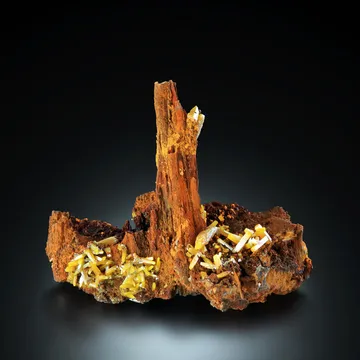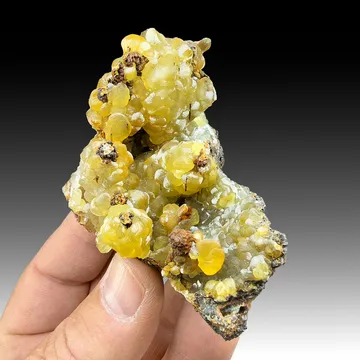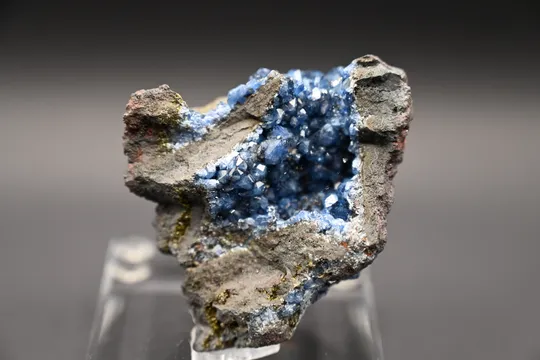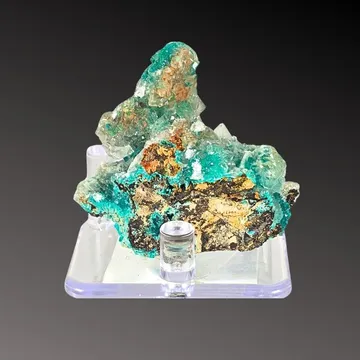
Mapimí, Mexico — Ojuela Mine, an oxidized ore system yielding adamite, legrandite, mimetite, wulfenite, and more; a cornerstone locality for collectors.
Key facts
Mapimí is collector shorthand for one of the great oxidized ore systems of the world: the Ojuela Mine, on the northeastern escarpment of the Sierra de Mapimí in Durango. The locality is a northern Mexican carbonate-replacement deposit developed in Cretaceous limestone and dolomite, with ore guided by fractures, favorable dolomitic horizons, chimneys, mantos, breccias, and veins. Its primary ores were rich in lead, silver, zinc, gold, and arsenic-bearing sulfides; its collector fame comes from what oxidation did to that chemistry. In the immense dry workings, arsenopyrite, sphalerite, argentiferous galena, pyrite, and associated gangue were transformed into a spectacular suite of zinc arsenates, lead minerals, iron oxides, carbonates, silicates, sulfates, and fluorides.
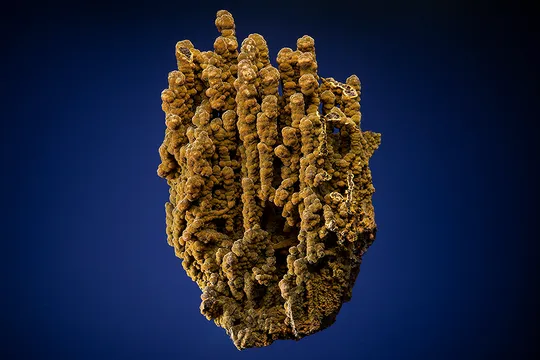
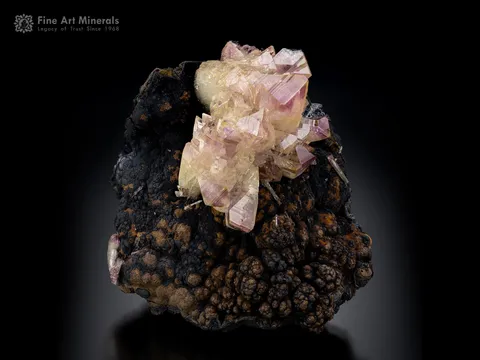
The minerals that made Mapimí legendary are adamite and legrandite, but the locality is far broader than two headline species. Paradamite, köttigite, metaköttigite, lotharmeyerite, mapimite, ojuelaite, miguelromeroite, hemimorphite, smithsonite, aurichalcite, rosasite, wulfenite, mimetite, scorodite, fluorite, calcite, and goethite all belong to the same intensely oxidized mineral theater. The best specimens are unmistakable: bright yellow to yellow-green adamite carpets on chocolate-brown limonite; waxy lemon-yellow legrandite sprays emerging from black and red-brown gossan; lilac manganese-bearing adamite crusts with zoned tips; yellow mimetite and wulfenite on calcite; glassy purple fluorite; blue-green copper-zinc carbonates; and sculptural iron oxide matrices that look almost designed to set off the color.
Historically, Ojuela is as important as it is beautiful. Mining began in the Spanish colonial period, and by the late nineteenth and early twentieth centuries the district had become a major industrial mining complex, with deep shafts, a smelter at Mapimí, narrow-gauge rail, a rack railway, power installations, pumping works, and the celebrated Puente de Ojuela suspension bridge. For mineral collectors, its modern identity crystallized in the twentieth century, especially after the classic adamite finds and later the steady recognition of Mapimí as a type locality and world-class source of secondary arsenates.
Regional View
Country View
What separates Mapimí from many other oxidized lead-zinc localities is scale. The mine is not a small pocketed prospect but a vast multi-level system; early writers remarked that one could travel underground for weeks without revisiting the same ground. That physical scale matters mineralogically. Different chimneys, levels, stopes, shafts, and replacement bodies offered subtly different fluid paths, redox conditions, zinc-copper-lead-arsenic availability, and cavity space. The result is a locality where “Ojuela adamite” alone can mean colorless, yellow, green, bluish, lilac, manganese-bearing, copper-bearing, lustrous druses, botryoidal-looking aggregates, and cabinet plates from different episodes of the mine’s collecting history.

Photo: Wikimedia Commons

Photo: Wikimedia Commons
Search for specimens: View all specimens from Mapimí, Mexico
The collector locality generally meant by Mapimí is the Ojuela Mine, about 7 km southeast of the town of Mapimí and roughly 43 km northwest of Torreón. The mine lies around 1,620 m elevation in the Sierra de Mapimí, within a hot desert climatic setting. The deposit is a polymetallic carbonate-replacement system in the Aurora Formation limestone and dolomite, with black calcareous shales and laminated limestones of the Indidura Formation acting locally as impermeable caps or barriers that helped focus mineralizing fluids. Dolomitic horizons within the Aurora limestone were especially favorable hosts.
Structurally, the district occupies part of the Mapimí anticlinorium, cut by normal faults, fractures, and later intrusions. Government geologic mapping describes an alaskite-latite intrusive body detected at depth, as well as diabase dikes that commonly followed the same weaknesses used by the ore fluids. Mineralization rose through faults and fractures and formed chimneys at structural intersections, mantos along favorable beds, and replacement veins and breccia bodies beneath sealing shale and dolomite horizons. The system is thus not one ore body but a set of interconnected and separated mineralized bodies, with barren limestone between productive zones.
The mine’s major ore forms included vertical and inclined chimneys, mantos, and brecciated veins. The Ojuela Vieja chimney was known from the surface to great depth and reached its greatest section around the 250 m level; the Cumbres inclined chimney formed along a fracture in the axial plane of an anticline; the San Carlos manto occupied the eastern flank of an anticline; and the Santa Rita vein was a brecciated, faulted axial-plane structure extending for kilometers. These names matter to collectors because many fine specimens were not anonymous “dump” material but came from particular ore bodies, levels, shafts, and chimneys, including Las Palomas, Palomas Oriente, San Diego, San Judas, Santo Domingo, San Juan Poniente, La Cigueña vein, the Norte shaft area, América No. 1, and América Dos.
The primary ore suite was dominated by argentiferous galena, sphalerite, pyrite, arsenopyrite, tetrahedrite-group minerals, and locally chalcopyrite, with calcite, quartz, fluorite, barite, and iron oxides as common gangue or later cavity minerals. Ojuela’s collector suite is overwhelmingly a product of oxidation. The oxidation zone reached extraordinary depth for a carbonate-replacement mine; official geologic reporting describes the oxide zone extending to roughly 500 m in the Ojuela mine. In that zone, cerussite, anglesite, chlorargyrite, cervantite, malachite, fluorite, barite, limonite, goethite, and a great variety of arsenates developed from the primary ore.
Mining began in 1598, when Spanish colonial exploitation focused on rich near-surface silver ores. By 1777, Ojuela was already regarded as the most prosperous mine in the area, though access was difficult and the mine had numerous shafts. In the late nineteenth century, Peñoles acquired the property and modernized it, installing electric power for drilling and pumping, rack-rail transport, a smelting and beneficiation works at Mapimí, and a narrow-gauge rail connection. A narrow-gauge line linked the Mapimí smelter to the mines, and the production plant included furnaces reported with capacities of 150 tons per day each.
The industrial peak transformed Ojuela from a colonial silver mine into a major lead-silver operation. Contemporary and later mineralogical accounts report that after the late nineteenth-century modernization, almost four million tons of ore were mined with average grades around 3.7 grams per ton gold, 462 grams per ton silver, and 14.9 percent lead. Production later declined as reserves were depleted and mine drainage became increasingly difficult; by the mid-twentieth century large-scale operations had faded, with cooperative, small-scale, and later specimen-oriented work becoming part of the mine’s identity.
The famous Puente de Ojuela is more than a picturesque ruin. It was built to solve a mining problem: how to connect the mine and settlement across a deep canyon and move ore efficiently through a difficult mountain landscape. Sources differ in dates and dimensions depending on whether they refer to construction, completion, original or restored span, but the bridge belongs to the late nineteenth-century Peñoles modernization and is usually described as a timber-and-steel suspension bridge built with Roebling cable technology. Today it is a pedestrian tourist landmark, while the old mine workings and ruins are part of Mapimí’s cultural landscape.
Collecting access today should be treated as controlled, not casual. The Ojuela bridge and mine-tour experience are public-facing tourist attractions, but that is not the same as permission to collect minerals underground or on mine property. Fine specimens have generally come through miners, local guides, concession arrangements, dealers, and specimen-recovery work by people who know the workings and have access. The mine is extensive, partly unsafe, partly inaccessible, and partly affected by water, collapse, and old stopes; collectors should not interpret a Mapimí label as an invitation to enter workings independently.
The most famous documented specimen find remains the June 1946 adamite pocket in the Las Palomas ore body just above the 11th level. It was a cavity roughly four feet across and four feet deep, lined with sparkling yellow to yellow-green adamite on limonite and limestone. The largest specimen weighed about 75 pounds underground and was nearly three feet square before trimming; it later entered the U.S. National Museum collection, and other major pieces went to Harvard. The find established the visual grammar of classic Mapimí adamite: lustrous, bright, closely set crystals on brown iron oxide matrix, in cabinet-scale pieces with real pocket architecture rather than isolated grains.
Later specimen production broadened the locality’s reputation. Legrandite became the mine’s other great emblem, with lemon-yellow sprays, sheaves, radial aggregates, and prismatic crystals on dark limonite. Palomas Oriente and San Diego are both recorded for legrandite, and San Judas became important in modern mineralogy through mikenewite, a newly described sulfite mineral from the San Judas Chimney. Other sublocalities and pocket systems yielded manganese-bearing adamite, paradamite, köttigite-related species, hemimorphite, rosasite, aurichalcite, mimetite, wulfenite, fluorite, and a host of rarities that keep Mapimí labels moving between aesthetic collecting and systematic mineralogy.
Mapimí adamite is one of the standard-setting occurrences for the species, and its best pieces are admired for dense, lustrous carpets of crystals on brown limonite, goethite, or limestone matrix rather than for isolated single crystals. The classic Las Palomas pocket above the 11th level produced yellow-green crystals ranging from water-clear through yellow-green to pale bluish yellow, with individual crystals reported to several millimeters and cabinet plates large enough to enter major museum collections; later pockets and other zones produced paler yellow material, green copper-bearing adamite, and the prized pink to lilac manganese-bearing adamite for which Ojuela is often misdescribed as “cobaltian.” Fine pieces show sharp, glassy, undamaged crystal faces, saturated color, contrast against iron oxide matrix, and coherent pocket coverage; ordinary pieces tend to be sparse, dull, bruised, or little more than adamite dusting on crumbly gossan.
Mapimí legrandite is the locality’s other signature mineral and remains the benchmark by which most legrandite specimens are judged: transparent to translucent yellow crystals, commonly prismatic, bladed, sheaflike, fan-shaped, or radial, perched on dark limonite or gossan and often associated with adamite, paradamite, smithsonite, köttigite, goethite, hydrozincite, gypsum, mimetite, calcite, and other oxidized-zone species. Recorded Ojuela occurrences include the main mine as well as Palomas Oriente and San Diego, and the best examples are miniature to cabinet specimens with well-terminated, lustrous, free-standing sprays rather than flattened crusts; even crystals around 1–2 cm are impressive here, while larger, transparent, richly colored groups with minimal bruising are genuinely elite. Good Mapimí legrandite has a warm, saturated yellow and a sculptural fan or burst that rises cleanly from the matrix; lesser pieces are incomplete, pale, granular, or visually lost among similar yellow arsenates.
Beyond adamite and legrandite, Mapimí is a systematic collector’s paradise. Ojuela is a type locality for important rare species including paradamite, lotharmeyerite, metaköttigite, mapimite, ojuelaite, miguelromeroite, and mikenewite, and it has supplied notable examples of köttigite, parasymplesite, symplesite, arseniosiderite, carminite, scorodite, dussertite, conichalcite, austinite, aurichalcite, rosasite, smithsonite, hemimorphite, mimetite, wulfenite, plattnerite, fluorite, calcite, and goethite. The rare-mineral suite is unusually rich because the primary ores supplied zinc, lead, iron, manganese, arsenic, copper, and sulfur, while the deep and long-lived oxidation zone supplied cavities, changing pH and redox conditions, and time.
Mapimí is one of the most commonly seen great localities on the specimen market, but abundance is uneven. Small adamites and hemimorphite-on-gossan pieces are common enough that they still appear regularly in show flats, online dealer inventories, and mixed Mexican collections. Excellent adamite—lustrous, saturated, undamaged, well placed on attractive matrix—is much scarcer. Legrandite is significantly less available in fine quality, and top pieces with transparent, well-terminated yellow sprays remain expensive and competitive.
The most important locality-specific authenticity issue is nomenclature around pink to violet adamite. Older labels and dealer descriptions may call this “cobaltian adamite,” but the accepted correction for Ojuela material is that the pink to violet color is caused by small manganese content, not cobalt. A good Mapimí label reading “manganese-bearing adamite” is preferable to an old “cobalt adamite” label unless the specimen has actual analytical support.
Mislabelling also occurs among visually similar blue-green and yellow secondary species. Rosasite, aurichalcite, hemimorphite with copper staining, chrysocolla-like material, conichalcite, austinite, and copper-bearing adamite can be confused in hand specimens, especially on iron oxide matrix. Mindat’s Ojuela mineral list also flags some problematic or erroneous historical entries, including chrysocolla as reported from the broader Mapimí district rather than securely from Ojuela, and a possibly man-made kobyashevite occurrence. For rare arsenates, visual identification alone is often inadequate; XRD, Raman, SEM-EDS, or a strong analytical provenance is appropriate for high-value or systematic pieces.
Condition is a central part of valuation. Adamite is more robust than legrandite, but Mapimí adamite often forms on crumbly limonite and can have bruised crystal tips, dusty cavities, or repaired matrix. Legrandite is much more vulnerable: slender sprays and blades are easily snapped, and many specimens have contact points where the pocket wall or mining tools removed terminations. Check legrandite with magnification for rehealed-looking breaks, fresh bright chips, glue at the base of sprays, and trimmed matrix edges that expose hidden damage.
Fluorescence can be useful but should not be overinterpreted. Some Ojuela adamite, especially manganese-bearing material, may show attractive fluorescence under UV, and some calcite from the mine can fluoresce as well. Fluorescence does not prove species identity, locality, or quality, but it can add interest when documented honestly. Because arsenates are involved, normal mineral-handling discipline is appropriate: avoid grinding, cutting, or producing dust; wash hands after handling friable pieces; keep specimens away from children and food-preparation surfaces; and store delicate legrandite where vibration and lid contact cannot shear crystals.
Market-wise, Mapimí rewards selectivity. An ordinary thumbnail of green adamite is collectible but not rare. A fine old Las Palomas-style adamite plate, a sharp lilac manganese-bearing adamite, a legrandite spray with intact terminations, an analyzed type-locality rare arsenate, or a specimen with a named sublocality and old provenance is a different category. The best labels will say more than “Mapimí, Mexico”; they may preserve Ojuela Mine, a shaft, level, ore body, chimney, vein, or former collection.
In June 1946, Mary E. Mrose, Dan E. Mayers, and Francis A. Wise recorded one of the great pocket discoveries in Mexican mineral collecting. They were in the Las Palomas ore body, just above the 11th level, on their way to a stope known for wulfenite and green mimetite when their lamps caught a cavity in limestone. The pocket was not a little seam. It was a chamber about four feet across and four feet deep, with undulating walls coated in sparkling yellow adamite. Mrose’s published account called it a “miniature grotto,” a phrase collectors still recognize because it conveys the scale: a whole cave wall turned into one specimen surface.
The miners were put to work immediately. One specimen from that pocket weighed 75 pounds underground and measured almost three feet square before trimming. Its continuous crust of green adamite, with crystals about a quarter inch across on brown limonite, later entered the U.S. National Museum. Two more important specimens went to Harvard. That single pocket did not merely add a few good adamites to the market; it gave Mapimí adamite its archetype—rich yellow-green crystal crusts on brown iron oxide, large enough for museums but vivid enough that even a thumbnail could look like a fragment of the same underground spectacle.
The circumstances of the pocket also explain why Ojuela is so productive mineralogically. The adamite did not form randomly on a dump. It sat in an elbow of the Las Palomas ore chimney, where descending zinc-rich solutions could stagnate rather than flush through too quickly. Hemimorphite was abundant in large crystals nearby between the 11th and 12th levels, smithsonite was present sparingly, and the pocket’s quiet chemistry allowed large adamite crystals to grow undisturbed. In collector language, it was a perfect storm of zinc, arsenic, cavity space, iron oxide matrix, and time.
The older mining story is just as cinematic. By the late nineteenth century, Ojuela’s ore was rich enough to justify an industrial landscape in the desert: shafts, pumping plants, power, rail, furnaces, a settlement, and a suspension bridge over the canyon. INAH records that by 1777 many merchants were established in the area and Ojuela was the most prosperous mine, but access remained a serious problem, with roughly 35 shafts complicating the operation. Peñoles acquired the mine in 1891 and modernized it with electricity, large drills, a rack railway, a beneficiation hacienda, and the bridge that still defines the view.
The Puente de Ojuela is often treated today as a tourist photograph, but for the mine it was an ore-moving machine suspended in air. It connected the working landscape across a canyon and linked the mine more efficiently with the Mapimí smelting system. The same historical sources that describe the bridge also mention narrow-gauge rail and high-capacity furnaces, making clear that Ojuela was not a romantic isolated prospect. It was a serious industrial mine whose oxidized remnants later became one of the world’s great specimen sources.