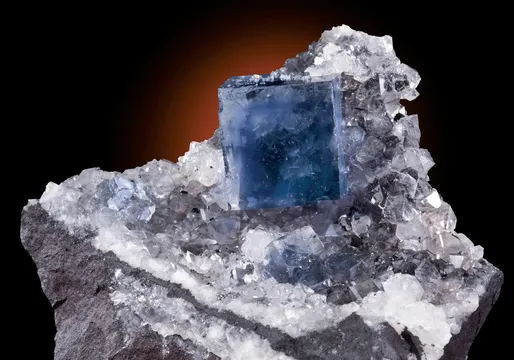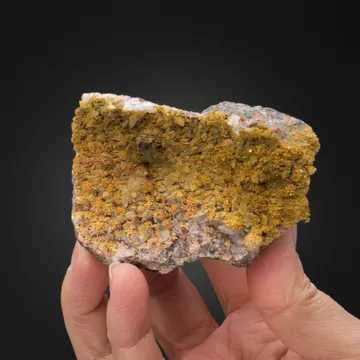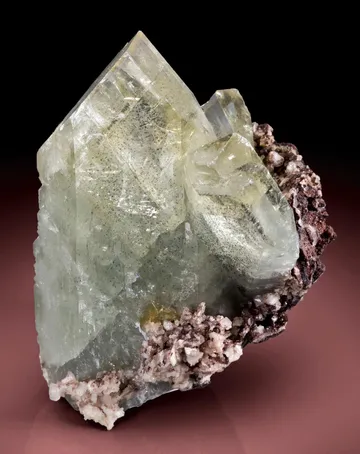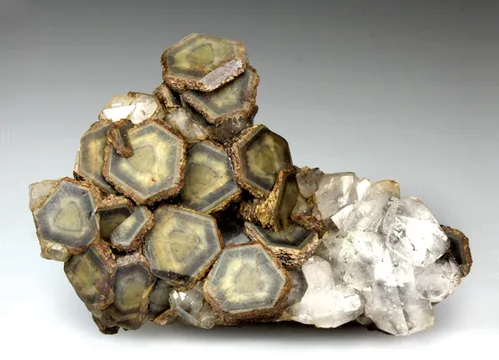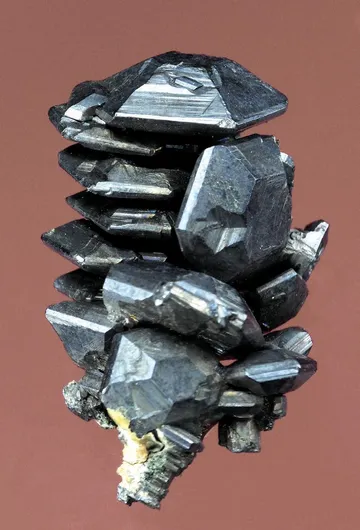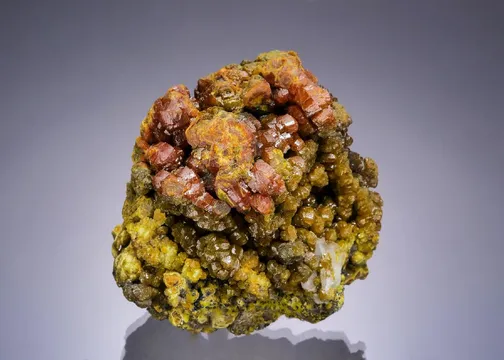
Dry Gill Mine, UK - a renowned British locality for mimetite and campylite, with lustrous crystals on quartz and baryte; valued for sculptural form and color.
Key facts
Dry Gill Mine is one of the great paradoxes of British mineral collecting: a commercially slight, wet, unstable lead prospect that became a world-class specimen locality because its “ore” was not ordinary galena but the lead arsenate-phosphate suite that collectors know at once as Dry Gill campylite. The mine lies high in the Caldbeck Fells of Cumbria, in the northern Lake District, where the Dry Gill Vein cuts a structurally complicated belt between the Upper Ordovician Drygill Shales and the Ordovician Eycott Volcanic Group, close to the Carrock Fell intrusive complex. The vein is an east-west quartz-baryte structure, locally rich in black manganese oxides, and its exceptional oxidation history produced large, lustrous mimetite crystals in the rounded barrel habit that gave campylite its name.
The finest Dry Gill specimens are unmistakable: orange-brown, toffee, honey, greenish yellow, olive-green, or yellow rounded mimetite crystals sitting on hard white quartz, white to pale baryte, and black manganese-oxide matrix. Classic pieces have the satisfying sculptural look of small polished fruits or “melons” perched on a dark, rugged veinstone. The best crystals are sharply lustrous despite their curved habit, well separated enough to show their rounded hexagonal form, and strongly contrasted against the black-and-white gangue. Dry Gill is also a serious locality for plumbogummite, pyromorphite, baryte, quartz, and manganese oxides, but its place in the canon rests on campylite: one of the most recognizable British mineral styles and a specimen type represented in major collections worldwide.
Regional View
Country View
The locality’s fame is not a matter of abundance alone. Dry Gill is a locality where the genetic problem is part of the appeal: the lead mineralization is dominated by mimetite and pyromorphite rather than by obvious primary galena. That unusual balance has long raised the question of whether the deposit represents unusually deep and intense supergene alteration, at least partly primary precipitation of lead arsenates and phosphates, or a more complicated combination of both. For the collector, the result is practical and visual: Dry Gill specimens are not simply “mimetite from England,” but the defining English campylite, with a particular matrix, habit, colour range, and historical pedigree.

Photo: Wikimedia Commons

Search for specimens: View all specimens from Dry Gill Mine, UK
Dry Gill Mine is an abandoned lead mine in the Caldbeck Fells mining region of Cumbria, historically Cumberland, with the old spelling “Drygill” often appearing on labels. The mine is situated on Dry Gill, a tributary of Carrock Beck, and the key structure is the Dry Gill Vein: an east-west fault vein exposed in and beside the gill. In the immediate mine area, the vein is a hard quartz vein, locally up to about 1.5 m wide, hading north at a shallow angle and cropping out as a conspicuous quartz rib on the north side of the stream. It was worked by small opencuts and by short levels driven from the stream banks.
The geological setting is a particularly intricate slice of the northern Lake District. The vein marks a major structure separating the Drygill Shales on the south from the Eycott Volcanic Group on the north, and the local fault pattern is complicated by north-south dislocations, including structures related to the Carrock Fell vein system farther south. The primary gangue is dominated by quartz, with baryte locally abundant; quartz replacement features include pseudomorphs and epimorphs after tabular or cockscomb baryte, showing that baryte was formerly more widespread or differently distributed than the surviving specimens alone suggest.
The ore assemblage is collector-important rather than mine-important. Lead at Dry Gill is present predominantly as phosphatian mimetite, with lesser pyromorphite, in quartz-baryte-manganese oxide gangue. Galena is recorded but scarce in the workings normally associated with the famous specimens. This is why the mine stands apart from many lead veins: instead of a conventional sulphide orebody with secondary minerals as an attractive afterthought, Dry Gill is essentially famous for the oxidized lead arsenate-phosphate mineralization itself. Its black manganese oxides are also significant, having been historically labelled “psilomelane” or pyrolusite, while later work showed romanèchite and coronadite to be important components.
The mining history is brief but unusually colourful. Fine mimetite specimens were known from Dry Gill before commercial working is recorded, with references to material as early as the 1830s. The first recorded working began in 1846, when Hugh Lee Pattinson took a lease and drove an adit on the vein where it crosses Dry Gill beck. Pattinson is better remembered for the desilvering process that bears his name, but at Dry Gill he encountered a material the miners called “coloured lead ore.” It was not a profitable lead ore in the usual sense, but several hundred tons of arsenio-phosphate lead material were sold, notably for glass manufacture. Recorded output in the early Pattinson period included 20 tons in 1847, 90 tons in 1848–1849, and 120 tons between 1850 and 1852. Later operators tried the property in a small way, and the mine was last worked in 1869; a later lease by the Cleator Iron Ore Co. in 1887 seems to have involved inspection and clearing rather than meaningful production.
The main named underground reference for specimens is the Deep or Pattinson Level, near where the vein crosses the beck, and later accounts mention additional short levels farther up the gill and stoping off at least one of them. The best nineteenth-century campylites almost certainly came from pockets opened during the working life of the mine, but important material was also recovered by collectors in the twentieth century, especially during the 1970s, when underground collecting and diggings exposed further cavities in the old workings and opencut. Modern collecting from the locality is tightly controlled. The Caldbeck and Uldale Commons mineral collecting policy requires permits, prohibits collecting for financial gain, and does not grant underground access; the policy also restricts work to small hand tools and shallow disturbance of loose surface material where collecting is allowed. The old Dry Gill workings themselves are cold, wet, unstable, and historically accident-prone, and serious collectors should regard documented old material, properly labelled, as the normal route to owning the locality today.
Mimetite is the signature mineral of Dry Gill, especially as the phosphatian campylite variety: rounded, barrel-shaped to globular hexagonal crystals in orange-brown, red-brown, toffee, honey, yellow, greenish yellow, and rarer olive-green shades, usually on quartz with baryte and black manganese oxides. Crystals are commonly around a few millimetres to about 10 mm across, with exceptional examples over 30 mm recorded, and the species also occurs in tabular and short to long prismatic habits. The best pieces show lustrous, well-defined, undamaged barrels with strong colour zoning or saturated colour, perched in open vugs rather than lost in massive veinstone; association with clean white baryte, bright quartz, blue plumbogummite, or contrasting manganese oxide elevates a specimen sharply. Ordinary Dry Gill mimetite is still a classic, but the collector-grade pieces are those with sculptural separation, lively lustre, and a label history that places them in the old Dry Gill stream-bank workings, Pattinson Level area, or the well-known twentieth-century collecting episodes.
Quartz is the principal vein mineral at Dry Gill and the matrix on which most of the locality’s important specimens are built. Much of it is massive white to grey vein quartz, tough and compact, but cavities contain pyramidal crystals and, in some recently described material, transparent crystals reaching several centimetres in length. The most locality-specific quartz forms are the epimorphs and pseudomorphs after tabular or cockscomb baryte, which preserve the earlier sulphate habit in silica and help explain the textural history of the vein. As a collectible species in its own right, Dry Gill quartz is secondary to the campylite, but specimens gain importance when sharp quartz crystals frame mimetite, pyromorphite, or plumbogummite, or when the quartz clearly records baryte replacement rather than serving merely as a broken white matrix.
Barite at Dry Gill is both a gangue mineral and a specimen-forming species, occurring as coarsely crystalline white masses, tabular crystals, and locally single crystals reported to several centimetres across, sometimes with a pale or greenish cast. It is intimately tied to the classic mimetite assemblage: baryte may occur with campylite on quartz, with plumbogummite, or as corroded and overgrown crystals involved in the supergene sequence of mimetite, plumbogummite, later mimetite, and secondary baryte. Fresh, well-formed, undamaged white tabular crystals are much scarcer than broken dump pieces, and underground examples are no longer a realistic collecting target. The most desirable Dry Gill barite specimens are therefore those that retain crisp crystal form and show the classic association with mimetite or plumbogummite, rather than isolated bruised white plates.
Baryte is the British spelling for the same BaSO4 species listed above, and it is the spelling most natural to Dry Gill’s historical and regional literature. In Dry Gill specimens, baryte commonly functions as the pale architectural counterpoint to campylite: white tabular blades or granular baryte in the hard quartz vein, sometimes partly coated, replaced, corroded, or overgrown by lead phosphates and arsenates. The best baryte-labelled pieces from this locality are not simply “baryte from Cumbria,” but specimens that show Dry Gill paragenesis—baryte with orange-brown mimetite, blue plumbogummite, yellow pyromorphite, and black manganese oxides. Because loose dump baryte is often fractured, weathered, or detached, clean matrix pieces with intact baryte and diagnostic campylite association are the ones serious collectors should prize.
“Manganese” from Dry Gill should be understood as manganese oxides, not native manganese metal: black coatings, crusts, and masses in the quartz-baryte vein, historically labelled pyrolusite or psilomelane and now known in part to include romanèchite and the lead manganese oxide coronadite. These black oxides are fundamental to the look of classic campylite specimens, giving the orange, yellow, or green rounded mimetite crystals their dramatic dark matrix. As standalone specimens they are usually of analytical interest rather than display interest, and unanalysed labels should be treated cautiously because visual distinction among wad-like manganese oxides is unreliable. Good “manganese” association pieces from Dry Gill are those where the black oxide is hard, lustrous, and compositionally credible, but its greatest collector value is as the authentic matrix and contrast for campylite, baryte, plumbogummite, or pyromorphite.
Pyromorphite is a lesser but important member of the Dry Gill lead phosphate-arsenate suite, occurring in bright canary-yellow acicular crystals and tapering prisms, and in colours and habits that may visually overlap with mimetite. Because mimetite and pyromorphite form a solid-solution series and Dry Gill material can be phosphorus-rich, confident distinction is not always possible by eye; analysis matters, especially for old labels. Documented associations include plumbogummite, mimetite, baryte, and quartz, and the most appealing pyromorphite pieces show sharp yellow crystals against blue plumbogummite or dark manganese oxide. Compared with the famous campylite, Dry Gill pyromorphite is scarcer and often less visually dominant, so specimens with confirmed identity, bright colour, and good association carry more interest than ambiguous yellow “mimetite/pyromorphite” coatings.
Other minerals documented from Dry Gill include plumbogummite, anglesite, cerussite, goethite, romanèchite, coronadite, and rare or debated supergene species. Plumbogummite is the most important of these for display collectors, occurring as blue to turquoise drusy, botryoidal, mamillary, or pseudomorphous material associated with mimetite and pyromorphite; it is less famous than Roughton Gill plumbogummite but highly desirable when richly coloured. Coronadite is especially noteworthy because Dry Gill was identified as the first British locality for the species. Old and Kingsbury-related records of uncommon species require caution: some Caldbeck Fells claims have been shown to involve mislabelled or fraudulent material, and unverified rare-species labels from Dry Gill deserve analytical confirmation before being accepted.
Dry Gill material is highly distinctive, but authenticity still deserves care. The classic campylite look is rounded barrel-shaped mimetite, typically orange-brown to red-brown, yellow, or greenish, on hard quartz-baryte matrix with black manganese oxides. Specimens lacking that geological “grammar” may still be real Dry Gill pieces, since mimetite also occurs in other habits, but the farther a specimen strays from the expected matrix and association, the more important provenance becomes.
The main mislabelling issue is not modern dyeing or treatment, but old-label confusion and overconfident species names. Campylite has historically been treated in different ways—as a variety name, an old species concept, and even a label applied loosely to rounded pyromorphite-group crystals. Today it is best treated as a variety of mimetite, commonly phosphatian, and Dry Gill crystals may grade chemically toward pyromorphite. Visual separation of mimetite and pyromorphite can be impossible in some Dry Gill specimens. Likewise, black manganese oxides are often labelled psilomelane, pyrolusite, romanèchite, coronadite, or simply “manganese oxide”; without XRD, Raman, or other analysis, the precise species should usually remain conservative.
There is a specific Caldbeck Fells caution attached to A.W.G. Kingsbury material. Later studies of Kingsbury specimens demonstrated falsified localities among rare British minerals, including Lake District examples, and a Russell Society review flagged several Dry Gill-related rare-species claims as fraudulent, probably fraudulent, or mixed genuine/fraud. That does not condemn ordinary Dry Gill campylite—abundant, recognizable, and repeatedly documented—but it does mean rare species on old Kingsbury-style labels should be treated as research problems, not trophies, until confirmed.
Condition is a central value factor. Dry Gill campylite crystals are rounded but not indestructible: edge bruising, broken barrels, rubbed lustre, and iron- or manganese-oxide encrustation can make a specimen look poorer than it first appears. Many pieces from dumps are fractured, and baryte crystals are particularly prone to bruising and cleavage damage. The best old pieces often have superior lustre and definition, but they should be inspected for repaired matrix, glued-on crystals, trimmed backs, and old contact damage hidden by dark oxides.
Handling is straightforward but should be respectful. Mimetite and pyromorphite contain lead and arsenic or phosphorus; normal dry handling is not hazardous for a careful collector, but avoid grinding, acid cleaning, ultrasonic cleaning, or creating dust, and wash hands after handling. Plumbogummite and pyromorphite associations may show fluorescence in some specimens, with reported green response from plumbogummite and orange response from pyromorphite under midwave UV, but fluorescence should not be used as a primary identification test.
On the market, Dry Gill is available but increasingly pedigree-driven. Small campylite thumbnails and miniatures appear regularly enough, while large, undamaged, saturated, highly lustrous pieces with strong matrix contrast are much less common. Green campylite, vivid red-brown old-time material, specimens with labelled nineteenth-century provenance, and pieces showing blue plumbogummite or clean baryte accents all command stronger collector interest. Because current legitimate collecting is tightly controlled and underground access is not granted by the normal collecting permit, most serious Dry Gill acquisitions will come from old collections, dealer stock, auctions, and properly documented deaccessions.
Dry Gill’s first great story is that it was a mine whose commercial ore was already a collector’s mineral. In ordinary lead districts, miners followed galena; at Dry Gill, Hugh Lee Pattinson and his successors followed “coloured lead ore,” the orange to brown arsenio-phosphate lead mineral that would become famous as campylite. At the Great Exhibition era, Dry Gill material was not promoted as a pretty cabinet curiosity but as “a peculiar ore of lead,” rare in large masses and useful in glass manufacture. The irony is delicious: the working was never a great mining success, yet the very material that frustrated ordinary lead production became one of Britain’s classic mineral specimens.
By the 1970s, Dry Gill had become a magnet for a small fraternity of northern English collectors. Pete Ward’s recollections place the scene vividly: old tractors, sheep carriers full of gear, long visits to the fell, boxes of orange crystals piling up at home, and a cast of names still familiar to collectors of British classics—Dick Barstow, Grant Waller, Chester Forster, Ian Plenderleith, Haggis Murray, Les Jackson, Guy Heelis, Ralph Sutcliffe, and others. This was not casual surface picking. Collectors worked old stopes, pillars, shafts, opencuts, and vugs, extracting specimens from hard quartz-baryte-manganese oxide ground that could reward skill but punished complacency.
One small episode has become part of the locality’s modern folklore. Ward’s mother joined a summer dig and sat in the opencut picking through rocks. She found a little quartz piece with a blue mamillary coating. Grant Waller recognized its importance at once, joking over the words “Plum Bog ummite.” The find mattered because it was the first plumbogummite specimen found there in recent times and confirmed, for those collectors, that Dry Gill really had produced the good blue material older reports had promised. It is a perfect Dry Gill moment: a famous mine still managing to surprise its regulars, and a major association mineral reintroduced not by a formal expedition but by someone quietly looking over broken rock in the opencut.
The darker Dry Gill stories are inseparable from the specimens. In one account, Ward and Dick Barstow were working underground when stacked deads and vein material suddenly failed from a pillar. Black manganese-oxide dust filled the stope, Ward fell into rubble at the bottom of the shaft, and Barstow vanished. After a frightening search, Ward heard a small sound and looked up to see white eyes in a soot-black face: the falling rock had struck Barstow’s plank staging and catapulted him into a recess above the working area. It is exactly the kind of absurdly lucky accident that old mine collectors laugh about only after enough years have passed.
The most dramatic incident came during work on a large green campylite cavity, described as about a foot across and full of huge crystals. Ward and Geoff Smith had spent about a week at the bottom of a small shaft in the opencut, using a generator and Kango hammer to drill around the pocket so specimens could be removed cleanly. Les Jackson arrived, slipped past them, and entered a dangerous level despite a shouted warning. Almost immediately, a low rumble came from the tunnel. The way ahead was blocked with fallen rock, and Jackson was somewhere underneath it. Smith went for help at Calebreck, while Ward dug through the running ground until he found fingers, then a hand, and squeezed it. The hand squeezed back.
The rescue took hours. Harry and Grant Waller helped organize the team, and Jackson was eventually freed from beneath a large slab that had pinned him yet protected his chest. He was flown to Carlisle by rescue helicopter after the fell-top drama finally ended. The next day, exhausted but still collectors, Ward and Smith returned to finish the pocket. Their reward was a run of “mind blowing specimens,” pieces that entered the lore of Dry Gill because they combined the two realities of the place: world-class beauty and genuinely treacherous ground.
That same 31 August 1979 Dry Gill rescue is remembered in Keswick Mountain Rescue Team history, anchoring the collectors’ oral tradition in the public record of Lakeland rescues. It is one reason modern accounts of Dry Gill so often pair specimen fame with warning. The mine was never simply “a good old locality.” It was a cold, wet, unstable set of workings that produced some of Britain’s most desirable lead arsenate-phosphate specimens, and the best stories from it are not romantic tales of effortless discovery but episodes of persistence, judgment, luck, and consequences.
Bevins, R.E., Young, B., Mason, J.S., Manning, D.A.C. & Symes, R.F. (2010), Mineralization of England and Wales, Geological Conservation Review Series No. 36, JNCC — Dry Gill Mine account — The key modern geological conservation account for the locality, covering the vein, geology, mining history, mimetite, pyromorphite, baryte, manganese oxides, interpretation, and conservation value.
JNCC, GCR site lists: Mineralogy of the Lake District — Dry Gill Mine, site code 1137, grid reference NY323346 — Confirms Dry Gill’s Geological Conservation Review status within the Mineralogy of the Lake District block.
Cooper, M.P. & Stanley, C.J. (1990), Minerals of the English Lake District—Caldbeck Fells, British Museum (Natural History), London — The essential monograph for serious Caldbeck Fells mineral collectors, repeatedly cited for Dry Gill mineralogy and history.
Stanley, C.J. & Cooper, M.P. (1991), “Famous Mineral Localities: Pyromorphite-Group Minerals from the Caldbeck Fells, Cumbria, England,” The Mineralogical Record, 22(2), 105–121 — A core collector reference for the pyromorphite-group suite of the Caldbeck Fells, including Dry Gill mimetite, campylite, pyromorphite, baryte, quartz, plumbogummite, and manganese oxides.
Mindat locality page: Dry Gill Mine, Caldbeck, Allerdale, Cumbria, England, UK — Useful for locality hierarchy, coordinates, synonym “Drygill Mine,” photographic records, references, and a concise Cooper & Stanley summary.
Mindat occurrence page: Campylite from Dry Gill Mine — Summarizes the campylite occurrence, including habit, colour, abundance, and common photo-based associations with baryte, quartz, manganese oxides, mimetite, and plumbogummite.
Mindat occurrence page: Pyromorphite from Dry Gill Mine — Useful for the Dry Gill pyromorphite occurrence, with habit, colour, and association notes.
Mindat occurrence page: Plumbogummite from Dry Gill Mine — Useful for Dry Gill plumbogummite, including colour, habit, and association data.
Handbook of Mineralogy: Plumbogummite — Includes Dry Gill analytical and distribution information for plumbogummite within the broader species treatment.
Journal of the Russell Society, Vol. 11 — supergene baryte notes including Dry Gill — Documents supergene baryte at Dry Gill, including baryte relationships with mimetite and plumbogummite.
Journal of the Russell Society, Vol. 12 — discussion of Kingsbury-related locality problems — Important for evaluating rare-species claims and potential fraudulent or mixed-provenance Dry Gill material.
Official Descriptive and Illustrated Catalogue of the Great Exhibition, Vol. I — Pattinson & Cain entry for Dry Gill material — Period documentation of Dry Gill arsenio-phosphate lead material and its use in glass manufacture.
“ASG4597 MIMETITE Var. CAMPYLITE, Dry Gill Mine, Cumbria, UK” — Crystal Classics, Vimeo — Short specimen video showing a Crystal Classics Dry Gill campylite specimen.
Wikimedia Commons: Category Dry Gill Mine — Open media category with Dry Gill mimetite, baryte, quartz, and pyromorphite specimen photographs.
GeoGuide: Dry Gill Mine, Cumbria — The most useful single open-access geological and mineralogical account of the locality.
Lake District National Park Authority: Caldbeck minerals and collecting policy — Official guidance on Caldbeck minerals, ownership, collecting controls, maps, permits, and code of conduct.
Caldbeck and Uldale Commons Mineral Collecting Policy and Code of Conduct — Essential reading before considering any collecting activity in the Caldbeck Fells.
Mindat: Dry Gill Mine locality page — Locality hierarchy, coordinates, mineral list, references, and specimen-photo database.
Mindat: Campylite from Dry Gill Mine — Focused occurrence page for the defining Dry Gill campylite material.
Wikimedia Commons: Dry Gill Mine media — Open photographic reference set for Dry Gill specimens.
Lakeland Minerals: mineral locations and Dry Gill notes — Collector-oriented notes on mimetite, plumbogummite, baryte, and related Lake District minerals.
Steetley Minerals: Caldbeck Fells locality notes — Concise collector overview of Caldbeck Fells mines, including Dry Gill campylite, baryte, plumbogummite, and pyromorphite.
Campylite.com: Pete Ward’s collecting history — First-person collecting narratives from the 1970s Dry Gill scene, including plumbogummite finds and the famous rescue.
Keswick Mountain Rescue Team: first 50 years — Includes reference to the 31 August 1979 Dry Gill Mine rescue.