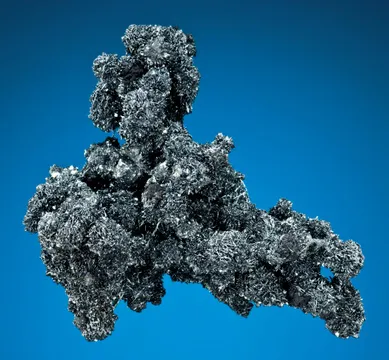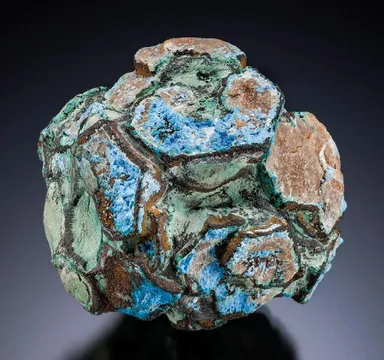
Coro Coro, Bolivia - classic locality for native copper pseudomorphs after aragonite; compact, heavy copper in salmon to mahogany red with cuprite shadows.
Key facts
Coro Coro is one of the classic names in native copper, but it is not classic in the same way as Michigan, Bisbee, or Itauz. Its great collector identity is built around a mineralogical sleight of hand: pseudohexagonal aragonite twins that have been replaced by native copper, preserving the external form of the carbonate while acquiring the weight, color, and metallic feel of Cu. A fine Coro Coro specimen is immediately recognizable—compact, heavy, salmon to mahogany-red copper, often with cuprite-red shadows and malachite-green seams, shaped like a blunt six-sided prism, a radial cluster, or a rounded “disco-ball” aggregate of aragonite forms.
Geologically, the district belongs to the sediment-hosted copper family of the Bolivian Altiplano. Copper mineralization is hosted in continental red-bed sandstones, conglomerates, shales, and related evaporitic strata around the town of Coro Coro in Pacajes Province, La Paz Department. The ore occurs as native copper and chalcocite in permeable beds and along structural controls associated with the Corocoro fault system, with historic divisions into the native-copper “Ramos” ores and chalcocite-bearing “Vetas” ores. The best specimens are not large cavern pieces in the vein-mining sense; they are small, dense objects from sedimentary horizons where copper-bearing solutions moved through porous beds, replaced carbonate, bleached red sandstone, and left the collector’s favorite product of the district: copper after aragonite.
Regional View
Country View
Historically, Coro Coro mattered long before mineral collectors made its pseudomorphs cabinet standards. Indigenous workers used copper-bearing outcrops and green copper minerals before the colonial period; colonial mining supplied copper to the mint at Potosí; nineteenth- and early twentieth-century companies turned the district into Bolivia’s principal copper camp; and modern state and joint-venture work has revisited the old mine and surrounding resources through hydrometallurgical copper recovery and renewed exploration. For collectors, that long mining history means that the finest pieces now encountered are often old-stock specimens, collection pieces, and auction material rather than abundant new mine output.

Photo: Wikimedia Commons
The strongest Coro Coro specimens combine three virtues: readable aragonite geometry, attractive natural copper color, and completeness. A chipped pseudohexagonal edge is more serious here than it would be on an ordinary copper mass, because form is the specimen. Green malachite, blue-green chrysocolla, red cuprite, pale aragonite remnants, and occasional gypsum or chalcophyllite can enrich a piece, but they should not obscure the essential pseudomorph. Matrix specimens are scarcer than loose floaters; sharp miniatures are much scarcer than thumbnails; and large, well-defined pieces are genuinely prized.
Search for specimens: View all specimens from Coro Coro, Bolivia
Coro Coro lies on the western Bolivian Altiplano, southwest of La Paz, in the Pacajes Province of La Paz Department. The town is commonly written both Coro Coro and Corocoro, and older literature frequently uses Corocoro for the mining district. The mine area sits at high altitude on cold, semi-arid plateau country cut by intermittent drainages that eventually relate to the Río Desaguadero system. This setting matters mineralogically: the district is a red-bed copper system rather than a quartz-vein copper camp, and its ores are intimately tied to porous clastic strata, oxidation-reduction boundaries, evaporitic influences, and fault-controlled fluid movement.
The classic geology is built around two historically important stratigraphic-mining terms, Ramos and Vetas. Older descriptions treated them as separate cupriferous series divided by the Corocoro fault; later studies refined the stratigraphy, but the practical mining distinction remains useful for collectors. The Ramos ores are especially associated with native copper, while the Vetas ores are better known for chalcocite-bearing red beds. Native copper occurs in sandstones and conglomeratic horizons as grains, flakes, sheets, irregular plates, arborescent fillings, and replacements. Chalcocite occurs as interstitial mineralization in certain red sandstone and arkosic beds. Near ore, red host rocks may be bleached to pale, whitish, or greenish colors, reflecting the reducing reactions and alteration halos around copper deposition.
The ore bodies are stratabound and structurally influenced. Published descriptions emphasize permeable sandstone beds, pebbly horizons, bedding-plane openings, and fractures close to the Corocoro fault and related structures. Copper mineralization is recorded over a strike length of several kilometers and through hundreds of meters of vertical extent in the mine district, with multiple copper-bearing lenses or beds. The red-bed model explains why the specimens look the way they do: aragonite crystals formed in the sedimentary environment, and later copper-bearing solutions replaced them while preserving their pseudohexagonal cyclic-twin shapes. This is why Coro Coro copper pseudomorphs do not look like normal native copper crystals; they are copper sculptures inherited from aragonite.
Mining history at Coro Coro begins before modern companies. Early workers used the oxidized outcrops, including green copper minerals, and colonial miners worked copper for practical use rather than silver-style bonanza wealth. The Rodríguez family is reported in early accounts as having supplied copper to the mint at Potosí; operations were interrupted in 1781 during revolutionary disturbances and by the difficulty of treating native copper ores after the easier oxidized outcrop material had been exhausted. A new mining phase began around 1830, when Claudio Rivero worked the native copper ores and encountered native silver, drawing miners back into the district.
In the nineteenth century, Coro Coro grew into Bolivia’s copper capital. Foreign and regional capital became increasingly important, and companies such as Compañía Corocoro de Bolivia and, later, Corocoro United Copper Mines shaped the industrial period. Corocoro United Copper Mines, Ltd. was organized under British law in 1909 and controlled a large block of claims; principal mines included Wisk’achani, Santa Rosa, and Guallatiri. Early twentieth-century logistics were a major part of the story: copper had to move across the high plateau to rail and then to Pacific export routes. The district’s production became famous not simply for quantity, but for the unusually high proportion of native copper that could be marketed as rich material.
By the mid-twentieth century, the district came under Bolivian state mining structures, eventually associated with COMIBOL. Later production and resource work included both underground knowledge inherited from old workings and modern approaches to leaching old ores, tailings, and dumps. The mine was closed in 1985 during the broader crisis and restructuring of Bolivian mining, then revived in the twenty-first century. In 2007 the reopening of the Coro Coro copper mine was announced after roughly twenty-two years of closure; in 2008 COMIBOL and Korea Resources Corporation agreed to a joint-venture exploration and development framework; and in 2009 Empresa Minera Corocoro began hydrometallurgical recovery from previously mined material. Modern sources record continuing association with KOMIR and COMIBOL through Empresa Minera Corocoro.
For collectors, the most important named source is the San Agustín Mine, north of Coro Coro, which is specifically noted for abundant native copper pseudomorphs after hexagonal cyclic twins of aragonite in poorly consolidated argillaceous sandstone. Specimens are also attributed more broadly to the Coro Coro district and to other mines or areas including Buen Pastor, Pisakheri, Veta Verde, Porvenir, Toledo, María Elena, and historic horizons such as Umacoya in the broader mining literature. Precise specimen-level provenance is often weak on older labels; many pieces are simply labeled “Coro Coro, Bolivia” or “Corocoro, La Paz,” and collectors should not assume a specific mine unless the label, old collection history, or original dealer record supports it.
Collecting access today should be regarded as restricted and industrial, not a casual field-collecting opportunity. The district includes active or administered mining areas, old underground workings, dumps, unstable sediments, and local land and mineral rights. Many specimen-grade pieces now reaching the market come from older recoveries, dealer inventories, private collections, and auction dispersals. Because the ore has economic copper value, specimen preservation has always depended on someone recognizing mineralogical value before the material was treated as ore.
Copper is the signature collector mineral of Coro Coro, and the finest specimens are native copper pseudomorphs after aragonite: pseudohexagonal single forms, rounded radial clusters, “snowman” double aggregates, and compact floater balls of replaced aragonite crystals, generally thumbnail to miniature in size. The color ranges from salmon copper and bronze to reddish brown, mahogany, and dark cuprite-red, often with green malachite staining, blue-green chrysocolla, reddish cuprite, pale aragonite remnants, gypsum crusts, or clayey sandstone matrix. San Agustín is the best-known specific mine source for abundant pseudomorphs, but older pieces are often labeled only Coro Coro or Corocoro district. Quality depends first on the preserved aragonite shape: sharp pseudohexagonal edges, complete all-around growth, distinct crystal faces, and minimal rounding or bruising separate serious examples from ordinary coppery lumps. Matrix pieces and larger sharp miniatures are considerably scarcer than small loose floaters, and a specimen that shows both strong copper color and crisp carbonate-inherited form is the locality’s essential prize.
Aragonite from Coro Coro is inseparable from the copper story because it is both a collectible species in its own right and the parent form for the district’s famous pseudomorphs. Verified specimens occur as beige to pale, pseudohexagonal cyclic-twin crystals and floaters, commonly small thumbnails to miniatures, with native copper, chalcophyllite, malachite, cuprite, chrysocolla, and rare sampleite or tenorite associations recorded from specimen data. The most desirable unreplaced aragonite pieces are not generic carbonate crystals but Coro Coro aragonites that still show the same six-sided habit collectors recognize in the copper replacements, especially when set off by bright blue chalcophyllite on pale aragonite. Such non-pseudomorphed aragonite with chalcophyllite has been described in the specimen market as much rarer than the copper-after-aragonite pseudomorphs, and good pieces are judged by sharp pseudohexagonal form, completeness, attractive contrast, and freedom from clay coating or bruising.
Beyond copper and aragonite, Coro Coro has a substantial red-bed copper assemblage. Documented species include chalcocite, cuprite, malachite, azurite, brochantite, chrysocolla, connellite, chalcophyllite, sampleite, tenorite, domeykite, algodonite, native silver, baryte, celestine, gypsum, calcite, fluorite, galena, jamesonite, tetrahedrite-group minerals, hematite, quartz, and petrified wood. Domeykite and algodonite reflect the arsenide side of the copper system; native silver is part of the old mining story as well as the mineral list; and chalcophyllite on aragonite is one of the most attractive collector rarities. The district is not chiefly known for type-locality species; its enduring mineralogical importance rests instead on an exceptional pseudomorph habit and on its role as one of the world’s best-known native-copper red-bed deposits.
Coro Coro copper is usually collected as a pseudomorph, and that is the first authenticity point. The specimen should not be sold as a true hexagonal native-copper crystal. Native copper is isometric; the six-sided form belongs to the aragonite that was replaced. Good labels should say “copper after aragonite,” “native copper pseudomorph after aragonite,” or similar wording. Labels that say only “hexagonal copper crystal” are imprecise and can mislead newer collectors.
The most common condition problems are chipped edges, rubbed high points, crushed faces, rounding from extraction, and obscuring alteration. Because many pieces are small floaters, they have often been hot-glued into thumbnail boxes; old glue, foam residue, or broken mounts can be present on bases or in cavities. Loose floaters should be mounted with reversible methods whenever possible. Poorly consolidated sandstone matrix can shed grains or crumble, so matrix specimens deserve gentle handling and a stable mount.
Color deserves careful judgment. Natural patina can be highly attractive—warm copper, red-brown cuprite, green malachite, blue-green chrysocolla—but heavy dark coating may hide form, and overly bright or oddly colored surfaces can suggest aggressive cleaning. On some specimens, pale blue material has been suspected by experienced collectors to be a chemical-cleaning artifact rather than a natural copper mineral; small blue-green patches should not automatically be called chrysocolla or connellite without magnification and, for important pieces, analysis. Red to reddish-brown microcrystalline areas are commonly cuprite; green films or clayey coatings are often malachite-stained sandstone or marl rather than discrete crystals.
The best market pieces are complete, sharp, and instantly legible as aragonite replacements. Small thumbnails are available with patience, but sharp miniatures and large floaters are much less common. Unreplaced aragonite with bright chalcophyllite is scarcer still in the collector market. Specimens with old labels, named collection provenance, or specific mine attribution such as San Agustín deserve a premium when the documentation is credible. Broad “Coro Coro” labels are normal and acceptable, but unsupported attempts to pin a specimen to a named mine should be treated cautiously.
No special fluorescence is central to the locality’s classic appeal. Copper itself is opaque and non-fluorescent; aragonite may fluoresce at some localities, but fluorescence should not be used as a primary test for Coro Coro provenance. Handle specimens dry, avoid acids, avoid ultrasonic cleaning, and keep them away from prolonged damp storage. Native copper can darken further in poor environments, and fragile associated aragonite, gypsum, clay, or sandstone may be damaged by water or cleaning chemicals.
The earliest Coro Coro story is almost the opposite of a silver-boom legend. While Potosí, Oruro, and Colquechaca fired colonial imagination with precious metal, Coro Coro’s metal was useful, stubborn, and less glamorous. When Spanish arrivals reached the high plateau, they found Indigenous workers already exploiting oxidized copper outcrops and green copper minerals. Later, the Rodríguez family worked the deposits regularly and supplied copper to the mint at Potosí. Then the year 1781 broke the rhythm. Revolutionary disturbances ruined many operations in the region, and at Coro Coro the miners also faced a practical metallurgical puzzle: once they had passed through oxidized outcrop ores into native metallic copper, their familiar smelting methods no longer answered the problem. The mines were abandoned until the next great phase.
That revival began around 1830 with Claudio Rivero. Accounts describe him arriving after reports that the district might yield not only copper but silver. His workings did find rich native copper, and native silver was encountered as well. What had been a depopulated or diminished place began drawing other miners, including foreigners, and the copper camp grew. The transformation was not a sudden bonanza like a silver strike; it was the patient discovery that the red beds held enough metallic copper to support a district.
Coro Coro’s native copper had its own commercial vocabulary. “Charque” referred to natural native copper in sheets, plates, or dendritic forms, a name that evokes strips of dried meat. “Barrilla” referred to granular native-copper concentrates, very rich in copper, suitable for chemical uses such as copper sulfate production. Adrien Berton’s 1930s account stressed that Coro Coro native copper was remarkably pure and valued in European markets before electrolytic copper became dominant. For roughly a century after the 1830 revival, reported native-copper production reached about 100,000 tons—a striking figure for a district that specimen collectors now know chiefly through thumb-sized pseudomorphs.
The industrial period had the atmosphere of a remote company town stitched to the world by rail and export routes. Corocoro United Copper Mines, Ltd. was organized in Britain in 1909, with its corporate office in London and mine office at Coro Coro. The company’s lands included hundreds of claims, and the principal mines included Wisk’achani, Santa Rosa, and Guallatiri. Water was a problem; transport was a problem; altitude was a constant. Older company descriptions place the district a little over 13,000 feet above sea level, in a cold semi-desert climate with strong day-night temperature swings. Copper moved from the high plateau through rail connections and onward toward Pacific ports. The modern collector holding a 2 cm floater is holding the aesthetic remnant of a district that was once planned in claims, rail mileage, export routes, and metallurgical tonnage.
The specimens themselves carry a quieter story. At San Agustín and related horizons, aragonite crystals grew as pseudohexagonal cyclic twins in weak argillaceous sandstone. Later, copper replaced them so completely that the resulting objects can fool the eye: they look like metallic copper crystals with forbidden geometry. A careful collector learns to read the contradiction. The shape says aragonite; the heft and color say copper. The best pieces preserve this contradiction cleanly, with sharp faces and complete form, as if a carbonate crystal had been transmuted into metal without forgetting its original body.