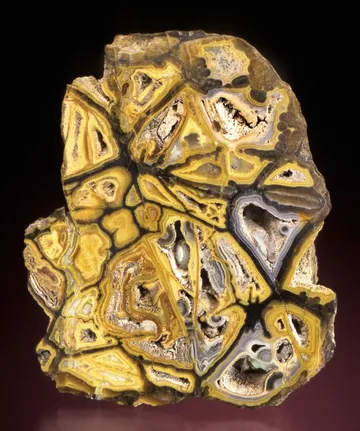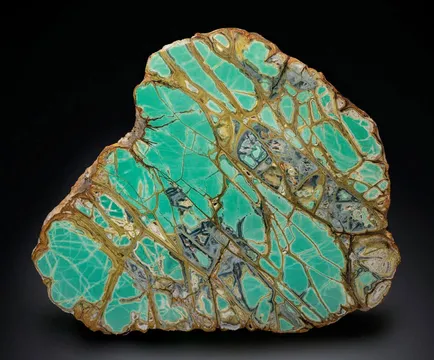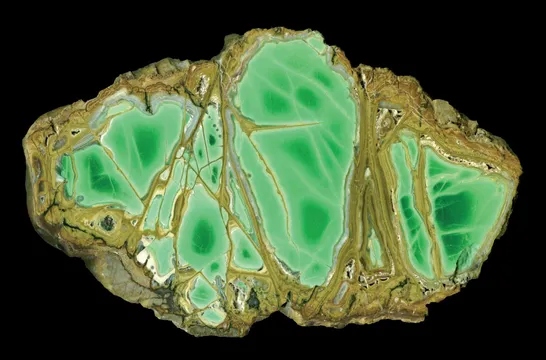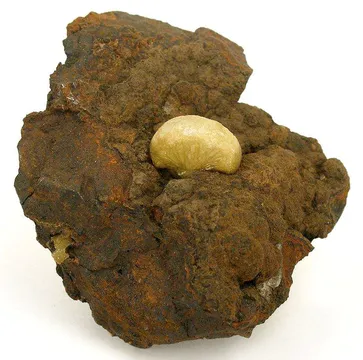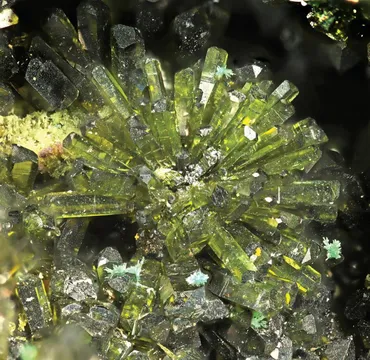
Wardite from Clay Canyon Mine, Utah — type-locality material prized for phosphate mosaics with variscite cores, yellow crandallite rims, and blue-gray wardite.
Key facts
Wardite from Clay Canyon is one of those classic American mineral occurrences whose importance is greater than its average crystal size. This is the type locality for wardite, NaAl3(PO4)2(OH)4·2H2O, first described in the 1890s from the phosphate nodules near Fairfield, Utah. For collectors, the locality’s signature is not the large, gemmy, isolated wardite of Rapid Creek, but the intimate phosphate mosaics of the Little Green Monster–Clay Canyon nodules: sea-green variscite, yellow to cream crandallite and millisite, and gray-green to blue-gray wardite in eyes, rims, seams, and finely banded zones.

Photo: Rob Lavinsky / Wikimedia Commons
The best Clay Canyon pieces are lapidary-mineral specimens as much as crystallographic specimens. They usually need a saw cut and polish to reveal their beauty: green variscite cores edged by yellow crandallite, with wardite appearing as cool gray-green eyes, blue-gray stringers, or concentric bands around the variscite. In less common vuggy material, wardite may occur as small crystals or crystal-lined seams in altered phosphate nodules, but the locality’s great visual appeal lies in pattern, color contrast, and documented old-time provenance.
Mineralogically, Clay Canyon is exceptional because wardite belongs to a remarkable suite of hydrated aluminum phosphates developed in altered limestone and black shale near Fairfield. The same district produced several classic phosphate species and type-locality minerals, including gordonite, millisite, montgomeryite, overite, englishite, and wardite. The deposit is also notable for scandium-bearing aluminum phosphate chemistry: crandallite, variscite, wardite, goyazite, and related minerals from the area have been discussed in the literature as part of Utah’s unusual scandium-enriched phosphate occurrences.
Collectors prize Clay Canyon wardite for three reasons: it is type-locality material; it is visually distinctive when associated with green variscite and yellow crandallite; and much of the best material is old, finite, and tied to the famous 1937–1940 Ed Over and Arthur Montgomery collecting period. A small polished slice may be attractive, but the most desirable examples show sharp color separation, bull’s-eye or nodule architecture, abundant gray-blue wardite, and a label chain connecting the piece to Clay Canyon, the Little Green Monster Mine, Ed Over, Arthur Montgomery, Rock Currier, the Smithsonian/National Museum stream of material, or other known early collections.
Search for specimens: View all wardite specimens from Clay Canyon Mine, Utah, USA
Clay Canyon lies west of Fairfield in Utah County, on the east side of the southern Oquirrh Mountains. The mineral locality most collectors mean when they say “Clay Canyon wardite” is the Little Green Monster Variscite Mine, also historically called the Clay Canyon Deposit or Clay Canyon Variscite Mine. Mindat records the Little Green Monster as a reclaimed former underground phosphate and gemstone deposit in altered limestone, with approximate coordinates near 40°16′33″ N, 112°10′10″ W.
The host setting is not a pegmatite, despite wardite’s fame at some other world localities. At Clay Canyon the phosphate bodies occur in dark limestone and black shale of the Upper Mississippian Great Blue Limestone, stratigraphically above the Long Trail Shale Member. The rocks dip northeast on the northwestern limb of the Ophir anticline. The nearest igneous body discussed in the geological literature is the altered Eagle Hill Rhyolite, about 2.2 miles northwest of the deposit and dated at about 31.5 million years.
The phosphate mineralization occurs as nodules and replacement bodies in altered carbonate rock. At the Little Green Monster, variscite nodules replace limestone along a north-trending vertical fracture zone, in pipe-like bodies plunging north. Variscite and crandallite occur as aggregates of nodules in a highly altered matrix, as elongate fracture replacements, and as fissure fillings. Surrounding alteration includes limonitic clays, alunite, chalcedonic quartz, and calcite. The western Clay Canyon occurrence also includes variscite in jasperoid vugs, showing how strongly silicification and brecciation influenced local deposition.
The paragenesis recorded in the classic studies is central to understanding wardite specimens from this locality. Variscite formed early by replacement of limestone. Crandallite then replaced much of the variscite. Rare aluminum phosphate minerals, including wardite and associated species, accompanied and followed that crandallite alteration. Quartz, calcite, and limonite came later. This is why polished nodules so often show variscite cores interrupted or rimmed by yellow crandallite, with wardite in later-looking gray-green zones, eyes, seams, and small pockets.
The mining history is unusually colorful. Variscite was recognized at Clay Canyon in the 1890s, and F. T. Millis of Lehi is credited in the Utah Geological Survey literature with first discovering variscite at the Little Green Monster in 1893. Don Maguire mined variscite as a gemstone from 1894 to 1911. Later, in 1936, Edwin Over and Arthur Montgomery staked the Little Green Monster claim, later obtaining a patent in the late 1940s. Their work in 1937 and probably 1938 produced much of the classic collector material now seen as polished slices, end cuts, and half nodules.
Clay Canyon also had an industrial afterlife. In 1959 and 1960, the Kawecki Chemical Company investigated the deposits as a possible scandium source. Two shipments of crandallite ore, weighing 330 pounds and 4,000 pounds, were produced and reported to contain 0.14 and 0.10 percent Sc2O3 respectively. Those figures help explain why a locality best known to collectors for variscite and wardite appears in economic-geology literature on scandium-bearing aluminum phosphates.
Collecting access today should be treated as effectively closed for casual field collecting. The Little Green Monster is recorded as reclaimed, and the old mine entrances and dumps have been bulldozed to match the surrounding topography. Very little of the historic locality is visible on the ground. Collectors should not expect productive digging; the practical route to Clay Canyon wardite is through old collections, dealer inventories, estate material, and museum deaccessions.
Clay Canyon wardite is usually best recognized by context. In polished nodules it is the gray-green, blue-gray, or pale gray phosphate that occurs with green variscite and yellow to cream crandallite or millisite. It may appear as narrow bands, irregular veinlets, small rounded “eyes,” rims around variscite pods, or compact patches in the altered nodule. In hand specimens, especially unpolished pieces, the contrast can be subtle; once cut and polished, wardite becomes much easier to separate visually from the green variscite core and the yellow crandallite zones.
True crystals from Clay Canyon are generally small. Collectors should think in terms of seams, micro-vugs, and crystal-lined cavities rather than large freestanding display crystals. Wardite as a species is tetragonal and may form pseudo-octahedral dipyramidal crystals, granular aggregates, crusts, fibrous aggregates, and spherulitic forms. At Clay Canyon, however, the collector aesthetic is dominated by compact nodular material and small cavity linings within the phosphate nodules.
Typical specimen formats include thin polished slabs, half nodules, end cuts, and occasional vuggy boxwork pieces. Published and dealer-documented examples range from small slices a few centimeters across to cabinet-size nodules and end sections over 10 cm. A 6.0 x 4.0 x 0.4 cm Wikimedia-documented slab shows the classic green-yellow-gray palette; other documented specimens include 8–11 cm polished slices, 9 cm faced nodules, and larger cabinet end sections exceeding a kilogram. The best wardite-rich pieces need not be large, but they must show the wardite clearly.
Color terminology can be confusing. Some older descriptions and dealer listings call wardite blue, blue-gray, gray-green, gray, or even white depending on lighting, polish, and association. In the Clay Canyon suite, yellow is generally crandallite or millisite, bright green is variscite, and wardite is usually the cooler gray-green to blue-gray component. Misidentification is easy in poorly polished or weathered material, and rare associated phosphates can complicate the picture.
Common associated minerals at the Little Green Monster and Clay Canyon include variscite, crandallite, millisite, englishite, gordonite, montgomeryite, overite, fluorapatite including carbonate-rich fluorapatite, goyazite, kolbeckite, quartz, calcite, alunite, limonite, and related alteration minerals. For display labels, “wardite with variscite and crandallite” is often accurate for the classic material, but high-end labels sometimes list additional species only when there is analytical or strong provenance support.
Quality is judged differently from crystal-locality wardite. At Clay Canyon, desirable factors include:
The main authenticity issue with Clay Canyon wardite is not an established epidemic of synthetic or dyed fakes; it is attribution, preparation, and species separation. Many green-and-yellow variscite nodules from Utah are sold under broad labels, and not every gray or pale zone in a nodule should automatically be called wardite without locality and association support. For serious species collectors, the best labels specify Clay Canyon or the Little Green Monster Variscite Mine and identify wardite separately from crandallite, millisite, and variscite.
Because the material is commonly cut and polished, condition standards are closer to those for classic lapidary mineral specimens than for fragile crystal groups. Look for saw scars, poor polish, edge bruising, chips on thin slabs, glued repairs, and excessive rounding from repolishing. A good polish can be legitimate and desirable; a smeary, waxy, or overly glossy surface may indicate oil, wax, resin, varnish, or another enhancement. At least one documented Clay Canyon phosphate specimen was sprayed with varnish decades ago to enhance details, so collectors should inspect surfaces carefully under oblique light and magnification.
Unpolished Clay Canyon nodules can be more difficult to evaluate. Weathered rind, limonitic matrix, and pale phosphate alteration may obscure the diagnostic color relations. If buying uncut material, do not assume that every nodule contains attractive wardite; many will show variscite and crandallite more prominently, and some may be visually dull until cut.
Rarity depends on the specimen type. Small polished slices of mixed variscite-crandallite-wardite still appear periodically, but fresh collecting is not a meaningful source. Rich, well-patterned old-time specimens with clear wardite, strong green variscite, and sharp yellow crandallite are much scarcer. Wardite-dominant specimens, especially pieces with little or no variscite and strong gray-blue banded wardite, are significantly rarer than standard variscite-centered nodules.
Recent market evidence shows a wide price spread. Small commercial polished slices may sell in the low hundreds or below when the pattern is modest. Better small-cabinet to cabinet pieces with good color, strong pattern, or old provenance have brought several hundred to over a thousand dollars. Large end cuts and unusually rich nodules can bring several thousand dollars, especially when they carry old collection history. End caps are generally more desirable than ordinary thin slices because they preserve the nodule’s three-dimensional structure.
For labels, use conservative wording when appropriate: “variscite, crandallite, wardite” is preferable to overloading a label with every possible rare phosphate unless the specimen has been analyzed or comes with credible analytical provenance. Clay Canyon is famous partly because the mineralogy is complex; that complexity is exactly why serious collectors reward accurate, restrained labels.
The Clay Canyon story begins with a mistake good enough to become a mineral classic. In 1893, Frank Butt and his brother entered Clay Canyon thinking they had found gold. They had not. The gold prospect failed, but one of the strange nodules from the canyon apparently reached F. T. Millis of Lehi, Utah, who sent material to George P. Merrill at the U.S. National Museum. There, the green phosphate was recognized as variscite, and a non-gold prospect began its second life as one of the most important American phosphate localities.
The early commercial story was not instantly glamorous. Don Maguire took over the property around 1904 and tried to market the green material as a gemstone resembling turquoise. The effort was modest: only about 200 carats were produced in four years, with much of that reportedly going to China. That figure is striking because it contrasts so sharply with the later collector fame of the mine. What looked like an obscure gemstone venture became, in hindsight, the source of some of the most recognizable variscite-wardite-crandallite specimens in American cabinets.
The Little Green Monster name came from a different place entirely: Alaska. Edwin Over and Arthur Montgomery had been collecting epidote at Green Monster Mountain on Prince of Wales Island. When they arrived at Clay Canyon in 1936, they carried the name with them and applied it to the Utah phosphate dig. It suited the material perfectly. The mine produced green nodules with hidden interiors, and the name “Little Green Monster” became inseparable from the best Clay Canyon specimens.
Over and Montgomery divided the work in the practical way collectors still understand: Ed dug, Art marketed. They found two new zones of nodules and distributed important material, including many specimens to the Smithsonian Institution. Between 1937 and 1940, several tons of classic material were removed by hand. That brief three-year window accounts for much of the old-time material that still circulates in collections: polished slabs, half nodules, end cuts, and vivid green-yellow-gray phosphate mosaics.
By 1940 the rich zones were becoming harder to find, and Over and Montgomery moved on. The locality then entered the long afterlife that famous mineral occurrences often have: scientific papers, old labels, rediscovered drawers, museum specimens, and dealer stories. Many of the finest pieces today are valued not only for their pattern but for their lineage—Ed Over material, Arthur Montgomery material, Smithsonian-related pieces, Rock Currier photographs, Dick Hauck collection specimens, Sorbonne or university specimens, and estate pieces that have carried the Clay Canyon name for generations.
The physical site has almost disappeared. The mine entrances and dumps were later bulldozed and contoured back into the hills. That reclamation gives Clay Canyon wardite a particular collector poignancy: the surviving specimens are not simply attractive polished nodules, but the durable record of a locality whose surface expression has largely been erased.