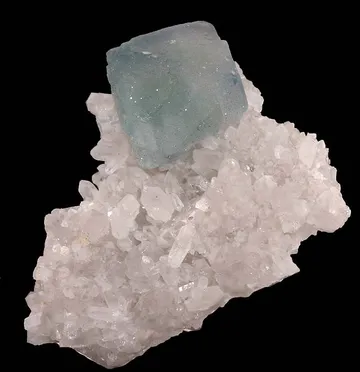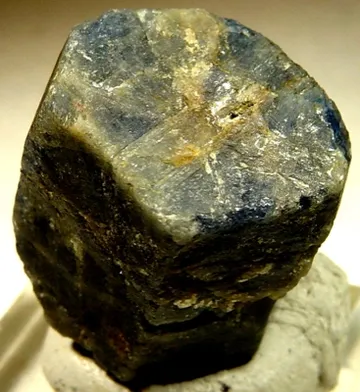
A collector's guide to Chelyabinsk Oblast, Russia: its geology, mining history and notable minerals, illustrated with the 43 specimens documented from this locality on EarthWonders.
Key facts
Chelyabinsk Oblast is not a single mine locality so much as a mineral province: a compact but astonishingly varied section of the Southern Urals where alkaline massifs, granitic and syenitic pegmatites, carbonate-silicate veins, gold placers, copper porphyry ores, coal-basin combustion rocks, and even a famous meteorite fall all crowd into the collecting record. For serious collectors the name immediately evokes the Ilmen and Vishnevye Mountains near Miass and Vishnevogorsk—classic alkaline-pegmatite country with zircon, amazonite, topaz, beryl, pyrochlore, aeschynite, samarskite, ilmenite, monazite-(Ce), and other rare-element species—as well as the Akhmatov mine area, the type locality of perovskite, where black to brown CaTiO3 crystals on pale carbonate, green chlorite-group minerals, magnetite, and titanite helped put a mineral name into the vocabulary of both collectors and modern materials science.
Regional View
Country View
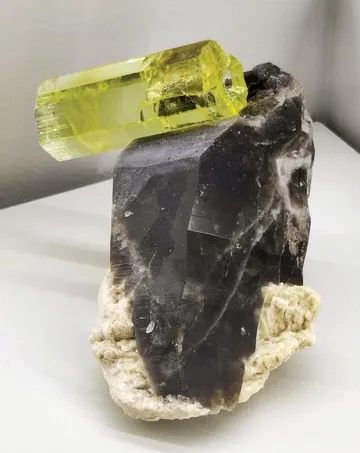
The region’s best specimens have very different visual signatures depending on which sub-locality is represented. Ilmen and Vishnevye zircon is the heavy, architectural material: brown, reddish brown, hyacinthine, or metamict crystals in feldspar-rich pegmatite, sometimes sharply complete and sometimes partly altered to cyrtolite or malacon-like material. Ilmen topaz ranges from colorless to faint bluish or greenish crystals in amazonite-bearing pegmatites, while the Sanarka–Kamenka “Russian Brazil” district is remembered for rare pink to imperial-colored topaz from placer and eluvial contexts. Perovskite from Akhmatov, Zelentsov, and neighboring mines is old-world cabinet material—dark, lustrous, blocky crystals in carbonate-silicate rock, most prized when isolated and sharp rather than massive or bruised. Mikheevskoe azurite, by contrast, is a modern copper-deposit product: rounded nodules and small geodes lined with deep blue, velvety to sparkling crystals, often with malachite.
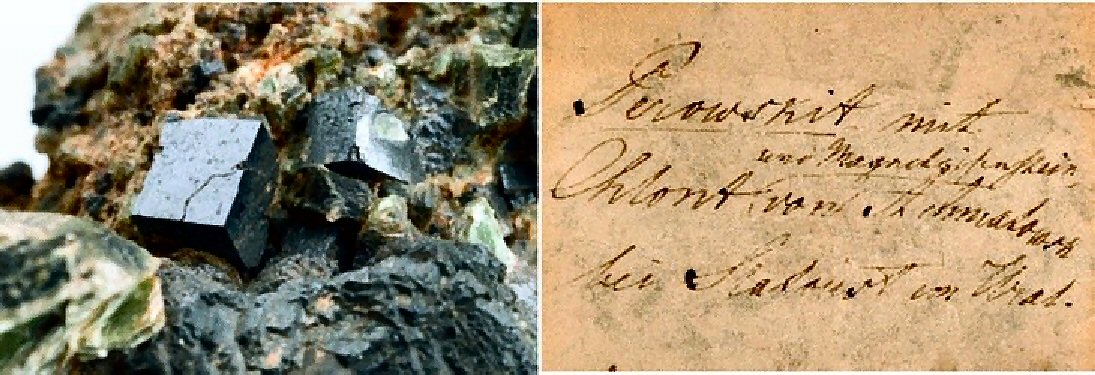
Photo: Webmineral
The historical weight of Chelyabinsk Oblast is unusually high for a regional locality. The Ilmen Mountains were protected in 1920 as a mineralogical reserve, and the Ilmen Natural Science Museum grew around collections from the very pegmatite pits that made the area famous. Several minerals were first described from the Ilmen area, including ilmenite, cancrinite, monazite-(Ce), samarskite-(Y), aeschynite-(Ce), chiolite, and later rare species such as ushkovite and polyakovite-(Ce). The district south of Plast added another layer of romance: nineteenth-century gold workings that yielded euclase, pink topaz, corundum, chrysoberyl, and other gem minerals from placers, earning the name “Russian Brazil.”
Search for specimens: View all specimens from Chelyabinsk Oblast, Russia
Chelyabinsk Oblast sits on the eastern and western structural domains of the Southern Urals, and its collectible minerals come from several genetically distinct settings rather than one deposit type. The Ilmenogorsky complex around Miass is the classic collector’s core: Precambrian gneisses, amphibolites, schists, quartzites, syenites, granites, ultramafic rocks, and biotite nepheline syenites known locally as miaskites are cut by numerous pegmatite systems. In the Ilmen Mountains these pegmatites are commonly grouped as granitic, syenitic, miaskitic, amazonitic, and related alkaline to rare-metal varieties; their mineralogy reflects repeated crystallization, deformation, metasomatism, and late alteration in a structurally complicated block. Collectors encounter the Ilmen name on specimens of amazonite, topaz, beryl, phenakite, zircon, samarskite, monazite, ilmenite, pyrochlore, columbite-group minerals, corundum, and many rare species, although modern collection from the reserve itself is prohibited except under scientific authorization.
The Vishnevye Mountains and Vishnevogorsk massif, north of the Ilmen Mountains, form another alkaline rare-metal center within the broader Ilmen–Vishnevogorsk belt. Here gneisses, schists, amphibolites, and quartzites host alkaline rocks, miaskite pegmatites, and hydrothermal assemblages. Feldspar mining began after large miaskite pegmatite veins were recognized at Kurochkin Log in the 1920s, and industrial work later expanded around niobium, zirconium, hafnium, rare earth, uranium, thorium, ilmenite, feldspar, and nepheline resources. For collectors, Vishnevogorsk and Karavay Mountain are important for zircon and ilmenite: heavy, dark to brown crystals from feldspar-aegirine and nepheline-bearing pegmatitic environments, including historic large crystals and more recent dump-collected material where access has been possible outside protected ground.
The Akhmatov mine and nearby Zelentsov and Perovskitovaya mines occupy a very different geological niche. They are carbonate-silicate vein localities in the Nazyam/Chernorechenskie Mountains area near the Kusinsko-Kopanskaya layered gabbro intrusion. Older literature commonly treated the assemblage as skarn related to contact between gabbroic rocks and dolomites, but modern work on perovskite chemistry and U-Pb ages has complicated that picture, with carbonatite-like or deeper endogenic processes now considered important. The veins contain perovskite with calcite, magnetite, clinochlore, diopside, forsterite, clinohumite, garnet, spinel, hydrotalcite-group minerals, magnesioferrite, titanite, and other minerals. These mines are historically critical because Akhmatov is the type locality of perovskite, and older nineteenth-century specimens from the area are among the most desirable examples of the species.
South of Plast, the Sanarka, Kamenka, and Kabanka valleys define the celebrated “Russian Brazil” district. Gold mining in the Kochkar system and associated placers exposed gem minerals that seemed, to nineteenth-century mineralogists, more like Brazilian material than ordinary Urals production: euclase, pink topaz, corundum, chrysoberyl, beryl, tourmaline, quartz, and occasional diamond have all been associated with the broader placer and bedrock system. In collecting terms this is not a place to reduce to a single mine label. A precise Sanarka River, Kamenka River, Proroko-Ilyinsky mine, Bakakinsk placers, or Kochkar gold-field label carries much more meaning than a broad “Chelyabinsk” tag.
The Mikheevskoe copper deposit in Kartalinsky District adds the modern blue note to the region. It is a major porphyry copper system hosted in Devonian volcanic and volcano-sedimentary rocks with later alteration and epithermal overprinting. The open-pit mine and concentrator have been operated by Mikheevsky GOK within the Russian Copper Company sphere, and the deposit is mined for copper with associated gold, silver, molybdenum, and rhenium. Collector azurite comes from the oxidized copper environment: rounded nodules, geodes, and cavity linings of blue copper carbonate, often sold simply as “Chelyabinsk azurite” but better labelled Mikheevskoe when that provenance is secure.
The broad regional label also covers important but less market-common specimen sources: Bakal iron deposits, Kyshtym and Slyudorudnik rutile and quartz occurrences, Svetlinskoe smoky quartz and piezoquartz pockets, corundum and sapphire-bearing pegmatites and meta-ultramafic rocks in the Ilmen area, Kopейsk coal-basin combustion minerals, Karabash copper-gold and telluride occurrences, and the Chelyabinsk meteorite strewn field of 2013. Because the oblast contains protected reserves, active industrial pits, old underground workings, and private or restricted lands, collecting legality varies sharply by sub-locality. Old labels, museum material, and legally collected dump or placer specimens are the backbone of the market; field collecting should never be assumed permissible merely because a locality is historically famous.
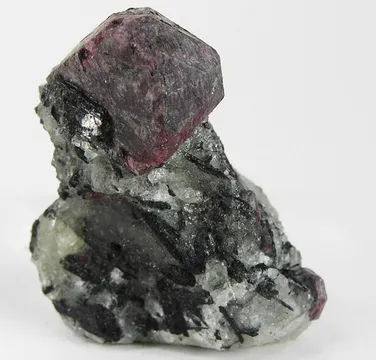
Zircon from Chelyabinsk Oblast is most strongly associated with the Ilmen and Vishnevye alkaline-pegmatite systems, especially feldspathic and nepheline-feldspathic pegmatites in which zircon grew with pyrochlore, xenotime, monazite, samarskite, ilmenorutile, columbite-group minerals, garnet, magnetite, apatite, albite, amazonite, topaz, aegirine, and calcite. The better crystals are brown to reddish brown, sometimes hyacinthine, commonly prismatic-dipyramidal or more equant, and may show distinct sector and growth zoning; old Ilmen accounts describe crystals several centimeters across, with an 8 × 6 cm zircon displayed from near Selyankino and even larger “fist-size” finds recorded from syenite-pegmatite veins, while Karavay Mountain in the Vishnevye Mountains has produced both historic large crystals and modern smaller sharp individuals from vein dumps. Fine Chelyabinsk zircon is judged less by brilliance than by completeness, heft, sharp terminations, surface sculpture, and credible sub-locality: a lustrous, intact Karavay or Ilmen crystal on feldspar-rich matrix is far more desirable than a rubbed, altered brown fragment carrying only a broad regional label.
Chelyabinsk Oblast is foundational for perovskite because the Akhmatov mine near Magnitka, in the old Zlatoust mining district, is the type locality of CaTiO3 perovskite, described by Gustav Rose from South Ural material in the nineteenth century and later joined in collections by specimens from Zelentsov and Perovskitovaya mines. The classic material occurs in carbonate-silicate veins with calcite, clinochlore or other chlorite-group minerals, magnetite, diopside, forsterite, clinohumite, garnet, spinel, hydrotalcite-group minerals, magnesioferrite, and titanite; crystals range from small sharp cubes and modified cubes to octahedral, rhombododecahedral, and more complex forms, dark brown to black with submetallic to resinous luster. Historic accounts describe exceptional crystals with edges up to about 12 cm, while modern finds are more commonly up to several centimeters, with rare rich aggregates carrying many individual crystals; the finest collector pieces are sharply isolated, lustrous, undamaged crystals on pale carbonate or green chloritic matrix, and an old Akhmatov provenance elevates even modest specimens because it ties the piece to the species’ original locality.
Topaz in Chelyabinsk Oblast belongs to two principal collecting traditions: the Ilmen Mountains pegmatites, where colorless to faint blue-green crystals occur with amazonite, beryl, phenakite, fluorite, cryolite-group aluminofluorides, muscovite, quartz, columbite-group minerals, garnet, and rare-element accessories, and the Sanarka–Kamenka “Russian Brazil” district, where rare pink to imperial-colored topaz was recovered from gold-bearing placer and eluvial material. In Ilmen pegmatites, especially amazonite-bearing bodies and the Gasberg topaz-cryolite pit, crystals may be thick, glassy, and prismatic, with historic material described to roughly 20 cm and individual crystal weights around a pound, while a famous Ilmen topaz exceeding 600 g is tied to the Blumovskaya pit record; from the Kamenka vicinity, the most memorable pink topaz is much smaller but far rarer, including a documented crystal 5.7 cm long and only 1.1 cm thick from the former Proroko-Ilyinsky mine area. Good Chelyabinsk topaz is evaluated on intact terminations, transparency, color, and label precision: a clean pink Sanarka/Kamenka crystal or an undamaged Ilmen topaz with amazonite or cryolite association is in a different league from a pale, cleaved, locality-vague fragment.
Azurite from Chelyabinsk Oblast is chiefly a Mikheevskoe copper-deposit specimen style: secondary Cu3(CO3)2(OH)2 formed in the oxidized zone of a large porphyry copper system in Kartalinsky District, far from the Ilmen pegmatite tradition. The collectible material is typically sold as rounded nodules or geodes, with dark royal-blue to electric-blue crystalline linings and occasional malachite association; the individual crystals are usually small, but dense sparkling surfaces and saturated, even color make attractive miniatures and small cabinet pieces. The best examples retain a natural nodule wall, show unbroken crystal lining across an open cavity, and have no suspicious dye bleed, glue, or artificial-looking crust; because many labels shorten the locality to “Chelyabinsk” or “South Ural,” a specimen specifically tied to Mikheevskoe carries greater scientific and market value.
Beyond these four market-facing species, Chelyabinsk Oblast is one of the world’s great type-locality regions. Ilmenite takes its name from the Ilmen Mountains, and the same region is tied to classic descriptions of cancrinite, monazite-(Ce), samarskite-(Y), aeschynite-(Ce), chevkinite-(Ce), chiolite, ilmenorutile, fergusonite-beta-(Ce), fluoro-richterite, fluoro-magnesio-arfvedsonite, potassium sadanagaite-group amphiboles, ushkovite, svyazhinite, makarochkinite, and polyakovite-(Ce). The oblast also includes zlatogorite and auricupride from the Karabash/Zolotaya Gora sphere, rare combustion minerals from Kopeisk coal-basin dumps, giant rutile from Kyshtym–Slyudorudnik quartz veins, large apatite from the Snezhinsk “Seven Keys” area, euclase from the Bakakinsk and Sanarka–Kamenka gold-placer system, corundum and sapphire from Ilmen and related ultramafic or pegmatitic rocks, and Chelyabinsk LL5 ordinary chondrite fragments from the 2013 fall.
The main authenticity issue with Chelyabinsk Oblast specimens is not usually synthetic mineral manufacture but label discipline. “Chelyabinsk,” “South Urals,” “Miass,” “Ilmen,” and “Vishnevogorsk” are often used loosely, and older European labels may give obsolete spellings such as Achmatowsk, Akhmatovskaya Kop, Slatoust, Zlatoust, Ilmeny, Ilmen Mts, or Miask. For perovskite, a true Akhmatov mine label is especially valuable because of type-locality status; however, nearby Zelentsov and Perovskitovaya specimens can look similar, so old labels, collection history, and matrix should be weighed carefully. For zircon, Karavay Mountain, Vishnevye Mountains, Ilmen Mountains, Selyankino, and generalized Vishnevogorsk labels should not be treated as interchangeable.
Condition standards vary by species. Chelyabinsk zircon is dense and durable but commonly worn, chipped on pyramidal terminations, or altered and dulled by metamictization; excellent pieces have complete geometry and fresh faces. Topaz has perfect basal cleavage, so seemingly small knocks can translate into flat cleavage breaks; pink Sanarka/Kamenka material is especially unforgiving because color and completeness drive value. Perovskite crystals often show edge wear, dull patches, carbonate encrustation, or old repairs; sharp, glossy crystals standing free of matrix are scarce. Mikheevskoe azurite is more fragile than its rounded geode form suggests: the blue crystal linings can rub, powder, or detach, and specimens should be kept dry, out of prolonged direct sun, and away from acidic storage materials.
Fluorescence is not a defining feature of the marquee species here, though associated minerals from pegmatites and carbonate-silicate assemblages may respond variably. Radioactivity deserves more attention: Ilmen and Vishnevye rare-element pegmatites can contain uranium- and thorium-bearing minerals such as samarskite, monazite, pyrochlore-group minerals, betafite-like material, thorite or huttonite, and related metamict phases. Most cabinet specimens are safe with ordinary mineral-collection hygiene, but avoid grinding, inhaling dust, storing large radioactive pieces beside occupied workspaces, or placing unsealed radioactive specimens in bedroom displays.
Market availability is uneven. Mikheevskoe azurite has appeared in recent trade in enough quantity that attractive pieces are obtainable, although top-quality geodes with even crystal linings are less common. Chelyabinsk perovskite is always a classic rather than a bulk commodity; small old specimens circulate, but superb Akhmatov pieces are museum-grade and seldom inexpensive. Zircon from Vishnevogorsk and Ilmen is available sporadically, especially as older stock or small modern pieces from dumps outside strict protected zones. Fine Sanarka/Kamenka pink topaz and euclase are genuinely scarce, and labels deserve scrutiny. Chelyabinsk meteorite fragments are widely traded, but they are also widely imitated or poorly documented; serious buyers should expect a known chain of custody, meteoritic fusion crust or interior texture consistent with LL ordinary chondrite material, and seller willingness to disclose weight, preparation, and provenance.
The perovskite story begins as a nineteenth-century relay between mines, collectors, and laboratories. The dark crystals that would eventually define CaTiO3 came from the Akhmatovskaya mine in the South Urals and reached Gustav Rose through Alexander Kämmerer in 1839. Rose recognized the mineral as new and named it for Count Lev Alekseevich Perovsky, an influential Russian mineral collector and statesman. That obscure-looking black oxide from a carbonate-silicate vein later lent its name to an entire structural family—“perovskites”—central to ceramics, geophysics, and photovoltaic research. For collectors, the irony is delicious: the global scientific word now used for high-tech materials began with heavy, dark crystals from a hand-worked Ural mine.
The Ilmen Mountains have their own mythology, and much of it is justified. By the early nineteenth century collectors and scientists were already treating the area as a natural mineral cabinet. Johann Menge, Gustav Rose, Alexander von Humboldt’s circle, Russian mining engineers, and later A. E. Fersman and V. I. Vernadsky all pass through the record. The pegmatite pits were not anonymous holes in the ground; many were numbered, mapped, revisited, and studied as if they were chapters in a book. Pit No. 69, Gasberg’s topaz-cryolite pit, became famous because a granitic pegmatite cavity roughly a meter across held cryolite and cryolithionite with topaz and other aluminofluorides. Pit No. 50, the Blumovskaya or Blum pit, was opened for topaz and aquamarine in 1835, later worked by engineer F. F. Blum, and eventually remembered for amazonite, beryl, topaz, samarskite, malacon-like zircon, and rare-element minerals.
One of the most evocative Ilmen episodes belongs to the Radium Expedition of 1911–1917 under V. I. Vernadsky. At the Blumovskaya pit, workers cut what became known as the Academic Trench across the pegmatite—about 30 m long and 1.5 m wide—to study the vein and recover radioactive samarskite. Several kilograms of Ilmen samarskite went to the laboratory of Marie Skłodowska-Curie for radioactivity experiments, and early Russian attempts at absolute age determination also used samarskite from the Ilmen Mountains. In collector terms, that is a powerful provenance: a black, heavy, metamict rare-earth niobate from a Ural pegmatite was not just a cabinet curiosity but a working material in the birth of geochronology and radioactivity studies.
The gold story south of Miass is larger and rougher. In 1842, at the Tsarevo-Alexandrovsky placer on the Tashkutarganka near Miass, the young worker Nikifor Syutkin struck a giant nugget at a depth of about 3 m. Its old Russian weight was recorded as 2 poods, 7 pounds, and 92 zolotniks—more than 36 kg—and its squat, irregular triangular shape gave it the name “Big Triangle.” The find was guarded, sent to Zlatoust, then on to the capital; Syutkin’s reward was calculated at 1266 rubles 60 kopecks, an extraordinary sum for the time. The nugget survives in the Diamond Fund in Moscow, while plaster casts became part of the Ural museum tradition. Chelyabinsk Oblast’s mineral fame is often told through pegmatites, but the region’s gold placers made legends of their own.
The “Russian Brazil” name came from the same southern district, where the Sanarka, Kamenka, and Kabanka valleys yielded a suite that seemed astonishingly exotic for the Urals. N. I. Koksharov used the phrase because euclase and pink topaz from the gold-bearing placers reminded him of Brazilian associations. The best-known euclase story is from the Bakakinsk placers: in 1862 a gem-quality, polychrome, well-formed euclase crystal about 7 cm long was recovered during gold washing and later kept at the Mining Institute in St. Petersburg. Pink topaz was never abundant, but the crystals were memorable enough to fix the district in Russian mineral literature; a 5.7 cm pink crystal from the former Proroko-Ilyinsky mine area remains one of the celebrated South Ural examples.
Then, on February 15, 2013, Chelyabinsk Oblast entered mineral history from the sky. At 9:22 a.m. local time, a brilliant fireball crossed the southern Urals and exploded in the atmosphere, shattering windows over a broad area and scattering stones across snow-covered ground. The official meteorite, Chelyabinsk, is an LL5 ordinary chondrite. A main mass broke the ice of Lake Chebarkul, leaving a roughly 7 m hole; months later divers recovered a huge fragment from the lake bottom, reported at about 570 kg. For collectors, the fall created an unusual modern market: small fusion-crusted stones and fragments could be picked from snow in the first days, while scientists raced to document the strewn field before weather, commerce, and curiosity dispersed the evidence.
Stepanov, S.; Palamarchuk, R.; Kutyrev, A.; Lepekhina, E.; Sharpenok, L.; Shagalov, E.; Minervina, E. “Nature of Perovskite Mineralization of Silicate-Carbonate Veins in the Margins of Kusinsko-Kopanskaya Layered Intrusion (South Urals, Russia).” Minerals 14, 478, 2024. Modern chemical and geochronological study of perovskite from the type-locality district.
Katz, E. A. “Perovskite: Name Puzzle and German-Russian Odyssey of Discovery.” Helvetica Chimica Acta 103, 2020. Historical study tracing the naming and transfer of the original South Ural perovskite material.
Popov, V. A.; Popova, V. I. Ilmeny Mountains: Mineralogy of Pegmatites. Mineralogical Almanac, Vol. 9, 2006. The essential monographic treatment of Ilmen pegmatite history, structure, and mineralogy.
Popova, V. I.; et al. “Distribution of Trace Elements Controlled by Sector and Growth Zonings in Zircon from Feldspathic Pegmatites (Ilmen Mountains, the Southern Urals).” Geosciences 11, 7, 2021. Detailed modern work on Ilmen zircon zoning and trace-element behavior.
Kolisnichenko, S. V. “Minerals-Giants of the Southern Urals.” New Data on Minerals 48, 2013. Valuable account of exceptionally large South Ural crystals, including Chelyabinsk-region perovskite, zircon, topaz, rutile, beryl, euclase, ilmenite, and gold.
Kolisnichenko, S. V.; Popov, V. A. “Russian Brazil” in the Southern Urals: Minerals of the Sanarka, Kamenka and Kabanka River Valleys. Chelyabinsk, 2008. Major illustrated encyclopedia of the Plast–Sanarka gem and gold province.
Rassomakhin, M. A.; Sorokina, E. S.; Somsikova, A. V. “Mineralogical-geochemical features of corundum miaskite-pegmatite from mine no. 210 (Ilmeny Mountains, South Urals): preliminary results.” Mineralogy 6(2), 2020. Study of sapphire-like corundum and rare-element accessories in an Ilmen miaskite pegmatite.
Kissin, A. J. “Ruby and Sapphire from the Southern Ural Mountains, Russia.” Gems & Gemology, 1994. Gemological treatment of corundum in the southern Urals, including the Kamenka–Sanarka placer context.
Meteoritical Bulletin Database entry for Chelyabinsk. Official meteorite record for the Chelyabinsk LL5 fall of February 15, 2013.
Righter, K.; et al. “Mineralogy, petrology, chronology, and exposure history of the Chelyabinsk meteorite and parent body.” Meteoritics & Planetary Science 50, 2015. Scientific petrology and chronology of the Chelyabinsk meteorite.
Plotinskaya, O. Y.; et al. “Precious metals assemblages at the Mikheevskoe porphyry copper deposit (South Urals, Russia) as proxies of epithermal overprinting.” Ore Geology Reviews 94, 2018. Ore-mineralogical study of the Mikheevskoe copper system.
Mindat: Chelyabinsk Oblast, Russia — Regional mineral index with locality hierarchy, species lists, photos, and type-locality records.
Mindat: Ilmen Mountains, Chelyabinsk Oblast — Best starting point for the Ilmen pegmatite and rare-mineral localities.
Mindat: Akhmatov mine, Magnitka, Kusinsky District — Type-locality page for perovskite and a key reference for classic Akhmatov specimens.
Mindat: Perovskite from Akhmatov mine — Species occurrence record with associations, significance, and historical specimen notes.
Mindat: Vishnevye Mountains — Regional page for the Vishnevogorsk alkaline massif and its zircon, ilmenite, feldspar, nepheline, and rare-metal assemblages.
Mindat: Feldspar Quarry, Vishnevye Mountains — Useful sub-locality page for Vishnevye feldspar quarry material including zircon.
Mindat: Sanarka River — Locality page for the Sanarka River gem and placer district.
Mindat: Topaz from Sanarka River — Occurrence record for Sanarka topaz, including imperial-topaz-labelled examples.
Mindat: Mikheevskoe Cu deposit — Locality page for the porphyry copper deposit that supplies modern azurite specimens.
Mindat: Azurite from Mikheevskoe Cu deposit — Occurrence record for Mikheevskoe azurite with malachite association.
South Ural Federal Research Center Museum: Pegmatite Excursion — Official museum resource describing Ilmen pegmatite types, pits, and mineral assemblages.
South Ural Federal Research Center Museum: Minerals first discovered in Ilmeny — Official summary of Ilmen type minerals and research history.
Ilmen Natural Science Museum: Ilmen Hall — Museum page for the systematic Ilmen mineral display and pegmatite-type collections.
Fersman Mineralogical Museum: Russian Brazil — Concise museum overview of the Sanarka–Kamenka–Kabanka “Russian Brazil” province.
State Historical Museum of the South Urals: Nikifor Syutkin and the Big Triangle nugget — Regional museum article on the 1842 discovery of the famous Miass gold nugget.
Meteoritical Bulletin: Chelyabinsk — Official database entry for the Chelyabinsk meteorite fall.