






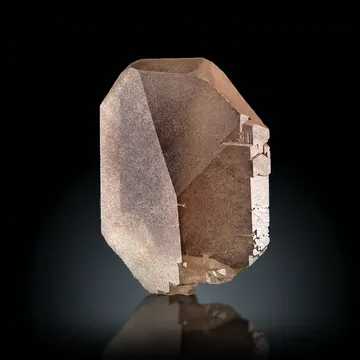
Chamonix, France — Alpine-cleft locality famed for smoky quartz and fluorite in granite fissures; prized by collectors for tension-grown crystals and allure.
Key facts
Chamonix matters to collectors because the valley is the practical capital of the French Mont Blanc crystal country: a granite high-alpine fissure province where mineral specimens are found not from a mine in the usual sense, but from narrow natural cavities called fours opened in the Mont Blanc massif during Alpine deformation. The classic Chamonix specimen is immediately recognizable—smoky to nearly black quartz from steep granite walls, often with vivid rose, raspberry-red, or rarer green fluorite perched on the faces, plus adularia, albite, chlorite, calcite, epidote, hematite, apatite, and late zeolites in smaller roles. These are Alpine-cleft minerals in the strict collector’s sense: crystals grown in open space, in tension fissures, with enough room to develop glassy faces, macromosaic structure, twisted quartz habits, etched surfaces, and delicate late coatings.
Regional View
Country View
Historically, Chamonix is as important culturally as it is mineralogically. The cristalliers—the crystal hunters of the Mont Blanc range—were part of the same mountain world that produced the first guides, the early Alpine naturalists, and the tourist trade of the 18th and 19th centuries. Rock crystal from the mountains around Chamonix was already being sold to visitors and to lapidaries when natural-history cabinets were reshaping European collecting. The locality’s scientific thread runs through Venance Payot, Alfred Lacroix, Bernard Poty, Laurent Gautron, Nicolas Meisser, and the modern Musée des Cristaux de Chamonix, while its collector mythology is carried by named finds such as “Georges,” “Amédée,” and the “Fluorite Laurent.”

Photo: Marie-Lan Taÿ Pamart, Wikimedia Commons
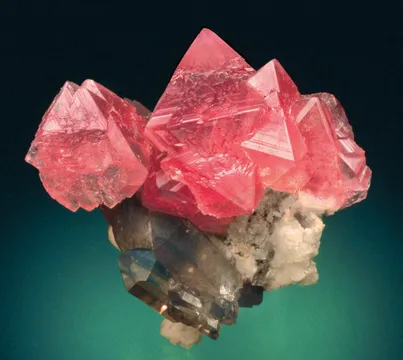
The best Chamonix specimens have a tension that fine Alpine minerals often show: they look both delicate and severe. Smoky quartz crystals may be squat, tapered, lamellar, windowed, doubly terminated, or twisted into comb-like gwindels; fluorite most often appears as octahedra, sometimes sharp and glassy, sometimes naturally frosted, corroded, or step-etched by ice and undersaturated meltwater. On an outstanding piece, the color of the fluorite is not a weak pink haze but a saturated raspberry red or bright rose that stands clear against the brown smoke of quartz or a pale feldspar base. Ordinary pieces are common enough on the local and European market; truly great Chamonix pieces are among the benchmark Alpine specimens of the world.
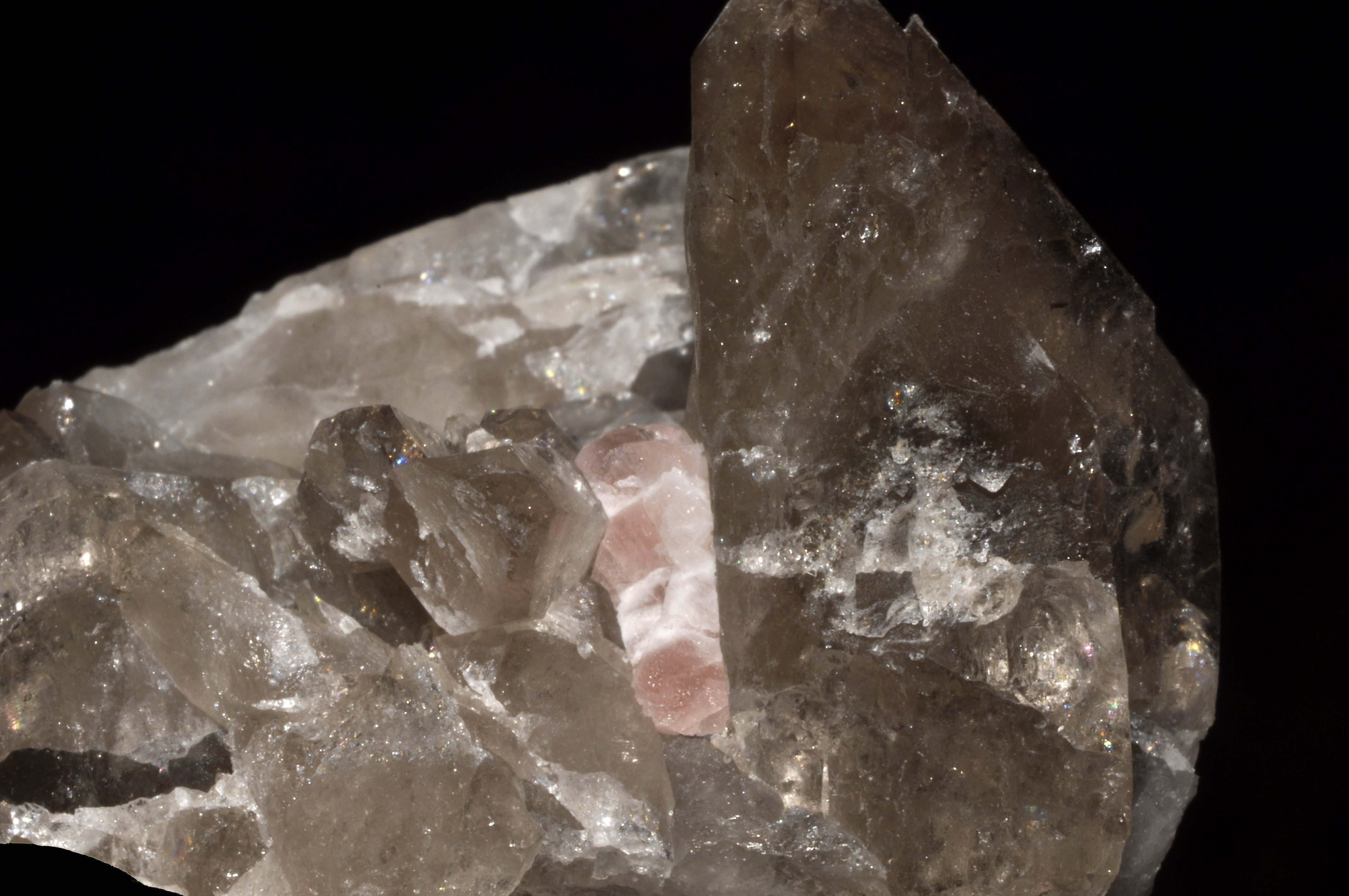
Search for specimens: View all specimens from Chamonix, France
The Chamonix specimens come from Alpine-type fissures in and around the French side of the Mont Blanc massif, especially the high cirques and glacier basins above the valley: Argentière, Talèfre, Leschaux, Les Courtes, Les Droites, Aiguille Verte, the Aiguilles de Chamonix, the Grands Charmoz, Les Périades, the Aiguille du Peigne, and related sectors. The geological host is the Mont Blanc crystalline massif, dominated by Hercynian granite and associated gneissic and metamorphic rocks that were later fractured, uplifted, and exhumed during the Alpine orogeny. Collectors often use the old Alpine term protogine for the altered Mont Blanc granite; in specimen terms, this is the rock that supplies both the hard wall rock and much of the chemistry for the cleft assemblage.
The deposit type is not an ore deposit but a high-alpine cleft system: open fractures formed by tectonic stress, then fed by hot aqueous fluids under high pressure. Quartz is the dominant phase. In the most accepted model for the Mont Blanc clefts, quartz growth is tied to pressure-dissolution and stress-driven transfer of silica from the surrounding granite into open fissures, while fluorite growth is related to mineral transformations in the wall rock—particularly the alteration of plagioclase toward albite and biotite toward chlorite, releasing calcium and fluorine into the fissure fluid. This explains both the abundance of quartz and the selective, locally spectacular appearance of fluorite in particular fissures.
There are no “ore bodies” in the conventional mining sense at Chamonix. The productive bodies are individual clefts, pockets, sheets, and narrow fissure systems, often discovered in sheer granite walls or glacier-polished rock. A productive pocket may yield only a handful of good specimens; another may be mostly barren, chloritic, frozen, or shattered. The principal collectible assemblage is quartz–fluorite, but important combinations include quartz with adularia, albite, chlorite, hematite, calcite, ankerite, epidote, apatite, titanite, rutile, brookite, monazite, kainosite, zircon, and late zeolites such as laumontite, chabazite, heulandite, stilbite, and scolécite. The crystallization sequence often places quartz early, fluorite later, and zeolites among the latest minerals in the fissures.
The valley’s specimen history is measured in centuries rather than in a few mining campaigns. Chamonix crystal collecting is documented from at least the 17th century and became visible to scientific travelers and tourists in the 18th century. William Windham and Richard Pococke visited the valley in 1741, and the accounts of crystal seekers helped make Chamonix famous among naturalists. In October 1791, Marc-Auguste Pictet reported rose fluorite from the Mont Blanc region to the Société de Physique et d’Histoire Naturelle de Genève, describing ruby- or spinel-colored octahedral “spath fluor” found by crystal seekers near the Grandes Jorasses and the Glacier du Bois area. By the 19th century, Chamonix mineral boxes and natural-history shops supplied tourists with local quartz, fluorite, and associated Alpine minerals.
The great modern period began after the mid-20th century, when improved alpinism, ropes, bivouac technique, and the rise of mineral shows gave skilled guides and climbers a way to reach pockets that older generations could not safely work. Important modern names include Roger Fournier, Georges Charlet, Georges Bettembourg, Jean-Paul Charlet, Éric Bellin, Jean-Marc Boivin, Christophe Péray, Jean-Franck Charlet, René Ghilini, Daniel Lagarde, Xavier Jean-Brun, Jean-Marie Buzzarello, Jonathan Bullat, and many others connected to the Chamonix club and museum. Most pieces were not “produced” by companies or mining operators but by individual cristalliers or small teams, often during short late-summer windows when snow and ice retreat enough to expose fissures.
Several finds have become reference points. In 1925, guide-cristallier Georges Charlet found a pocket in the west face of the Aiguille des Pélerins near the Carmichael route that yielded rose-red fluorite octahedra reportedly up to about 10 cm; a major partial cleaved crystal of about 15 cm later entered the Paris Muséum collection through Colonel Louis Vésigné. In 1968, Roger Fournier’s “Amédée” find in the Argentière basin produced a coating with fluorite crystals up to about 5 cm. In July 1975, close to the old Pélerins occurrence and about 50 m below the summit, a single giant polysynthetic rose-red octahedron about 18 cm across was found and named “Georges” in honor of Georges Bettembourg. The Requin area in the Aiguilles de Chamonix yielded green octahedral fluorite with rose cores, while the north spur of Les Droites produced high-quality smoky quartz with bright pink fluorite in a frozen pocket at about 3600 m.
The Argentière basin is especially important for smoky quartz and fluorite combinations. The Tour Noir sector produced strongly colored pink fluorite on smoky quartz, including 1997 finds of satin-bright, slightly corroded dark pink octahedra to roughly 20 mm. The Pointe Kurz sector is noted for zoned fluorites, including red-pink cores, pale violet edges, and, in some cases, bluish-grey peripheral zones. Les Courtes is known for both smoky quartz and green fluorite associations, including green octahedral fluorite on smoky quartz from the early 1990s. Talèfre and Leschaux have produced smoky quartz, quartz “peignes,” quartz à âme, fluorite, calcite, and feldspar associations that are central to the Chamonix look.
Collecting access today is regulated. Since August 2008, crystal searching on the territory of Chamonix-Mont-Blanc has required prior declaration and agreement with the mairie, renewed annually, under a code of honor for cristalliers. Traditional collecting is tolerated only when it is small-scale and manual—no explosives, no mechanical extraction, no motorized transport into the collecting ground. Important or scientifically significant finds must be declared, and pieces offered for sale may be subject to presentation to the Musée des Cristaux committee so that the local patrimony can be studied or acquired. For serious collectors, this regulation is part of the provenance: a modern Chamonix specimen is best accompanied by a precise basin or peak, collector name when possible, date or season, and disclosure of any repair.
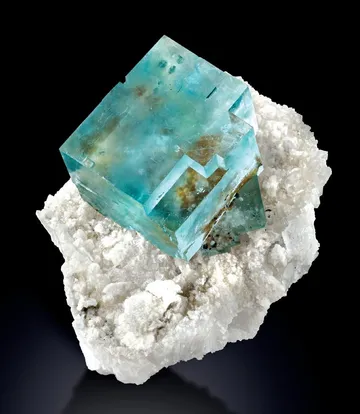
Fluorite from Chamonix is the locality’s signature mineral when it occurs as rose to raspberry-red octahedra on smoky quartz, although green, violet-edged, pale grey-blue, white, and nearly colorless crystals are also documented from the Mont Blanc area. The habit is overwhelmingly octahedral, commonly with polysynthetic growth, natural etching, frosted or satin luster, and softened edges from slight dissolution; cubo-octahedral and other modified forms are rarer. Crystal sizes range from millimetric coatings to major isolated crystals of 10–18 cm, but the collector sweet spot is a sharp, translucent, well-colored octahedron or group sitting visibly on smoky quartz, pale feldspar, or clean matrix rather than lost against dark chlorite. Important zones include Argentière, Tour Noir, Pointe Kurz, Aiguille Verte, Les Courtes, Les Droites, Requin, Talèfre, Leschaux, and the Aiguilles de Chamonix, and the best pieces are judged by color saturation, lack of internal cleavage, intact octahedral points, natural rather than applied luster, and the architectural balance between fluorite and quartz.
Quartz is the fundamental Chamonix mineral and the dominant product of the Mont Blanc clefts, with the finest finds concentrated in the cirques of Argentière, Talèfre, Leschaux, and related high basins. It occurs as colorless rock crystal, pale smoky crystals, darker smoky crystals, morion, quartz à âme, windowed crystals, doubly terminated crystals, scepters, chlorite-phantom specimens, and the celebrated twisted “peigne” or gwindel-like forms that have made the massif a classic among Alpine-quartz collectors. Individual crystals may range from small cabinet-size points to very large masses, with one local record cited at about 50 kg from the base of the north face of Les Droites, but the most desirable collectible pieces are not merely large: they are glassy, well-terminated, undamaged, and show the macromosaic, lamellar, faden-like, or twisted Alpine growth features without being dulled by chlorite, bruising, or frost damage. Fine quartz with balanced fluorite, adularia, albite, calcite, hematite, or chlorite phantoms carries a premium because it preserves a complete Chamonix cleft story rather than presenting quartz alone.
Smoky quartz is the collector’s dark stage for Chamonix fluorite, and the best examples come from the high Mont Blanc granite above roughly 2500 m, especially Argentière, Talèfre, Leschaux, Les Courtes, Les Droites, Aiguille Verte, and related walls and glacier basins. Colors run from pale tea and grey smoke through rich brown to morion-black, and the habit may be simple prismatic, stout and glassy, doubly terminated, windowed, or twisted into peignes and gwindels; some crystals show chlorite phantoms or small hematite, adularia, albite, calcite, or fluorite attachments. Good pieces are separated from ordinary ones by luster, transparency through the smoky body, sharp undamaged terminations, undistorted balance, and the presence of naturally seated pink or red fluorite rather than loose or repaired octahedra. The most admired Chamonix smoky quartz specimens feel alpine rather than pegmatitic: they have crisp wall-rock aesthetics, minor natural etching, and a sense of being grown in a narrow fissure under stress rather than in a broad open vug.
Other documented minerals from the Chamonix and Mont Blanc cleft province include adularia, albite and cleavelandite, calcite, ankerite, siderite, hematite, goethite, rutile, brookite, titanite, epidote, apatite, monazite, kainosite, zircon, beryl, axinite, datolite, chlorite, byssolite, muscovite, prehnite, schorl, and several zeolites. The locality is not chiefly a modern type-locality story; its importance rests on world-class Alpine-cleft crystallization, historical firsts for French Alpine mineralogy, and rare parageneses. Among the notable rarities are purple apatite on quartz from the Courtes sector, kainosite from the Rochefort ridge and Triolet area, large epidote from the Aiguille d’Argentière region, green fluorite from Les Courtes and Requin, violet-zoned fluorite from Pointe Kurz and nearby high basins, and tiny but significant accessory minerals that make Chamonix specimens rewarding under a loupe.
Chamonix provenance is unusually important. “Mont Blanc,” “Chamonix,” “Aiguille Verte,” “Argentière,” “Talèfre,” and “Les Courtes” are often used loosely in the trade, and older labels may blur the French, Italian, and Swiss sides of the massif. A fine label should name the basin, glacier, peak, arête, or pocket where possible, and should distinguish Chamonix-Mont-Blanc, Haute-Savoie, France from Courmayeur, Val Veny, Val Ferret, Triolet, or Swiss-side localities. Specimens labeled only “Mont Blanc” can still be desirable, but they should be priced with that uncertainty in mind.
The most common authenticity issue is not synthetic material but assembly. Pink or red fluorite octahedra from the Mont Blanc massif are valuable enough that detached crystals have been glued or re-glued onto smoky quartz, and repaired fluorite points can be difficult to read without magnification. Look for glue menisci, unnatural contact shadows, a mismatch between fluorite base and quartz contact, missing dissolution prints, and inconsistent dirt or chlorite around the attachment. The Chamonix code of honor explicitly requires repaired pieces to be disclosed and forbids modified assemblages, which gives collectors a clear ethical standard to apply.
Surface treatments are another known concern. Natural Chamonix fluorite may be glassy, but much is satin-bright, frosted, etched, or partly dulled by natural dissolution. Oiling, spraying, or other luster enhancement can temporarily hide cleavage, abrasions, and surface corrosion. Under strong side light, treated pieces may show greasy pooling in tiny pits or along cleavage lines; under magnification the shine may look continuous across broken surfaces where it should not. Do not penalize natural etching automatically—many authentic Mont Blanc fluorites are naturally corroded—but do be wary of uniformly wet-looking surfaces.
Condition is central. Fluorite is soft and cleaves perfectly; even excellent Chamonix octahedra may show internal cleavage, minute bruises on points, or contact marks from extraction in frozen pockets. Quartz is tougher, but terminations, gwindel edges, and quartz à âme structures can chip, especially where crystals were carried down by hand from high bivouacs. Chlorite-rich pockets may produce unattractive coatings, but chlorite phantoms inside quartz are desirable when sharp and well placed. Late zeolites, if present, require gentle handling and dry, stable storage.
Color stability deserves respect. The red and pink color of Mont Blanc fluorite is related to color centers activated by natural radiation in the granite environment, and the smoky color of quartz is also radiation-related. Avoid prolonged strong sunlight and unnecessary heat; display important fluorite away from windows, hot lamps, and UV-heavy lighting. Fluorite may fluoresce variably, but Chamonix material is collected for daylight color and association, not for strong fluorescence.
Market availability is paradoxical. Modest Chamonix smoky quartz and small fluorite-on-quartz pieces appear regularly through European dealers, the Chamonix crystal show circuit, and private Alpine collections. Exceptional red fluorite on smoky quartz, large intact octahedra, fine gwindels, and named-pocket material are scarce, expensive, and often remain in long-held French or Swiss collections. Museum-quality specimens can reach institutional or high-end private pricing, especially when color, association, provenance, and historical narrative all converge.
In the old Chamonix story, the first people who went high into the Mont Blanc range were not sportsmen in the modern sense. They were chamois hunters and crystal seekers, moving through dangerous ground for things they could carry out by hand: meat, skins, horns, and quartz. By the 18th century, the work had become part of the valley’s identity. When William Windham and Richard Pococke came to Chamonix in 1741, they did not arrive merely to admire scenery; they came, in part, to “see the crystals.” Windham described crystal seekers descending to the base of rock faces in August, striking the rock with picks, listening for the hollow ring of a cavity, and opening caves “full of crystallizations.” That simple image—the hammer blow, the hollow sound, the hidden chamber—still explains why the Chamonix cristallier has such a powerful hold on mineral collectors.
The 1791 announcement of rose fluorite gave Chamonix another kind of fame. Marc-Auguste Pictet presented the material in Geneva as rose or ruby-spinel-colored octahedral fluorite found by crystal seekers around the Grandes Jorasses and the Glacier du Bois/Mer de Glace side of the massif. The old names are wonderful in themselves: “spath fluor rose de Chamouni,” “chaux fluatée rosée,” and “spath calcaire vitreux rose.” These were not anonymous industrial minerals but cabinet specimens entering the language of Enlightenment mineralogy. In the following century, Chamonix’s natural-history shops sold mineral boxes to visitors, and the valley’s crystals became souvenirs of both science and danger.
One of the great early fluorite pockets was found in 1925 by Georges Charlet in the west face of the Aiguille des Pélerins, below the Carmichael route. The pocket yielded rose-red octahedra up to about 10 cm, and its best-known survivor was a large partial cleaved fluorite crystal of about 15 cm that passed to Colonel Louis Vésigné and then to the Muséum national d’Histoire naturelle in Paris. Half a century later the mountain repeated itself. In July 1975, near the old pocket and about 50 m below the summit, a single giant rose-red polysynthetic fluorite octahedron about 18 cm across emerged from massive fluorite in a neighboring cavity. It was named “Georges” for Georges Bettembourg, the Chamonix guide-cristallier whose short life became inseparable from the legend of Mont Blanc fluorite.
Some stories are named like people because, in Chamonix, the specimen and the climber are often remembered together. “Amédée,” found on 1 August 1968 by Roger Fournier in the Argentière basin, produced a fluorite coating with crystals to about 5 cm. “Georges” followed in 1975. In the 1980s and 1990s, fresh ground, retreating snow, and improved climbing tactics brought more finds from Les Courtes, Les Droites, Requin, Tour Noir, and Pointe Kurz. A frozen pocket on the north spur of Les Droites, found on 23 July 1989 at about 3600 m, yielded isolated grey smoky quartz crystals up to about 18 x 12 x 12 cm carrying scattered, brilliant, transparent pink fluorite octahedra to about 25 mm. The details read almost like a mountaineering route description because that is what specimen recovery was: altitude, exposure, cold rock, and a small number of objects worth bringing home.
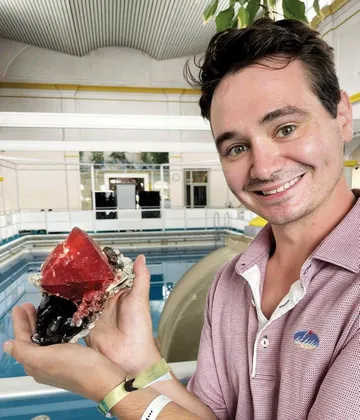
The “Fluorite Laurent” is the modern Chamonix story collectors know best. Christophe Péray found it on 21 July 2006 in the Aiguille Verte sector: red fluorite on smoky quartz, about 20 x 15 x 10 cm, later registered by the Paris Muséum as MNHN Inv. 210.1. Péray named it for Laurent Chatel, his rope companion, who had died in 2005 after a fall of nearly 600 m on Les Courtes. The specimen’s beauty was only part of its importance. It was classified as a “bien culturel d’intérêt patrimonial majeur,” the first natural-history object to receive that status in France, and it was acquired by the Muséum national d’Histoire naturelle in 2010 for €250,000 with corporate patronage. In a single piece, Chamonix had mineralogy, grief, law, money, public heritage, and the mountain all locked together.
Modern field accounts make clear that Chamonix crystal collecting is still a physical craft rather than a casual rockhounding excursion. In one reported expedition with Christophe Péray, the approach was described as five hours to the refuge, then six more to a bivouac—eleven hours in two days, carrying packs. The party moved through the Mer de Glace side of the massif, toward the Couvercle and the Courtes, where small specimens rested on refuge mantels and window ledges like quiet proof that the old trade remained alive. Jean-François Baud, a younger cristallier, recalled following a quartz vein, finding a crack, breaking into a cavity, and reaching into dust to pull out pure crystals—“la chance du débutant,” the beginner’s luck that every collector secretly wants.
The same account moves quickly from wonder to exposure. One cavity sat just below a ridge, only a few meters beneath classic climbing traffic. “Thousands of people passed five meters higher and never saw it,” Péray explained. Another descent was introduced by the guide Simón Elías as “un rappel douteux”—a dubious rappel—while the Whymper Couloir of the Aiguille Verte lay nearby, transformed by summer conditions from a snowy historic route into rockfall terrain. At another site, the team hung in harnesses above a 500 m drop to the glacier while crystals were sorted in place, the least promising pieces discarded, the good ones kept. After about 13 hours out and more than 1200 m of ascent, the haul was estimated at about €2000, but the larger pieces were fractured. No miracle—just the ordinary mathematics of Chamonix collecting.

_rose_sur_quartz_fum%C3%A9_1(France).jpg)