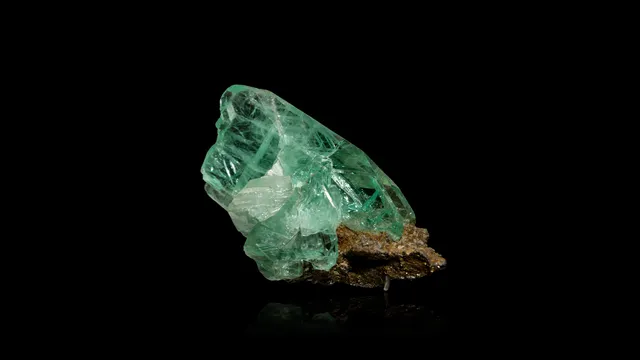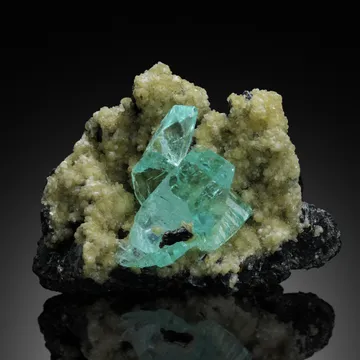
Cerro de Potosí, Bolivia — historic silver-tin locality famed for polymetallic sulfides and especially phosphophyllite crystals, a standout for collectors.
Key facts
Cerro de Potosí—better known to collectors, historians, and miners as Cerro Rico—is one of the supreme mineral localities of the Americas: a Miocene silver-tin giant rising immediately above the city of Potosí in Bolivia’s Eastern Cordillera. Its fame began with native silver and rich silver ores in the sixteenth century, but its collector importance rests just as firmly on later, deep, polymetallic mineralization: sphalerite, galena, pyrite, quartz, cassiterite, wolframite, arsenopyrite, tetrahedrite-group minerals, bournonite and other sulfosalts, and, most memorably, the incomparable blue-green phosphophyllite crystals from the Unificada and Pailaviri workings.
Geologically, Cerro Rico is not a simple vein locality. It is a mineralized, strongly altered dacitic to rhyodacitic volcanic dome and associated breccia-tuff system cut by a dense array of steep veins, stockworks, and disseminated ore zones. The deposit is zoned in a way collectors can feel in the specimens: hotter, deeper tin-tungsten-bismuth assemblages toward the core, and cooler zinc-lead-silver-sulfosalt assemblages outward and upward. In the finest hand specimens, that zoning becomes visual—black sphalerite, brassy pyrite, pale quartz, tan siderite, and dark sulfosalts forming the matrix for phosphate or sulfosalt crystals that are small by cabinet-specimen standards but intensely historic.
Regional View
Country View
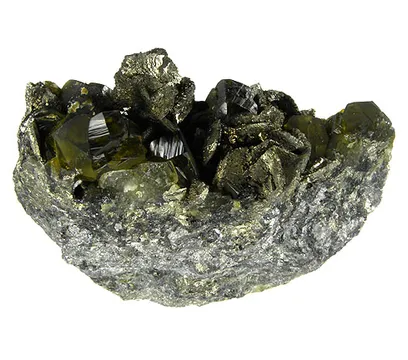
For the mineral collector, Cerro de Potosí is most revered for phosphophyllite: transparent to translucent sea-green, mint-green, or blue-green crystals, commonly twinned into fishtail or swallowtail forms, on dark sulfide-rich matrix. The best examples have an almost impossible combination of softness, transparency, color, and historic locality cachet. Even a small, damaged, or partly embedded Potosí phosphophyllite can anchor a serious phosphate suite; a complete, lustrous crystal on matrix is among the classic trophy objects of twentieth-century mineral collecting.

Photo: Wikimedia Commons

Photo: Wikimedia Commons
Cerro Rico also matters because the specimens carry the weight of one of the most consequential mining landscapes on Earth. Potosí was inscribed as a UNESCO World Heritage property in 1987, and the mountain’s continuing deformation and mining pressure have placed it on the List of World Heritage in Danger since 2014. For collectors, that means labels from Cerro de Potosí are never merely geographic. They point to a deposit that shaped global silver circulation, powered colonial industry, fed twentieth-century tin and zinc mining, and still supports miners working in a mountain whose stability has become a central heritage and safety concern.
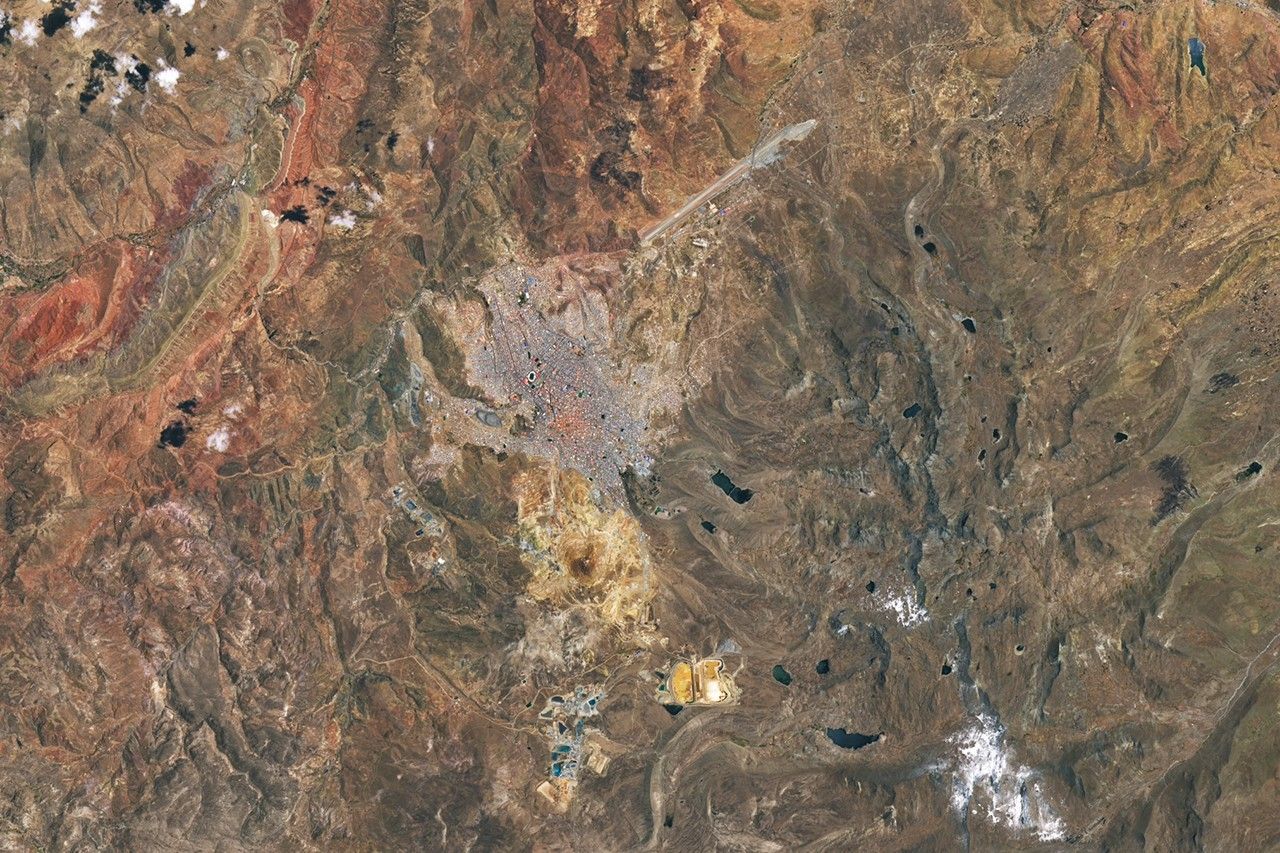
Photo: NASA Earth Observatory
Search for specimens: View all specimens from Cerro de Potosí, Bolivia
Cerro de Potosí stands immediately south of the city of Potosí in the Tomás Frías Province of the Potosí Department. The mountain occupies part of the Bolivian tin-silver belt, in the southern Cordillera Oriental, and is generally treated as a world-class polymetallic silver-tin deposit of the Bolivian type. Modern geological work interprets the main body as a Middle Miocene dacitic volcanic dome with associated tuff ring and explosion breccia, intruded into older sedimentary rocks and later fractured repeatedly along the structural system that guided the original emplacement. Hydrothermal alteration and mineralization followed quickly after dome formation, producing intense quartz-sericite-pyrite alteration as well as argillic and advanced argillic assemblages in the upper system.
The ore system is both vein-controlled and disseminated. Numerous steeply dipping veins and veinlets cut the altered dome and its surrounding sedimentary and volcaniclastic rocks, while broader zones of impregnation and stockwork mineralization occur in fractured wall rock. The best-developed structures trend roughly north-south to northeast-southwest, and mining has followed them vertically for more than a kilometer and laterally for several kilometers. The deposit shows classic telescoping: early high-temperature tin-tungsten-bismuth mineralization is overprinted in places by later, lower-temperature silver-lead-zinc-sulfosalt mineralization. That paragenetic compression helps explain the richness of the specimen assemblage: cassiterite, wolframite, bismuthinite, arsenopyrite, pyrite, quartz, stannite and other tin-bearing sulfides may occur in the same broad system that later furnished sphalerite, galena, bournonite, tetrahedrite-group minerals, pyrargyrite, miargyrite, diaphorite, and other Ag-Pb-Sb-Bi sulfosalts.
The earliest bonanza ores came from oxidized silver-rich zones high on the mountain, where native silver, chlorargyrite, acanthite after argentite, iron oxides, quartz, and other secondary products made extraction comparatively direct. As mining moved deeper, the oxide ores gave way to sulfide and sulfosalt ores, and processing shifted toward mercury amalgamation and later industrial milling. In the twentieth century the emphasis broadened from silver to tin and zinc, with by-product lead and copper. Modern work also recognizes the economic significance of disseminated, oxidized silver-bearing material in pallacos, sucus, dumps, and low-grade bodies around the mountain, which fed the San Bartolomé operation rather than classic underground specimen pockets.
Historically, Cerro Rico’s mining began in 1545 and rapidly transformed Potosí into one of the largest and most important industrial cities of the early modern world. By the late sixteenth century the mountain was riddled with hundreds of mines, and Potosí’s hydraulic system of artificial lakes, aqueducts, mills, and refining installations became part of the same industrial landscape as the veins themselves. Colonial production focused overwhelmingly on silver; later Republican and twentieth-century production incorporated tin and zinc as market conditions and technology changed. The Empresa Minera Unificada del Cerro de Potosí, COMIBOL, cooperative miners, and private downstream operators all belong to the later chapters of the locality’s mining history.
Collector labels from Cerro de Potosí commonly mention the Unificada Mine, Pailaviri Mine, Rosario Mine, Santa Rita Mine, Santa Catalina Mine, Lariba or Lariva Mine, Desamparados Mine, 6 de Agosto Mine, or individual veins such as the Krauser vein. One must treat such sublocality labels with care. The Unificada name, in particular, has often been used loosely in the mineral trade for phosphophyllite from Cerro Rico, even when the precise mine or pocket is not proven. Strong provenance matters here: old labels, published photographs, documented dealer descriptions, and collection history can add real value because many of the great phosphophyllites and sulfosalts entered collections decades ago and have circulated with simplified or inconsistent mine names.
The specimen-producing zones for phosphophyllite were not broad commercial ore faces yielding endless material. The classic crystals occur in limited hydrothermal pockets and seams within sulfide- and quartz-rich matrix, associated especially with sphalerite, pyrite, quartz, siderite, and arsenopyrite. Well-formed phosphophyllite crystals are typically small—thumbnail to miniature in most collector pieces—though the species is documented to reach extraordinary sizes, and Potosí is one of the very few localities capable of producing large, transparent, aesthetic crystals. A 1968 Pailaviri Mine, Krauser vein phosphophyllite is a well-documented example of the locality’s vein-specific labeling, and later Unificada-labeled pieces show the same essential visual language: green phosphate against dark metallic ore.
Collecting access today is not comparable to a recreational collecting locality. Cerro Rico remains an active and hazardous mining area with cooperative workings, restricted zones, unstable ground, and formal preservation concerns. UNESCO and Bolivian authorities have repeatedly focused on closing or relocating operations above the 4,400-meter level because of deformation and collapse risk. Any modern specimen supply is therefore best regarded as mine-run or miner-saved material that reaches the market through local mining activity and dealers, not as material available to visiting collectors. Mine tours around Potosí may exist, but they are not collecting trips, and the ethical and safety issues are substantial.
Phosphophyllite from Cerro de Potosí is the locality’s collector signature: glassy, pale blue-green to mint-green monoclinic crystals, commonly thick tabular and frequently twinned into fishtail or swallowtail forms, occurring in narrow seams and pockets in dark sulfide- and quartz-rich matrix. Most collectible crystals are thumbnail to miniature scale, with many good examples showing crystals from a few millimeters to around 2 cm; exceptional crystals and crystal sections can be larger, and the species is documented from Potosí in sizes that remain legendary for phosphate collectors. The best pieces show clean color, transparency, sharp terminations, minimal cleaving or contacting, and attractive contrast against sphalerite, pyrite, quartz, siderite, or arsenopyrite. Ordinary pieces may be small, cleaved, embedded, dull, or mislabeled simply as “Unificada”; superior examples have a believable old provenance, a distinct crystal habit, and enough matrix context to identify the Cerro Rico look rather than merely the species.
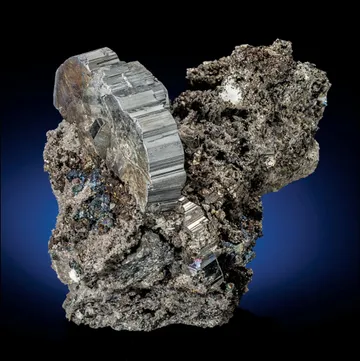
Bournonite at Cerro de Potosí belongs to the late Ag-Pb-Sb-Cu sulfosalt suite rather than the phosphate story, and it is best thought of as a historic ore mineral that only occasionally rises to the level of an aesthetic specimen. The locality is recorded for compact masses and dull to metallic gray crystals, with cogwheel-style twins reported to about 1 cm, generally on or in quartz-sulfide ore with pyrite, sphalerite, galena, and tetrahedrite-group minerals nearby in the paragenesis. Fine Cerro Rico bournonite is not the sharp, highly lustrous, large-crystal material that made some other Bolivian districts famous; good pieces from Potosí are valued for locality, association, and correct old attribution. A collector should look for recognizable crystal form, minimal oxidation, and a label that separates Cerro de Potosí from the more prolific Machacamarca/Viboras bournonite material of the wider Potosí Department.
Freibergite from Cerro de Potosí should be approached with modern tetrahedrite-group caution: older labels often used “freibergite” broadly for silver-rich tetrahedrite-group material, while current species-level assignments require chemical data. In the Cerro Rico ore system, these minerals are part of the economically important silver-bearing sulfosalt assemblage of the later, lower-temperature stages, associated with sphalerite, galena, pyrite, quartz, bournonite, pyrargyrite, and other Ag-Pb-Sb minerals. Display specimens are usually dark steel-gray to black metallic masses or small tetrahedral crystals in ore matrix rather than sculptural freibergite showpieces. The best examples are those with visible tetrahedral habit, bright metallic luster, associated silver minerals or sulfides, and analytical or publication support; unverified “freibergite” labels from old Bolivian suites may more safely be described as silver-rich tetrahedrite-group minerals.
Quartz is one of the essential gangue minerals of Cerro de Potosí, present from early high-temperature quartz-pyrite-cassiterite vein stages through later sulfide and sulfosalt assemblages, and it is central to the texture of many Cerro Rico specimens even when it is not the named species. Collectible quartz pieces from the locality are usually valued as association specimens: drusy white to colorless quartz lining cavities, quartz-rich vein fragments with pyrite, sphalerite, galena, bournonite or tetrahedrite-group minerals, and matrix pieces carrying phosphophyllite. Fine single-crystal quartz is not the Cerro Rico specialty; the best quartz specimens here are those that show the banded, brecciated, sulfide-rich hydrothermal environment of the mountain. Attractive contrast, clean druse, and meaningful association beat size, and quartz matrix can be an important clue in distinguishing authentic Potosí phosphophyllite-bearing material from loose or context-poor crystals.
Pyrite is ubiquitous in the Cerro Rico system, occurring as disseminations, vein material, alteration-related masses, and small metallic crystals in quartz-sulfide ore. It is part of the pervasive quartz-sericite-pyrite alteration tied to main-stage mineralization and also appears in specimen matrices with sphalerite, quartz, arsenopyrite, galena, bournonite, and phosphophyllite. Collector-grade pyrite from Cerro de Potosí is generally not about large isolated cubes; it is about locality-rich sulfide matrix, bright microcrystalline coatings, brassy contrast, and association with rarer species. The best pieces are stable, not heavily oxidized, and show crisp pyrite rather than crumbly, acid-generating massive sulfide; because Cerro Rico ore can be pyrite-rich and weathered, condition and storage history matter more than they would for a dry, robust pyrite cube locality.
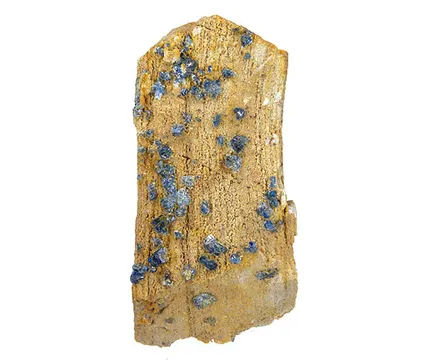
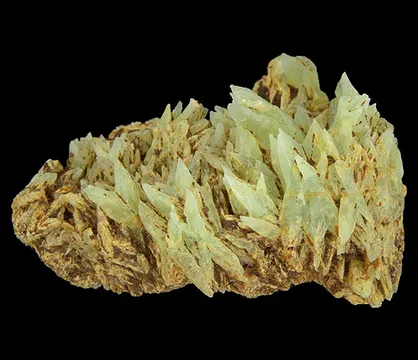
Beyond these collector staples, Cerro de Potosí has an unusually broad mineral list for a single mountain. It is the type locality for the tin sulfides berndtite, SnS2, and ottemannite, Sn2S3, both historically important but not commonly represented by showy hand specimens. The broader assemblage includes cassiterite, wolframite-group minerals, arsenopyrite, bismuthinite, stannite, sphalerite, galena, chalcopyrite, chalcocite, covellite, famatinite, franckeite, herzenbergite, jamesonite, matildite, miargyrite, pyrargyrite, stephanite, pyrostilpnite, diaphorite, fizélyite, owyheeite, native silver, chlorargyrite, argentojarosite, alunite, jarosite, siderite, baryte, dickite, nacrite, pyrophyllite, faustite, wavellite, and several tetrahedrite-group species or subgroups. For collectors, the rarest and most scientifically interesting Cerro Rico minerals are often ore-polished-section or micromount subjects rather than cabinet specimens, but they give the locality its extraordinary mineralogical density.
The most important authenticity issue is locality precision. “Potosí, Bolivia” can mean the city, the department, the broader tin-silver belt, or a specific Cerro Rico working. “Cerro Rico” and “Cerro de Potosí” are equivalent locality names, but sublocalities such as Unificada, Pailaviri, Rosario, Santa Rita, Santa Catalina, Lariba, Desamparados, and 6 de Agosto should not be accepted uncritically unless the label history supports them. Unificada has been especially overused on phosphophyllite labels; an old collection label, publication record, invoice from a reputable dealer, or a chain of ownership can matter almost as much as the crystal itself.
For phosphophyllite, condition is everything. The mineral is soft, brittle, and perfectly cleavable, so many crystals are contacted, cleaved, repaired, chipped at the tips, or partly embedded in matrix. A clean, transparent, terminated, undamaged crystal is exponentially rarer than a colorful fragment. Examine edges and re-entrant twin notches carefully under magnification, and be alert to reattached loose crystals on matrix, hidden glue, and trimmed matrices designed to present a seam as a pocket specimen. Because the color can be delicate and the mineral contains structural water, conservative display away from heat, intense direct sunlight, and rough handling is wise.
Bournonite, freibergite, pyrite, and other sulfides raise different concerns. Oxidation, dulling, bruised crystal edges, and powdery decomposition in pyrite-rich ore are common condition risks. Store sulfide-rich Cerro Rico specimens dry, with stable humidity and good air circulation; pyrite-rich pieces that smell acidic, shed yellow-white sulfate crusts, or stain labels should be isolated and monitored. Sulfosalt specimens should also be handled with care because many occur as brittle metallic crystals on friable quartz-sulfide matrix.
Mislabelling against other Bolivian localities is a real market issue. Bournonite from Machacamarca/Viboras, freibergite from Ánimas or other Potosí Department mines, and phosphophyllite from Llallagua, Morococala, or other Bolivian occurrences can all be simplified in trade as “Potosí.” That simplification may be harmless on a casual label but is significant for value. Cerro Rico phosphophyllite has a particular dark sulfide-quartz-siderite matrix style and a long history of iconic Unificada and Pailaviri pieces; Llallagua and other Bolivian phosphate occurrences deserve their own locality names.
Market availability is polarized. Small phosphophyllite thumbnails, cleaved crystals, and fragments appear occasionally, but fine matrix examples are scarce and expensive. Historic, well-provenanced Cerro Rico phosphophyllites are blue-chip mineral specimens. Bournonite, freibergite, quartz, and pyrite from the mountain are far more affordable when they appear, but truly attractive, accurately labeled Cerro de Potosí examples are not common. Type-locality minerals such as berndtite and ottemannite are largely the province of systematic collectors, institutions, and ore microscopy rather than the open display-specimen market.
The most repeated origin story of Cerro Rico begins not with a mining company, but with Diego Huallpa, also rendered Gualpa or Gualca in historical sources. In 1545, the story goes, he was on the mountain with llamas when a clump of grass or scrub pulled loose and exposed rich silver mineralization beneath it. Another version has him taking shelter on the mountain and noticing silver by firelight. However polished by later chroniclers, the essential image is irresistible: a herder on a cold Andean slope, a torn root in his hand, and the revelation of the vein that would make Potosí a word for immeasurable wealth. By April 1545 the Spanish had registered exploitation of the discovery, and the mountain’s human and mineral history changed at once.
Potosí then became an industrial landscape at high altitude. The city grew under a mountain threaded with veins, but the mines alone were not the whole machine. Artificial lakes in the surrounding high country, aqueducts, ore mills, and refining patios formed an integrated system for turning Cerro Rico ore into silver. The cold Andean climate complicated the classic patio process, and Potosí’s refiners adapted with heated stone tanks and other methods to speed mercury amalgamation. The mountain produced metal, but the city processed it; the result was not merely a mine camp but a vast colonial industrial complex with the Casa de la Moneda, churches, elite houses, workers’ quarters, reservoirs, mills, and waste streams all tied to the same ore.
The mountain’s name also darkened. Cerro Rico, the “Rich Mountain,” acquired the other name that still shadows it: “the mountain that eats men.” The phrase compresses centuries of forced labor, accidents, silicosis, mercury exposure, cave-ins, poverty, and the modern risks of cooperative mining. It is not a romantic slogan for collectors. It is the human cost behind the historic labels, the same reason that mine-tour photographs and mineral specimens from Potosí can feel uneasy in the hand. A good Cerro Rico specimen may be beautiful, but the locality has never been an innocent backdrop.
The phosphophyllite story is much smaller in scale but just as potent in collecting culture. These were not wagonloads of showy crystals pouring from a commercial gem mine. They were rare occurrences in a mountain mined for metals, where a soft hydrated zinc-iron phosphate survived in pockets and seams within hard, dark ore. When the finest crystals reached the mineral world in the mid-twentieth century and afterward, they immediately seemed improbable: pastel blue-green, gemmy, sharply twinned, and fragile, set against the grimy sulfide matrices of one of the world’s great silver mines. Few species-locality pairings have ever been so visually distinctive. To this day, even collectors who own no phosphophyllite can usually picture the Potosí ideal: a transparent green fishtail crystal from Unificada, glowing as if it belonged to a pegmatite rather than a battered tin-silver mountain.
Modern Cerro Rico has its own unfinished story. Authorities, miners, heritage specialists, and local communities remain caught between preservation and livelihood. Technical reports describe deformed ground, subsidence zones, unstable galleries, and pressure to close workings above the 4,400-meter level. COMIBOL has reported negotiations with cooperatives and staged mine closures or migration plans, while UNESCO continues to keep Potosí on the List of World Heritage in Danger. The collector sees only the label; the locality is still being argued over, worked, stabilized, and feared.