Cerro de Potosí phosphophyllite, Bolivian locality famed for intense sea-green, transparent crystals, classic butterfly twin, old provenance, and rarity.
Key facts
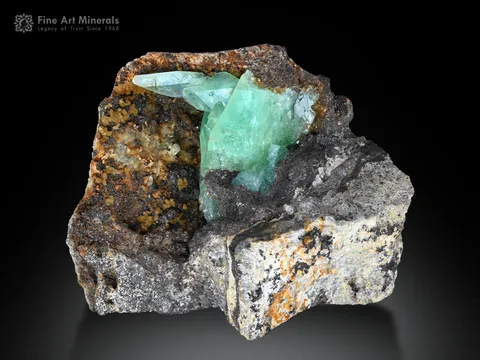
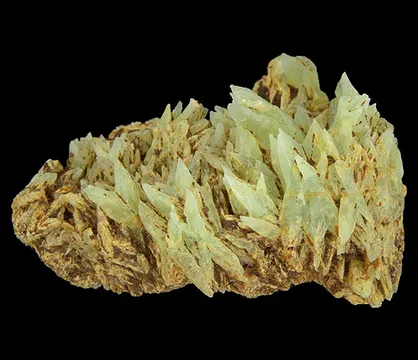
Phosphophyllite from Cerro de Potosí—better known to many collectors as Cerro Rico, the “Rich Mountain” above Potosí—is one of the few mineral-locality pairings that has become legendary on appearance alone. The best crystals have a luminous sea-green to blue-green color, a watery transparency, and a glassy luster that seems almost too delicate for the dark, metallic environment that produced them. Their classic form is the sharply re-entrant “butterfly” or fishtail twin: two monoclinic crystals joined in a symmetrical V, sometimes complete enough to look like a small, frozen splash of mint-colored light.

Photo: Rob Lavinsky, iRocks.com / Wikimedia Commons
The setting is not a quiet phosphate pegmatite or a small alpine fissure. Cerro Rico is a giant silver-tin-polymetallic orebody, mined since the sixteenth century and riddled with centuries of workings. Geologically, the mountain is a Miocene dacitic volcanic dome and associated hydrothermal system, fractured repeatedly and mineralized by silver-, tin-, zinc-, lead-, and iron-bearing fluids. In that harsh sulfide environment, phosphophyllite formed as a rare hydrous zinc-iron phosphate, chemically tied to the zinc-rich ore assemblage and visually set off by siderite, sphalerite, quartz, pyrite, and gossanous matrix.
Collectors value Cerro de Potosí phosphophyllite for a combination of factors that almost never coincide: intense color, transparency, large crystal size for the species, textbook twinning, old provenance, and extreme scarcity. A complete, undamaged crystal on matrix is extraordinary; even a contacted or cleaved crystal section from the classic finds is a serious locality specimen. The finest Bolivian pieces established the aesthetic standard for the species, and later finds from other Bolivian localities, while important, are generally judged against the old Cerro Rico material.

Photo: Rob Lavinsky, iRocks.com / Wikimedia Commons
The name “Unificada Mine” appears on many classic labels, but collectors should use it carefully. Unificada was an administrative grouping rather than a precise pocket or vein locality. Older labels are part of the history of the material, yet for modern cataloging, “Cerro de Potosí” or “Cerro Rico, Potosí, Bolivia” is often the more defensible locality unless the exact mine, vein, or collection provenance is known.
Search for specimens: View all phosphophyllite specimens from Cerro de Potosí, Bolivia
Cerro de Potosí rises immediately above the city of Potosí in southern Bolivia. It is one of the great ore mountains of the world: a silver-tin-zinc-lead system developed in and around a dacitic volcanic dome of Miocene age. The dome and its ore fluids are understood as parts of a larger magmatic-hydrothermal system at depth. Repeated fracturing opened pathways for mineralizing fluids, and later oxidation overprinted portions of the deposit. For specimen collectors, the important point is that phosphophyllite did not come from a simple phosphate environment; it occurred in the complex, metal-rich vein system of Cerro Rico, in cavities and fractures associated with sulfide ore.
The mountain’s mining history is inseparable from the history of the Americas. Silver was discovered there in 1545, and Potosí rapidly became one of the great colonial mining cities. By the seventeenth century, the city and its mines were operating on an enormous scale, with mercury amalgamation and hydraulic ore-processing systems helping turn Cerro de Potosí into a global silver source. Mining later shifted in emphasis, with tin and zinc becoming increasingly important in the twentieth century alongside silver and other metals.
Phosphophyllite is a minute chapter in that massive mining story, but for mineral collectors it is the chapter that made Cerro Rico immortal. Scientific and collector literature places the discovery of the famous material in the mid-1950s, with the Krause vein cited in analytical work on the species. Accounts from the classic collecting period identify exceptional pockets in the late 1950s and early 1960s, with particularly large crystals recovered in 1962. Some good material continued to appear into 1964, after which the famous phosphophyllite area was reportedly sealed by COMIBOL because of heat, lack of ventilation, bad air, and repeated danger to miners.
Modern collecting access should be treated as effectively closed for classic phosphophyllite. Cerro Rico remains an active, hazardous mining district, not a recreational collecting locality, and the stability of the mountain has long been a serious cultural, engineering, and safety concern. Tourist mine visits in Potosí are not specimen-collecting opportunities, and the historic phosphophyllite stopes are not realistically accessible to collectors. Nearly all desirable Cerro de Potosí phosphophyllite on the market is therefore old material, old-collection material, or later small pieces with imperfect locality detail.
Cerro de Potosí phosphophyllite is prized above all for color and form. The classic color range is pale sea-green through vivid blue-green, sometimes with a mint or aquamarine cast. The finest crystals are transparent to richly translucent, with an internal glow that differs from the colder greens of many zeolites and the denser greens of copper minerals. In transmitted light, good pieces can appear nearly colorless at the thinnest edges, but face-up they show the delicate blue-green that made Bolivian phosphophyllite famous.
Crystal habit is usually thick tabular to prismatic, with the most desirable pieces showing contact twinning that creates the V-shaped fishtail or butterfly habit. Sharp re-entrant angles, bright lustrous faces, and a balanced twin outline are major quality factors. Single crystals and crystal sections also occur, and many old specimens are loose crystals or fragments rather than matrix pieces. Matrix examples are much rarer and command special attention when the crystal is well displayed and protected in a cavity.
Size is one of the reasons this locality dominates the species. Many collectible examples are thumbnail-scale, from a few millimeters to about 1–3 cm. Good crystals around 2 cm are already important if sharp and undamaged. Larger crystals in the 4–5 cm range are exceptional, and the celebrated giant crystals from the old finds reach a scale that is essentially mythic for phosphophyllite. The famous “Great Phosphophyllite” is a 13 cm butterfly twin, a size that remains a benchmark in any discussion of the species.
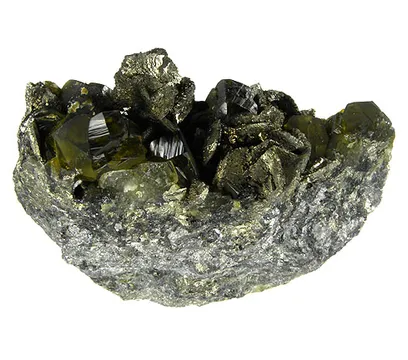
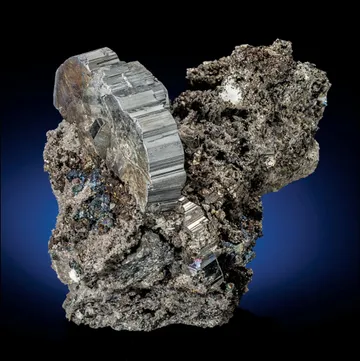
The most typical associates are siderite and sphalerite, with quartz and pyrite also common in documented Cerro Rico material. Gossanous iron oxides, sulfide-rich matrix, and pale to tan carbonate matrix can make the blue-green crystals stand out dramatically. Matrix pieces with phosphophyllite rising cleanly from siderite or sulfide are the most aesthetically satisfying; loose twins are judged more on perfection of form, transparency, color saturation, and absence of repairs or contacts.
Chemically, the Bolivian material is notably iron-rich and essentially manganese-poor compared with some Hagendorf phosphophyllite. Analytical work on Potosí crystals showed remarkably consistent composition and confirmed the material as close to Zn2Fe(PO4)2·4H2O. That consistency is useful for understanding why the classic Bolivian crystals have such a distinctive and repeatable look within the species.
Cerro de Potosí phosphophyllite rewards careful buying. The first authenticity issue is locality precision. A label reading “Unificada Mine” may be historically conventional, but it does not always identify an exact mine in the modern sense. Unless a specimen has a reliable old label, collection history, or published reference, “Cerro Rico” or “Cerro de Potosí” is often the safer locality wording. Recent Bolivian phosphophyllite from other localities should not be casually upgraded to the classic Cerro Rico locality.
The second issue is condition. Phosphophyllite has low hardness, perfect cleavage, and brittle tenacity. Edge bruises, cleaved backs, repaired crystals, and contacts are common enough that they must be described explicitly. A beautiful face can hide a cleaved rear; a matrix specimen can conceal repair at the point of attachment; and old loose crystals may have been stabilized or reassembled. The famous large pieces themselves remind collectors that phosphophyllite’s beauty and fragility travel together.
There are no known treatments for phosphophyllite in mainstream gemological reporting, and the species is not commonly enhanced in the way dyed agate, coated quartz, or treated zeolites are. The greater practical danger is misidentification, overoptimistic locality attribution, or undisclosed repair. Very inexpensive “Bolivian phosphophyllite” offered as large, clean, vividly colored crystals should be approached with skepticism. A serious specimen should have convincing morphology, credible provenance, and, for high-value pieces, analytical confirmation or a dealer guarantee from a source that understands the locality.
Market availability remains extremely thin. Fine, complete, old Cerro Rico crystals are locked in museums and major private collections; they change hands rarely and at prices reflecting their near-iconic status. More available, but still scarce, are small thumbnails, crystal sections, matrix reference pieces, and older damaged or cleaved examples. For many collectors, a modest but genuine fragment from Cerro de Potosí is more realistic than a perfect twin—and still represents one of the classic species-locality combinations in mineral collecting.
The story that collectors repeat most often is the arrival of the “Great Phosphophyllite” in Colorado in 1977. Richard A. Kosnar received a Spanish-language letter and snapshots of a matrix phosphophyllite in July of that year. His Bolivian partner drove to Sucre to inspect it. The owner was a mining engineer named Urquidi, who had worked at Unificada for years and was selling his pride and joy to raise enough money to become a full partner in a small ceramic tile factory.
Kosnar was away in Colorado, working the Sweet Home mine at Alma, when the deal began to unfold. Unable to reach him, his partner bought the specimen anyway. The next call came with the sentence every mineral dealer dreams of hearing: he was flying to Denver the next day and bringing the phosphophyllite.
When the piece reached Kosnar’s house in Boulder on September 15, 1977, the first test was not a loupe or a scale. Kosnar put a shortwave ultraviolet lamp on it. The response was devastating: the specimen lit up in a grid pattern, revealing that the great 13 cm matrix crystal had been crudely glued back together. It was not one pristine object but seven pieces, including the matrix. A friend who saw it reportedly blurted out, “Christ, I hope you can get your money back!” Kosnar kept it anyway.
That judgment proved correct. He later sold the specimen to David Wilber in November 1978, and Wilber displayed it at the Tucson Show in February 1979. The crystal had been mined by Urquidi in 1962, from what became known among collectors as the phosphophyllite stope. The story attached to its discovery is even more vivid than its later travels: after a blast, Urquidi and the miners returned to find the floor of the drift covered with broken phosphophyllite, as if hundreds of glass bottles had been smashed in the stope. It took days to gather the broken pieces and thumbnails.
Urquidi’s recollection also fixes the short-lived production window that matters most to collectors. He worked as mining engineer from 1956 through 1964 and stated that the best phosphophyllites came from early pockets found in 1957, that the largest and most spectacular crystals appeared in 1962, and that decent pockets continued until 1964. In that year the famous stope was closed off with a concrete bulkhead. The reason, in this account, was not romance or secrecy but danger: heat had become severe, the drift was a dead end with no ventilation raises, and bad air had accumulated there over the years.
The Great Phosphophyllite’s later provenance is part of its aura. It passed from Richard Kosnar to David Wilber, then onward, and is now recorded in the Research Charitable Trust Collection. A photograph of Kosnar holding the crystal in 1977 has itself become part of phosphophyllite lore: the collector, the impossible crystal, and the knowledge that even one of the most famous mineral specimens in the world arrived with a secret only ultraviolet light immediately betrayed.