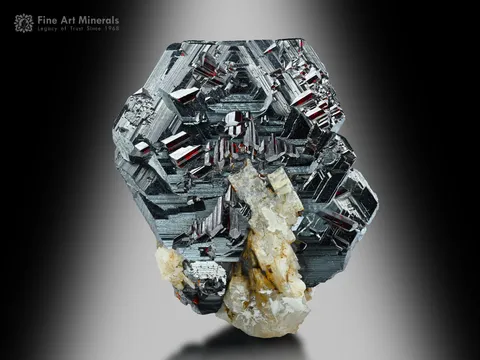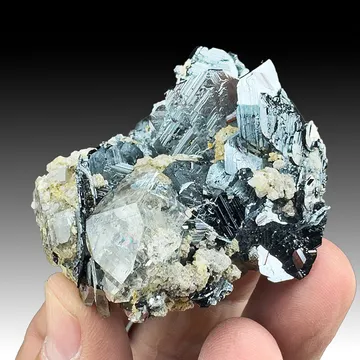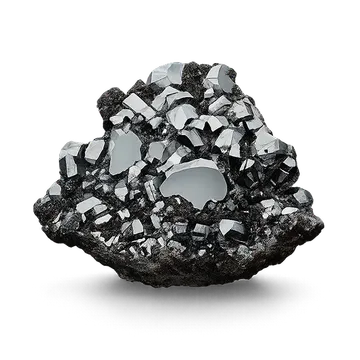
Cavradi Gorge hematite, Switzerland — Alpine locality famed for razor-sharp, mirror-luster plates with epitaxial rutile and quartz, highly prized by collectors.
Key facts
Cavradi Gorge is one of the essential Alpine hematite localities: a steep, worked ravine at the north end of Val Curnera in Tujetsch, Graubünden, where hematite forms as bright, black-silver, tabular “iron roses” in Alpine-type fissures. The best specimens have a look that serious collectors recognize at a glance—razor-edged plates, mirror luster, bevelled margins, geometric growth striations, and a sculptural association with glassy quartz, adularia, and, at its most coveted, wine-red rutile growing epitaxially on the hematite faces.

Photo: Wikimedia Commons
The locality is not a mine in the conventional ore-deposit sense; it is a classic Alpine fissure district. The central gorge cuts Permian and Carboniferous rocks of the Urseren-Gavera zone within the Gotthard massif—mica schists and gneisses cut by productive cleft systems. These pockets yielded the famous iron roses, often with epitactic rutile and, locally, copper minerals such as digenite and djurleite. Northward, the gorge enters the Tavetscher Zwischenmassiv and a different “anatase zone”; southward toward Lai da Curnera the paragneisses are much less productive.
The mineralogical drama of Cavradi is partly the contrast of textures. Bright, heavy hematite plates sit against pale quartz or feldspar matrix; red rutile needles and plates pick out the hematite faces; and the whole association can be perched on water-clear to faintly smoky quartz. The finest matrix pieces are not merely mineralogically interesting—they have the display logic of sculpture, with metallic blades rising from translucent “ice.”

Photo: Wikimedia Commons
Collectors prize Cavradi hematite for three overlapping qualities: crystal sharpness, luster, and association. A single razor-sharp thumbnail can be highly desirable if the faces are clean and striated; a balanced matrix miniature with quartz is even better; and a hematite-rutile-quartz combination with intact epitaxial rutile can be among the classic Alpine specimens of the species. Larger plates occur, and individual hematite crystals of several centimeters are documented, but the market rewards elegance more than mass: complete roses, fresh mirror faces, crisp bevelled rims, and undamaged rutile are what separate ordinary Cavradi material from collection-grade examples.
Search for specimens: View all hematite specimens from Cavradi Gorge, Switzerland
Cavradi Gorge, or Cavradischlucht, lies in Val Curnera in the municipality of Tujetsch, Surselva Region, Graubünden. The locality is centered near 46°38'39" N, 8°42'33" E, below Tschamut and north of Lai da Curnera. Mindat treats the locality as a gorge rather than a mine, which is the right mental model for collectors: this is a steep Alpine ravine cut by many mineralized fissures, not a single shaft, adit, or quarry.
The productive hematite ground belongs chiefly to the middle part of the gorge. Here the rocks of the Urseren-Gavera zone—part of the Gotthard massif—contain abundant Alpine-type fissures. These clefts formed during Alpine metamorphism and deformation, and the hematite grew freely into open pocket space rather than as massive ore. The famous iron roses with epitaxial rutile come from this central zone. To the north, the mineralization changes as the gorge crosses gneisses of the Tavetscher Zwischenmassiv; this “anatase zone” is also cleft-rich but is not the same hematite-rutile association. To the south, nearer the Curnera reservoir, paragneisses of the Gotthard massif are comparatively poor in pockets.
Cavradi is historically a strahler locality—the domain of Swiss Alpine crystal hunters. Local collectors have worked the ravine for generations, in some areas almost quarrying the cleft-bearing walls. The locality’s modern reputation rests on hematite, but the full mineral suite is broader: quartz, smoky quartz, quartz gwindel, adularia, rutile, anatase, brookite, calcite, siderite, strontianite, malachite, copper sulfides, monazite-(Ce), xenotime-(Y), native gold, native silver, tourmaline/schorl, and other species are recorded.
Access is serious Alpine terrain. The collecting area is commonly approached from the Tschamut side, and descriptions by local strahlers place the most interesting area roughly a 45-minute walk from the golf-course area near Tschamut, following the east side of the gorge above the stream. The lower and central gorge has active working areas, loose rock, steep walls, and in places rope work. Local descriptions emphasize that some strahlers use explosives and drilling in the central working areas; casual visitors should not treat the gorge as an open dump-collecting site.
Collecting in Tujetsch is regulated by municipal law. A strahler permit is required for mineral collecting with tools, and the municipality issues daily, weekly, and annual permits. Day and week permits do not allow explosives or drilling; additional permissions for blasting or drilling are restricted and tied to local requirements. The law also prohibits collecting on Sundays and specified holidays, restricts work in certain areas, requires liability insurance, and gives protection to an actively worked cleft when properly marked by tools. For collectors, the practical message is simple: do not collect without checking the current Tujetsch rules, obtaining the proper permit, and respecting active clefts and working strahlers.
Production is episodic rather than industrial. Cavradi pieces continue to surface through field collecting and older collections, but the classic material in circulation often comes from long-held Swiss and European collections. Notable finds include large iron-rose groups, hematite-rutile combinations, hematite on clear to smoky quartz from Val Aulta and related parts of the gorge system, and occasional unusual associations with adularia, calcite, siderite, strontianite, malachite, and copper sulfides. One widely illustrated specimen was an intergrowth of thick tabular hematite crystals found during construction of the service road to the Curnera Dam, measuring about 6.6 x 3.5 cm.
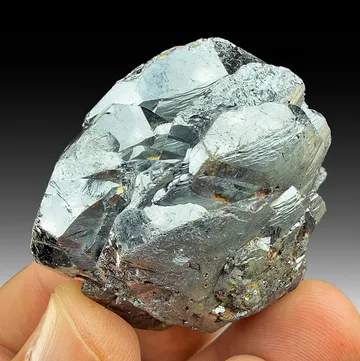
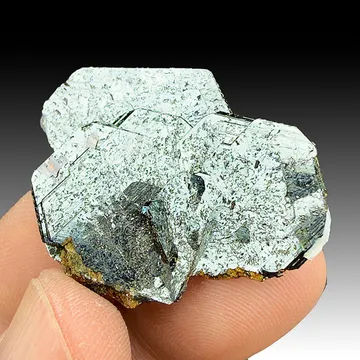
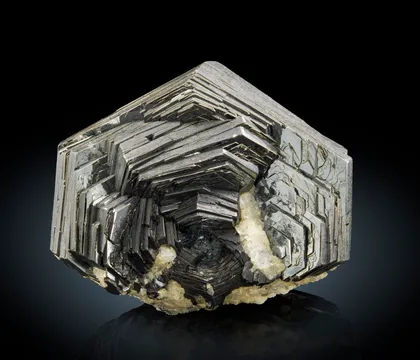
Cavradi hematite is chiefly known for tabular, flattened crystals and rosette aggregates—the classic Alpine “iron rose” habit. Individual crystals are commonly hexagonal to rhombic in outline, with bright metallic black to silvery-gray faces. The better plates show sharp bevelled edges, stepped growth, and fine striations that catch light like engraving on polished steel. Some specimens are lustrous enough to look wet or lacquered under strong lighting.
The habit varies from single plates to stacked rosettes, parallel-growth blades, fan-like groups, and thicker, more three-dimensional “rose” clusters. Thin blades can be elegant but fragile; thicker tabular crystals, especially those with bevelled margins and complex faces, are often more desirable. Local strahler terminology has even been reported for unusual multifaceted hematites—some described as “potatoes”—a reminder that Cavradi is not limited to textbook flat plates.

Photo: Wikimedia Commons
Color is mostly dark metallic gray to black, sometimes with a bluish or iridescent tarnish. The streak remains red-brown, as expected for hematite, but collectors evaluate Cavradi specimens visually by surface quality: mirror-black faces, bright silvery flash, and clean striated growth are the hallmark. Dull, etched, bruised, or abraded pieces are far less desirable unless the association is exceptional.
Rutile is the signature association. On the best specimens, red to wine-red rutile crystals grow epitaxially on hematite faces, meaning the rutile is crystallographically oriented to the hematite substrate. This is not just a color accent; it is one of the defining mineralogical features of the locality. The rutile may appear as tiny red blades, needles, or more robust crystals scattered over the hematite surfaces. Intact rutile on both sides of a hematite plate is especially attractive and vulnerable.
Quartz is the other major association. Cavradi hematite may sit on clear rock crystal, faint cognac smoky quartz, darker smoky quartz, or quartz-rich gneissic matrix. Large quartz crystals are less common than modest matrix groups because many clefts are narrow, but excellent quartz-hematite combinations are known. Adularia provides a pale feldspar contrast on some specimens, and siderite, calcite, malachite, strontianite, anatase, brookite, schorl, and copper sulfides can occur in the broader locality suite.
Typical collectible Cavradi hematites range from thumbnails to miniatures. Documented examples include thumbnails around 2.5 cm, miniatures around 4–6 cm, and small-cabinet matrix pieces in the 8–12 cm range. Individual hematite crystals may reach several centimeters; illustrated examples include 4 cm crystals on matrix, 5 cm iron-rose crystals, and reports of tabular crystals up to about 10 cm. Size alone is not decisive: a 2.5 cm iron rose with perfect form and luster can outrank a larger but bruised or flattened cluster.
Quality factors are highly locality-specific. Look for complete rosettes rather than broken blade stacks; mirror luster rather than gray abrasion; bevelled crystal edges rather than chipped terminations; rutile that is red, visible, and undamaged; and quartz that is clean enough to provide contrast. A top Cavradi matrix piece should feel balanced from multiple viewing angles, with hematite not merely attached to quartz but compositionally integrated with it.
Cavradi hematite is sufficiently distinctive that many genuine pieces can be recognized by style: metallic tabular iron roses, often on clear to smoky quartz or adularia, and sometimes carrying wine-red epitaxial rutile. Still, locality labels deserve scrutiny. Similar Alpine hematite occurs elsewhere in Switzerland and the Alps, and “Swiss hematite” can be too broad for a Cavradi attribution. Provenance from an old Swiss collection, a known strahler, or a reputable dealer is particularly valuable.
No well-documented, locality-specific epidemic of Cavradi fakes is known, but the usual hematite problems apply. Watch for repaired matrix specimens, reattached roses, and composite pieces. The reason is practical: Alpine clefts can be narrow, decomposed, and difficult to work, and hematite plates can separate from friable matrix during extraction. Even high-end specimens may have old repairs; what matters is disclosure. UV light, magnification, and close inspection around the hematite–matrix contact can reveal glue, fill, or suspiciously convenient attachments.
Condition is critical. Hematite is physically hard, but Cavradi’s platey habit makes edges vulnerable. Common condition issues include chipped bevels, contacted backs, dulled high points, missing rutile, cleaved or detached blades, and abrasions on mirror faces. Rutile on hematite is especially delicate; a specimen can look complete at first glance but lose much of its value if the red epitaxy has been rubbed away. Quartz matrix should be checked for repaired tips and bruised contacts.
Cleaning should be conservative. Avoid aggressive mechanical cleaning of hematite faces because the luster and fine striations are the specimen’s value. Iron oxides on associated quartz may be natural and aesthetically important; removing them can leave a sterile-looking specimen and, in careless hands, damage rutile or loosen plates. If the piece has old collection value, preserve labels and bases, even when the specimen itself is modest.
Rarity varies sharply by quality. Small Cavradi hematite thumbnails and miniatures appear regularly enough that the locality remains obtainable. Fine iron roses on quartz, sharp hematite-rutile combinations, large undamaged plates, and balanced matrix pieces are much scarcer. High-end examples are established Alpine classics, and competition is strongest for specimens with old provenance, excellent luster, complete rutile, and no repairs.
Market availability is steady but selective. Dealer archives, mineral auctions, and private collection dispersals show Cavradi material in a broad range—from affordable small matrix specimens to four-figure thumbnails and major cabinet pieces. The best purchases are usually not the biggest pieces, but the ones with unmistakable Cavradi character: bright metallic rose, crisp geometry, visible red rutile, and a matrix that makes the hematite look intentional rather than merely attached.
The first impression of Cavradi is not of a gentle collecting slope, but of a worked Alpine ravine. From the Tschamut side, the path follows the east wall of the gorge above the creek, sometimes only a few meters above it and sometimes high enough to make the water feel remote. Then the warning sign appears: avoid walks in the Cavradi area. It is not decorative. The central gorge is a working ground, and for decades local strahlers have opened small quarry-like cuts with long piles of waste rock below the clefts.
The mineral zone is narrow enough to feel intimate and steep enough to feel dangerous. Local descriptions place much of the work below 2000 meters and partly southwest-facing, so early-season days can be possible, and midsummer days can become punishingly hot. In the lower and central gorge, the advice is not to linger under active work. Overburden piles may tempt a visitor, but they are also where falling stone, active tools, and human conflict meet. The safer ground lies away from the main working faces, among old and partly overgrown clefts.
Rope work is part of the Cavradi reality. The walls can rise tens of meters above the floor, and the rock is both loose and tough. Before working a wall, experienced strahlers clean the ground above them because sharp plates can project from the cliff in spring and fall without warning. The danger is not only rockfall; a sharp falling slab can cut a rope. Trees, roots, rock heads, and bolts are used for anchors, but old bolts require skepticism, especially where the rock sounds hollow. This is not a locality where a hammer and enthusiasm substitute for Alpine judgment.
One local description gives a vivid picture of the working culture: on sunny days there may be up to ten strahlers at work in Cavradi, but on cold, foggy days the same walls can feel lonely. That contrast—crowded labor one day, empty gorge the next—is part of why Cavradi specimens carry a different aura from mine-run production. These pieces are not the output of an open pit. They are individual recoveries from clefts in a steep, regulated, humanly demanding ravine.
The specimens justify the trouble. The Cavradi book and related photo essays record an astonishing range: a 7 x 4 cm hematite rose from one of the biggest clefts; a 6 x 5.5 cm hematite with adularia; a 10 x 12 cm doubly terminated quartz crystal with hematite from Val Aulta; thin tabular hematite on quartz at 9.5 x 5.5 cm; thick hematite crystals with quartz and adularia at 7.5 x 6 cm; and an 11.2 x 6 cm hematite-rutile-quartz specimen from Val dils Cavengs. These are not generic Alpine labels—they are the kind of objects that made Cavradi a world locality, each one a different solution to the same visual problem of black metal, red rutile, and mountain quartz.
There is also a collecting-room story that says much about the fragility of great Cavradi matrix pieces. A major hematite-on-quartz specimen, filmed by The Arkenstone, was remembered from a collection around 2002 as a much larger and heavier piece—“about the size and weight of a bowling ball.” It later passed through other hands and was trimmed in two stages to a more balanced 10 x 8 x 8 cm display specimen. The surprise, after suspicion that it had been repaired, was that it was not repaired at all. The collector’s risk was in reducing the mass without destroying the balance: preserving the dramatic hematite, the sparkling quartz, and the granite matrix while making the specimen displayable from all sides.