






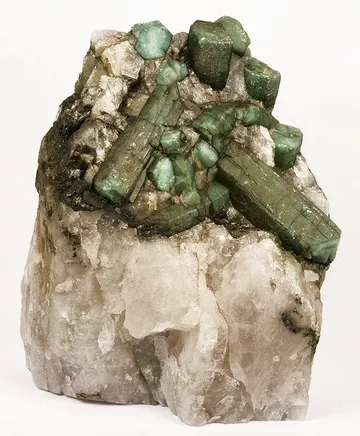
Bahia, Brazil — a collector-grade locality with emerald, rutile-in-quartz, blue euclase, and dumortierite; prized for variety, top localities, and inclusions.
Key facts
Bahia is not a single-mine locality in the tidy Alpine sense; it is a broad, collector-grade mineral province spread across one of Brazil’s most geologically varied states. For specimen people, the name immediately evokes three very different Bahias. In the north, the Carnaíba–Socotó emerald belt around the Serra de Jacobina made Bahia central to Brazil’s modern emerald story, with green beryl and emerald formed where Be-bearing granitic pegmatites and quartz-albitic veins reacted with Cr-bearing ultramafic rocks, producing emeralds in mica-rich metasomatic zones with molybdenite, scheelite, phenakite, chromite, tourmaline and quartz. In the Chapada Diamantina and Serra do Espinhaço country, Novo Horizonte and nearby Remédios became the classic source for golden rutile in quartz and rutile-on-hematite “stars,” while Boquira and Macaúbas yielded vivid dumortierite-bearing quartzites and dumortierite included in rock crystal. Farther south and west, Bahia’s pegmatites and metamorphic belts have supplied aquamarine beryl, blue apatite, kyanite, euclase, magnesite-suite minerals and a remarkable set of type-locality rarities.
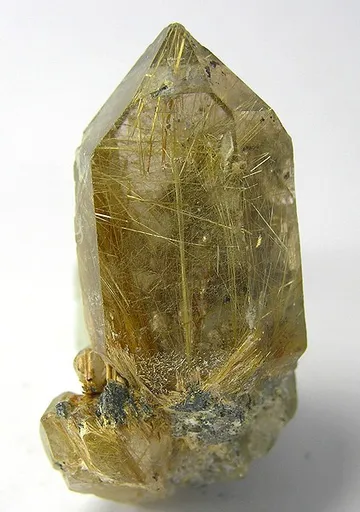
The best Bahia specimens have a look that is easy to recognize across a room: smoky to water-clear quartz shot through by straight golden rutile needles or six-rayed rutile trillings; emerald crystals as hexagonal green prisms against pale quartz, silvery mica or dark phlogopite-rich matrix; blue dumortierite sprays suspended inside transparent quartz; deep blue fluorapatite crystals from the Ipirá–Capim Grosso area; and lustrous euclase crystals, including the small but now famous pink-orange material from central Bahia. The locality’s collector value lies in this variety. Bahia can furnish a gem crystal, a dramatic inclusion piece, a scientific rarity and an ornamental-stone mineral assemblage, all within the same state label.
Regional View
Country View

Photo: Wikimedia Commons
For collectors, Bahia rewards locality precision. “Bahia, Brazil” can mean emerald from Carnaíba or Socotó, rutilated quartz from Remédios–Novo Horizonte, dumortierite quartz from Vaca Morta near Boquira, blue fluorapatite from the Ipirá Complex, aquamarine from Guaratinga, kyanite from Vitória da Conquista or Rio de Contas, or euclase from Brumado, Livramento de Nossa Senhora or Abaíra. A specimen simply labeled “Bahia” may be perfectly legitimate, but the best examples are those whose labels preserve the mine, claim, district and older trade name, because several Bahia localities have been relabeled over time as municipal boundaries and dealer conventions changed.

Photo: Wikimedia Commons
Search for specimens: View all specimens from Bahia, Brazil
Bahia’s specimen production comes from several deposit classes rather than from one orebody. The most historically important is the emerald mineralization of Carnaíba and Socotó, on and near the western side of the Serra de Jacobina in northeastern Bahia. There the collector story begins with granitic pegmatites, albitic or quartz-albitic pegmatoids and quartz veins intersecting ultramafic lenses, serpentinites, talc rocks, amphibolites and mica-rich metasomatic rocks. Beryllium came from the evolved granitic system; chromium and iron came from the mafic-ultramafic rocks; reaction zones of phlogopite or biotite schist became the emerald traps. The result is the classic Brazilian “granitic emerald-type” deposit: green beryl to emerald in mica schist and vein selvages, locally accompanied by molybdenite, scheelite, pyrite, phenakite, apatite, chromite and quartz.
The Carnaíba district has traditionally been divided into Carnaíba de Cima and Carnaíba de Baixo. Carnaíba de Cima includes old sectors such as Trecho Velho, Trecho Novo, Bica and Cabra, with workings high in the Serra de Jacobina. Carnaíba de Baixo includes sectors such as Bode, Gavião, Lagarta, Formiga, Marota and Braúlia, some developed in serpentinite roof pendants within granite and others in the country-rock terranes. Older geological work distinguished vertical fracture veins, called frinchas, from contact veins or esteiras developed along contacts involving quartzite and serpentinite. The frinchas could be narrow but productive, and the Trecho Velho area was especially noted for molybdenite. Formiga stood out in the mid-1980s for higher production and better-than-average emerald quality.
Mining at Carnaíba began near the end of 1963 in the Braúlia sector after emerald discoveries in the Pindobaçu area. Marota followed in 1964, and Trecho Novo was discovered in 1972. Before the rise of Santa Terezinha de Goiás, Carnaíba was the dominant Brazilian emerald field, and even afterward it remained a persistent producer. Work has long been dominated by garimpeiros using small shafts, pits, trenches and underground openings, with output fluctuating according to the depth of workings, water, costs, organization and the ability to mechanize. Socotó, roughly 40 km northeast of Carnaíba near Campo Formoso, is geologically related but sits in a large block of metamorphosed ultramafic and volcanic rocks enclosed in the Campo Formoso granitic massif. Its emeralds are similar in many gemological properties to Carnaíba emeralds, but the district is also known for carbonate inclusions, tube-like channels and color zoning.
The Remédios–Novo Horizonte area in the Chapada Diamantina is the second great Bahia specimen province. It is the famous source of golden rutilated quartz and rutile-on-hematite specimens long traded as “Ibitiara, Bahia.” That older label reflects the commercial route and municipal history: specimens were sold through dealers in the town of Ibitiara, and before municipal changes in the 1990s, both Remédios and Novo Horizonte were districts of Ibitiara. Today the more precise locality is the rutilated quartz localities near Remédios, in the municipality of Novo Horizonte, about 5 km west-northwest of the town of Novo Horizonte and south of Ibitiara. Collectors should preserve old “Ibitiara” labels but annotate them when a piece can be tied to Remédios or Novo Horizonte.
The Novo Horizonte mineralization is best known for quartz veins that produce smoky to clear crystals containing acicular golden rutile, as well as free-grown rutile on metallic hematite. The most desirable pieces have transparent quartz, bold rutile orientation, undamaged crystal terminations and visible rutile entering and exiting the quartz rather than merely lying on broken surfaces. The rutile-on-hematite pieces are often miniature to small-cabinet specimens, with bronzy to golden acicular rutile sprays arranged on lustrous hematite plates; the finest show sharp six-rayed, epitaxial-looking “star” patterns rather than chaotic felted masses.
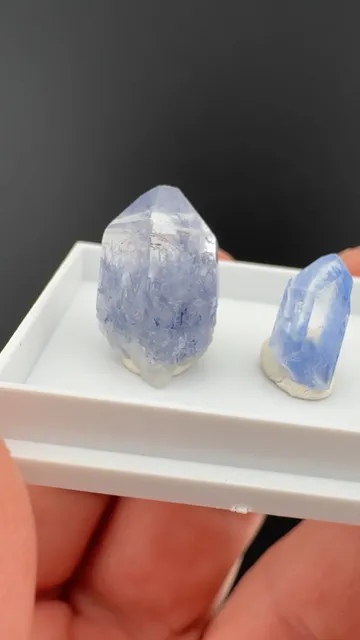
Boquira and the Serra da Vereda–Macaúbas area add a different blue signature. The Vaca Morta quarry and related localities exploit or expose dumortierite-bearing quartzites marketed as Blue Macaúbas, Blue Boquira and related ornamental stones. Petrographic descriptions of these rocks emphasize quartz, dumortierite and subordinate kyanite, with the blue minerals concentrated in lenses, bands or acicular radial aggregates. For collectors, the same region is prized not only for polished slabs and architectural stone, but also for quartz crystals containing blue dumortierite tufts, sprays and coatings. These specimens are much more satisfying when the inclusions are internal and three-dimensional, not just a blue crust on a sawn or polished surface.
The Ipirá Complex, including material traded from the Ipirá–Capim Grosso area and the Pedras Altas claim, is the important Bahia source for intensely colored blue fluorapatite. Most available pieces are single crystals, partial crystals or small groups rather than big matrix specimens; calcite matrix pieces are notably less common. Color is the point: the better Bahia fluorapatites show strong teal to electric blue body color, good luster, and where preserved, doubly terminated or well-formed hexagonal outlines.
Other Bahia pegmatites and metamorphic localities broaden the state label. Guaratinga and the Jaquetô mine have produced aquamarine beryl, typically as slender etched or elongated crystals in quartz-muscovite pegmatite associations. Vitória da Conquista is represented on the specimen market by blue kyanite, and Rio de Contas is also recorded for kyanite. Brumado, Livramento de Nossa Senhora and Abaíra have supplied euclase, including recent pink-orange gem euclase from central Bahia and euclase with rare-earth phosphate inclusions in hydrothermal quartz veins. Serra das Éguas at Brumado is better known industrially for magnesite and related mineralization, but it is also the type locality of brumadoite and a recurring name on Brazilian systematic labels.
Collecting access today should be treated as private, commercial and regulated. Bahia’s important specimen localities are active or former mines, claims, quarries, garimpos, flooded workings, private lands or industrial stone operations. Field collecting without permission is not appropriate, and many productive pockets are found by miners whose livelihood is gem or ornamental-stone recovery. Serious collectors are best served by buying from reputable Brazilian dealers, asking for precise claim or mine names, retaining old labels, and distinguishing mined specimens from lapidary byproducts.
Bahia quartz is at its best when it is not merely “Brazil quartz,” but a transparent record of a specific Bahia inclusion environment: Novo Horizonte smoky to clear crystals with golden rutile needles and hematite, Vaca Morta rock crystal with blue dumortierite sprays, and Carnaíba or Socotó quartz associated with emerald-bearing mica schist and pegmatitic veins. Good Novo Horizonte pieces show the rutile suspended cleanly inside the crystal, often as straight golden bundles, angled sprays or rare six-rayed trillings, with enough transparency to read the geometry from multiple directions; ordinary pieces are cloudy, broken, over-polished, or so densely included that the rutile pattern is lost. Vaca Morta quartz is judged by the depth and placement of blue dumortierite inclusions, with internal tufts and acicular clusters far more desirable than superficial blue staining or coatings, while emerald-associated quartz from Carnaíba is strongest when it carries well-formed green beryl or emerald on the same matrix.
Beryl from Bahia divides into two collector personalities: the emerald and green beryl of Carnaíba, Socotó, Salininha and related ultramafic-contact systems, and aquamarine or pale beryl from granitic pegmatites such as Guaratinga’s Jaquetô mine. The emerald material occurs as hexagonal prisms, commonly included but richly colored, in mica-rich or quartz-bearing matrix where the contrast between green beryl, pale quartz and dark phlogopite or biotite is a major part of the specimen appeal; better examples retain sharp prism faces, visible terminations and a natural matrix contact rather than isolated broken crystals. Bahia aquamarine is generally valued for slender elongated habit, sea-blue to blue-green color, clarity, etched surfaces and complex terminations, with the Jaquetô material especially desirable when it preserves an elegant complete crystal rather than a repaired or heavily abraded pegmatite fragment.
Rutile from Bahia is dominated by the Novo Horizonte–Remédios style: golden to reddish or bronzy acicular crystals either enclosed in quartz or perched on metallic hematite. In rutilated quartz, the finest pieces are not simply full of needles; they have legible architecture—parallel bundles, sprays, star-like trillings or needles that appear to pierce the quartz volume without being masked by fractures. Free rutile on hematite is a different collecting target, with the best small specimens showing bright golden sprays or six-rayed stellate aggregates on lustrous gray hematite plates, sometimes with associated quartz or hyalite; lesser pieces are dull, jumbled, flattened against the matrix or damaged at the tips of the needles. The most common label problem is older “Ibitiara” labeling for material now more precisely assigned to Remédios, Novo Horizonte.
Bahia euclase has become much more interesting to collectors because it is no longer represented only by classic blue-to-colorless Brazilian crystals on vague labels: Brumado, Livramento de Nossa Senhora and Abaíra are all documented, and central Bahia produced gem-quality pink-orange euclase discovered in 2015–2016 that reached the international gem and specimen market in 2018. The pink-orange material is scarce, with limited total production, and specimens tend to be small but prized for unusual color zoning, transparency and rarity; the best examples show crisp crystal form, attractive salmon, pink, orange or cream zoning and minimal bruising on this brittle beryllium silicate. Euclase from Abaíra is also scientifically important because hydrothermal veins there contain euclase and quartz with rare-earth phosphate inclusions, so a precise locality label matters far more than a broad “Bahia” tag.
Bahia kyanite is best understood through the state’s blue metamorphic and quartzite assemblages: the Serra da Vereda–Macaúbas ornamental quartzites contain subordinate kyanite along with quartz and dumortierite, and specimen-market blue kyanite is also recorded from localities such as Vitória da Conquista and Rio de Contas. The notable Bahia look is bladed to prismatic, saturated blue kyanite, sometimes in masses or clusters that were originally sorted from material treated as decorator stone rather than as fine mineral specimens. Good collector pieces have individual blades, depth of color, translucency, and aesthetic separation from massive quartzite or mica-rich matrix; ordinary pieces are simply blue rock with no crystal definition, or bruised blades whose pleochroic flash is lost in a rough decorative block.
Emerald is Bahia’s historically defining gemstone, with Carnaíba and Socotó as the key collector localities and Salininha important in the early Brazilian emerald story. Carnaíba emeralds occur where pegmatitic and quartz-albitic fluids reacted with serpentinite and related ultramafic rocks to make phlogopite- or biotite-rich metasomatic zones, producing green to bluish green hexagonal prisms that are commonly included but visually forceful on matrix; Socotó emeralds formed in a metamorphosed ultramafic-volcanic block enclosed by the Campo Formoso granite and are known for similar physical and chemical traits, with carbonate inclusions, tubes and banded zoning recorded in the material. The best specimens are sharp, well-positioned prisms on quartz or mica schist, particularly when the emerald remains naturally attached and contrasts against dark mica or pale vein quartz; commercial-grade pieces with broken, oiled or glued crystals on anonymous black schist are far less satisfying.
Dumortierite from Bahia is most closely associated with the Serra da Vereda–Boquira–Macaúbas blue quartzites and the Vaca Morta quarry, where the mineral occurs as blue acicular aggregates in quartzite and, more rarely for collectors, as brilliant blue inclusions inside rock crystal quartz. The quartzite material can be handsome lapidary stone, but specimen collectors usually chase clear quartz crystals with internal blue sprays, puffballs, coatings or tufts that can be viewed through natural faces. Choice pieces combine transparency, saturated royal to electric blue color, three-dimensional inclusion placement and minimal polishing; common pieces are opaque blue quartzite, cut slabs, or quartz with surface coatings that lack the suspended-in-crystal effect. Associated minerals recorded from Vaca Morta photo data include quartz, citrine, albite, muscovite, schorl and dickite, reinforcing the locality’s mixed quartz-vein and metamorphic character.
Bahia fluorapatite is represented chiefly by the Ipirá Complex and the Ipirá–Capim Grosso trade area, with Pedras Altas, Capim Grosso specifically documented for the species. Collector specimens are prized for vivid deep blue to teal color, glassy luster, and well-shaped hexagonal crystals, including doubly terminated examples; matrix specimens, especially fluorapatite on calcite, are scarcer than loose or partial crystals. The better pieces are clean, saturated, lustrous and crystallographically complete enough to read as apatite rather than simply blue rough, while lower-grade material may be chipped, cleaved, tumbled, or sold in bulk as bright blue lapidary material with little locality precision. Unlike many fluorescent apatites, Ipirá fluorapatite has been reported by collectors as non-fluorescent under UV, so visible-light color and form should drive evaluation.
Beyond these market-facing species, Bahia is unusually rich in systematic rarities and type-locality minerals. Bahianite, Al5Sb3O14(OH)2, is named for the state and has its type locality at the Pico das Almas river near Paramirim das Crioulas, Érico Cardoso, where it occurs as stream-worn pebbles, commonly with radial-fibrous or vuggy textures and small newly formed crystals. Brumadoite, Cu3(TeO4)(OH)4·5H2O, is a copper tellurate hydrate from the Pedra Preta pit, Serra das Éguas, Brumado. Almeidaite, Pb(Mn,Y)Zn2(Ti,Fe3+)18O36(O,OH)2, is a crichtonite-group mineral from the Paulo de Mudo claim at Novo Horizonte, occurring as black platy crystals associated with anatase, bastnäsite-(La), hematite, kaolinite, muscovite, quartz, rutile and xenotime-(Y). Parisite-(La), CaLa2(CO3)3F2, was also described from the Novo Horizonte area, making the same rutilated-quartz district significant not only for beautiful quartz-rutile specimens but for rare-earth carbonate mineralogy. Brumado and Serra das Éguas also contribute classic magnesite-suite material and copper secondary minerals, while the Chapada Diamantina alluvial and metamorphic assemblages include cassiterite, eskolaite, andalusite, staurolite, topaz, corundum, zircon, monazite, native gold and diamond in documented regional occurrences.
The biggest collecting risk with Bahia is imprecise labeling. “Bahia” is acceptable only as a broad regional label; serious specimens should ideally say Carnaíba, Socotó, Salininha, Novo Horizonte, Remédios, Vaca Morta, Boquira, Macaúbas, Ipirá, Capim Grosso, Pedras Altas, Guaratinga, Jaquetô, Brumado, Livramento de Nossa Senhora, Abaíra, Vitória da Conquista or Rio de Contas, as appropriate. Older “Ibitiara” labels on rutilated quartz are common and historically meaningful, but many such pieces are now understood to come from the Remédios–Novo Horizonte workings.
For emerald, expect treatments and fractures. Bahia emeralds are commonly included, and commercial stones are often oiled or fracture-filled; specimen crystals may also be stabilized, repaired, or glued back onto matrix. Be wary of emerald crystals set too neatly into black mica or schist, especially where glue is visible around the base or where matrix and crystal contact surfaces do not match. A natural Carnaíba or Socotó matrix specimen should show geological continuity: mica selvage, quartz, feldspar or schist in plausible contact with the prism, not a staged “green crystal on black rock” presentation.
Rutilated quartz from Novo Horizonte is abundant enough that faking high-end rough specimens is less necessary than with rarer minerals, but the lapidary market is full of misleading material. Glass and resin with metallic fibers can imitate rutilated quartz in beads and carvings, and the old gemological misnomer “rutilated topaz” refers to Brazilian topaz with limonite-stained channels rather than true rutile needles. For natural quartz, look for rutile that continues in three dimensions through the host, intersects internal growth zones, and shows natural terminations or embedded ends; avoid pieces with bubbles, molded shapes, metallic-looking foil strips or needles that all lie on a single artificial plane.
Dumortierite in quartz from Vaca Morta is best evaluated under strong light from several angles. True inclusions appear inside the quartz and change position with parallax; surface coatings, dyed fractures and polished blue quartzite do not. Some specimens are partly polished to improve windows into the inclusions, which is acceptable if disclosed, but natural-faced crystals command a premium. The quartz may be chipped or polished around the base because much material was recovered in a quarrying and ornamental-stone context rather than in specimen-minded pocket work.
Blue fluorapatite from Ipirá–Capim Grosso is widely available compared with many fine apatite localities, but good crystal form is much less common than blue rough. Apatite is brittle and has distinct parting or cleavage tendencies, so check terminations and prism edges carefully. Some collectors report that Ipirá material is not fluorescent; a lack of UV response should not by itself be taken as a red flag. Because some blue apatites can contain minor radioactive trace elements, very large lots or lapidary stock are best stored sensibly, but ordinary display specimens are generally handled like other phosphate minerals: keep them dry, avoid acids, and protect them from knocks.
Euclase demands condition scrutiny. It is brittle, cleaves readily, and the recent pink-orange Bahia material is sufficiently scarce that even small bruises materially affect value. Ask whether a crystal is from Brumado, Livramento de Nossa Senhora or Abaíra, and whether a pink-orange piece belongs to the limited central Bahia finds that entered the trade after 2018. Kyanite is also condition-sensitive because blades split and fray; the best Bahia pieces are those with intact blade ends and enough translucency or color zoning to rise above decorator-grade blue rock.
Market availability varies sharply by species. Novo Horizonte rutilated quartz and Bahia blue apatite remain regularly available, from inexpensive small pieces to exceptional collector specimens. Dumortierite-in-quartz from Vaca Morta is available but much scarcer in transparent, well-composed specimens. Bahia emerald on matrix appears periodically, though fine undamaged crystals on natural matrix are far less common than included or repaired material. Pink-orange euclase is genuinely scarce, and type-locality rarities such as bahianite, almeidaite, parisite-(La) and brumadoite are specialist-systematic purchases rather than routine show stock.
In 1983, before golden rutilated quartz from Bahia had become a familiar presence in gem shows, Brian Cook first reached the remote Remédios area as a geology student. The trip from Salvador took two and a half days. What he saw there was a local example of golden rutilated quartz, a material then still relatively rare on the gem market. Cook later became an exporter and helped bring the quartz to wider attention, but the locality remained more than a buying stop. Years later, he and Kendra Cook owned land in Remédios that included a productive golden rutilated quartz mine, and their return journey from Salvador had shrunk to about ten hours as roads improved. By 2017, they were working with a regional population of about 2,500 miners on a collective for the Remédios–Novo Horizonte quartz fields: origin certificates, a warehouse, cutting facilities, a visitor center, mine safety, lapidary training and beadmaking instruction for local women who were already selling rough gems in markets. It is one of the more memorable modern Bahia stories because it treats a familiar cabinet mineral—golden rutile in quartz—not as an anonymous export product, but as the basis for a named community, a traceable origin and a possible mining culture visitors could actually understand.
The most notorious Bahia mineral story belongs to a very different object: the Bahia Emerald, a colossal mass of black schist carrying huge emerald crystals from the Carnaíba range. Reported as roughly 341 kg, or 752 pounds, it was removed from Bahia in 2001 and then entered a long, tangled sequence of sales claims, storage moves, lawsuits and law-enforcement custody. Accounts place it at different moments in São Paulo, San Jose, New Orleans, South El Monte, Las Vegas and ultimately a Los Angeles County sheriff’s evidence locker. The rock became famous not because it was a fine mineral specimen in the normal collector sense—its color has often been described as poor for gem use—but because it looked mythic: a dark, heavy matrix with thick green emerald prisms jutting out like columns. By late 2024, after years of litigation, a U.S. federal judge ruled that the smuggled stone should return to Brazil. For collectors, the lesson is blunt: Bahia’s emerald heritage is significant enough that provenance, export legality and chain of custody are not academic niceties. They can determine whether a specimen is a collectible, evidence, or cultural property in limbo.
.jpg)
_5_(34600920506).jpg)

