Ibitiara, Brazil: Bahia locality famed for rutilated quartz and rutile-on-hematite, featuring golden rutile sprays and hematite plates prized by collectors.
Key facts
“Ibitiara” is one of those Brazilian locality names that lives two lives in mineral collections. On older specimen labels it is the classic name attached to golden rutile in quartz and rutile-on-hematite “suns” from central Bahia; in modern locality terms, much of that material is now placed in the Remédios district of Novo Horizonte, a municipality that was formerly part of the larger Ibitiara county. For collectors, the name still points to a very specific visual world: glassy colorless to smoky quartz crystals pierced by metallic yellow to honey-gold rutile needles, and freestanding radiating rutile sprays perched on black, specular hematite plates.
Geologically, the specimens belong to hydrothermal quartz-vein systems of the western Chapada Diamantina, in the Serra do Espinhaço belt of Bahia. The productive veins cut low-grade metavolcanic rocks of the Novo Horizonte Formation, part of the Rio dos Remédios Group, where rhyolitic and dacitic rocks were fractured, altered, kaolinized, and invaded by silica-rich fluids. Those veins are not merely decorative quartz seams: they are a complex hydrothermal environment that has yielded gold, barite, rutile, rutilated quartz, hematite, xenotime-(Y), and rare-earth minerals, including Brazilian type-locality species.
The best specimens have an unmistakable architecture. In the rutilated quartz, fine to stout golden rutile needles may run in crossing sprays, loose sheaves, or dense internal nets within transparent quartz; the finest pieces are bright, undamaged crystals with enough clarity to make the inclusions legible from several angles. In the rutile-on-hematite style, acicular rutile grows in epitaxial orientation from metallic black hematite, producing six-rayed stars, flower-like bursts, and layered sprays that look delicate even when the rutile crystals are surprisingly lustrous. This pairing—warm golden rutile against cold mirror-black hematite—is the signature by which the locality is recognized across show tables.
Regional View
Country View
The historical-name issue matters. A specimen labeled “Ibitiara, Bahia” may be a perfectly old and honest label if it entered commerce before the municipal changes that separated Novo Horizonte from Ibitiara; the modern refined locality for the famous rutilated quartz and rutile-on-hematite material is generally Novo Horizonte, especially the Remédios-area workings south of Vila dos Remédios. A careful collection should preserve both pieces of information: the original label as historical evidence, and a modern locality note explaining the corrected political geography.

Photo: Wikimedia Commons
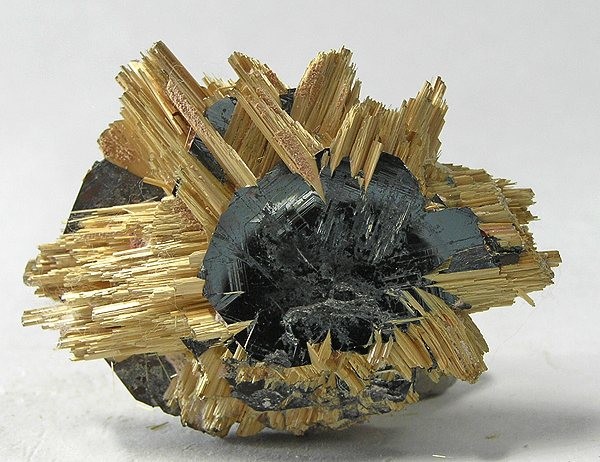
Photo: Wikimedia Commons
Search for specimens: View all specimens from Ibitiara, Brazil
The famous “Ibitiara” collector material is best understood as a hydrothermal quartz-vein district in the western Chapada Diamantina of Bahia, with the most important modern locality name being Novo Horizonte, especially the Remédios area. Mindat’s modern locality description places the rutilated-quartz workings just south of Vila dos Remédios, about 5 km west-northwest of Novo Horizonte and about 21 km south of the town of Ibitiara. Older labels persist because Ibitiara once covered a larger administrative area; after municipal reorganization in the 1990s, Novo Horizonte became a separate municipality and Remédios became part of Novo Horizonte.
The geological host is the Novo Horizonte Formation at the base of the Rio dos Remédios Group within the Espinhaço Supergroup. In the Novo Horizonte area, the formation includes low-grade metamorphosed volcanic and subvolcanic rocks—dacites, rhyolites, quartz porphyries, agglomerates, and tuffs—modified by later hydrothermal alteration. Regional geological work ties the Rio dos Remédios Group to Statherian rift-related volcanism, followed by deformation, metamorphism, folding, and hydrothermal veining during late Brasiliano tectonism. The veins exploited for quartz and rutile therefore record a later hydrothermal event superimposed on much older volcanic rocks.
The ore and specimen bodies are quartz veins and vein-stockworks rather than pegmatites in the ordinary collector sense. Productive quartz veins in the district have been described with a general NNW-SSE orientation, with dips from subvertical to subhorizontal, discordant to the volcanic flows. Some veins reach substantial dimensions, and the Lavra do Costa is described in the literature as a representative regional deposit: brecciated quartz veins cemented by chalcedony, partly kaolinized, with stockwork zones 2–3 m thick containing randomly distributed quartz druses that may be rutilated, hematite-rich, or both. At the Mula mine near Tapera, hydrothermal quartz veins cut metarhyolite and are associated with rutile, hematite, almeidaite, xenotime-(Y), rare-earth carbonates and phosphates, and kaolinized wall rock.
Mining history here is layered. The broader Chapada Diamantina was historically important for quartz crystal, especially during the Second World War, when Brazilian quartz was sought for electronic and optical uses. At that stage, rutile-filled quartz was not the prize; clear, usable quartz mattered more, and included material had little industrial value. The modern collector and gem interest in the golden rutilated quartz developed much later, especially from the 1980s and 1990s onward, when dealers, lapidaries, and collectors began to recognize the unusual beauty and commercial value of the golden rutile inclusions and rutile-hematite stars.
The mining is artisanal and claim-based rather than a single large mechanized specimen mine. The literature records the Lavra do Costa as being in production since the 1990s and employing hundreds of garimpeiros at the time of the 2018 geological study. The Mula mine and Paulo de Mudo claim are important in the rare-mineral literature, while the Pyramid Mine in Remédios is notable in the responsible-sourcing world as a golden rutilated quartz mine connected with Brian Cook and community-focused projects. Claims, pits, and underground workings in the district are working mineral properties; casual collecting access should not be assumed. Specimens reach the market through miners, local buyers, Brazilian dealers, and international mineral and gem channels.
Collectors should distinguish several styles of production. Transparent quartz crystals with internal rutile are the most familiar, ranging from small thumbnails to cabinet-sized crystals and clusters. Some are ordinary included quartz, while the best show sharp terminations, complete crystals, high transparency, bright golden rutile, and pleasing internal geometry. Rutile-on-hematite specimens form a second elite category: sprays, six-rayed stars, and layered “flowers” of golden rutile on black hematite. The Mula/Tapera material added an unexpected scientific chapter, because rare-earth and crichtonite-group minerals were found in the same hydrothermal setting, showing that the district is mineralogically deeper than the commercial rutile-quartz label suggests.
Rutile is the emblem mineral of the Ibitiara/Novo Horizonte collector district, occurring both as golden acicular inclusions sealed inside quartz and as exposed sprays on hematite. In the classic rutile-on-hematite specimens, the rutile commonly forms honey-yellow to brassy, metallic, needle-like crystals arranged in radiating, epitaxial bundles from lustrous tabular hematite; fine examples are sharply three-dimensional, with intact terminations, strong golden color, and no crushed or brushed-away needle tips. In quartz, the rutile may appear as scattered needles, dense crossing networks, or organized internal sprays, with the most desirable pieces combining bright golden inclusions, clear quartz, and visible hematite source plates or centers that tell the growth story. Documented specimens range from delicate thumbnails to showy cabinet pieces, and the best pieces are judged as much by composition and preservation as by size.
Quartz from the Ibitiara/Novo Horizonte district is prized less for unusual external crystal form than for what it encloses: golden rutile needles, hematite plates, and, in rare exceptional pieces, rutile stars seemingly suspended in the crystal. The quartz may be colorless, glass-clear, translucent, smoky, or slightly citrine-toned by inclusions and internal reflections; crystals are commonly offered as miniatures to cabinet specimens, with documented examples around 5–10 cm but occasional larger clusters and plates entering the market. Good pieces are transparent enough to reveal the rutile pattern, complete enough to show attractive terminations, and balanced enough that the inclusions read as a coherent scene rather than a muddy mass. Particularly choice specimens show exposed hematite with rutile continuing into the quartz, linking the external epitaxial sprays to the internal “rutilated quartz” effect.
Hematite from this locality is the black, metallic stage on which the rutile performs. It occurs as lustrous tabular to platy specular crystals and aggregates, commonly serving as the nucleation surface for golden rutile sprays; in quartz specimens it may be included, partly exposed, or present as a basal plate from which rutile needles project into later quartz. The most collectible hematite-bearing pieces have mirror-bright faces, strong contrast against the rutile, and intact star-like or fan-like rutile growths along crystal edges and surfaces. Ordinary hematite plates from the district are interesting, but the market rewards specimens in which hematite is compositionally central: sharp black plates carrying complete golden rutile “suns,” or hematite bases visibly connected to rutile-filled quartz.
Beyond the three show minerals, the Novo Horizonte–Remédios district has produced an unusually sophisticated rare-mineral assemblage for a locality once known mainly through attractive trade specimens. Almeidaite, a crichtonite-group oxide, was described from the Novo Horizonte area as black, opaque, submetallic platy crystals associated with quartz, rutile, anatase, hematite, kaolinite, muscovite, xenotime-(Y), and bastnäsite-(La). Parisite-(La), the La-dominant analogue of parisite-(Ce), was described from the Mula mine at Tapera as residual nuclei in pseudo-hexagonal, doubly terminated crystals associated with hematite, rutile, almeidaite, fluocerite-(Ce), brockite, monazite-(La), rhabdophane-(La), and bastnäsite-(La). Geological work also records xenotime-(Y) crystals, anatase, monazite, muscovite, kaolinite, barite, gold, and other hydrothermal phases in the broader vein system, making the locality a meeting point between specimen aesthetics and serious Brazilian type-mineralogy.
The main authenticity issue is not widespread treatment but locality precision. Many older labels say “Ibitiara, Bahia, Brazil,” while modern references place the famous rutilated quartz and rutile-on-hematite material in Novo Horizonte, especially the Remédios district. Do not discard an old Ibitiara label: preserve it as part of the specimen’s provenance, then add a modern annotation such as “old label: Ibitiara; modern locality: Remédios, Novo Horizonte, Bahia.” Conversely, be cautious with new material marketed vaguely as Ibitiara if the seller cannot explain the locality history.
The second concern is misidentification within included quartz. Brazil supplies many kinds of included quartz, and golden acicular inclusions are not automatically Novo Horizonte rutile. The strongest locality-consistent pieces show the district’s familiar combination of golden rutile, clear to smoky quartz, and black specular hematite, often with rutile visibly radiating from hematite. Be alert for unrelated “rutilated quartz” from other Brazilian states, polished freeforms with no locality support, and decorative material in which golden fibers or foils are embedded in glass or resin rather than grown naturally in quartz.
Condition is critical. Exposed rutile sprays on hematite are fragile, and even minor brushing, trimming, or careless packing can shorten needle tips and flatten the best three-dimensional effect. The rutile-hematite stars are often thin, plated specimens; edge wear on hematite, missing rays, and crushed fiber bundles are common. In rutilated quartz, the usual condition questions are termination chips, bruised edges, internal fractures, and sawn or polished bases. Some lapidary pieces are perfectly legitimate, especially for jewelry use, but a collector specimen should be described clearly as natural crystal, polished, trimmed, or cut.
Fluorescence is not a central collecting feature for the classic rutile-quartz-hematite assemblage. Rutile and hematite are opaque oxides and quartz is generally collected here for clarity and inclusions, not UV response. Handling should focus on physical preservation: hold exposed rutile-on-hematite pieces by the matrix or mount, keep them out of loose flats where needles can snag, and avoid ultrasonic cleaning. Rutilated quartz crystals are more robust but can still have healed fractures and delicate edges.
Market availability is steady but quality is very uneven. Small rutile-on-hematite stars and included quartz pieces remain obtainable, while top examples with complete, sculptural rutile sprays on mirror hematite or transparent quartz crystals with dramatic internal rutile geometry are much scarcer. The best specimens compete across multiple markets—mineral collectors, quartz specialists, lapidary buyers, and jewelry designers—so clean, well-provenanced examples from old collections often command a premium.
The most revealing story at this locality is the label story. For decades, “Ibitiara” was the name collectors knew: a compact, memorable label attached to golden rutilated quartz, rutile stars, and hematite-rutile combinations. Then locality work caught up with political geography. Until the mid-1990s, Ibitiara county was larger, and both Remédios and Novo Horizonte were tied to it administratively. After a municipal vote, Novo Horizonte separated from Ibitiara, and Remédios became part of Novo Horizonte. The mineral locality did not move; the map around the label changed. That is why old labels can be historically true and modern labels can also be more geographically exact. A good specimen card today should tell both stories.
The Mula mine added a scientific surprise to what had looked like a familiar specimen district. In 2011, Luiz Alberto Dias Menezes Filho encountered almeidaite and parisite-(La) not in a grand museum expedition but in the fill of an abandoned shaft where miners had mainly been seeking rutilated quartz. In 2013, another shaft was opened only a few meters away, and the minerals were collected in situ at the contact between quartz vein and metarhyolite. What emerged was startling for a new-mineral occurrence: almeidaite in black, submetallic plates up to 3.0 x 3.0 x 0.6 cm, and parisite-(La) crystals that later reached nearly 8 cm along the c-axis. Many newly described mineral species are microscopic curiosities; these were macroscopic, collectible crystals from a district already famous for showy quartz and rutile.
The modern mining story around Remédios is also unusually human. Brian Cook, connected with the Pyramid Mine in the area, has described first visiting the remote northeastern Brazilian village before the Paraíba tourmaline boom pulled his attention elsewhere. Rutilated quartz in the 1980s was supplemental income for his family and a reason to keep returning to Brazil; later, he and Kendra Cook bought land that became the Pyramid Mine. The mine’s legalization reportedly took twelve years, a delay Cook has attributed to refusing to bribe officials, and he has described using that legal footing to help other mine and landowners formalize claims in a district where mining had long operated informally.
The health story is sobering. Cutting, drilling, and mining quartz generate silica dust, and responsible-sourcing projects around the Pyramid Mine and the Remédios mining community have focused on silicosis prevention. One account described a study in which twelve miners were selected and nine were found to have silicosis, a result that triggered renewed action around masks, personal protective equipment, and education. Crystal Clear’s Bahia project records donations for silicone masks and safety equipment, and then an abrupt pivot during COVID-19: when buyers from China, Europe, and the United States left Brazil, gemstone trade in the remote communities dried up, and funds were redirected to care packages for mining families.
The locality’s beauty can make the work behind it easy to forget. A rutile star on hematite is a pocket-sized object, often only a few centimeters across; the mining culture behind it includes underground shafts, seasonal income, local auctions, women working through tailings after pockets are opened, and families waiting through long periods when no valuable quartz appears. The best specimens from Ibitiara/Novo Horizonte therefore carry more than a mineralogical signature. They also carry a social signature: artisanal labor, changing municipal names, old garimpo knowledge, and a specimen trade that has slowly learned to value the golden material once passed over in search of clear industrial quartz.