A collector's guide to Caraş-Severin County, Romania: its geology, mining history and notable minerals, illustrated with the 48 specimens documented from this locality on EarthWonders.
Key facts
Caraş-Severin County is the collector’s heart of the Romanian Banat: a compact, historically deep mining province where Late Cretaceous “banatitic” intrusions cut carbonate and metamorphic rocks of the western South Carpathians and built some of Europe’s classic skarn mineral assemblages. The name most collectors recognize first is Ocna de Fier–Dognecea, a zoned Fe-Cu-Zn-Pb skarn field whose northern Ocna de Fier sector is dominated by grandite garnet and magnetite-hematite iron ore, while the southern Dognecea sector becomes more sulphidic, with hedenbergite, galena, sphalerite, chalcopyrite, and associated bismuth minerals. That mineralogical gradient is not just an academic nicety: it explains why specimens from the county range from lustrous brown-black andradite on pale carbonate, to quartz and hematite “iron rose” combinations, to rare sulphosalts, cobalt-nickel arsenides, borates, phosphates, and copper secondary minerals.
The county’s importance is broader than one mine. Ocna de Fier is the type locality for ludwigite and veszelyite; Oraviţa is tied to alloclasite; Ciclova is central to the history of hörnesite and the disputed Banat type-locality story of wollastonite; Moldova Nouă is the type locality for cyanotrichite. Few European collecting districts of comparable size combine skarn geology, old imperial mining history, museum-quality specimens, and multiple type-locality minerals so tightly.
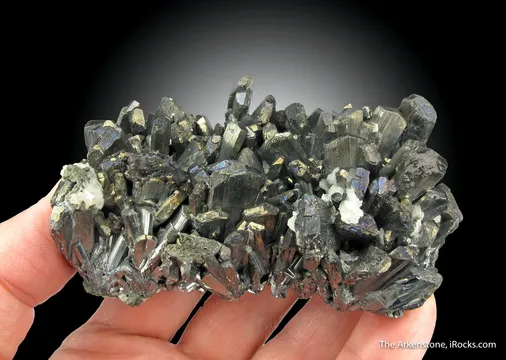
The best Caraş-Severin specimens have a very recognizable look. Ocna de Fier and Dognecea andradites are typically deep honey-brown, reddish brown, greenish brown, or near-black melanite-like crystals, often dodecahedral to trapezohedral, set on pale calcite, quartz, skarn, hematite, magnetite, or sulphide-rich matrix. Quartz can be ordinary as a gangue mineral, but becomes highly desirable when it appears as well-formed crystals with calcite, hematite, andradite, or the celebrated Japanese twins documented from Ocna de Fier. The rarest county specimens are not always showy at first glance: a small blue-green crust of veszelyite or a tuft of cyanotrichite may carry more locality significance than a much larger cabinet piece.
Regional View
Country View

Photo: Wikimedia Commons

Photo: Wikimedia Commons

Photo: Wikimedia Commons
Search for specimens: View all specimens from Caraş-Severin County, Romania
The specimen-producing geology of Caraş-Severin County is dominated by intrusion-related skarn and associated hydrothermal ore systems developed along the Banat sector of the Late Cretaceous magmatic and metallogenic belt. At Ocna de Fier–Dognecea, a granodioritic body intruded a package of limestone, dolomite marble, metapelites, gneiss, and schist, generating contact metamorphism, metasomatism, and ore deposition. The classic skarn crops out for roughly seven kilometres between Ocna de Fier and Dognecea, with average skarn thickness around 50 metres and exceptional development up to about 300 metres in the Iuliana area. Modern work places peak contact-metamorphic conditions near 700 ± 50 °C and about 2.8 ± 1 kbar, a deep, hot environment for the making of garnet-pyroxene-magnetite skarn.
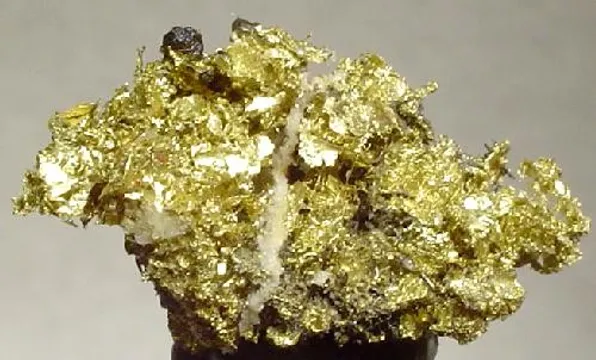
The orefield is zoned in a way that maps directly onto its collecting character. In the north, around Ocna de Fier, the skarn is a calcic Fe system: grandite garnet, magnetite, hematite, calcite, quartz, diopside, phlogopite, tremolite, serpentine minerals, and the borate ludwigite are central. In the middle, around the great Simon Iuda orebody and neighbouring workings, Cu-Fe mineralization becomes important, including bornite, chalcopyrite, magnetite, and a suite of trace phases that includes cobalt pentlandite, carrollite, wittichenite, galena, mawsonite, electrum, silver, and Se-Te minerals such as kawazulite, bohdanowiczite, hessite, and volynskite. Farther south at Dognecea, the assemblage becomes a more distal Zn-Pb-Cu skarn, with hedenbergite, galena, sphalerite, chalcopyrite, pyrite, calcite, quartz, and related sulphides more conspicuous.
The old mine names matter on labels. Ocna de Fier specimens may carry Vaskő, Vaskö-Moraviţa, Vaskö-Moravicza, Eisenstein, Moravica, or Morawitza. Dognecea appears as Dognácska, Dognaczka, Dognatzka, or on imperfect dealer labels in other spellings. Important Ocna de Fier–Dognecea workings and open pits cited in the literature and specimen trade include Eleonora, Paulus, Franciscus, Ignatius, Terezia, Delius, Magnet, Sfinții Arhangheli, Simon Iuda, Elias-Enoch, Iuliana, Petru and Pavel, Reichenstein, and related adits and dumps. The Iuliana pit is especially important because it lies in the central mixed Fe-Zn-Pb-Cu zone and has produced grandite, tremolite-actinolite, epidote, calcite, magnetite, ludwigite, serpentine, hematite, pyrite, galena, sphalerite, chalcopyrite, marcasite, and quartz.
Mining here has very old roots. Archaeological and historical sources treat the Banat iron and copper districts, including Ocna de Fier, Dognecea, Moldova Nouă, Sasca Montană, Ciclova Română, and Bocşa, as part of a metal-producing landscape active from antiquity. In the early modern period, development accelerated after the 1718 Peace of Passarowitz, when the Banat came under Habsburg control and mining and metallurgy were reorganized along Central European technical lines. Official archival summaries record at least 100,000 tonnes of iron ore extracted at Ocna de Fier between 1720 and 1814, about 1,850 kilograms of silver from Dognecea between 1777 and 1854, and major copper-lead-silver output from Moldova Nouă in the 1770s. Rail links later supported the industry, including the Secu–Reşiţa–Bocşa–Ocna de Fier route constructed in 1873.
Modern collecting is mostly the realm of old mine dumps, old collections, and specimens dispersed through European and American trade. The underground mines are closed and should be considered inaccessible without formal authorization and professional safety arrangements. Some surface localities and dumps are physically reachable, and educational field trips have sampled skarn minerals at outcrop, but collectors should not confuse a visible dump or quarry with permission to collect. Many of the finest pieces now available are old-time specimens from miners’ collections, institutional deaccessions, or the European trade of the 1970s and 1980s.
The county’s specimen finds include several distinct traditions. Ocna de Fier produced the famous iron-mineral aesthetic: andradite with platy hematite, magnetite, quartz, and calcite; stalactitic or fibrous manganese oxides; richly crystallized calcite; and ludwigite in black fibrous or radiating aggregates once likened historically to “black asbestos.” Terezia, Reichenstein II, and Iuliana veche are specifically documented as sources for Japanese-twinned quartz associated with lamellar hematite, magnetite, and andradite. Delius quarry has yielded sharp reddish-brown andradite crystals, and the old Dognecea sector produced cabinet pieces of golden-brown dodecahedral andradite with stacked calcite and quartz, often with the patina and labels collectors expect from a true European classic.
Andradite is the signature collector mineral of the Ocna de Fier–Dognecea skarn, occurring as grandite to andradite-rich garnet in the Fe-skarn and mixed Fe-Zn-Pb-Cu zones; specimens range from small, tightly packed brown crystals to unusually large locality examples over 2 cm, most commonly dodecahedral with trapezohedral modifications, in colours from honey-brown and greenish brown through reddish brown to nearly black melanite-like crystals. The most desirable pieces show sharp, lustrous crystals standing proud on contrasting pale calcite, quartz, or carbonate matrix, or in distinctive association with platy hematite, magnetite, diopside, hedenbergite, chalcopyrite, galena, and sphalerite. Ocna de Fier material tends to represent the more oxidic, garnet-magnetite-hematite side of the system, while Dognecea examples may carry the more sulphidic character of the southern skarn; ordinary pieces are dense garnet skarn with little relief, whereas superior specimens have open vugs, clean crystal faces, old labels, and recognizably Banat associations rather than anonymous brown garnet on massive matrix.
Quartz from Caraş-Severin County is most collectible when it records the late hydrothermal overprint of the skarn rather than simply filling space as white gangue: at Ocna de Fier it appears with calcite, andradite, hematite, magnetite, and sulphides, and documented Japanese twins came from Terezia, the Reichenstein II adit, and Iuliana veche, associated with lamellar hematite, magnetite, and andradite. Dognecea specimens can show small white prismatic quartz crystals with calcite and garnet, while quartz-sulphide veining is noted in particular areas such as Cracul cu Aur. The best quartz pieces from the county are not judged by size alone but by crystallographic interest, matrix contrast, and association: a modest Japanese twin or sharp quartz on hematite-andradite matrix is far more locality-specific than a larger but generic milky vein fragment.
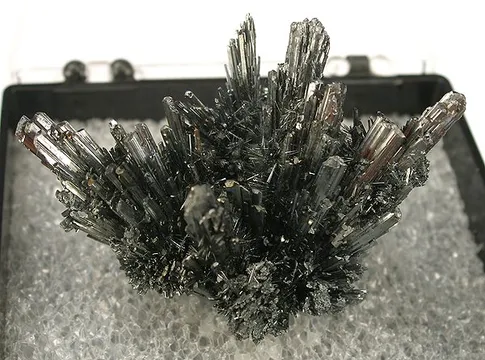
Beyond andradite and quartz, Caraş-Severin County is remarkable for type-locality and rare-species collecting. Ocna de Fier is the type locality for ludwigite, Mg2Fe3+(BO3)O2, and veszelyite, (Cu,Zn)2Zn(PO4)(OH)3 · 2H2O; the former is a black fibrous to radiating borate of the magnesian skarn, while the latter is a prized blue-green Cu-Zn phosphate usually seen as small crystals or crusts. Oraviţa’s Elizabeth Mine is the type locality for alloclasite, Co1-xFexAsS, and Ciclova is the type locality for hörnesite, Mg3(AsO4)2 · 8H2O, while the wollastonite type-locality question remains historically tied to Banat skarns, with Ciclova often cited as the more plausible source than Dognecea. Moldova Nouă is the type locality for cyanotrichite, Cu4Al2(SO4)(OH)12 · 2H2O, whose intense blue acicular tufts are among the county’s most attractive secondary copper minerals. Other documented county minerals include magnetite, hematite, calcite, diopside, hedenbergite, vesuvianite, wollastonite, tremolite-actinolite, epidote, phlogopite, serpentine minerals, galena, sphalerite, chalcopyrite, pyrite, bornite, pyrrhotite, bismuthinite, cosalite, tetradymite, mawsonite, wittichenite, hodrušite, gladite, schefferite, szaibélyite, pyromorphite, realgar, malachite, brochantite, and a broad suite of Bi-Ag-Pb-Cu sulphosalts and Se-Te minerals.
The first authenticity issue is locality, not treatment. Old labels may say Vaskő, Eisenstein, Moravicza, Moravica, Dognácska, Dognaczka, Oravitza, Újmoldova, or Csiklovabánya, and all can be legitimate historical names if the mineral assemblage matches the modern Caraş-Severin locality. Conversely, vague “Banat” or “Romania” labels should be treated cautiously when a specimen is sold as a particular mine or quarry. Dognecea and Ocna de Fier are often paired as one district, but the best labels preserve the specific mine, pit, or sector; that matters because Ocna de Fier is more strongly associated with garnet-magnetite-hematite and ludwigite, while Dognecea is more sulphidic and hedenbergite-rich.
No widely documented treatment problem defines this locality. The usual risks are trimming, cleaning, repaired matrix, and overconfident relabelling of old collection pieces. Andradite crystals can be edge-worn, bruised, or dulled by iron oxide coatings; platy hematite may be bent, chipped, or partly detached; quartz twins can be small and easy to damage; calcite associations may be cleaved or etched. Veszelyite and cyanotrichite specimens should be handled as delicate secondary minerals: keep them dry, avoid ultrasonic cleaning, and never assume that a blue-green microcrystalline crust is identifiable without context or analytical support.
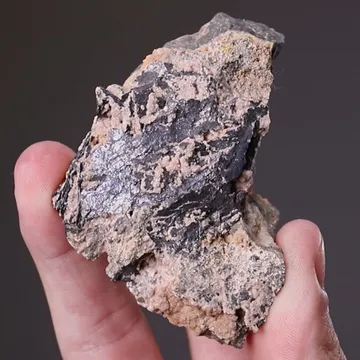
Asbestos-group and serpentine minerals occur in the skarn environment, and historic descriptions of fibrous ludwigite used “black asbestos” only as a visual comparison, not as a modern mineralogical identification. Still, fibrous skarn specimens from old dumps should be stored and trimmed with sensible dust control. Arsenic-bearing species such as realgar, hörnesite, alloclasite, and related arsenides require normal collector hygiene: do not grind, inhale dust, or handle food after working with them. Realgar is light-sensitive and should be kept away from strong, prolonged light.
On the market, fine Caraş-Severin specimens are sporadic rather than abundant. Small andradite specimens appear periodically, especially through European dealers and auctions, while sharp miniatures and cabinet specimens with good labels command a premium. Large, aesthetic old-time andradites from Ocna de Fier or Dognecea, Japanese-twinned quartz, and convincing type-locality veszelyite are much harder to replace. A specimen with an old Habsburg-era locality name, a named mine such as Iuliana, Delius, Terezia, Paulus, or Simon Iuda, or a documented collection pedigree should be valued above a similar piece with only a broad county label.
One of the strongest stories in Caraş-Severin mineral collecting is not a pocket discovery but a room: a 10 by 4 metre hall in Ocna de Fier, built by Constantin Gruescu to hold a private mineralogical museum. Gruescu was born at Dognecea on 12 April 1924 and died at Ocna de Fier on 22 January 2020. He began collecting mineral specimens in 1945, and the museum he assembled from Banat mining basins and beyond eventually held more than 2,000 specimens. Its specialties read like a collector’s inventory of the region’s soul: Japanese-twinned quartz, coaxial quartz twins with double or triple twinning, hematite “iron roses,” grossular and andradite garnets, and specimens from Ocna de Fier, Dognecea, Sasca Montană–Ciclova Montană, Armeniş–Teregova, Moldova Nouă, Rusca Montană–Ruşchiţa, the Apuseni Mountains, Baia Mare, Călimani, and farther afield.
Gruescu’s museum was called the “Colecţia de Mineralogie Estetică a Fierului,” and that phrase—“aesthetic mineralogy of iron”—is unusually apt for Ocna de Fier. This is a place where iron ore was not merely an industrial material but a sculptural medium: hematite plates in rose-like groups, magnetite in sharp black crystals, garnets glowing brown and black against pale calcite, and quartz twins prized for geometry rather than bulk. Visitors remembered the house as the “Casa Binelui,” the House of Good, and accounts of Gruescu emphasize the same blend of autodidact, miner, collector, host, writer, and local cultural figure. He had only seven formal school grades, then three specialization courses, but taught himself from Romanian and foreign mineralogical treatises and worked as a technical controller in metallurgy and mining.
His collecting life became part of the county’s civic memory. Gruescu donated specimens to museums in Brăila, Constanța, Caransebeș, Galați, Iași, Reșița, Timișoara, and Caen in France. He was named an honorary citizen of Dognecea in 2002, Ocna de Fier in 2003, Caraş-Severin County and Timișoara in 2004, and Bocșa in 2006, and he received Romania’s Crucea Națională „Serviciul Credincios” in 2003. The museum was internationally known during his lifetime; after his death, reports note that part of the collection was moved to the Reșița Department of Babeș-Bolyai University, while plans were underway in Bocșa for a dedicated space bearing his name.
The other vivid thread is older: the eighteenth-century industrial transformation of the Banat. After 1718, the Habsburg administration did not merely reopen scattered workings; it reorganized mining and metallurgy in the Dognecea–Ocna de Fier–Bocşa zone to match the technological standards of Central Europe. The results were measurable. Archival summaries record at least 100,000 tonnes of iron ore extracted from Ocna de Fier between 1720 and 1814, and roughly 1,850 kilograms of silver produced from Dognecea between 1777 and 1854. At Moldova Nouă, in only the years 1773–1778, production reached 4,427 tonnes of copper, 225 tonnes of lead, and 124 tonnes of silver. Those figures help explain why so many Caraş-Severin specimens entered old European collections: the mines were not isolated curiosities, but part of a major metallurgical landscape.
Even the mineral names preserve that nineteenth-century world. Ocna de Fier was Vaskő or Eisenstein when the first ludwigite and veszelyite specimens were circulating among Central European mineralogists. Anton Veszelyi, a mining engineer associated with the district, supplied material from Eisenstein in which Gustav Tschermak recognized ludwigite in 1874, while Albrecht Schrauf described the phosphate later bearing Veszelyi’s name. The county’s old labels are therefore not merely obsolete geography; they are part of the scientific biography of the specimens.